×

South Korea🇰🇷 | best regionsThe 4 Top regions in South Korea

Regions in South Korea differ less by landscape than by how far they sit from Seoul. A compact, mountainous country of about 100,000 square kilometers, it packs a capital area holding roughly half the population beside provinces where buses run a few times a day and English fades fast. That gradient drives everything a backpacker feels. The Seoul metropolitan belt is dense, fast and the priciest, with dorm beds around US$20 to 35. Southeastern and southwestern provinces run cheaper, with older temple towns, food-focused cities and coasts. Island and mountain regions are the hardest to reach but the quietest, and depend on seasonal ferries and local buses. Thanks to the KTX high-speed rail, mainland regions sit 2 to 3 hours apart, so independent travel is easy, though crowds peak on weekends and national holidays. Choose by how much convenience you want against how much solitude.

By Johan Kruseman 🇳🇱 | Updated October 19, 2026
Explore the best cities in South Korea

Why go?Key Factors That Shape the Experience

South Korea suits region-hopping because geography and infrastructure align. About 70 percent of the land is mountainous, which pushed settlement into river valleys and coastal plains, and each of those developed its own dialect, cuisine and festival calendar. Satellite-city sprawl and a rapid postwar industrialization then concentrated people and money in the northwest, so regional identity survives mostly through food, accents and heritage sites rather than political separation. Travelers feel this as real variety inside short distances.

The transport network is the second reason. KTX and SRT trains, frequent express buses and cheap domestic flights to Jeju connect almost every provincial capital, and a T-money card works on nearly all urban transit. Most of what you need to book can be … read more 👉
South Korea suits region-hopping because geography and infrastructure align. About 70 percent of the land is mountainous, which pushed settlement into river valleys and coastal plains, and each of those developed its own dialect, cuisine and festival calendar. Satellite-city sprawl and a rapid postwar industrialization then concentrated people and money in the northwest, so regional identity survives mostly through food, accents and heritage sites rather than political separation. Travelers feel this as real variety inside short distances.

The transport network is the second reason. KTX and SRT trains, frequent express buses and cheap domestic flights to Jeju connect almost every provincial capital, and a T-money card works on nearly all urban transit. Most of what you need to book can be done on Korail and Naver Map, while Google Maps is poor for walking and transit directions because of mapping restrictions.

There are limits to know before choosing. Outside big cities, English signage and menus thin out, and some rural restaurants serve only groups or two portions minimum. The country is small but intensely seasonal, so festivals, foliage and beach summers pack accommodation and push prices up. Public holidays such as Seollal and Chuseok empty cities and fill every train for days. DMZ-adjacent areas and military zones require organized access. For a first trip, the country rewards moderate ambition: its regions feel different, yet the rail system makes them easy to sample without heavy planning.
Evaluating the Top Choices
The list of best regions in South Korea is created based on landscapes, local culture, attractions, vibes, and overall appeal. If you feel a region is missing in this list, please let us know.

When to go?Optimal Periods for Travel

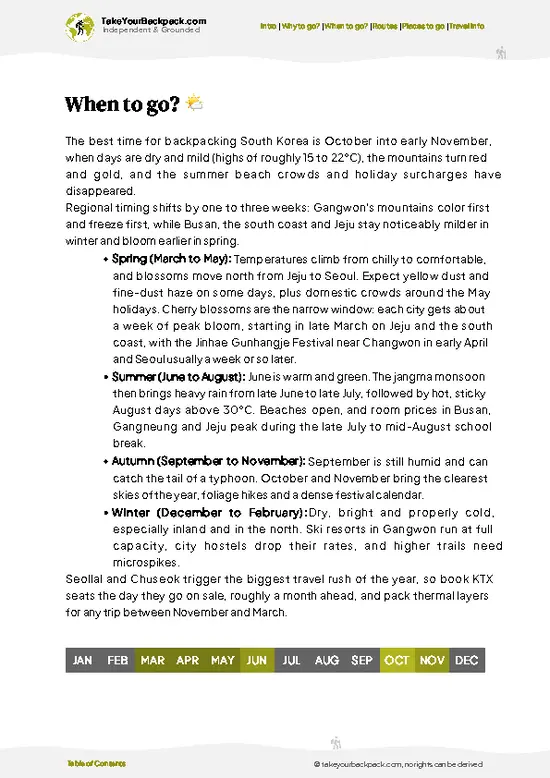
Best months and why: The best months for exploring South Korea’s regions are April to early June and mid-September to early November, when daytime temperatures sit around 15 to 25°C, skies are clear and humidity is low. Spring brings cherry blossoms, usually late March to mid-April in the south and a week or so later toward Seoul. Autumn foliage peaks in late October in the mountains and moves south into November.

Summer and winter: Summer is hot and sticky, with 28 to 35°C and the monsoon (jangma) from late June to late July, delivering a large share of the year’s 1,200 to 1,400 mm of rain. Typhoons can disrupt ferries and flights from August to September, especially on the southern coast and islands. Beach areas are busiest in the last week of July and first two weeks of August, when prices … read more 👉
Best months and why: The best months for exploring South Korea’s regions are April to early June and mid-September to early November, when daytime temperatures sit around 15 to 25°C, skies are clear and humidity is low. Spring brings cherry blossoms, usually late March to mid-April in the south and a week or so later toward Seoul. Autumn foliage peaks in late October in the mountains and moves south into November.

Summer and winter: Summer is hot and sticky, with 28 to 35°C and the monsoon (jangma) from late June to late July, delivering a large share of the year’s 1,200 to 1,400 mm of rain. Typhoons can disrupt ferries and flights from August to September, especially on the southern coast and islands. Beach areas are busiest in the last week of July and first two weeks of August, when prices can rise by 30 to 100 percent. Winter runs from December to February, with Seoul and the northeast often between -10 and 2°C. The east coast mountain region gets heavy snow, which suits skiing, while the southern coast and Jeju stay milder at about 3 to 10°C.

Holidays and shoulder seasons: Shoulder periods, March and late November, are cooler but cheaper, with dorm and guesthouse rates often 10 to 25 percent below peak. Spring and autumn weekends still fill, so book in advance for popular regions. National holidays change the calculation more than weather: Seollal (late January or February) and Chuseok (September or October) sell out intercity trains within minutes of booking opening, and some small restaurants and shops close for two to three days. Golden Week-style long weekends, such as early May and early October, also raise prices. Reserve KTX seats about 30 days ahead for these dates.

region hoppingSuggested Travel Strategies

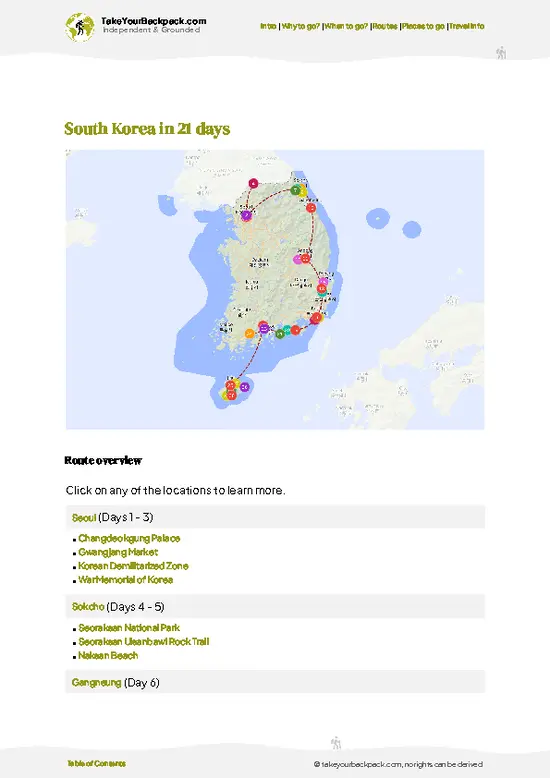
How many days to plan: A trip linking several regions of South Korea needs 10 to 14 days, and 7 days works only if you limit yourself to two or three areas. The country’s shape makes this possible: its main corridor runs from Seoul southeast to Busan, and rail, bus and ferry networks fan out from it.

Grouping and direction: Regions group best along two axes: a northwest-to-southeast line through the center, and a separate southwest arc along the coast. Travelers usually do best flying into Incheon, starting in the Seoul area, then heading south by KTX through Daejeon, Daegu or Gyeongju toward Busan, and finishing on Jeju by a one-hour flight or returning north along the western side. This avoids backtracking and takes advantage of fast rail. Going the reverse way works equally well if you … read more 👉
How many days to plan: A trip linking several regions of South Korea needs 10 to 14 days, and 7 days works only if you limit yourself to two or three areas. The country’s shape makes this possible: its main corridor runs from Seoul southeast to Busan, and rail, bus and ferry networks fan out from it.

Grouping and direction: Regions group best along two axes: a northwest-to-southeast line through the center, and a separate southwest arc along the coast. Travelers usually do best flying into Incheon, starting in the Seoul area, then heading south by KTX through Daejeon, Daegu or Gyeongju toward Busan, and finishing on Jeju by a one-hour flight or returning north along the western side. This avoids backtracking and takes advantage of fast rail. Going the reverse way works equally well if you find cheaper flights into Busan.

Time per stop and transfers: Give a major region 2 to 4 nights and a smaller or remote one 1 to 2. Seoul to Busan takes about 2.5 hours on KTX (roughly US$45 to 60). Seoul to Gwangju by KTX or SRT takes about 2 hours, and Busan to Jeju by air about 1 hour. Intercity buses cover most of the rest, with trips of 2 to 5 hours at about US$10 to 30. Ferries to islands take 1 to 4 hours and depend on weather.

Planning mistakes: The first mistake is cramming too many stops. Moving every day wastes the best hours in stations, so move every two or three days. The second is ignoring holidays and weekends, when trains sell out. Book ahead, or take buses, which often have seats. The third is underestimating rural transit: buses to mountains and islands may run only a few times a day, so check the last departure. Finally, a long KTX hop can look short on a map but still consume half a day once you add station transfers.

The ListTop regions of South Korea

1 Jeju Island

Lava tubes, oreum cones, tangerine orchards

Climb volcanic peaks, descend into ancient caves, and follow stone walls through landscapes shaped by wind, sea, and a unique island culture.

2 Ulleungdo Island

Volcanic cliffs, sea caves, wind-bent forests

Circle dramatic coastlines by boat or foot, taste seafood caught hours before, and feel isolation sharpen every detail of the island’s rugged scenery.

3 Namhae Island

Rice paddies, German village, coastal ridges

Navigate winding roads between sea and mountain, discover unexpected European influences, and watch tidal rhythms shape daily life along the shore.

4 Cheongsando Island

Stone-walled fields, terraced hills, slow city designation

Walk coastal trails lined with wildflowers, pass through tranquil farming villages, and experience a pace of life shaped by tradition and landscape.

Loading the map 🌍

Expert viewTips and Advice from Travelers

How many regions to visit: For most backpackers, three to four regions is the right number for a trip of 10 to 14 days. Korea’s rail network makes moving easy, which tempts people to see everything. Yet each region needs at least two full days to feel distinct, and every transfer costs half a day with luggage. An experienced traveler picks fewer places and uses day trips by local bus or subway to add depth.

Choosing the kind of region: Match the type of region to your travel style. If you value food, nightlife and museums, favor the big-city areas, where everything is walkable and English is most common. If you want temples, hiking and quiet, prioritize mountain and heritage provinces, but accept less English and fewer transport options. If you want coast and islands, schedule them for late … read more 👉
How many regions to visit: For most backpackers, three to four regions is the right number for a trip of 10 to 14 days. Korea’s rail network makes moving easy, which tempts people to see everything. Yet each region needs at least two full days to feel distinct, and every transfer costs half a day with luggage. An experienced traveler picks fewer places and uses day trips by local bus or subway to add depth.

Choosing the kind of region: Match the type of region to your travel style. If you value food, nightlife and museums, favor the big-city areas, where everything is walkable and English is most common. If you want temples, hiking and quiet, prioritize mountain and heritage provinces, but accept less English and fewer transport options. If you want coast and islands, schedule them for late spring or early autumn, because summer prices spike and typhoon cancellations are common. A balanced trip pairs one urban area with one or two slower, rural ones, so the pace varies and costs even out.

What it costs: Budget about US$45 to 70 a day in cities and US$35 to 55 in rural areas, covering a dorm bed or basic guesthouse at US$20 to 35, two to three meals at US$4 to 9 each, and local transit. Mid-range travelers using private rooms (US$45 to 80, or a yeogwan or motel) should plan US$80 to 130. Intercity transport adds up: a KTX ride is US$25 to 60, while express buses cost about half as much for the same distance. Temples and palaces typically charge US$2 to 6, national parks are often free or under US$4, and templestay programs run about US$50 to 100 per night including meals. A discounted rail pass such as KORAIL’s foreign-visitor passes makes sense only when you take three or more long rides in a short window. Otherwise, individual tickets, bought early on the Korail app or at the station, cost less. Guides are rarely needed, though DMZ and some island tours must be booked and cost US$50 to 100.

Safety and cultural points: South Korea is among the safest countries for solo travelers, with low violent crime and well-lit streets. The main risks are practical: summer heat and monsoon flooding, typhoon-canceled ferries, and slippery mountain trails in autumn rain. Mountain regions often close trails early in winter or after storms, so check park notices and carry a headlamp, since daylight ends around 5 pm in December. Scams are uncommon, but taxis in some tourist areas may not use the meter.

Cultural habits matter more in rural areas. Remove shoes in guesthouses, temples and many restaurants. Use two hands when passing or receiving items from older people. Be quiet on trains and buses, where phone calls are discouraged. In templestays, follow the schedule, including the 3 am wake-up where offered. Many rural eateries serve a single dish for two people, so solo travelers should look for places with one-person menus such as bibimbap, kimbap or gukbap. Cash is rarely needed, but a few markets and rural buses accept only cash or a T-money card, so keep about US$20 in won.

Smarter habits: Download Naver Map or KakaoMap, since Google Maps lacks reliable walking and transit directions. Buy a local eSIM or rent a pocket wifi before arrival, because free wifi is patchy outside cities. Book weekend and holiday accommodation early, but leave midweek flexible, because rooms are plentiful and cheaper. Reserve popular trains 30 days ahead, and use express buses when sold out. The best rule is to move less and stay longer.

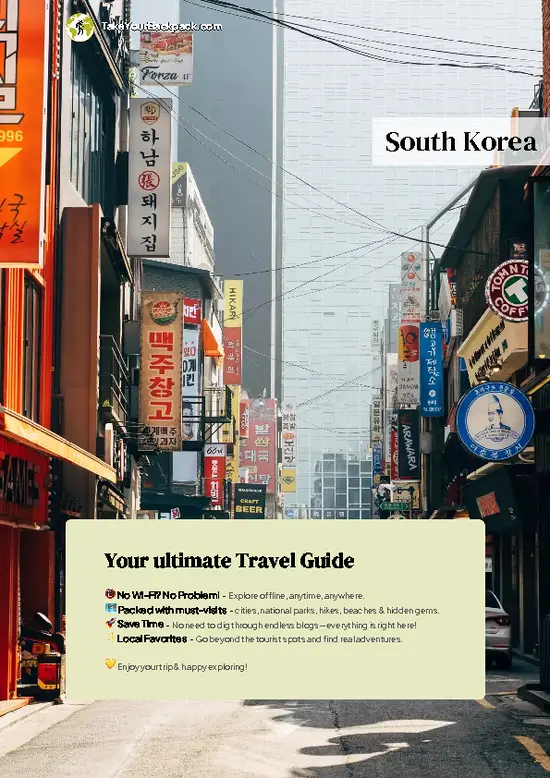
✈️ The backpacker research shortcutSouth Korea Travel Guide

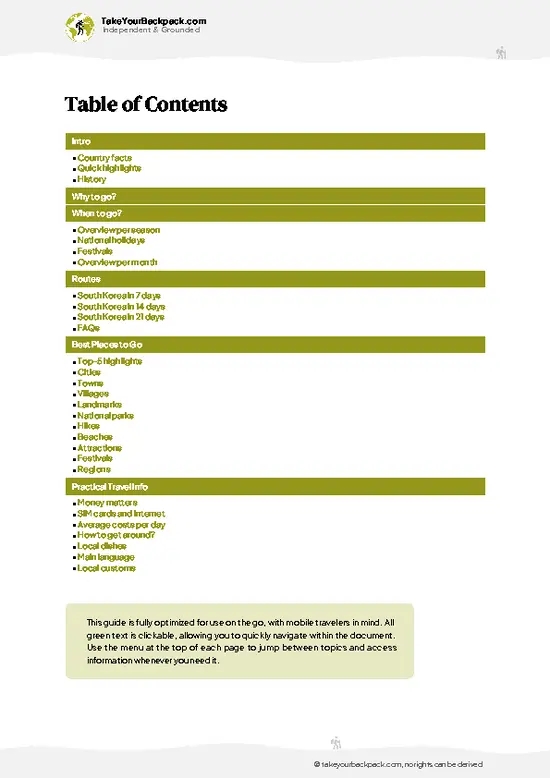
An offline-friendly backpacking guide with optimized travel routes, ranked highlights, transport advice, and the best areas to stay.
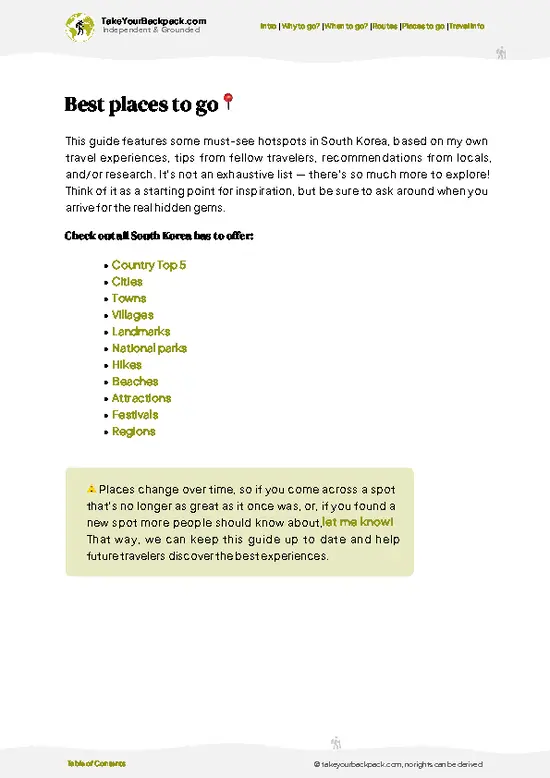
example page 0 from our offline Travel Guide for South Korea
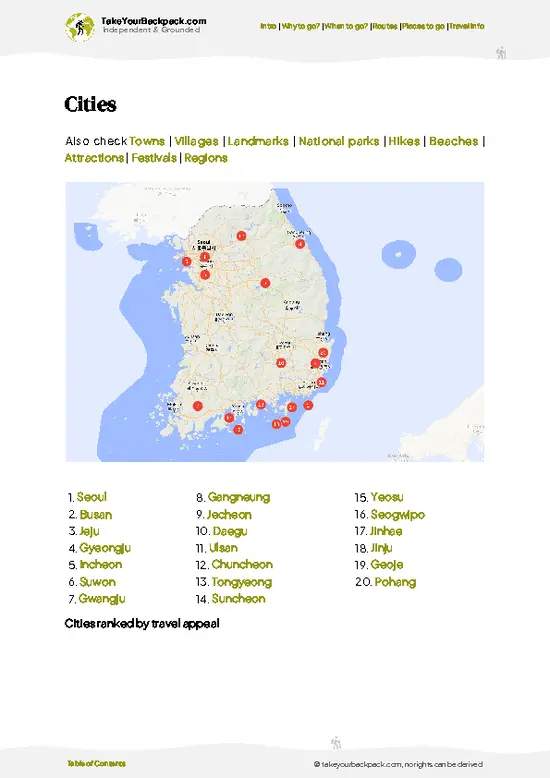
example page 1 from our offline Travel Guide for South Korea
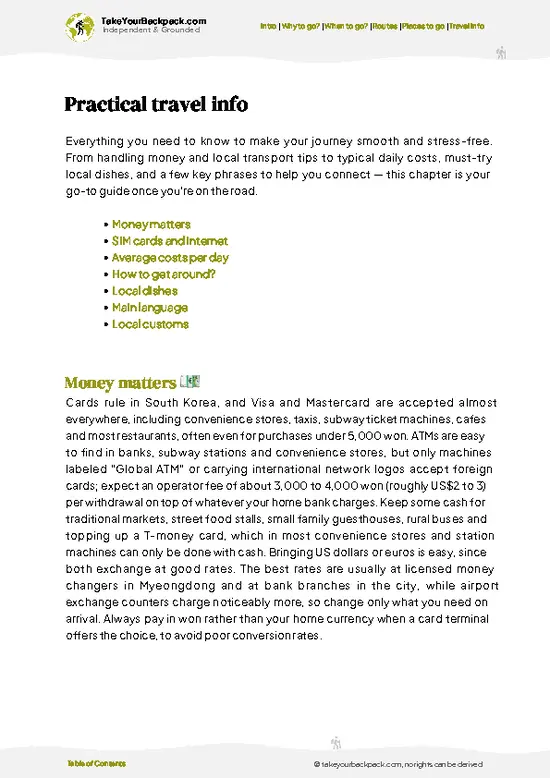
example page 2 from our offline Travel Guide for South Korea
example page 3 from our offline Travel Guide for South Korea
example page 4 from our offline Travel Guide for South Korea
example page 5 from our offline Travel Guide for South Korea
example page 6 from our offline Travel Guide for South Korea
example page 7 from our offline Travel Guide for South Korea
The digital guide (419 pages) contains:
✅ 117 highlights, ranked by travel appeal
✅ Optimized 7, 14 & 21-day travel routes
✅ Cities, national parks, landmarks, beaches
✅ How to get around
✅ Offline-friendly for travel without Wi-Fi
👉 Click to see all 30+ guide features

📅 Plan smarter in minutes, not weeks
✅ Month by month travel advice
✅ Festivals & national holidays
✅ Budget expectations

🗺️ Go to the right places, skip the overrated ones
✅ Honest pros & cons of destinations
✅ Top hikes, parks & viewpoints
✅ Lesser-known places most travelers miss
✅ Clear “worth it vs skip it” guidance

🛏️ Travel smoothly without rookie mistakes
✅ Best areas to stay
✅ Transport systems explained simply
✅ Common scams & safety advice
✅ SIM cards, money & practical tips

🌍 Understand the country, not just visit it
✅ Culture & traditions
✅ 52 Essential phrases & customs
✅ Festivals worth planning around
✅ Traveler-friendly historical context
✅ Insights that make places more meaningful

📱 Built for real travel conditions
✅ Fully downloadable PDF
✅ Works completely offline
✅ Optimized for phone use
✅ Useful in remote areas & buses
✅ Everything in one place
Stop searching, start planning
Get instant access to your full guide. 30‑day money-back guarantee.
+ Add another guide for just

By proceeding you agree to our terms.
Sent to your inbox immediately after payment • 100% Secure Checkout
Best Backpacking Travel Advisor 2025 tourism awardBest Backpacking
Travel Advisor
2025
What others say about Take Your Backpack Guides:
⭐⭐⭐⭐⭐
Fantastic, amazing amount of information!
⭐⭐⭐⭐⭐
My goodness this is amazing, it's what I've been looking for hats off too you!
⭐⭐⭐⭐⭐
I think this is absolutely BRILLIANT
⭐⭐⭐⭐
Very complete and informative. It's still missing places, but I gotta to commend you
⭐⭐⭐⭐⭐
This is truly amazing, thank you, can't wait to explore it with my kids!
⭐⭐⭐⭐⭐
Awesome resource, thank you!
⭐⭐⭐⭐⭐
This is amazing! Can't wait to explore the ones I haven't seen
⭐⭐⭐⭐
I love this! Well done, great idea.
⭐⭐⭐⭐⭐
Thanks for taking the time to make this gem!
⭐⭐⭐⭐⭐
This might be the best website I've ever seen.
⭐⭐⭐⭐⭐
Congratulations, and thank you so much for your work; it's incredibly valuable.
⭐⭐⭐⭐
In all seriousness I think you did a great job pointing out the important spots
⭐⭐⭐⭐⭐
10/10 very good
⭐⭐⭐⭐⭐
As someone who's only just starting to visit regularly this is awesome, thank you.
⭐⭐⭐⭐
Thank you very much! I'm going to visit my dad, it's going to be very useful!
⭐⭐⭐⭐⭐
This is really cool! We'll be travelling for the first time and this definitely come in handy.
⭐⭐⭐⭐⭐
You are now our minister of culture, congratulations 👨‍💼
⭐⭐⭐⭐⭐
Just wanted to tell you that this is a pearl! Going to follow your recommendations.
⭐⭐⭐⭐⭐
This is so cool. I'll definitely be using the resource for my travels soon.
⭐⭐⭐⭐⭐
This is very impressive! Good work.
⭐⭐⭐⭐⭐
This is an amazing and informative site. Very well done!

🛏️ Where to stay?Where to Stay in South Korea

South Korea has plenty of hostels and guesthouses, with dorm beds typically running ₩20,000 to 35,000 (about US$15 to 25) and private rooms in budget guesthouses from roughly ₩45,000 (US$33). In Seoul, Hongdae has the densest cluster and the loudest nightlife, so expect late noise on weekends. Myeongdong is central with direct airport bus links but gets crowded, Jongno and Insadong put you near the palaces and stay quieter after dark, and Itaewon mixes bars with an international crowd. In Busan, Haeundae means beach access and higher prices, while Seomyeon is cheaper and better connected by metro; all of these areas are safe to walk at night.

If you enjoy meeting fellow travelers, consider choosing … read more 👉
South Korea has plenty of hostels and guesthouses, with dorm beds typically running ₩20,000 to 35,000 (about US$15 to 25) and private rooms in budget guesthouses from roughly ₩45,000 (US$33). In Seoul, Hongdae has the densest cluster and the loudest nightlife, so expect late noise on weekends. Myeongdong is central with direct airport bus links but gets crowded, Jongno and Insadong put you near the palaces and stay quieter after dark, and Itaewon mixes bars with an international crowd. In Busan, Haeundae means beach access and higher prices, while Seomyeon is cheaper and better connected by metro; all of these areas are safe to walk at night.

If you enjoy meeting fellow travelers, consider choosing hostels with high ratings for atmosphere. On the other hand, if you prefer having your own space, a hotel might be a better option.

South KoreaMore of South Korea

👋 Meet the founderWho’s Behind Take Your Backpack?

Johan, backpacker and founder of TakeYourBackpackHi, I’m Johan (Netherlands 🇳🇱), the creator of TakeYourBackpack. Over the past 3 decades, I’ve backpacked through 90+ countries across six continents, gaining extensive experience with independent travel, long-term trips, and overland routes.

This site is built on a combination of firsthand travel experience and carefully curated insights from other backpackers. Many guides are based on places I’ve personally visited, while others bring together tips, observations, and practical advice shared by trusted travelers I’ve met along the way.

The goal is to provide realistic, experience-driven guidance — not generic itineraries — so you can explore destinations with better context, clearer expectations, and more confidence.