×

South Korea🇰🇷 | best citiesThe 10 Top cities in South Korea

Cities in South Korea are dense, fast and built around public transit, which is why independent travel here is easier than the language barrier suggests. Roughly half the population lives in the Seoul metropolitan area, so the capital region delivers the most nightlife, museums and choice, and also the highest prices and the biggest crowds. Further south, port and provincial cities trade that scale for coastline, regional food and lower costs, with rooms often 20 to 40 percent cheaper than in the capital. Historic cities hold the royal tombs, temples and hanok lanes that survived a century of war and rapid rebuilding, so they feel slower and smaller. The KTX high-speed rail links the main hubs in roughly 2 to 3 hours, which means distance rarely decides your choice. Atmosphere and budget do. Backpackers who pick one kind of city per leg get a clearer sense of the country than those who chase every famous name.

By Johan Kruseman 🇳🇱 | Updated October 19, 2026
Explore the best towns in South Korea

Why go?Key Factors That Shape the Experience

South Korea suits city travel because almost everything that makes a city easy to use was built in a single, compressed burst. After the Korean War, the country industrialized so quickly that urban planning, subways and rail arrived together, and a mountainous landscape pushed people into compact basins and river valleys. Only about 30 percent of the land is flat enough to build on, so cities grew upward, packed with apartment towers, and stay walkable and transit-led. The result is a network where a rechargeable T-money card works on subways and buses in nearly every major city, and trains run to the minute.

History explains the contrast you will see. War and rebuilding flattened much of the old fabric, so ancient sites sit beside glass and concrete rather than inside preserved medieval … read more 👉
South Korea suits city travel because almost everything that makes a city easy to use was built in a single, compressed burst. After the Korean War, the country industrialized so quickly that urban planning, subways and rail arrived together, and a mountainous landscape pushed people into compact basins and river valleys. Only about 30 percent of the land is flat enough to build on, so cities grew upward, packed with apartment towers, and stay walkable and transit-led. The result is a network where a rechargeable T-money card works on subways and buses in nearly every major city, and trains run to the minute.

History explains the contrast you will see. War and rebuilding flattened much of the old fabric, so ancient sites sit beside glass and concrete rather than inside preserved medieval cores. Expect temples on hillsides and palaces ringed by office blocks, not intact old towns. Many cities also share a distinct late-night culture: shops, cafes and restaurants stay open past midnight, a legacy of long working hours and small apartments that push social life outdoors.

Before you choose South Korea for its cities, know a few practical things. English signage is strong in transit but thin in local restaurants, so a translation app and offline maps are worth setting up before you land. Google Maps navigation is limited, and Naver Map or Kakao Map work far better. Most places expect cards or mobile payment, though cash helps at markets. Lodging runs from hostels and guesthouses to compact business hotels, and in major cities rooms are small by Western standards. Finally, the country is expensive at the top and affordable at the bottom: transport and set-menu meals are cheap, while accommodation and bars add up quickly.
Our Approach to Ranking
The list of best cities in South Korea is created based on culture, vibe, attractions, transport ease, and local charm. If you feel a city is missing in this list, please let us know.

When to go?Optimal Periods for Travel

Best Months for City Travel: The best months are April to May and September to October, when daytime temperatures sit around 15 to 25°C, skies are clear and humidity is low enough to walk all day. Spring brings cherry blossoms, usually from late March in the south to early or mid April in the capital region, while autumn adds red and gold foliage from mid October through early November.
Summer, Winter and Shoulder Seasons: June to August is hot and humid, with highs of 28 to 34°C. The monsoon (jangma) arrives in late June and runs into July, and the country gets more than half its annual rain in these weeks, with heavy downpours that can flood streets and halt outdoor plans. Typhoons are possible from August to September, mostly affecting the southern coast and Jeju. Cities stay fully open, … read more 👉
Best Months for City Travel: The best months are April to May and September to October, when daytime temperatures sit around 15 to 25°C, skies are clear and humidity is low enough to walk all day. Spring brings cherry blossoms, usually from late March in the south to early or mid April in the capital region, while autumn adds red and gold foliage from mid October through early November.
Summer, Winter and Shoulder Seasons: June to August is hot and humid, with highs of 28 to 34°C. The monsoon (jangma) arrives in late June and runs into July, and the country gets more than half its annual rain in these weeks, with heavy downpours that can flood streets and halt outdoor plans. Typhoons are possible from August to September, mostly affecting the southern coast and Jeju. Cities stay fully open, but sightseeing is sweaty and indoor time grows.

December to February is cold and dry. The capital region averages around -6 to 3°C in January, with colder spells from Siberian air, while southern port cities stay milder at roughly 0 to 8°C. Snow is limited in lowland cities, and clear skies make winter good for museums, markets and hot food. Prices drop, with lodging commonly 15 to 30 percent below spring and autumn rates outside ski areas.
Peak Periods That Change Plans: Three periods affect bookings. Seollal (Lunar New Year, January or February) and Chuseok (September or early October) send millions travelling home, so intercity trains sell out days ahead and some small shops close for two to three days. Domestic summer holidays in late July and early August push up coastal prices. Book transport early for those dates, and expect the major cities themselves to feel quieter, since residents leave.

city hoppingSuggested Travel Strategies

How Many Days to Combine Cities: A trip linking several cities in South Korea needs 10 to 14 days, which allows three or four bases without spending half your time on trains. The country is compact and the rail network is fast, so the limit is energy and budget, not distance.
Which Regions Group Well: The country divides into three practical clusters. The capital region in the northwest works as a hub for arrival and departure. The southeast coast and Gyeongsang inland bundles port cities with ancient-capital culture, and the southwest (Jeolla) is quieter and more food focused. Moving in one loop beats zigzagging: start in the capital, head southeast, then return via the southwest or the central corridor, or fly out of a southern airport if your ticket allows an open-jaw. This follows the main … read more 👉
How Many Days to Combine Cities: A trip linking several cities in South Korea needs 10 to 14 days, which allows three or four bases without spending half your time on trains. The country is compact and the rail network is fast, so the limit is energy and budget, not distance.
Which Regions Group Well: The country divides into three practical clusters. The capital region in the northwest works as a hub for arrival and departure. The southeast coast and Gyeongsang inland bundles port cities with ancient-capital culture, and the southwest (Jeolla) is quieter and more food focused. Moving in one loop beats zigzagging: start in the capital, head southeast, then return via the southwest or the central corridor, or fly out of a southern airport if your ticket allows an open-jaw. This follows the main KTX and SRT lines, which radiate from Seoul, Yongsan and Suseo stations.
Time Per Stop and Travel Times: Give the capital 3 to 4 nights, because its sights are spread across many districts. Other cities need 1 to 3 nights each, and 2 is usually enough for a provincial city with a day trip. Typical rail times from the capital are about 2 to 2.5 hours to the southeast port and southeast historic cities, and about 1.5 to 2 hours to the southwest. Intercity buses cost less but take 4 to 5 hours on the same routes, and cross-country transfers between non-adjacent regions often need a connection.
Common Planning Mistakes: The first is doubling back through the capital, which adds hours and cost. Plan a loop and use regional rail lines between provincial cities. The second is too many one-night stops, since check-in, transit and station transfers eat the afternoon. The third is booking holiday weekends without checking the calendar, when trains sell out. Reserve KTX seats on Korail or the SRT app ahead, and keep one flexible day for weather.

The ListTop cities of South Korea

1 Seoul

Palaces, street markets, urban hiking trails

Navigate a metropolis where tradition and innovation intersect, from historic quarters to panoramic city hikes and late-night food stalls.

South Korea - Seoul

2 Busan

Haeundae beach, seafood markets, hillside villages

Swim at urban beaches, climb steep alleys for city views, and eat at sprawling fish markets along the southern coast.

3 Jeju

Volcanic craters, tangerine orchards, lava tubes

Hike volcanic slopes, sample local produce, and descend into underground caves shaped by the island’s unique geology.

4 Gyeongju

Royal tombs, ancient observatory, Buddhist relics

Trace the city’s Silla-era roots among grassy burial mounds, stone pagodas, and quiet lanes lined with centuries-old artifacts.

5 Incheon

Chinatown, tidal mudflats, airport gateway

Arrive to a city where international influences meet tidal landscapes, offering quick escapes and diverse neighborhoods near the capital.

6 Suwon

Fortress walls, chicken street, traditional markets

Walk along UNESCO-listed ramparts, sample local specialties, and browse bustling markets in a city with a distinct identity.

south-korea-city-suwon
© Google |

7 Gwangju

Democracy plaza, art museums, street food alleys

Reflect on modern history at civic sites, explore contemporary galleries, and sample diverse local dishes in bustling neighborhoods.

8 Gangneung

East Sea beaches, pine forests, coffee street

Wake early for sunrise over the coast, then wander through seaside cafés and pine groves where locals gather year-round.

9 Jecheon

Mountain lakes, herbal markets, rail bike trails

Cycle along lakeshores, browse medicinal herb stalls, and use the city as a base for exploring nearby highland scenery.

10 Daegu

Textile district, herbal medicine alley, city festivals

Browse traditional medicine markets, attend seasonal events, and explore neighborhoods shaped by the textile trade.

11 Ulsan

Whale museum, shipbuilding docks, bamboo groves

Tour maritime museums, stroll through bamboo forests, and observe the scale of Korea’s largest industrial complexes.

12 Chuncheon

Lake islands, dakgalbi street, rail bikes

Paddle between islands, taste spicy chicken dishes, and ride converted railways through lakeside countryside.

13 Tongyeong

Island hopping, mural village, seafood harbors

Take ferries to scattered islands, explore hillside art neighborhoods, and eat fresh catch at bustling harbors.

14 Suncheon

Wetland reserve, reed fields, eco-park

Walk boardwalks through vast wetlands, observe migratory birds, and explore eco-friendly parks on the city’s edge.

15 Yeosu

Cable car, night markets, coastal promenade

Ride over the bay for panoramic views, stroll lively night markets, and follow the waterfront promenade after dark.

16 Seogwipo

Waterfalls, coastal cliffs, citrus farms

Follow coastal trails past waterfalls and rocky shores, with small harbors and fruit orchards scattered across the southern tip of Jeju.

17 Jinhae

Cherry blossom festival, naval base, mountain backdrop

Visit in spring to see streets transformed by blossoms, or explore the city’s maritime heritage and surrounding hillsides year-round.

18 Jinju

Riverside fortress, lantern festival, silk market

Visit a riverside fortress, experience the autumn lantern festival, and browse markets known for traditional textiles.

19 Geoje

Island coastline, shipyards, wind-swept cliffs

Roam rugged shores and fishing villages, with ferries linking remote islets and panoramic trails above the industrial port.

20 Pohang

Steel mills, sunrise point, seafood markets

Watch the sun rise over the sea, explore industrial heritage, and sample fresh seafood in a city shaped by heavy industry.

21 Mokpo

Harborfront, modernist architecture, ferry terminal

Wander waterfront promenades, spot early 20th-century buildings, and catch ferries to outlying islands from the city port.

22 Andong

Folk village, mask dance, wooden bridges

Attend mask performances, wander preserved villages, and cross historic bridges in a city focused on preserving regional traditions.

23 Danyang

limestone caves, river cliffs, cable car views

Take in dramatic river scenery, descend into cool caverns, and ride above forested valleys for a landscape-focused escape from city life.

24 Samcheok

Cave systems, coastal rail, pebble beaches

Ride scenic trains along the coast, descend into vast limestone caves, and relax on quiet beaches away from crowds.

25 Gimhae

Royal tombs, archaeological sites, Gimhae airport

Uncover traces of the ancient Gaya kingdom, with museums and burial sites set among modern neighborhoods and transit links.

26 Cheongju

Early printing museum, university campus, tobacco history

Visit a museum dedicated to movable type, explore leafy campuses, and learn about the city’s industrial roots.

27 Gunsan

Colonial-era buildings, rice warehouses, port district

Walk through preserved Japanese-era streets, visit riverside warehouses, and explore a port city shaped by trade.

28 Wonju

Mountain biking, Hanji paper workshops, riverside trails

Cycle forested paths, try traditional crafts, and enjoy river walks in a city balancing outdoor activity with local culture.

29 Gwangmyeong

Cave attraction, shopping complexes, suburban rail

Tour a repurposed mine, browse sprawling malls, and use efficient transit to connect with Seoul’s urban core.

30 Gwangyang

Steelworks, plum blossom groves, riverside parks

Experience a city defined by industry and springtime blooms, with riverside paths and seasonal festivals shaping local life.

31 Gyeongsan

University district, commuter city, suburban parks

Stay in a city known for student life and easy access to Daegu, with quiet parks and residential neighborhoods.

32 Iksan

Baekje relics, jewelry museum, lotus ponds

Discover ancient temple sites, browse gemstone exhibits, and visit lotus-filled parks in a city with archaeological significance.

33 Sacheon

Aerospace museum, tidal flats, fishing harbors

Visit working harbors and tidal zones, or explore aviation history in a city where industry meets the sea.

34 Seosan

Salt farms, migratory bird wetlands, lotus ponds

Watch seasonal bird migrations, explore quiet rural landscapes, and visit lotus-filled ponds in a city shaped by agriculture.

35 Nonsan

Strawberry farms, Baekje fortress, rural plains

Pick strawberries in season, explore fortress ruins, and travel through agricultural landscapes dotted with small villages.

36 Yeongju

Confucian academy, apple orchards, forested hills

Tour a UNESCO-listed academy, sample regional apples, and hike wooded trails in a city known for scholarly heritage.

37 Gimcheon

Ginkgo avenue, Buddhist temples, agricultural markets

Stroll tree-lined streets in autumn, visit hillside temples, and sample local produce in a city shaped by rural traditions.

Think you know South Korea?

Prove you’re a true local — uncover 27 lesser-known cities in South Korea that locals tend to keep to themselves.
Loading the map 🌍

Expert viewTips and Advice from Travelers

How Many Cities to Visit: I advise three to four cities on a trip of up to two weeks. That number holds because each city needs at least two full days to see properly, and intercity transfers plus station time eat roughly half a day each time you move. Beyond four, you spend more hours in transit than on streets, and your budget goes to train tickets instead of experiences. A first visit works best with the capital plus two contrasting places, one coastal and one historic, which gives variety without exhaustion.
Choosing by Travel Style: Pick the capital for nightlife, museums, shopping, and the widest hostel selection. Choose port cities if you want seafood markets, beaches and a looser pace. Choose historic cities for temples, royal tombs and cycling routes, and for lower prices and fewer … read more 👉
How Many Cities to Visit: I advise three to four cities on a trip of up to two weeks. That number holds because each city needs at least two full days to see properly, and intercity transfers plus station time eat roughly half a day each time you move. Beyond four, you spend more hours in transit than on streets, and your budget goes to train tickets instead of experiences. A first visit works best with the capital plus two contrasting places, one coastal and one historic, which gives variety without exhaustion.
Choosing by Travel Style: Pick the capital for nightlife, museums, shopping, and the widest hostel selection. Choose port cities if you want seafood markets, beaches and a looser pace. Choose historic cities for temples, royal tombs and cycling routes, and for lower prices and fewer crowds. Food-driven travelers should favor the southwest, where meals are larger and cheaper. Those with a short trip should skip the extras and spend more time in one or two places instead of ticking off a list.
Daily Budget and Costs: A backpacker staying in hostels, eating at local restaurants and using transit can manage US$45 to 70 (about 60,000 to 95,000 KRW) a day in the capital, and US$35 to 55 (about 48,000 to 75,000 KRW) elsewhere. Dorm beds run roughly US$15 to 30, private rooms US$40 to 80. Set meals at local restaurants cost US$5 to 9, convenience store food US$2 to 4. Palace and museum entry usually costs US$2 to 5, and many are free or discounted for those wearing a hanbok. City subway rides cost about US$1.10 to 2, while a KTX ticket between major hubs runs about US$30 to 60 depending on distance. Intercity express buses cost roughly half that, so choose them if you are not in a hurry. Guided tours are optional, and free volunteer walking tours exist in several cities.
Safety and Cultural Considerations: South Korea has low violent crime, and cities are safe to walk at night, though drunk crowds near entertainment districts and spiked-drink scams in some clubs warrant normal caution. Keep your card details secure and avoid leaving valuables unattended, even though it is common for locals to leave phones on cafe tables. Lines form at station platforms, so wait your turn and let passengers exit first. Priority seats on subways are for elderly, pregnant and disabled riders, so leave them empty.

Remove your shoes when entering homes, guesthouses with ondol floors, and many traditional restaurants. Use two hands when giving or receiving items, especially from elders. Tipping is not expected, and trying to leave one often causes confusion. Public trash cans are scarce, so carry your litter until you find a bin. Learn a few Korean phrases, since a simple “annyeonghaseyo” earns warm responses. Download Naver Map or Kakao Map before arrival, because Google Maps cannot give walking or driving directions in much of the country. Carry a passport copy, and note that some venues only accept cards issued in Korea, so keep a small cash reserve for those moments.

✈️ The backpacker research shortcutSouth Korea Travel Guide

An offline-friendly backpacking guide with optimized travel routes, ranked highlights, transport advice, and the best areas to stay.
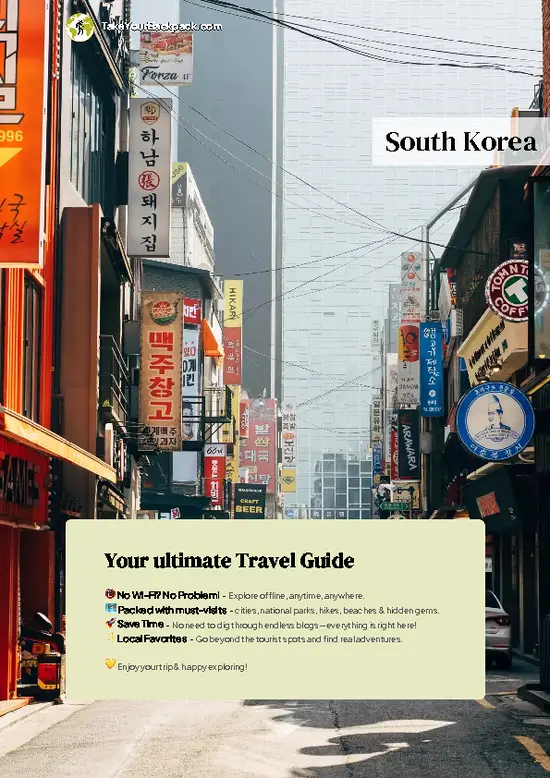
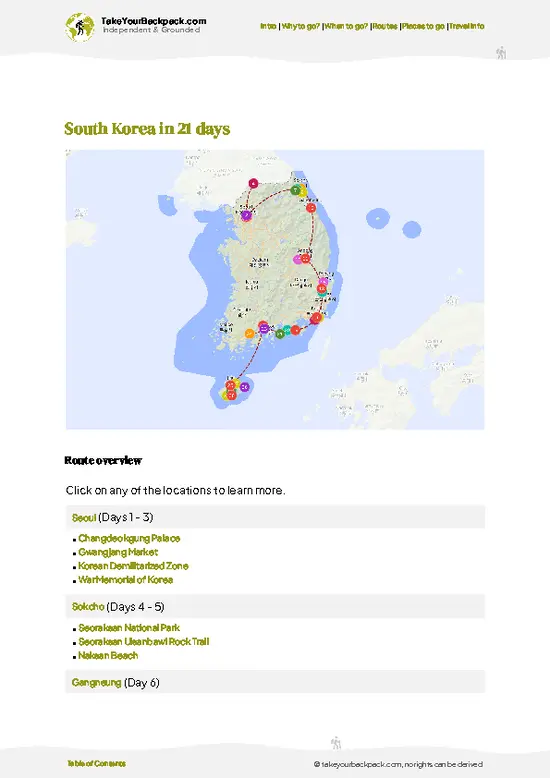
example page 0 from our offline Travel Guide for South Korea
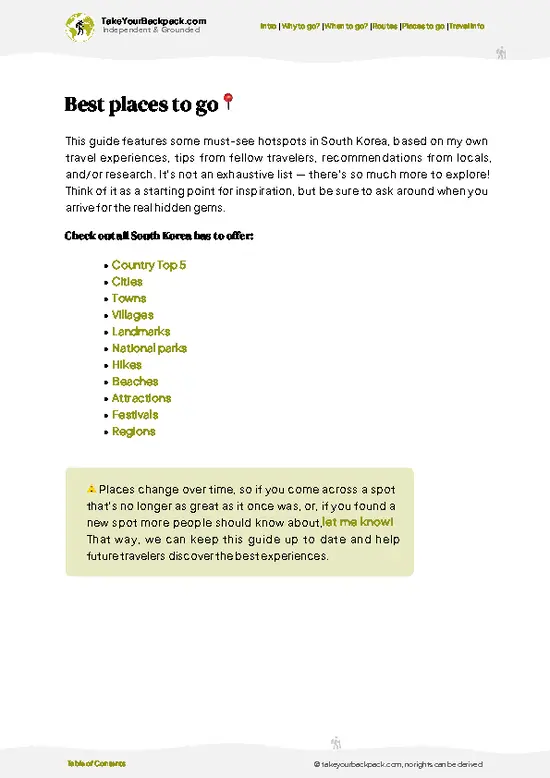
example page 1 from our offline Travel Guide for South Korea
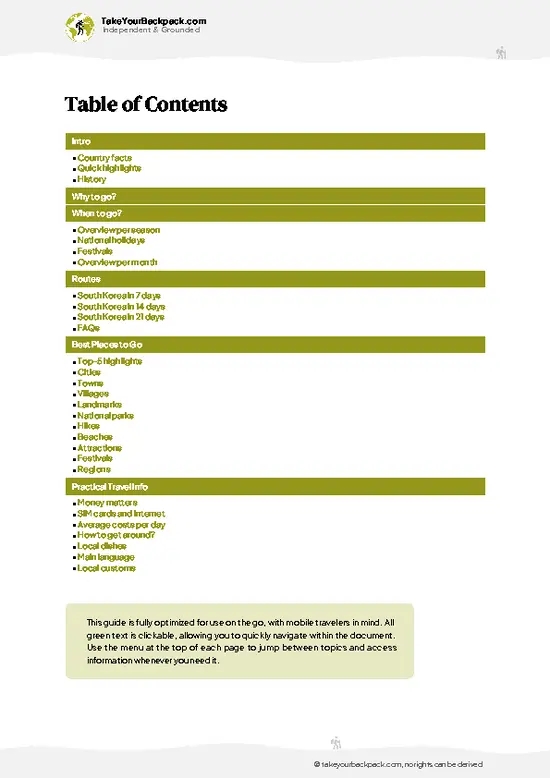
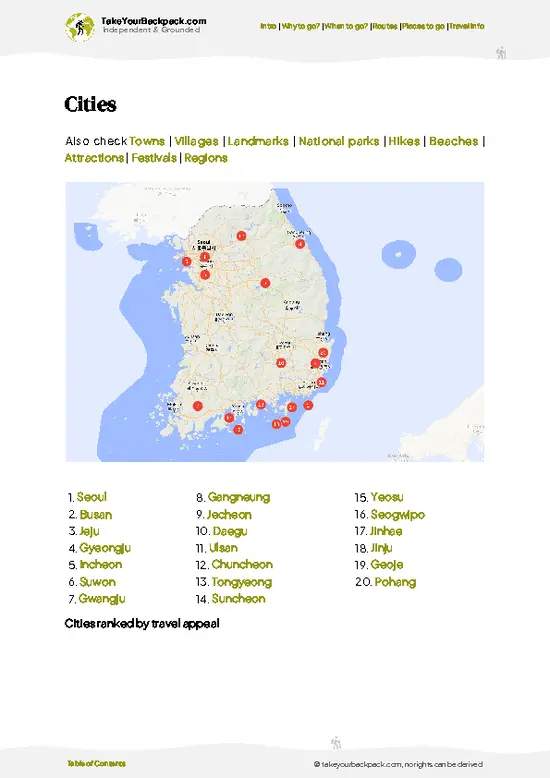
example page 2 from our offline Travel Guide for South Korea
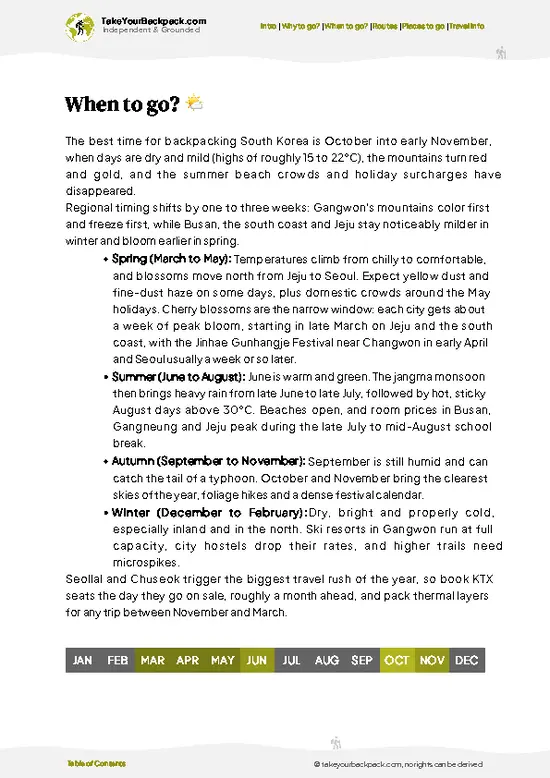
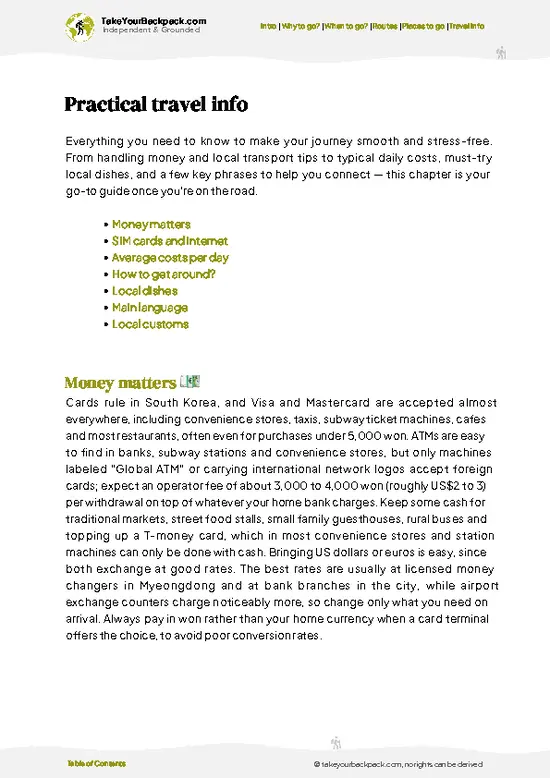
example page 3 from our offline Travel Guide for South Korea
example page 4 from our offline Travel Guide for South Korea
example page 5 from our offline Travel Guide for South Korea
example page 6 from our offline Travel Guide for South Korea
example page 7 from our offline Travel Guide for South Korea
The digital guide (419 pages) contains:
✅ 117 highlights, ranked by travel appeal
✅ Optimized 7, 14 & 21-day travel routes
✅ Cities, national parks, landmarks, beaches
✅ How to get around
✅ Offline-friendly for travel without Wi-Fi
👉 Click to see all 30+ guide features

📅 Plan smarter in minutes, not weeks
✅ Month by month travel advice
✅ Festivals & national holidays
✅ Budget expectations

🗺️ Go to the right places, skip the overrated ones
✅ Honest pros & cons of destinations
✅ Top hikes, parks & viewpoints
✅ Lesser-known places most travelers miss
✅ Clear “worth it vs skip it” guidance

🛏️ Travel smoothly without rookie mistakes
✅ Best areas to stay
✅ Transport systems explained simply
✅ Common scams & safety advice
✅ SIM cards, money & practical tips

🌍 Understand the country, not just visit it
✅ Culture & traditions
✅ 52 Essential phrases & customs
✅ Festivals worth planning around
✅ Traveler-friendly historical context
✅ Insights that make places more meaningful

📱 Built for real travel conditions
✅ Fully downloadable PDF
✅ Works completely offline
✅ Optimized for phone use
✅ Useful in remote areas & buses
✅ Everything in one place
Stop searching, start planning
Get instant access to your full guide. 30‑day money-back guarantee.
+ Add another guide for just

By proceeding you agree to our terms.
Sent to your inbox immediately after payment • 100% Secure Checkout
Best Backpacking Travel Advisor 2025 tourism awardBest Backpacking
Travel Advisor
2025
What others say about Take Your Backpack Guides:
⭐⭐⭐⭐⭐
Fantastic, amazing amount of information!
⭐⭐⭐⭐⭐
My goodness this is amazing, it's what I've been looking for hats off too you!
⭐⭐⭐⭐⭐
I think this is absolutely BRILLIANT
⭐⭐⭐⭐
Very complete and informative. It's still missing places, but I gotta to commend you
⭐⭐⭐⭐⭐
This is truly amazing, thank you, can't wait to explore it with my kids!
⭐⭐⭐⭐⭐
Awesome resource, thank you!
⭐⭐⭐⭐⭐
This is amazing! Can't wait to explore the ones I haven't seen
⭐⭐⭐⭐
I love this! Well done, great idea.
⭐⭐⭐⭐⭐
Thanks for taking the time to make this gem!
⭐⭐⭐⭐⭐
This might be the best website I've ever seen.
⭐⭐⭐⭐⭐
Congratulations, and thank you so much for your work; it's incredibly valuable.
⭐⭐⭐⭐
In all seriousness I think you did a great job pointing out the important spots
⭐⭐⭐⭐⭐
10/10 very good
⭐⭐⭐⭐⭐
As someone who's only just starting to visit regularly this is awesome, thank you.
⭐⭐⭐⭐
Thank you very much! I'm going to visit my dad, it's going to be very useful!
⭐⭐⭐⭐⭐
This is really cool! We'll be travelling for the first time and this definitely come in handy.
⭐⭐⭐⭐⭐
You are now our minister of culture, congratulations 👨‍💼
⭐⭐⭐⭐⭐
Just wanted to tell you that this is a pearl! Going to follow your recommendations.
⭐⭐⭐⭐⭐
This is so cool. I'll definitely be using the resource for my travels soon.
⭐⭐⭐⭐⭐
This is very impressive! Good work.
⭐⭐⭐⭐⭐
This is an amazing and informative site. Very well done!

🛏️ Where to stay?Where to Stay in South Korea

South Korea has plenty of hostels and guesthouses, with dorm beds typically running ₩20,000 to 35,000 (about US$15 to 25) and private rooms in budget guesthouses from roughly ₩45,000 (US$33). In Seoul, Hongdae has the densest cluster and the loudest nightlife, so expect late noise on weekends. Myeongdong is central with direct airport bus links but gets crowded, Jongno and Insadong put you near the palaces and stay quieter after dark, and Itaewon mixes bars with an international crowd. In Busan, Haeundae means beach access and higher prices, while Seomyeon is cheaper and better connected by metro; all of these areas are safe to walk at night.

If you enjoy meeting fellow travelers, consider choosing … read more 👉
South Korea has plenty of hostels and guesthouses, with dorm beds typically running ₩20,000 to 35,000 (about US$15 to 25) and private rooms in budget guesthouses from roughly ₩45,000 (US$33). In Seoul, Hongdae has the densest cluster and the loudest nightlife, so expect late noise on weekends. Myeongdong is central with direct airport bus links but gets crowded, Jongno and Insadong put you near the palaces and stay quieter after dark, and Itaewon mixes bars with an international crowd. In Busan, Haeundae means beach access and higher prices, while Seomyeon is cheaper and better connected by metro; all of these areas are safe to walk at night.

If you enjoy meeting fellow travelers, consider choosing hostels with high ratings for atmosphere. On the other hand, if you prefer having your own space, a hotel might be a better option.

South KoreaMore of South Korea

👋 Meet the founderWho’s Behind Take Your Backpack?

Johan, backpacker and founder of TakeYourBackpackHi, I’m Johan (Netherlands 🇳🇱), the creator of TakeYourBackpack. Over the past 3 decades, I’ve backpacked through 90+ countries across six continents, gaining extensive experience with independent travel, long-term trips, and overland routes.

This site is built on a combination of firsthand travel experience and carefully curated insights from other backpackers. Many guides are based on places I’ve personally visited, while others bring together tips, observations, and practical advice shared by trusted travelers I’ve met along the way.

The goal is to provide realistic, experience-driven guidance — not generic itineraries — so you can explore destinations with better context, clearer expectations, and more confidence.