Yes, Sri Lanka is one of the easiest countries in South Asia to backpack on your own. English is widely spoken in guesthouses and at stations, and buses and trains reach almost every town on a standard route.
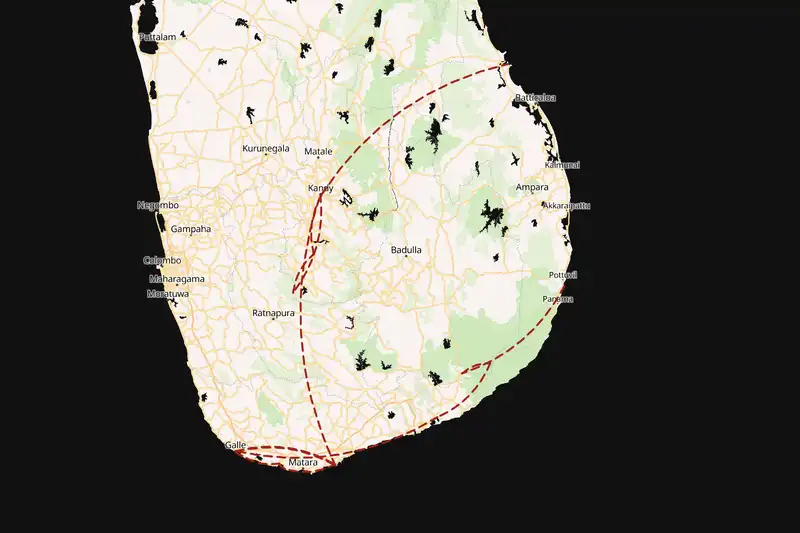
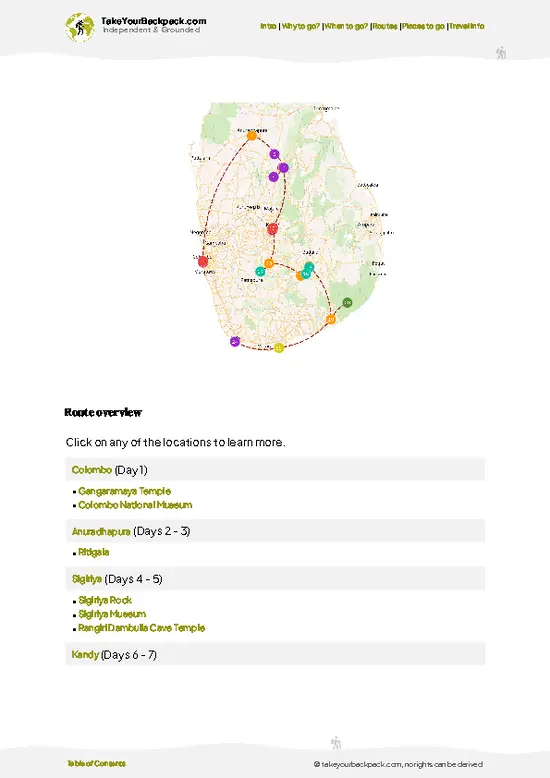
A typical first loop runs from
Colombo to
Sigiriya,
Kandy,
Ella and the south coast, and most of it needs no advance booking apart from reserved seats on the Kandy–Ella train, which sell out weeks ahead in high season. Dorm beds cost US$8 to 15, guesthouse doubles US$15 to 30, and a rice-and-curry lunch LKR 400 to 800 (US$1.30 to 2.70). Plan on US$20 to 35 a day.
Two weeks is the right length for a first trip to Sri Lanka, covering the ancient cities, the hill country and a stretch of beach without rushing.
With 5 days, stick to one region, such as
Kandy,
Nuwara Eliya and
Ella. Ten days adds
Sigiriya,
Polonnaruwa and the south coast around
Mirissa and
Galle. Fifteen days leaves room for
Anuradhapura,
Adam’s Peak and a
Yala safari. Distances look short on the map, but travel is slow: Kandy to Ella takes 6 to 7 hours by train, Ella to Mirissa 4.5 to 5.5 hours by bus, and Colombo to Galle about 2.5 hours by train.
Yes, you can get around Sri Lanka without a car: trains, buses and tuk-tuks reach nearly every stop on a typical backpacker route.
Colombo to
Kandy takes 2.5 to 4 hours by train or bus for roughly US$1 to 3. The
Kandy to
Ella train takes 6 to 7 hours and costs under US$5 in second class.
Ella to
Tissamaharama is about 3 hours by bus. For gaps like
Sigiriya to
Polonnaruwa, a tuk-tuk for the day runs LKR 6,000 to 9,000 (US$20 to 30). National park safaris need a jeep, which you book locally.
The must-visits in Sri Lanka are
Sigiriya, the
Temple of the Sacred Tooth Relic in Kandy, the hill-country train to
Ella and
Galle Fort, with a safari in
Yala or
Udawalawe close behind.
Climb
Sigiriya Rock Fortress at the 7 am opening; it has about 1,200 steps and costs around US$35. Give Ella 2 nights for
Ella Rock and
Little Adam’s Peak. The 9.5-kilometer
Horton Plains to World’s End loop is best before 10 am. A shared half-day jeep in Yala costs US$40 to 70 per person including fees. Walking Galle’s ramparts at sunset is free.
If you are short on time in Sri Lanka, keep
Colombo and
Negombo to a single night each. Leave the far north and east for a second trip unless your dates fit their season.
Jaffna is 6 to 7 hours by train from Colombo, so it needs at least 3 days to justify the trip.
Arugam Bay and
Trincomalee are at their best from roughly April to October, when the south coast is wetter. If you have already seen
Polonnaruwa,
Anuradhapura can wait. In the hill country, choose either
Ella or
Haputale as your base and skip a night in
Nuwara Eliya town.
Yes, our itinerary-planner does exactly that. Set your trip length in days, give your interests and travel style, optionally give start- and end location and/or some mandatory stops you would like to include and the itinerary planner creates your personalized routes for Sri Lanka in seconds. Try it out!
Try the itinerary plannerv2.webp)
 Best Backpacking