×

Sweden🇸🇪 | best citiesEssential 10 cities to Explore in Sweden

Cities in Sweden are mostly compact, clean and easy to read, built around water, with old cores that can be crossed on foot in an hour or two. The differences lie in scale and character. The capital region on the east coast is the largest, busiest and most expensive. The west coast is more relaxed, centered on a harbor and fishing heritage. The south has a university-town feel and sits close to Denmark, with easy rail links. In the north, cities are small, far apart and shaped by long winters. Independent travelers will find trains, buses and English reliable everywhere, but costs and distances vary widely.

By Johan Kruseman 🇳🇱 | Updated October 18, 2026
Explore the best towns in Sweden

Why go?Why These city Stand Out

Sweden suits city travel because its urban life developed around water, trade and a strong public sector. Most major cities began as ports or river crossings, and the old cores survive beside orderly modern districts. A long tradition of public investment shows in punctual rail, cycle lanes, free-to-enter parks and well-kept museums. The country is also long and thinly populated, with roughly 10 million people, most of them in the southern third. That means cities are separated by real distance, and the gap between the large southern centers and the small northern ones is wide.

Travelers should know that Sweden is a cashless society. Many shops, cafés and transit operators accept cards or phone payments only, and some do not take notes at all. Prices are high by European standards, especially … read more 👉
Sweden suits city travel because its urban life developed around water, trade and a strong public sector. Most major cities began as ports or river crossings, and the old cores survive beside orderly modern districts. A long tradition of public investment shows in punctual rail, cycle lanes, free-to-enter parks and well-kept museums. The country is also long and thinly populated, with roughly 10 million people, most of them in the southern third. That means cities are separated by real distance, and the gap between the large southern centers and the small northern ones is wide.

Travelers should know that Sweden is a cashless society. Many shops, cafés and transit operators accept cards or phone payments only, and some do not take notes at all. Prices are high by European standards, especially for alcohol, restaurant meals and central accommodation, though hostels, supermarkets and lunch specials keep costs manageable. Opening hours tend to be short on Sundays and public holidays, and many smaller shops close early on Saturdays.

Cities here reward interest in design, waterfront walking, museums and café culture more than nightlife or sunshine. Daylight changes the whole character of a visit, from near-constant light in summer to only a few hours in winter, so the season matters as much as the destination.
Evaluating the Top Choices
The list of best cities in Sweden is created based on culture, vibe, attractions, transport ease, and local charm. If you feel a city is missing in this list, please let us know.

When to go?Timing Your Visit for the Best Experience

Best months for city travel: The best months for Sweden’s cities are June to August, when daytime highs of 18 to 24°C (64 to 75°F) and up to 18 hours of daylight in the south make waterfront walking and outdoor dining easy. In the far north, the sun barely sets in midsummer. Rain is light but fairly frequent, with July and August often the wettest months, at around 60 to 80 mm in many southern areas.
Shoulder seasons: May and September are the best value. Highs of 12 to 18°C (54 to 64°F), thinner crowds and lower hotel rates, often 15 to 30 percent below midsummer, suit museum-heavy trips. Evenings turn cool, and September can bring early autumn color. April and October are cooler, at 5 to 12°C (41 to 54°F), and some seasonal attractions, island boats and outdoor terraces begin to close.
Winter … read more 👉
Best months for city travel: The best months for Sweden’s cities are June to August, when daytime highs of 18 to 24°C (64 to 75°F) and up to 18 hours of daylight in the south make waterfront walking and outdoor dining easy. In the far north, the sun barely sets in midsummer. Rain is light but fairly frequent, with July and August often the wettest months, at around 60 to 80 mm in many southern areas.
Shoulder seasons: May and September are the best value. Highs of 12 to 18°C (54 to 64°F), thinner crowds and lower hotel rates, often 15 to 30 percent below midsummer, suit museum-heavy trips. Evenings turn cool, and September can bring early autumn color. April and October are cooler, at 5 to 12°C (41 to 54°F), and some seasonal attractions, island boats and outdoor terraces begin to close.
Winter and peak periods: From November to February, daytime temperatures hover around -5 to 3°C (23 to 37°F) in the south and drop well below -10°C (14°F) in the north, with only 4 to 7 hours of light. Snow is reliable in northern cities, less so on the southern coast. Christmas markets in December add atmosphere and push up prices in the capital region. Midsummer weekend in late June is the one date to plan around: shops, restaurants and some transport close or run reduced services, and many Swedes leave the cities for the countryside.

city hoppingSuggested Travel Strategies

How many days to allow: A trip combining several cities in Sweden needs 7 to 12 days, enough for three or four stops without turning the journey into a series of platforms. The country’s length is the main constraint, so most travelers stay in the southern half.
Regions and direction: The most natural cluster is the south and west coast, where cities lie 30 minutes to 3 hours apart by train. Adding the capital region on the east coast works well as an end point, since Stockholm Central is the largest rail hub and has direct links to the south, west and north. Traveling from south to north, or ending at Stockholm, reduces backtracking and keeps the longest rail leg for the end. Fast X 2000 trains link Stockholm with Gothenburg in about 3 to 3.5 hours and with Malmö in 4.5 to 5 hours. Reaching … read more 👉
How many days to allow: A trip combining several cities in Sweden needs 7 to 12 days, enough for three or four stops without turning the journey into a series of platforms. The country’s length is the main constraint, so most travelers stay in the southern half.
Regions and direction: The most natural cluster is the south and west coast, where cities lie 30 minutes to 3 hours apart by train. Adding the capital region on the east coast works well as an end point, since Stockholm Central is the largest rail hub and has direct links to the south, west and north. Traveling from south to north, or ending at Stockholm, reduces backtracking and keeps the longest rail leg for the end. Fast X 2000 trains link Stockholm with Gothenburg in about 3 to 3.5 hours and with Malmö in 4.5 to 5 hours. Reaching the far north takes an overnight train of 12 to 17 hours or a flight of 1.5 hours, so it needs its own days.
Time per stop and common mistakes: Allow 2 to 3 nights in larger cities and 1 to 2 in smaller ones. A frequent mistake is cramming north and south into one short trip, which uses up days in transit. Another is booking rail at the last minute, when fares can be several times higher than advance tickets, which often start around 200 to 400 SEK (US$20 to 40). Travelers also arrive on Sundays or holidays without checking that shops and some museums are closed. Choose one region, book trains early and keep arrival times in daylight.

The ListTop cities of Sweden

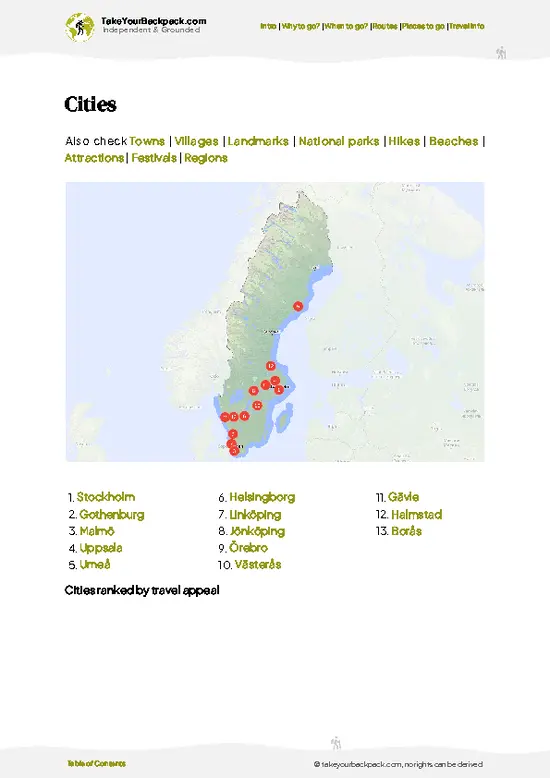
1 Stockholm

island neighborhoods, royal palaces, waterside promenades

Navigate a capital built on islands, where ferries connect districts and centuries-old buildings stand beside contemporary galleries and shops.

Sweden - Stockholm

2 Gothenburg

harbor districts, seafood markets, tram-lined avenues

Wander through neighborhoods shaped by maritime trade, sample fresh catch at indoor halls, and ride trams past parks and industrial relics.

sweden-city-gothenburg
© Google |

3 Malmö

Öresund views, modern architecture, multicultural squares

Experience a city where Danish influence meets Swedish design, with waterfront promenades and a blend of global communities shaping daily life.

4 Uppsala

cathedral spires, student traditions, botanical gardens

Stroll through a city defined by academic life, medieval landmarks, and green spaces that invite quiet reflection or lively gatherings.

sweden-city-uppsala
© Google |

5 Umeå

northern forests, university campus, riverside trails

Discover a youthful city in the north, where creative energy thrives alongside birch-lined streets and outdoor activities dominate every season.

6 Helsingborg

ferry port, castle ruins, coastal cliffs

Stand at Sweden’s edge, where ferries cross to Denmark and seaside parks frame views of fortifications and the open sea.

7 Linköping

aviation museum, canal paths, medieval church

Visit a city where engineering heritage meets tranquil waterways, offering museums, historic quarters, and easy access to the countryside.

sweden-city-linkoping
© Google |

8 Jönköping

lake vistas, matchstick museum, wooden piers

Spend time in a lakeside city where industrial history and scenic views combine, offering quiet walks and glimpses of Sweden’s past.

9 Örebro

moated castle, city parks, riverfront cafés

Relax in a city centered around a medieval fortress, with leafy spaces and a lively riverbank that draws locals year-round.

sweden-city-orebro
© Google |

10 Västerås

lakefront marina, ancient burial mounds, industrial legacy

Explore a city where lakeside recreation meets Viking history, with green parks and reminders of Sweden’s industrial past.

11 Gävle

coastal harbor, gingerbread houses, railway junction

Travel through a city known for its distinctive architecture and strategic location, where the coast meets a network of rail lines.

12 Halmstad

west coast beaches, sculpture parks, student nightlife

Swim or surf along sandy shores, explore outdoor art installations, and find lively bars clustered near the university.

sweden-city-halmstad
© Google |

13 Borås

public art, textile heritage, rain-soaked streets

Experience a city shaped by creative installations and a legacy of fabric production, where weather and design influence daily routines.

Think you know Sweden?

Prove you’re a true local — uncover 3 lesser-known cities in Sweden that locals tend to keep to themselves.
Loading the map 🌍

Expert viewInsights from Locals and Experts

How many cities to visit: I advise three cities on a trip of one to two weeks, four at most. Each city here takes at least two nights to absorb, and distances between regions eat half a day. Three stops cost roughly 15 to 20 percent less in transport than five, and they leave room for the slower things, like an archipelago ferry or an afternoon in a park. More than four turns the trip into logistics for very little gain.
Which kind suits which traveler: The largest city in the east gives the most museums, nightlife and range, but it is also the most expensive. It suits travelers with a higher daily budget or a short trip. The west and south coast are friendlier to a tight budget, with lower beds, student-oriented cafés and quick rail connections, so they give a backpacker the most for the money. … read more 👉
How many cities to visit: I advise three cities on a trip of one to two weeks, four at most. Each city here takes at least two nights to absorb, and distances between regions eat half a day. Three stops cost roughly 15 to 20 percent less in transport than five, and they leave room for the slower things, like an archipelago ferry or an afternoon in a park. More than four turns the trip into logistics for very little gain.
Which kind suits which traveler: The largest city in the east gives the most museums, nightlife and range, but it is also the most expensive. It suits travelers with a higher daily budget or a short trip. The west and south coast are friendlier to a tight budget, with lower beds, student-oriented cafés and quick rail connections, so they give a backpacker the most for the money. Northern cities cost a similar amount but need more time and flights or long trains, so they make sense only if aurora, winter sports or big landscapes are the point. A combination of one large city with one smaller one balances cost and comfort best.
What it costs: A realistic budget is US$80 to 130 a day (about 850 to 1,400 SEK) if you use hostel dorms, supermarket meals and city transit passes. Dorm beds run 300 to 500 SEK (US$28 to 48), a private budget room 800 to 1,400 SEK (US$75 to 130). Museums charge 100 to 200 SEK (US$10 to 19), though many national museums are free or cheaper on certain days. Local transit day tickets cost about 100 to 150 SEK (US$10 to 14). Lunch specials, usually 110 to 150 SEK (US$10 to 14) on weekdays, are the best-value meal. Alcohol is heavily taxed, so a beer in a bar costs 70 to 100 SEK (US$7 to 10), and buying from the state-run Systembolaget is cheaper though limited to certain hours. Per visit, expect US$200 to 350 for a two-night stop including a couple of entries and local transport.
Safety and cultural points: Sweden is very safe for travelers, with low violent crime against visitors. Pickpocketing occurs around main stations, tourist areas and on crowded trains, so keep phones and wallets zipped away. Some neighborhoods on city outskirts have higher crime rates, and they rarely appear in a typical itinerary. Carry a working card or phone payment, since cash is often refused. Queue patiently, take a ticket where a machine is offered and keep voices down on public transport. Swedes value personal space and punctuality, and tipping is optional, usually rounding up or adding 5 to 10 percent for good service. Right of public access does not extend to cities, so wild camping is not an option in urban areas.

✈️ The backpacker research shortcutSweden Travel Guide

An offline-friendly backpacking guide with optimized travel routes, ranked highlights, transport advice, and the best areas to stay.
example page 0 from our offline Travel Guide for Sweden
example page 1 from our offline Travel Guide for Sweden
example page 2 from our offline Travel Guide for Sweden
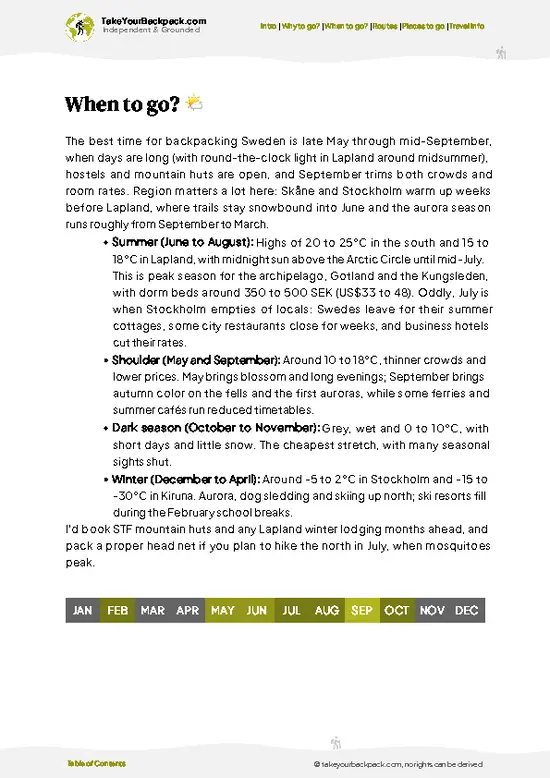
example page 3 from our offline Travel Guide for Sweden
example page 4 from our offline Travel Guide for Sweden
example page 5 from our offline Travel Guide for Sweden
example page 6 from our offline Travel Guide for Sweden
example page 7 from our offline Travel Guide for Sweden
The digital guide (414 pages) contains:
✅ 109 highlights, ranked by travel appeal
✅ Optimized 5, 10 & 15-day travel routes
✅ Cities, national parks, landmarks, beaches
✅ How to get around
✅ Offline-friendly for travel without Wi-Fi
👉 Click to see all 30+ guide features

📅 Plan smarter in minutes, not weeks
✅ Month by month travel advice
✅ Festivals & national holidays
✅ Budget expectations

🗺️ Go to the right places, skip the overrated ones
✅ Honest pros & cons of destinations
✅ Top hikes, parks & viewpoints
✅ Lesser-known places most travelers miss
✅ Clear “worth it vs skip it” guidance

🛏️ Travel smoothly without rookie mistakes
✅ Best areas to stay
✅ Transport systems explained simply
✅ Common scams & safety advice
✅ SIM cards, money & practical tips

🌍 Understand the country, not just visit it
✅ Culture & traditions
✅ 52 Essential phrases & customs
✅ Festivals worth planning around
✅ Traveler-friendly historical context
✅ Insights that make places more meaningful

📱 Built for real travel conditions
✅ Fully downloadable PDF
✅ Works completely offline
✅ Optimized for phone use
✅ Useful in remote areas & buses
✅ Everything in one place
Stop searching, start planning
Get instant access to your full guide. 30‑day money-back guarantee.
+ Add another guide for just

By proceeding you agree to our terms.
Sent to your inbox immediately after payment • 100% Secure Checkout
Best Backpacking Travel Advisor 2025 tourism awardBest Backpacking
Travel Advisor
2025
What others say about Take Your Backpack Guides:
⭐⭐⭐⭐⭐
Fantastic, amazing amount of information!
⭐⭐⭐⭐⭐
My goodness this is amazing, it's what I've been looking for hats off too you!
⭐⭐⭐⭐⭐
I think this is absolutely BRILLIANT
⭐⭐⭐⭐
Very complete and informative. It's still missing places, but I gotta to commend you
⭐⭐⭐⭐⭐
This is truly amazing, thank you, can't wait to explore it with my kids!
⭐⭐⭐⭐⭐
Awesome resource, thank you!
⭐⭐⭐⭐⭐
This is amazing! Can't wait to explore the ones I haven't seen
⭐⭐⭐⭐
I love this! Well done, great idea.
⭐⭐⭐⭐⭐
Thanks for taking the time to make this gem!
⭐⭐⭐⭐⭐
This might be the best website I've ever seen.
⭐⭐⭐⭐⭐
Congratulations, and thank you so much for your work; it's incredibly valuable.
⭐⭐⭐⭐
In all seriousness I think you did a great job pointing out the important spots
⭐⭐⭐⭐⭐
10/10 very good
⭐⭐⭐⭐⭐
As someone who's only just starting to visit regularly this is awesome, thank you.
⭐⭐⭐⭐
Thank you very much! I'm going to visit my dad, it's going to be very useful!
⭐⭐⭐⭐⭐
This is really cool! We'll be travelling for the first time and this definitely come in handy.
⭐⭐⭐⭐⭐
You are now our minister of culture, congratulations 👨‍💼
⭐⭐⭐⭐⭐
Just wanted to tell you that this is a pearl! Going to follow your recommendations.
⭐⭐⭐⭐⭐
This is so cool. I'll definitely be using the resource for my travels soon.
⭐⭐⭐⭐⭐
This is very impressive! Good work.
⭐⭐⭐⭐⭐
This is an amazing and informative site. Very well done!

🛏️ Where to stay?Where to Base Yourself

Budget beds are easy to find in Sweden, with dorms typically running SEK 300 to 500 (US$28 to 48) a night and private hostel rooms from about SEK 700 (US$65), though many places charge extra for sheets and towels unless you bring your own. In Stockholm, Södermalm has the best mix of bars, cheap eats and late nights, while Norrmalm around the central station wins on transport links but feels more functional, and Gamla Stan puts you beside the sights at a higher price, with streets that go very quiet after dark. In Gothenburg, Linnéstaden and Haga give you walkable cafés and bars with an easy tram ride to everything else, and all of these areas are safe to walk at night.

If you enjoy meeting fellow … read more 👉
Budget beds are easy to find in Sweden, with dorms typically running SEK 300 to 500 (US$28 to 48) a night and private hostel rooms from about SEK 700 (US$65), though many places charge extra for sheets and towels unless you bring your own. In Stockholm, Södermalm has the best mix of bars, cheap eats and late nights, while Norrmalm around the central station wins on transport links but feels more functional, and Gamla Stan puts you beside the sights at a higher price, with streets that go very quiet after dark. In Gothenburg, Linnéstaden and Haga give you walkable cafés and bars with an easy tram ride to everything else, and all of these areas are safe to walk at night.

If you enjoy meeting fellow travelers, consider choosing hostels with high ratings for atmosphere. On the other hand, if you prefer having your own space, a hotel might be a better option.

SwedenExpand Your Journey

👋 Meet the founderWho’s Behind Take Your Backpack?

Johan, backpacker and founder of TakeYourBackpackHi, I’m Johan (Netherlands 🇳🇱), the creator of TakeYourBackpack. Over the past 3 decades, I’ve backpacked through 90+ countries across six continents, gaining extensive experience with independent travel, long-term trips, and overland routes.

This site is built on a combination of firsthand travel experience and carefully curated insights from other backpackers. Many guides are based on places I’ve personally visited, while others bring together tips, observations, and practical advice shared by trusted travelers I’ve met along the way.

The goal is to provide realistic, experience-driven guidance — not generic itineraries — so you can explore destinations with better context, clearer expectations, and more confidence.