×

Sweden🇸🇪 | best hikesEssential 10 hikes to Explore in Sweden

Hiking in Sweden rests on allemansrätten, the public right of access that lets you walk and camp almost anywhere on uncultivated land. Trails split into two broad types. In the north, Lapland offers long, remote routes above the tree line with mountain huts run by the Swedish Tourist Association, high costs and short seasons. In the south, forest and coastal paths are easier to reach by train, quieter and cheaper, with shelters and free wind shelters along the way. For backpacking on a budget, the south and the middle suit you best. The far north rewards planning and a larger purse.

By Johan Kruseman 🇳🇱 | Updated October 18, 2026
Explore the best beaches in Sweden

Why go?Why These hike Stand Out

Sweden is built for walking in a way few countries are. Allemansrätten, written into custom and law, lets you pitch a tent for a night or two on most open land, provided you keep your distance from homes and leave no trace. That removes the need for permits, booking systems and campsite fees on most routes. The country is long and thinly populated, so wilderness lies within reach of towns, and trail networks are maintained by local associations and the Swedish Tourist Association. Many marked routes have wind shelters, cabins and clear signage, and drinking water is often taken directly from streams in the mountains.

Before choosing Sweden, know that the country is expensive. Food, mountain hut stays and transport all cost more than in southern Europe, and supplies in the high north are limited … read more 👉
Sweden is built for walking in a way few countries are. Allemansrätten, written into custom and law, lets you pitch a tent for a night or two on most open land, provided you keep your distance from homes and leave no trace. That removes the need for permits, booking systems and campsite fees on most routes. The country is long and thinly populated, so wilderness lies within reach of towns, and trail networks are maintained by local associations and the Swedish Tourist Association. Many marked routes have wind shelters, cabins and clear signage, and drinking water is often taken directly from streams in the mountains.

Before choosing Sweden, know that the country is expensive. Food, mountain hut stays and transport all cost more than in southern Europe, and supplies in the high north are limited and priced accordingly. The mountains are far from the main cities, so travel time is part of the plan. Weather shifts quickly in the fjäll, and the long summer daylight in the north changes how you pace a day. Mosquitoes and biting flies are a real feature of the northern summer. Trails are generally well marked but not groomed, and self-reliance is expected rather than offered.
Evaluating the Top Choices
The list of best hikes in Sweden is created based on scenery, challenge, trail quality, landmarks, and overall enjoyment. If you feel a hike is missing in this list, please let us know.

When to go?Timing Your Visit for the Best Experience

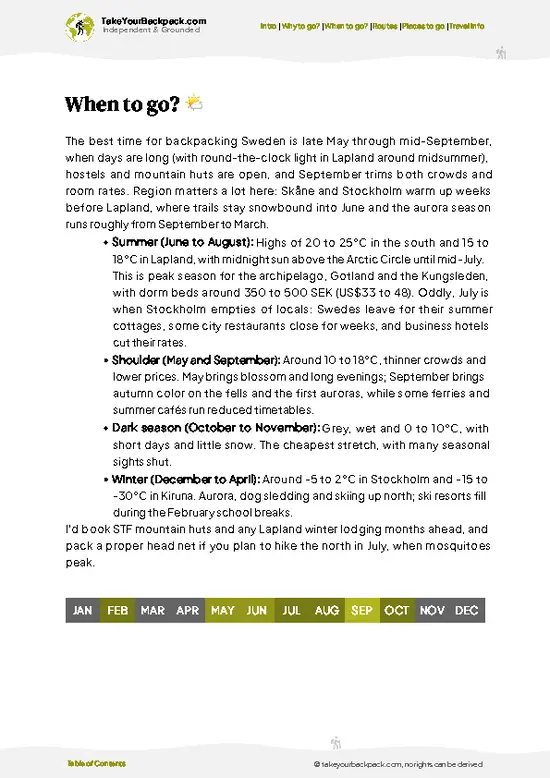
Best months: The best months for hiking in Sweden are July and August in the northern mountains, and June to September in the south, because snow has melted from the trails, huts are open and daylight runs long. In Lapland, huts usually open from late June or early July until mid September, and snow can linger on high passes into early July. Daytime temperatures in the mountains are typically 8 to 18°C, with nights near freezing at altitude. Rain falls on roughly half the days in the western mountains.
Shoulder seasons: Late August to mid September is the best window for the north: autumn colors peak in the first half of September, mosquitoes fade and crowds thin, but nights can drop below 0°C and snow is possible. In the south, May and September bring 10 to 18°C and few walkers. Winter hiking … read more 👉
Best months: The best months for hiking in Sweden are July and August in the northern mountains, and June to September in the south, because snow has melted from the trails, huts are open and daylight runs long. In Lapland, huts usually open from late June or early July until mid September, and snow can linger on high passes into early July. Daytime temperatures in the mountains are typically 8 to 18°C, with nights near freezing at altitude. Rain falls on roughly half the days in the western mountains.
Shoulder seasons: Late August to mid September is the best window for the north: autumn colors peak in the first half of September, mosquitoes fade and crowds thin, but nights can drop below 0°C and snow is possible. In the south, May and September bring 10 to 18°C and few walkers. Winter hiking exists but needs ski or snowshoe skills and is a different trip.
Peak periods: Late July is the busiest stretch, when Swedes take their long summer holidays. Popular mountain huts fill, and the most-walked trails see queues at hut check-in. Mountain hut prices stay fixed through the season, while accommodation in cities and coastal towns rises in July. Mosquitoes are worst in July in the north, so a head net is worth carrying.

hike hoppingSuggested Travel Strategies

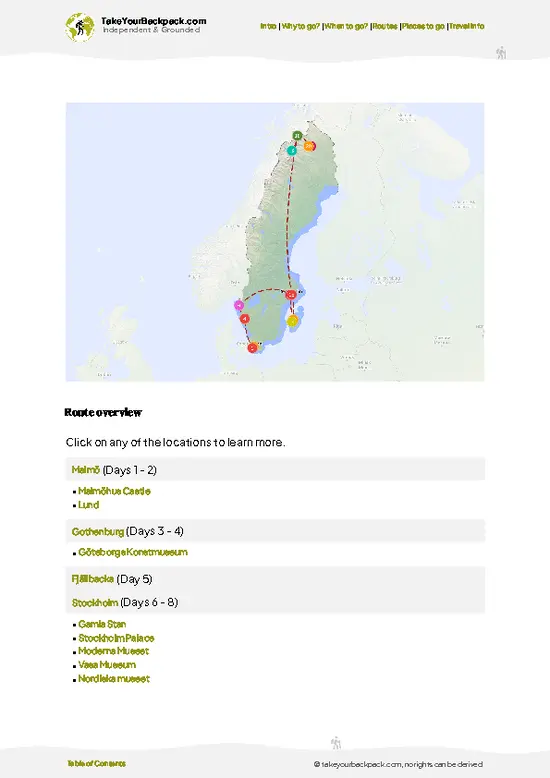
How long you need: A trip that combines several hikes in Sweden needs 10 to 21 days, depending on whether you stay in one half of the country or cross it. Sweden is about 1,600 km from tip to tip, so treat the country as two or three separate zones rather than one loop.
Grouping regions: The south and the middle group well around Stockholm, Gothenburg and Malmö, linked by fast trains taking 3 to 5 hours between them. The north works better as its own trip, reached by night train or flight to Kiruna, Gällivare or Östersund. A sensible direction is to start in the south, where you can test gear on easier ground, then move north by overnight train from Stockholm (about 14 to 17 hours to Abisko or Kiruna). Allow 3 to 7 days per stop on a mountain route, and 1 to 3 days on shorter forest or coastal … read more 👉
How long you need: A trip that combines several hikes in Sweden needs 10 to 21 days, depending on whether you stay in one half of the country or cross it. Sweden is about 1,600 km from tip to tip, so treat the country as two or three separate zones rather than one loop.
Grouping regions: The south and the middle group well around Stockholm, Gothenburg and Malmö, linked by fast trains taking 3 to 5 hours between them. The north works better as its own trip, reached by night train or flight to Kiruna, Gällivare or Östersund. A sensible direction is to start in the south, where you can test gear on easier ground, then move north by overnight train from Stockholm (about 14 to 17 hours to Abisko or Kiruna). Allow 3 to 7 days per stop on a mountain route, and 1 to 3 days on shorter forest or coastal paths.
Common mistakes: Travelers often underestimate distances and try to fit north and south into a week. Another is assuming local buses run daily to trailheads. In remote areas, services can be a few a day or fewer on weekends, so check timetables and book a rest day after each long transfer. Build in a spare day for weather, especially in the mountains, and avoid tight same-day connections between a trail end and a long train.

The ListTop hikes of Sweden

1 Kungsleden

Arctic tundra, mountain huts, glacial valleys

Experience remote wilderness as you cross open fells and birch woods, passing through Sweden’s most dramatic mountain scenery north of the Arctic Circle.

Sweden - the Kungsleden

2 Höga Kustenleden

coastal cliffs, pine forests, suspension bridges

Traverse a landscape shaped by ancient uplift, following rugged shorelines and forested ridges with sweeping views over the Baltic Sea.

3 Jämtlandstriangeln

alpine huts, highland plateaus, reindeer grazing

Hike a well-marked circuit through open mountain country, staying in staffed huts and watching for wildlife on the tundra.

sweden-hike-jamtlandstriangeln
© Google |

4 Padjelantaleden

Sámi culture, alpine plateaus, remote cabins

Cross vast open spaces above the tree line, encountering reindeer herders and expansive views in Sweden’s largest national park region.

5 Skåneleden

rolling farmland, beech woods, sandy beaches

Walk through southern Sweden’s gentle countryside, moving from leafy groves to open fields and quiet stretches of coastline.

sweden-hike-skaneleden
© Google | Kateryna B

6 Bohusleden

granite outcrops, deep forests, freshwater lakes

Navigate a route marked by rocky ridges and quiet woods, with frequent opportunities to swim or camp beside clear inland lakes.

sweden-hike-bohusleden
© Google |

7 Sörmlandsleden

lakeside trails, mixed forests, Bronze Age sites

Follow winding paths past tranquil lakes and ancient stones, weaving through varied woodland and glimpses of rural Swedish life.

sweden-hike-sormlandsleden
© Google | Loke Johansson

8 Blekingeleden

archipelago views, oak groves, rural villages

Move between coastal inlets and wooded hills, discovering small farms and glimpses of the Baltic’s scattered islands along the way.

9 Upplandsleden

meadow paths, medieval ruins, bird wetlands

Stroll through lowland fields and past old stone churches, with detours to nature reserves rich in birdlife and wildflowers.

sweden-hike-upplandsleden
© Google |

10 Vasaloppsleden

historic route, spruce forest, open moorland

Trace the legendary path of the Vasaloppet ski race, hiking through dense woods and open landscapes dotted with traditional red cottages.

Loading the map 🌍

Expert viewInsights from Locals and Experts

How many hikes to plan: Three to four hikes is the number I would advise for one trip. Two multi-day routes and one or two shorter walks fill about two to three weeks without turning the trip into a series of transfers. Sweden’s distances are large and the best trails are far apart, so each extra hike costs a travel day and often US$50 to 100 in transport. Beyond four, you spend more time on trains than on trails.
Choosing the kind of hike: For a first long hike, a marked forest or coastal route in the south gives the most for the least: shelters are free, trailheads connect to public transport and a bad weather day is manageable. Mountain hut routes in Lapland suit walkers who want big landscapes and are happy to pay for them. They cost more in time and money, but they are the experience Sweden … read more 👉
How many hikes to plan: Three to four hikes is the number I would advise for one trip. Two multi-day routes and one or two shorter walks fill about two to three weeks without turning the trip into a series of transfers. Sweden’s distances are large and the best trails are far apart, so each extra hike costs a travel day and often US$50 to 100 in transport. Beyond four, you spend more time on trains than on trails.
Choosing the kind of hike: For a first long hike, a marked forest or coastal route in the south gives the most for the least: shelters are free, trailheads connect to public transport and a bad weather day is manageable. Mountain hut routes in Lapland suit walkers who want big landscapes and are happy to pay for them. They cost more in time and money, but they are the experience Sweden is known for. If you carry a tent and stove, the high north becomes cheaper and more flexible, and it gives the most to a self-sufficient backpacker with a few weeks.
What it costs: Expect roughly US$40 to 70 a day on southern trails if you camp and cook, mostly for food and local transport. In the mountains, a bed in a Swedish Tourist Association hut costs roughly SEK 400 to 700 (US$40 to 70) a night for members, more for non-members, and meals or provisions bought in huts add to that. Camping near huts costs a smaller fee. Budget US$70 to 120 a day if you use huts, or US$45 to 75 camping with your own food. Long-distance transport is the largest extra: a night train to the north can run US$50 to 150 depending on booking time, and trailhead boats or buses add US$10 to 40 each. Entry to national parks is free, and guides are rarely needed on marked routes, though guided trips cost around US$150 to 300 a day.
Safety: Weather turns fast above the tree line, with fog, wind and cold rain even in July, so carry waterproofs, warm layers and a paper map. Mobile coverage is patchy in the mountains. River crossings are the main hazard on northern routes, and water levels rise after rain or in early-season melt, so use bridges and unbuckle your pack straps when wading. Sign hut logbooks. Reindeer herding is part of Sami life in the north, so keep dogs on leads and give animals space.
Cultural considerations: Allemansrätten comes with a duty to respect it: camp out of sight of houses, do not stay more than a night or two in one place, and take all waste out. Open fires are often banned in dry spells and in many national parks, so carry a stove. Swedes value quiet and personal space on trails and in huts, and a polite greeting is the norm.

✈️ The backpacker research shortcutSweden Travel Guide

An offline-friendly backpacking guide with optimized travel routes, ranked highlights, transport advice, and the best areas to stay.
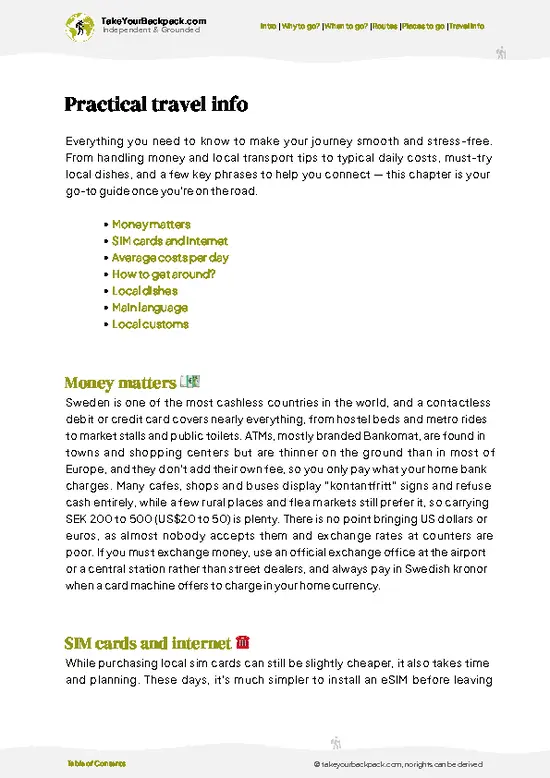
example page 0 from our offline Travel Guide for Sweden
example page 1 from our offline Travel Guide for Sweden
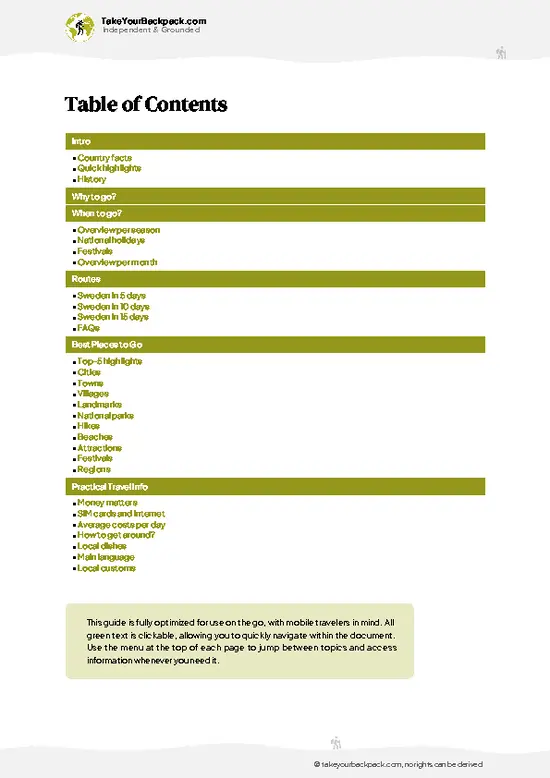
example page 2 from our offline Travel Guide for Sweden
example page 3 from our offline Travel Guide for Sweden
example page 4 from our offline Travel Guide for Sweden
example page 5 from our offline Travel Guide for Sweden
example page 6 from our offline Travel Guide for Sweden
example page 7 from our offline Travel Guide for Sweden
The digital guide (414 pages) contains:
✅ 109 highlights, ranked by travel appeal
✅ Optimized 5, 10 & 15-day travel routes
✅ Cities, national parks, landmarks, beaches
✅ How to get around
✅ Offline-friendly for travel without Wi-Fi
👉 Click to see all 30+ guide features

📅 Plan smarter in minutes, not weeks
✅ Month by month travel advice
✅ Festivals & national holidays
✅ Budget expectations

🗺️ Go to the right places, skip the overrated ones
✅ Honest pros & cons of destinations
✅ Top hikes, parks & viewpoints
✅ Lesser-known places most travelers miss
✅ Clear “worth it vs skip it” guidance

🛏️ Travel smoothly without rookie mistakes
✅ Best areas to stay
✅ Transport systems explained simply
✅ Common scams & safety advice
✅ SIM cards, money & practical tips

🌍 Understand the country, not just visit it
✅ Culture & traditions
✅ 52 Essential phrases & customs
✅ Festivals worth planning around
✅ Traveler-friendly historical context
✅ Insights that make places more meaningful

📱 Built for real travel conditions
✅ Fully downloadable PDF
✅ Works completely offline
✅ Optimized for phone use
✅ Useful in remote areas & buses
✅ Everything in one place
Stop searching, start planning
Get instant access to your full guide. 30‑day money-back guarantee.
+ Add another guide for just

By proceeding you agree to our terms.
Sent to your inbox immediately after payment • 100% Secure Checkout
Best Backpacking Travel Advisor 2025 tourism awardBest Backpacking
Travel Advisor
2025
What others say about Take Your Backpack Guides:
⭐⭐⭐⭐⭐
Fantastic, amazing amount of information!
⭐⭐⭐⭐⭐
My goodness this is amazing, it's what I've been looking for hats off too you!
⭐⭐⭐⭐⭐
I think this is absolutely BRILLIANT
⭐⭐⭐⭐
Very complete and informative. It's still missing places, but I gotta to commend you
⭐⭐⭐⭐⭐
This is truly amazing, thank you, can't wait to explore it with my kids!
⭐⭐⭐⭐⭐
Awesome resource, thank you!
⭐⭐⭐⭐⭐
This is amazing! Can't wait to explore the ones I haven't seen
⭐⭐⭐⭐
I love this! Well done, great idea.
⭐⭐⭐⭐⭐
Thanks for taking the time to make this gem!
⭐⭐⭐⭐⭐
This might be the best website I've ever seen.
⭐⭐⭐⭐⭐
Congratulations, and thank you so much for your work; it's incredibly valuable.
⭐⭐⭐⭐
In all seriousness I think you did a great job pointing out the important spots
⭐⭐⭐⭐⭐
10/10 very good
⭐⭐⭐⭐⭐
As someone who's only just starting to visit regularly this is awesome, thank you.
⭐⭐⭐⭐
Thank you very much! I'm going to visit my dad, it's going to be very useful!
⭐⭐⭐⭐⭐
This is really cool! We'll be travelling for the first time and this definitely come in handy.
⭐⭐⭐⭐⭐
You are now our minister of culture, congratulations 👨‍💼
⭐⭐⭐⭐⭐
Just wanted to tell you that this is a pearl! Going to follow your recommendations.
⭐⭐⭐⭐⭐
This is so cool. I'll definitely be using the resource for my travels soon.
⭐⭐⭐⭐⭐
This is very impressive! Good work.
⭐⭐⭐⭐⭐
This is an amazing and informative site. Very well done!

🛏️ Where to stay?Where to Base Yourself

Budget beds are easy to find in Sweden, with dorms typically running SEK 300 to 500 (US$28 to 48) a night and private hostel rooms from about SEK 700 (US$65), though many places charge extra for sheets and towels unless you bring your own. In Stockholm, Södermalm has the best mix of bars, cheap eats and late nights, while Norrmalm around the central station wins on transport links but feels more functional, and Gamla Stan puts you beside the sights at a higher price, with streets that go very quiet after dark. In Gothenburg, Linnéstaden and Haga give you walkable cafés and bars with an easy tram ride to everything else, and all of these areas are safe to walk at night.

If you enjoy meeting fellow … read more 👉
Budget beds are easy to find in Sweden, with dorms typically running SEK 300 to 500 (US$28 to 48) a night and private hostel rooms from about SEK 700 (US$65), though many places charge extra for sheets and towels unless you bring your own. In Stockholm, Södermalm has the best mix of bars, cheap eats and late nights, while Norrmalm around the central station wins on transport links but feels more functional, and Gamla Stan puts you beside the sights at a higher price, with streets that go very quiet after dark. In Gothenburg, Linnéstaden and Haga give you walkable cafés and bars with an easy tram ride to everything else, and all of these areas are safe to walk at night.

If you enjoy meeting fellow travelers, consider choosing hostels with high ratings for atmosphere. On the other hand, if you prefer having your own space, a hotel might be a better option.

SwedenExpand Your Journey

👋 Meet the founderWho’s Behind Take Your Backpack?

Johan, backpacker and founder of TakeYourBackpackHi, I’m Johan (Netherlands 🇳🇱), the creator of TakeYourBackpack. Over the past 3 decades, I’ve backpacked through 90+ countries across six continents, gaining extensive experience with independent travel, long-term trips, and overland routes.

This site is built on a combination of firsthand travel experience and carefully curated insights from other backpackers. Many guides are based on places I’ve personally visited, while others bring together tips, observations, and practical advice shared by trusted travelers I’ve met along the way.

The goal is to provide realistic, experience-driven guidance — not generic itineraries — so you can explore destinations with better context, clearer expectations, and more confidence.