×

Switzerland🇨🇭 | best festivalsThe Must-See 10 festivals in Switzerland

Festivals in Switzerland are shaped by language regions, altitude and a strong local-club culture, so the experience changes sharply within a few hours by train. In the German-speaking north and center, Carnival, folk and open-air music events are well organized and expensive, with tickets often CHF 80 to 250. The French-speaking west leans toward lakeside music and street events, while Ticino brings Italian-flavored summer nights and Alpine valleys host herder and cheese traditions. Public transport reaches nearly every venue, which suits independent travel and backpacking, but beds fill fast and prices spike. Smaller village events cost less and feel more local.

By Johan Kruseman 🇳🇱 | Updated October 19, 2026
Explore the best regions in Switzerland

Why go?Why Travelers Love These Spots

Switzerland suits festivals because direct democracy and strong municipalities keep traditions alive at village level. Each canton, and often each valley, runs its own calendar, shaped by four national languages and by the Catholic and Protestant split that still determines which towns hold Carnival and which do not. Farming life in the mountains also produced seasonal rituals tied to moving cattle between pastures, which survive because the work they mark still happens.

The country is also very well organized. Trains, buses and boats run on a national timetable, and large events add extra late services, so reaching a festival rarely needs a car. That reliability comes with a high-cost economy: a beer at a festival typically runs CHF 6 to 9, and a meal CHF 15 to 25. Wages are high, so entry … read more 👉
Switzerland suits festivals because direct democracy and strong municipalities keep traditions alive at village level. Each canton, and often each valley, runs its own calendar, shaped by four national languages and by the Catholic and Protestant split that still determines which towns hold Carnival and which do not. Farming life in the mountains also produced seasonal rituals tied to moving cattle between pastures, which survive because the work they mark still happens.

The country is also very well organized. Trains, buses and boats run on a national timetable, and large events add extra late services, so reaching a festival rarely needs a car. That reliability comes with a high-cost economy: a beer at a festival typically runs CHF 6 to 9, and a meal CHF 15 to 25. Wages are high, so entry and food prices follow.

Before choosing Switzerland, know that festivals here are punctual, orderly and tightly scheduled. Parades start on time, noise rules apply late at night, and many events are seasonal, tied to weather and altitude. Accommodation near major events is booked months ahead. Expect polished, community-driven gatherings rather than spontaneous parties, and plan around that structure.
Behind the Scenes of Selection
The list of best festivals in Switzerland is created based on energy, traditions, crowd experience, activities, and overall excitement. If you feel a festival is missing in this list, please let us know.

When to go?Optimal Periods for Travel

Best months and why: Late June to early September is the best window, because open-air events cluster in summer when daytime highs reach 22 to 28°C in the lowlands and Alpine roads and lifts are fully open. July and August bring the most music and lakeside programming, though thunderstorms are common and August averages roughly 100 to 130 mm of rain in the north.
Shoulder seasons: Late February and March carry the winter traditions, with cold days of about 0 to 8°C in the German-speaking cities, and Carnival in Basel and Lucerne is rooted in Catholic and Protestant calendar differences. September and October bring herder and harvest events in the Alps, with crisp 10 to 18°C days and fewer crowds. Cattle descend from summer pastures on a schedule set by grass and weather, so dates shift by a … read more 👉
Best months and why: Late June to early September is the best window, because open-air events cluster in summer when daytime highs reach 22 to 28°C in the lowlands and Alpine roads and lifts are fully open. July and August bring the most music and lakeside programming, though thunderstorms are common and August averages roughly 100 to 130 mm of rain in the north.
Shoulder seasons: Late February and March carry the winter traditions, with cold days of about 0 to 8°C in the German-speaking cities, and Carnival in Basel and Lucerne is rooted in Catholic and Protestant calendar differences. September and October bring herder and harvest events in the Alps, with crisp 10 to 18°C days and fewer crowds. Cattle descend from summer pastures on a schedule set by grass and weather, so dates shift by a week or so.
Peak periods and prices: Peak weekends in July and August push hotel rates up by 30 to 60 percent in lake towns such as Montreux and Locarno, and hostel dorms (typically CHF 35 to 60) sell out weeks ahead. Ticino stays mild into October, around 15 to 20°C, while high valleys can see snow from late October. Winter festivals in ski areas cost more during school holidays, so midweek visits are cheaper.

festival hoppingSuggested Travel Strategies

How long it takes: A trip combining several festivals in Switzerland needs 8 to 14 days, because the country is small but events are tied to fixed dates and regions. Plan roughly 2 to 3 days per stop: one day for the event, one for arrival and recovery, and a buffer for weather or sold-out beds.
Regions that group well: The German-speaking north and center (Zurich, Basel, Lucerne, Bern) sit within 1 to 1.5 hours of each other by train and combine easily. The Lake Geneva arc from Lausanne to Montreux is linked by frequent regional trains, with Geneva to Lausanne around 40 minutes. Ticino is further: Zurich to Lugano takes about 2 hours 30 minutes through the Gotthard Base Tunnel. Alpine valleys in Valais and Graubünden add 2 to 4 hours, often with a bus or postbus change.
Direction and pacing: … read more 👉
How long it takes: A trip combining several festivals in Switzerland needs 8 to 14 days, because the country is small but events are tied to fixed dates and regions. Plan roughly 2 to 3 days per stop: one day for the event, one for arrival and recovery, and a buffer for weather or sold-out beds.
Regions that group well: The German-speaking north and center (Zurich, Basel, Lucerne, Bern) sit within 1 to 1.5 hours of each other by train and combine easily. The Lake Geneva arc from Lausanne to Montreux is linked by frequent regional trains, with Geneva to Lausanne around 40 minutes. Ticino is further: Zurich to Lugano takes about 2 hours 30 minutes through the Gotthard Base Tunnel. Alpine valleys in Valais and Graubünden add 2 to 4 hours, often with a bus or postbus change.
Direction and pacing: Travel in date order, then fit geography around it, often moving from north to west and finishing in the south or the mountains as summer turns to early autumn. A Swiss Travel Pass or a point-to-point Supersaver ticket can reduce costs depending on how many legs you ride.
Common planning mistakes: Travelers often pack in too many stops and ignore that late events end after the last regional train in smaller towns. Instead, book a bed within walking distance or on the night-bus network. Another error is leaving accommodation until the last week; book early, and keep cancellable options.

The ListMust-Visit festivals in Switzerland

1 Zürich Street Parade

electronic music, parade floats, lake promenade

Move with crowds through Zürich’s city center as DJs and dancers fill the streets with beats and colorful energy.

2 Montreux Jazz Festival

lakefront stages, global artists, improvisation

Hear diverse sounds from jazz to rock in intimate venues and open-air spaces along Lake Geneva’s scenic shoreline.

3 Locarno Film Festival

open-air screenings, Piazza Grande, auteur cinema

Watch international films under the stars, surrounded by mountains and a crowd of cinephiles in a lakeside Italian-speaking town.

4 Basel Carnival

lantern procession, confetti, masked cliques

Experience pre-dawn parades and surreal costumes as the city transforms into a world of satire, music, and secretive rituals.

5 Paléo Festival

open fields, multi-genre line-up, camping

Camp out with thousands for a week of music, food stalls, and late-night shows on the outskirts of Nyon.

6 Sechseläuten

guild parade, burning effigy, spring ritual

Witness Zürich’s guilds parade in costume before the symbolic burning of the Böögg to mark the end of winter.

7 Zibelemärit

onion braids, early morning market, folk crafts

Browse stalls piled with onions and local goods as Bern’s old town fills with scents, snacks, and traditional decorations.

8 Fête de la Musique

free concerts, public squares, local bands

Discover spontaneous performances and eclectic sounds as musicians take over city streets and parks for a day.

9 Château-d’Oex International Balloon Festival

alpine launches, hot air balloons, snowy landscape

Watch colorful balloons rise above snowy peaks, with sunrise flights and family activities in a mountain village setting.

10 Fête de la Tulipe

flower displays, lakeside park, spring blooms

Stroll through thousands of tulips in bloom, with Lake Neuchâtel as a backdrop and a relaxed festival atmosphere.

11 Fête de l’Escalade

torchlit march, chocolate cauldrons, medieval costumes

Join locals in Geneva’s old town as they commemorate a historic siege with reenactments, sweets, and lively street gatherings.

12 Fête des Vendanges de Neuchâtel

grape harvest, wine tastings, vineyard walks

Celebrate the grape harvest with cellar visits, tastings, and processions through terraced vineyards overlooking the lake.

13 Fête de la Châtaigne

chestnut roasting, forest trails, autumn produce

Sample roasted chestnuts and regional treats while exploring chestnut groves and seasonal markets in southern Switzerland.

Think you know Switzerland?

Prove you’re a true local — uncover 3 lesser-known festivals in Switzerland that locals tend to keep to themselves.
Loading the map 🌍

Expert viewInsights from Locals and Experts

How many to attend: I advise two to four festivals in one trip. Switzerland is expensive, so each event takes a large share of your budget, and most are one to three days with a fixed schedule. That number leaves room for rest days and for the hiking and train rides that people actually come here for. Going beyond four usually means rushing between booked beds and paying for last-minute transport.
Prioritizing by travel style: If you travel on a tight budget, choose free village and street events, which are mostly funded by the municipality and local clubs. Parades, folk gatherings and herder celebrations often cost nothing to watch. If music matters most, pick one major ticketed open-air event and treat it as the splurge, since line-ups and production are polished but prices are high. If you … read more 👉
How many to attend: I advise two to four festivals in one trip. Switzerland is expensive, so each event takes a large share of your budget, and most are one to three days with a fixed schedule. That number leaves room for rest days and for the hiking and train rides that people actually come here for. Going beyond four usually means rushing between booked beds and paying for last-minute transport.
Prioritizing by travel style: If you travel on a tight budget, choose free village and street events, which are mostly funded by the municipality and local clubs. Parades, folk gatherings and herder celebrations often cost nothing to watch. If music matters most, pick one major ticketed open-air event and treat it as the splurge, since line-ups and production are polished but prices are high. If you want local character, choose one regional tradition in a German-speaking or Alpine area, where the community is the main audience and visitors are welcome but not the focus.
What it costs: A realistic budget is CHF 90 to 150 a day (about US$100 to 170) for a backpacker using dorms, supermarket food and regional trains. A festival visit adds roughly CHF 20 to 60 for free or modest local events, and CHF 100 to 300 for a major ticketed event with a day pass or weekend ticket. Festival beer and food run CHF 6 to 9 and CHF 15 to 25, so eating beforehand at a Coop or Migros saves real money. Dorm beds near big events can double in price, and camping at music events often costs CHF 30 to 80 extra. Transport is usually the largest hidden cost: a single long train ride can exceed CHF 60, so a Half Fare Card (around CHF 120 for a month) pays back after a few trips.
Safety and etiquette: Swiss festivals are very safe, with low violent crime and professional medical and security teams. The main risks are weather and alcohol. Mountain storms arrive fast in summer, and at altitude cold nights are normal even in July, so carry a waterproof layer. Tap water is safe and often free at fountains, which helps at long outdoor events.
Cultural considerations: Rules are followed closely. Noise limits and quiet hours apply, usually after 10 pm in residential areas, and littering fines are real. At traditional events, ask before photographing costumed participants or herders, and don’t cross barriers into parades. Many events charge a refundable deposit on cups, so return them. Greet people with a quick “Grüezi” in the German-speaking areas or “Bonjour” in the west; it is expected and noticed. Cash is less needed than cards, but small village stands may take only cash or the TWINT app, so carry some coins.

✈️ The backpacker research shortcutSwitzerland Travel Guide

An offline-friendly backpacking guide with optimized travel routes, ranked highlights, transport advice, and the best areas to stay.
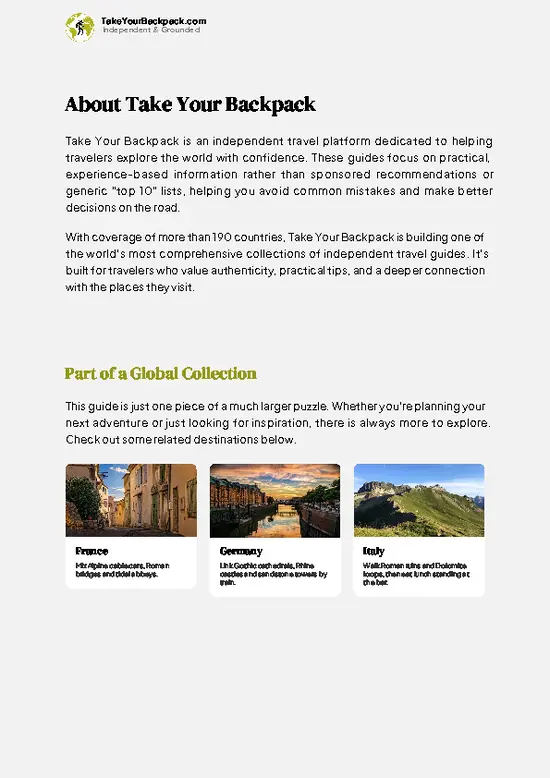
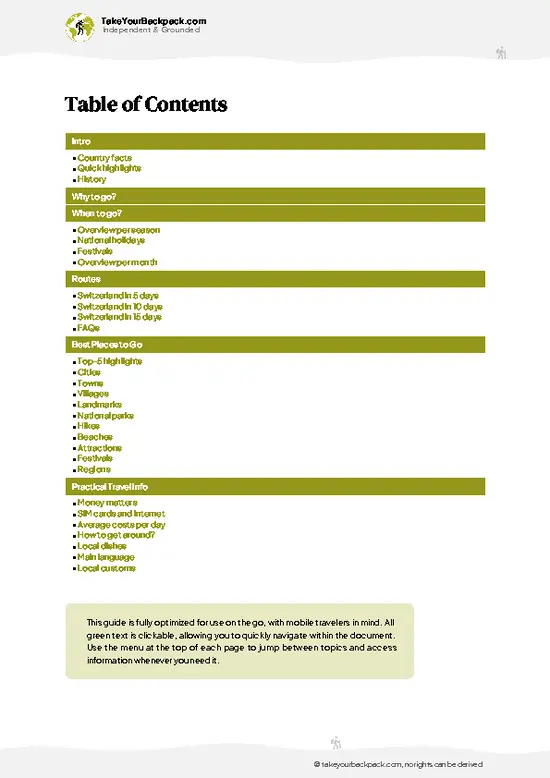
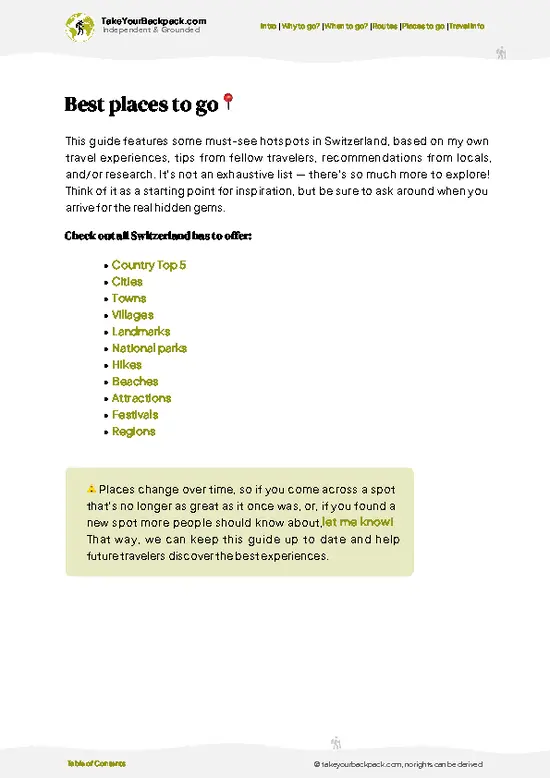
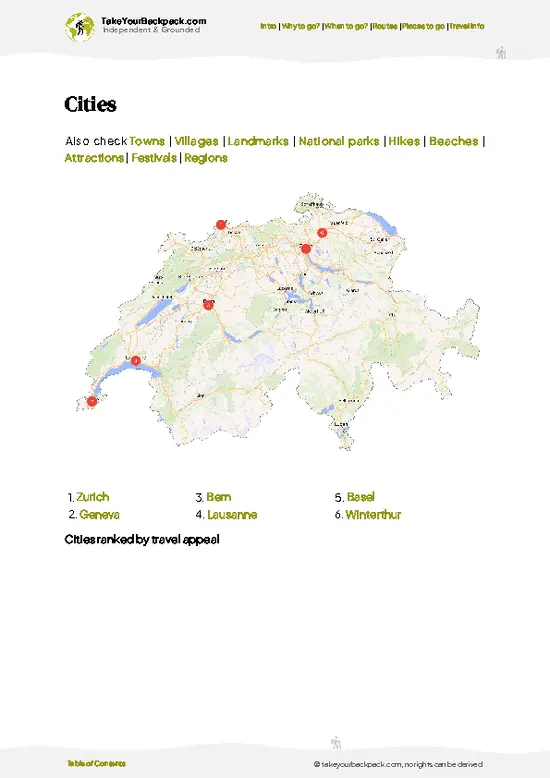
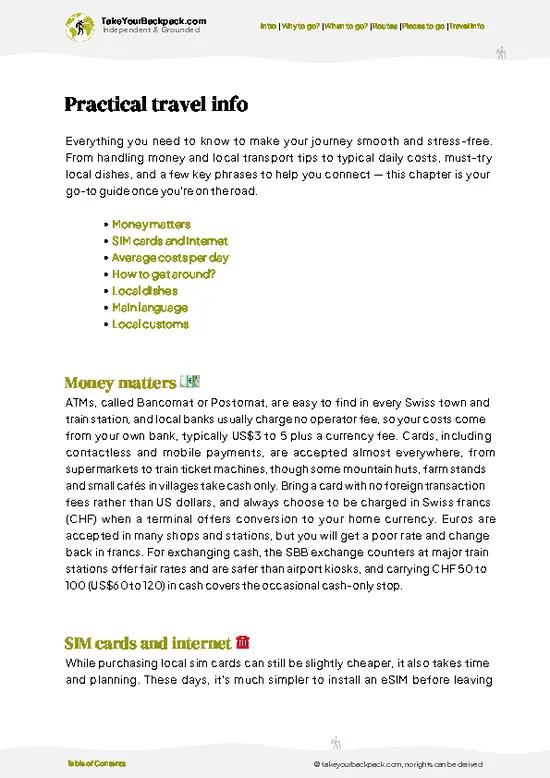
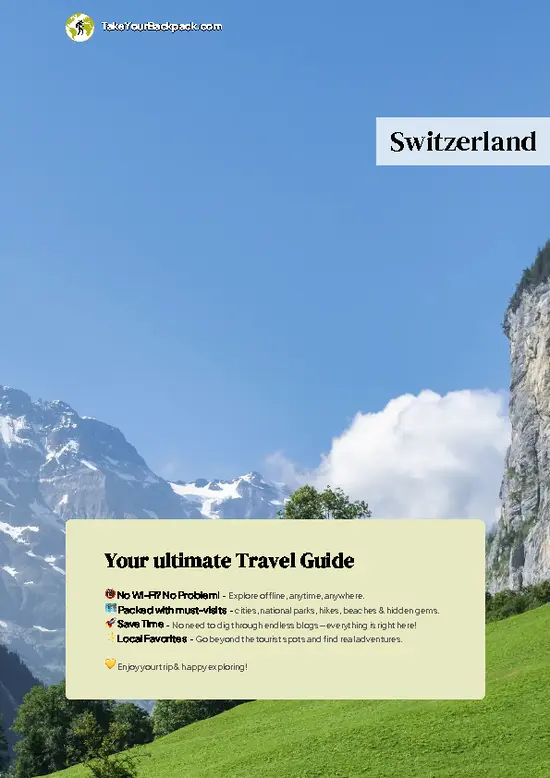
example page 0 from our offline Travel Guide for Switzerland
example page 1 from our offline Travel Guide for Switzerland
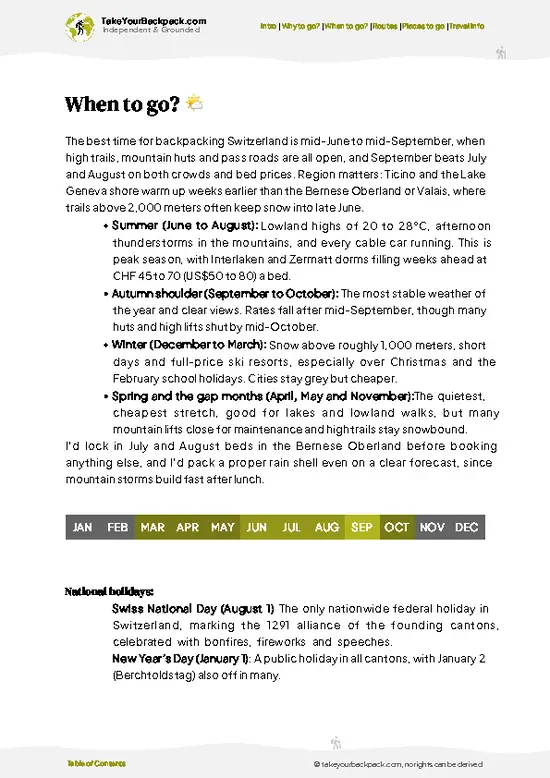
example page 2 from our offline Travel Guide for Switzerland
example page 3 from our offline Travel Guide for Switzerland
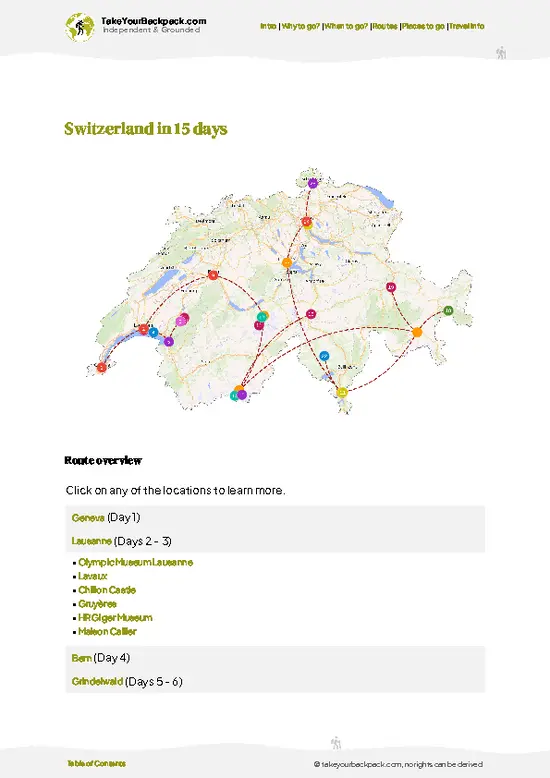
example page 4 from our offline Travel Guide for Switzerland
example page 5 from our offline Travel Guide for Switzerland
example page 6 from our offline Travel Guide for Switzerland
example page 7 from our offline Travel Guide for Switzerland
The digital guide (432 pages) contains:
✅ 117 highlights, ranked by travel appeal
✅ Optimized 5, 10 & 15-day travel routes
✅ Cities, national parks, landmarks, beaches
✅ How to get around
✅ Offline-friendly for travel without Wi-Fi
👉 Click to see all 30+ guide features

📅 Plan smarter in minutes, not weeks
✅ Month by month travel advice
✅ Festivals & national holidays
✅ Budget expectations

🗺️ Go to the right places, skip the overrated ones
✅ Honest pros & cons of destinations
✅ Top hikes, parks & viewpoints
✅ Lesser-known places most travelers miss
✅ Clear “worth it vs skip it” guidance

🛏️ Travel smoothly without rookie mistakes
✅ Best areas to stay
✅ Transport systems explained simply
✅ Common scams & safety advice
✅ SIM cards, money & practical tips

🌍 Understand the country, not just visit it
✅ Culture & traditions
✅ 52 Essential phrases & customs
✅ Festivals worth planning around
✅ Traveler-friendly historical context
✅ Insights that make places more meaningful

📱 Built for real travel conditions
✅ Fully downloadable PDF
✅ Works completely offline
✅ Optimized for phone use
✅ Useful in remote areas & buses
✅ Everything in one place
Stop searching, start planning
Get instant access to your full guide. 30‑day money-back guarantee.
+ Add another guide for just

By proceeding you agree to our terms.
Sent to your inbox immediately after payment • 100% Secure Checkout
Best Backpacking Travel Advisor 2025 tourism awardBest Backpacking
Travel Advisor
2025
What others say about Take Your Backpack Guides:
⭐⭐⭐⭐⭐
Fantastic, amazing amount of information!
⭐⭐⭐⭐⭐
My goodness this is amazing, it's what I've been looking for hats off too you!
⭐⭐⭐⭐⭐
I think this is absolutely BRILLIANT
⭐⭐⭐⭐
Very complete and informative. It's still missing places, but I gotta to commend you
⭐⭐⭐⭐⭐
This is truly amazing, thank you, can't wait to explore it with my kids!
⭐⭐⭐⭐⭐
Awesome resource, thank you!
⭐⭐⭐⭐⭐
This is amazing! Can't wait to explore the ones I haven't seen
⭐⭐⭐⭐
I love this! Well done, great idea.
⭐⭐⭐⭐⭐
Thanks for taking the time to make this gem!
⭐⭐⭐⭐⭐
This might be the best website I've ever seen.
⭐⭐⭐⭐⭐
Congratulations, and thank you so much for your work; it's incredibly valuable.
⭐⭐⭐⭐
In all seriousness I think you did a great job pointing out the important spots
⭐⭐⭐⭐⭐
10/10 very good
⭐⭐⭐⭐⭐
As someone who's only just starting to visit regularly this is awesome, thank you.
⭐⭐⭐⭐
Thank you very much! I'm going to visit my dad, it's going to be very useful!
⭐⭐⭐⭐⭐
This is really cool! We'll be travelling for the first time and this definitely come in handy.
⭐⭐⭐⭐⭐
You are now our minister of culture, congratulations 👨‍💼
⭐⭐⭐⭐⭐
Just wanted to tell you that this is a pearl! Going to follow your recommendations.
⭐⭐⭐⭐⭐
This is so cool. I'll definitely be using the resource for my travels soon.
⭐⭐⭐⭐⭐
This is very impressive! Good work.
⭐⭐⭐⭐⭐
This is an amazing and informative site. Very well done!

🛏️ Where to stay?Top Places to Consider Staying

Switzerland has a solid hostel network, with dorm beds typically running CHF 35 to 60 (about US$40 to 70) a night, plus campgrounds and simple mountain guesthouses for stretching the budget further. In Zurich, Langstrasse (Kreis 4) packs the cheapest beds and liveliest bars within walking distance of the main station, though weekend nights get loud, while in Geneva the Pâquis district puts you near the lake and station with good inexpensive food but feels a little rough late at night. Interlaken has the country’s densest cluster of backpacker hostels between its two train stations, social and handy for Jungfrau region trains, whereas Lucerne’s Old Town is compact, quiet after dark and a few … read more 👉
Switzerland has a solid hostel network, with dorm beds typically running CHF 35 to 60 (about US$40 to 70) a night, plus campgrounds and simple mountain guesthouses for stretching the budget further. In Zurich, Langstrasse (Kreis 4) packs the cheapest beds and liveliest bars within walking distance of the main station, though weekend nights get loud, while in Geneva the Pâquis district puts you near the lake and station with good inexpensive food but feels a little rough late at night. Interlaken has the country’s densest cluster of backpacker hostels between its two train stations, social and handy for Jungfrau region trains, whereas Lucerne’s Old Town is compact, quiet after dark and a few minutes on foot from the lakefront.

If you enjoy meeting fellow travelers, consider choosing hostels with high ratings for atmosphere. On the other hand, if you prefer having your own space, a hotel might be a better option.

SwitzerlandMore Places Across Switzerland

👋 Meet the founderWho’s Behind Take Your Backpack?

Johan, backpacker and founder of TakeYourBackpackHi, I’m Johan (Netherlands 🇳🇱), the creator of TakeYourBackpack. Over the past 3 decades, I’ve backpacked through 90+ countries across six continents, gaining extensive experience with independent travel, long-term trips, and overland routes.

This site is built on a combination of firsthand travel experience and carefully curated insights from other backpackers. Many guides are based on places I’ve personally visited, while others bring together tips, observations, and practical advice shared by trusted travelers I’ve met along the way.

The goal is to provide realistic, experience-driven guidance — not generic itineraries — so you can explore destinations with better context, clearer expectations, and more confidence.