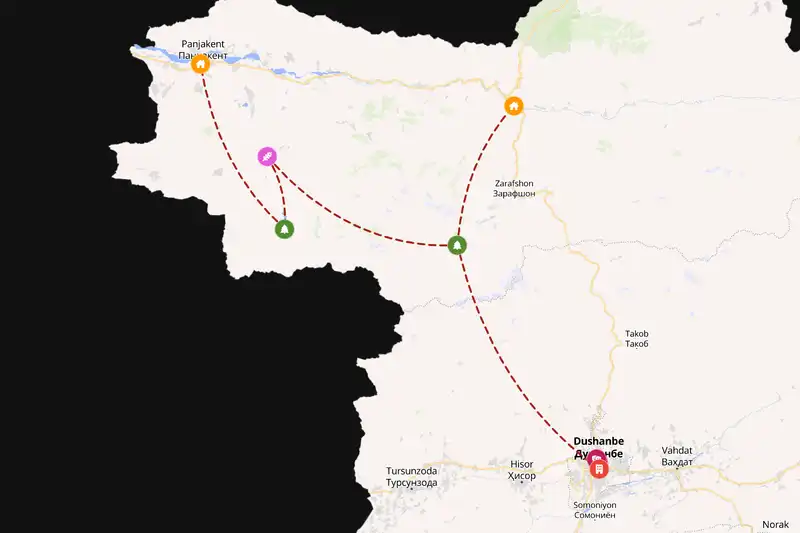
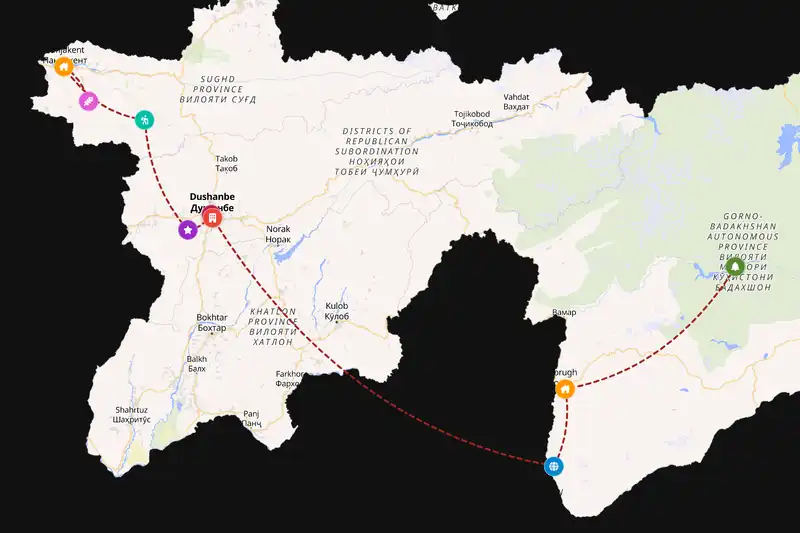
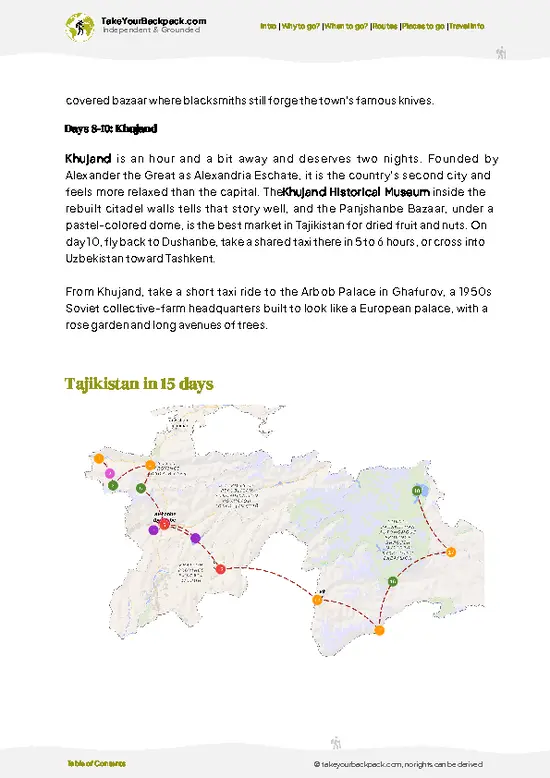
This fifteen-day route is for travelers who want both of Tajikistan’s great mountain systems in one trip: the lake country of the Fann Mountains and the high, dry Pamirs along the Afghan border. It suits people comfortable with long road days, basic homestays and altitude above 4,000 meters, and it runs west to east, entering from Samarkand and leaving for Osh in Kyrgyzstan. The pace is steady rather than rushed, with a rest day after every brutal drive. You’ll use shared taxis between towns, shared or hired 4x4s for the Pamir roads, and occasional marshrutkas around Dushanbe. Add the GBAO permit to your e-visa before you arrive, and plan this for June to September when the high passes are reliably open.
Days 1-3: Panjakent and the Seven Lakes
Crossing from Samarkand puts you in
Panjakent in about an hour, which makes it the most painless way into the country. Spend the afternoon on the hill of ancient Penjikent, the mud-brick remains of a Sogdian trading town, then eat at the bazaar where …
read more 👉This fifteen-day route is for travelers who want both of Tajikistan’s great mountain systems in one trip: the lake country of the Fann Mountains and the high, dry Pamirs along the Afghan border. It suits people comfortable with long road days, basic homestays and altitude above 4,000 meters, and it runs west to east, entering from Samarkand and leaving for Osh in Kyrgyzstan. The pace is steady rather than rushed, with a rest day after every brutal drive. You’ll use shared taxis between towns, shared or hired 4x4s for the Pamir roads, and occasional marshrutkas around Dushanbe. Add the GBAO permit to your e-visa before you arrive, and plan this for June to September when the high passes are reliably open.
Days 1-3: Panjakent and the Seven Lakes
Crossing from Samarkand puts you in Panjakent in about an hour, which makes it the most painless way into the country. Spend the afternoon on the hill of ancient Penjikent, the mud-brick remains of a Sogdian trading town, then eat at the bazaar where the bread is still baked against tandoor walls. The next morning a driver takes you east and up past the village of Shing into the Seven Lakes (Haft Kul). Two nights here is the right amount. Sleep in a homestay in Nofin or Padrud, and walk the dirt road between the lakes instead of driving it: the water changes from milky green to deep blue as you climb, and the last lake, Hazorchashma, sits around 2,400 meters below bare rock walls. Walking gives you the orchards, the donkeys and the kids selling dried apricots that you miss from a car window.Day 4: Iskanderkul
Head back down the Zeravshan valley through Ayni and turn up the side road to Iskanderkul, roughly 3 to 4 hours in total. The lake sits at about 2,200 meters, cold and turquoise, ringed by peaks that hold snow into July. Use the afternoon for the short walk to the waterfall below the lake’s outflow, where the river drops through a narrow slot and the spray reaches the viewing platform. One night breaks the journey to the capital neatly.Days 5-6: Dushanbe
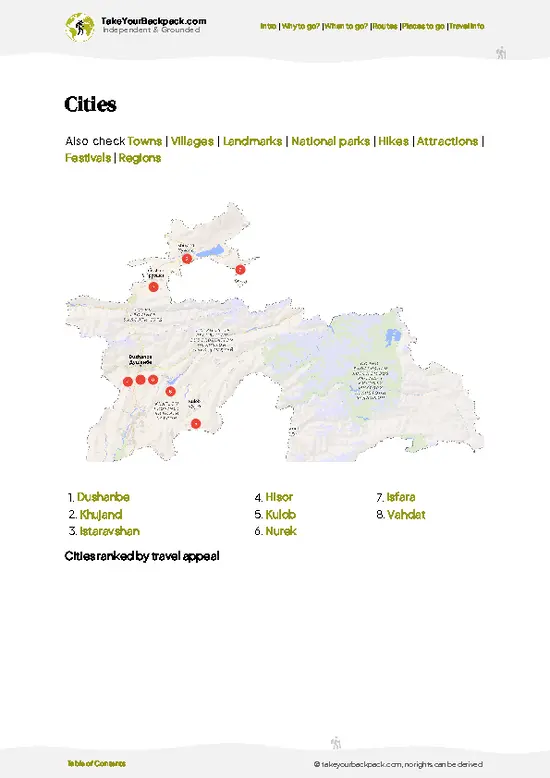
Dushanbe is your logistics stop before the Pamirs: cash, supplies, a laundry run and a proper bed. That still leaves a full day for the city. Take a marshrutka 25 kilometers west to the Hisor Fortress Museum Complex, whose rebuilt gatehouse and old madrasas make a good half-day, then come back for the Mehrgon Bazaar, a vast modern hall where dried fruit, nuts and Pamiri wool socks are piled high. The tiny Gurminj Museum of Musical Instruments is a niche stop with Pamiri rubabs and setors on the walls, and the gilded, carved ceilings of Navruz Palace are over the top in the most entertaining way.Day 7: Nurek Dam and Kulob
Rather than doing Dushanbe to Khorog in one exhausting push, split it. The southern road passes the Nurek Dam, an earth-fill wall roughly 300 meters high holding back a long turquoise reservoir, and viewpoints above the water make a good stop (photography of the dam structure itself is restricted). Sleep in Kulob, about 3 to 4 hours from the capital in total, and visit the mausoleum of the Sufi scholar Mir Sayyid Ali Hamadani in the evening.Days 8-9: Khorog
The drive from Kulob to Khorog is the long day of the trip, 10 to 12 hours along the Panj River with Afghan villages so close across the water you can see people working their fields. Day 9 is for recovery. Walk the river path, browse the Khorog Regional Museum for its Pamiri ethnography, and climb to the botanical garden above town, one of the highest in the world at around 2,300 meters. Khorog has the last reliable ATMs until Osh, so withdraw everything you need here.Days 10-11: Langar
The road southeast into the Wakhan Valley is where this trip earns its reputation. Stop at the Garm Chashma hot spring, the ruined Yamchun Fortress on its ridge, and the Buddhist stupa at Vrang before reaching Langar, 6 to 8 hours from Khorog with stops. On day 11 hike above the village to the petroglyph fields, thousands of carved ibex and hunters, with the Hindu Kush filling the horizon on the Afghan side.Days 12-15: Yashilkul, Murghab and Karakul
Leaving Langar, the road climbs over the Khargush Pass at around 4,300 meters onto the high plateau. Spend a night at Yashilkul Lake, staying in the small village of Bulunkul nearby, where it can freeze in August. Continue to Murghab, a windswept Kyrgyz town at about 3,600 meters with a container bazaar and yurts on the edges, 3 to 4 hours away. The next day crosses the Ak-Baital Pass, the highest point of the Pamir Highway at around 4,650 meters, to Karakul Lake, a huge dark-blue crater lake fringed with salt at roughly 3,900 meters. On day 15 a shared 4x4 takes you over the Kyzyl-Art Pass into Kyrgyzstan and down to Osh in 7 to 8 hours.
If you can stretch the Khorog stay by two days, a driver can take you up the Shokhdara Valley, a quiet side valley of stone houses and hot springs off the main highway.
 Best Backpacking