×

Tanzania🇹🇿 | best landmarksDiscover the 2 Best landmarks Across Tanzania

Tanzania packs its landmarks into a few wildly different landscapes, and the kind you chase changes everything about your trip. The northern safari circuit and the big volcanic peaks come with park fees charged in US dollars, guides that are mandatory, and crowds that thicken in dry months. Zanzibar and the coast swap that for Swahili stone towns, spice-scented alleys and sites you can walk to on your own, for a few dollars. Inland, the Southern Highlands and the central plains hold rock art, fossil beds and old caravan routes where you may be the only visitor that day. Independent travel here is wonderfully doable, since dala-dala minibuses and long-distance buses reach most hubs, though the most famous names need pre-booked operators. Pick your kind, then go find it.

By Johan Kruseman 🇳🇱 | Updated October 23, 2026
Explore the best national parks in Tanzania

Why go?Why Travelers Love These Spots

Tanzania stacks geology, wildlife and human history on top of each other in a way few countries manage. The Great Rift Valley slices through the country and has produced volcanoes, soda lakes and escarpments on a scale that dominates the skyline for hundreds of kilometers. The same valley is a cradle of early human history, with fossil sites and ancient rock paintings that sit among the oldest evidence of our species anywhere. Along the Indian Ocean, centuries of monsoon trade with Arabia, Persia and India left coral-stone towns, mosques and ruins, a layer of history that most of East Africa lacks. Then come the colonial and liberation-era traces, from German forts to the sites tied to Nyerere’s ujamaa politics.

Before choosing Tanzania for its landmarks, know the cost structure. Protected … read more 👉
Tanzania stacks geology, wildlife and human history on top of each other in a way few countries manage. The Great Rift Valley slices through the country and has produced volcanoes, soda lakes and escarpments on a scale that dominates the skyline for hundreds of kilometers. The same valley is a cradle of early human history, with fossil sites and ancient rock paintings that sit among the oldest evidence of our species anywhere. Along the Indian Ocean, centuries of monsoon trade with Arabia, Persia and India left coral-stone towns, mosques and ruins, a layer of history that most of East Africa lacks. Then come the colonial and liberation-era traces, from German forts to the sites tied to Nyerere’s ujamaa politics.

Before choosing Tanzania for its landmarks, know the cost structure. Protected areas, including the national parks and Kilimanjaro, charge high daily fees in US dollars, and park rules push you toward guided, pre-arranged visits. Cultural and historical sites cost far less and are open to independent exploring, but signage and facilities can be thin, so a local guide often adds the context. Distances are huge. Roads between regions can swallow a full day, and some sites are reachable only by 4x4 or small plane. The rains also matter, because dirt tracks in the south and west can turn impassable. Tanzania rewards those who accept slow travel, budget realistically for the big-ticket names, and balance them with cheaper cultural stops. Swahili is the shared language, and a few phrases open doors faster than any guidebook.
Why These Made the Cut
The list of best unique sites in Tanzania is created based on history or culture, wow factor, atmosphere, quirks, and memorability. If you feel a unique site is missing in this list, please let us know.

When to go?Seasonal Guide to Visiting

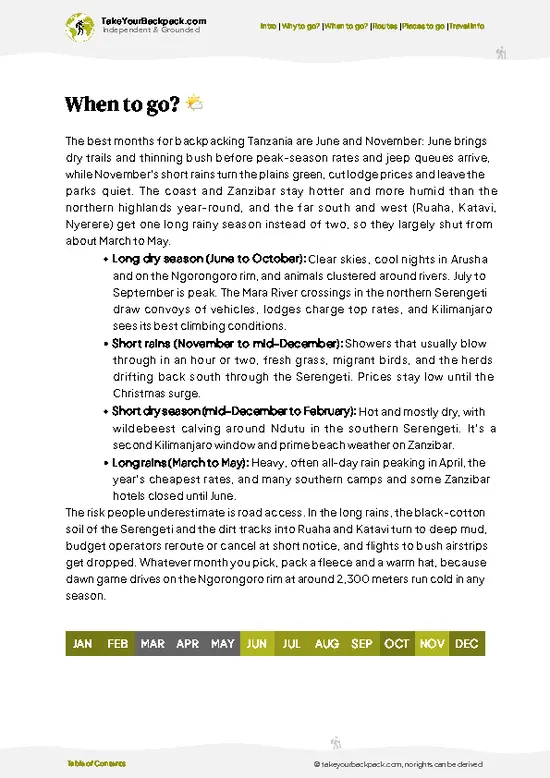
Best months: The best months for landmarks in Tanzania are June to October, the long dry season, when skies are clear, trails are firm and roads stay passable across most of the country. Days run about 22 to 28°C on the plateau and in the north, nights cool noticeably at altitude, and rain is rare. Summit climbs and park drives are at their most reliable, and the coast stays comfortable with lower humidity.
Shoulder seasons: January and February form a second dry window, shorter and hotter, with coastal temperatures of 30 to 33°C and lively humidity. These months suit the northern parks and the peaks well. November and December bring the short rains, usually in brief afternoon bursts, and late June to early July can mix cool, cloudy weather in the highlands. Both periods mean fewer crowds and … read more 👉
Best months: The best months for landmarks in Tanzania are June to October, the long dry season, when skies are clear, trails are firm and roads stay passable across most of the country. Days run about 22 to 28°C on the plateau and in the north, nights cool noticeably at altitude, and rain is rare. Summit climbs and park drives are at their most reliable, and the coast stays comfortable with lower humidity.
Shoulder seasons: January and February form a second dry window, shorter and hotter, with coastal temperatures of 30 to 33°C and lively humidity. These months suit the northern parks and the peaks well. November and December bring the short rains, usually in brief afternoon bursts, and late June to early July can mix cool, cloudy weather in the highlands. Both periods mean fewer crowds and lower lodge rates, often 20 to 40 percent below peak.
Wet season: March to May is the long rains, with heavy downpours that can total 200 to 500 mm a month on the coast and in the north. Dirt roads in the south and west turn to mud, some tracks close, and a number of lodges and camps shut down for several weeks, mostly in April and May. Mountain trails get slippery and views often vanish into cloud. Coastal and island sites stay open but feel sticky and wet.
Peak periods: Mid-July to September and the Christmas to New Year stretch bring the highest prices and fullest bookings. Park lodging should be reserved several months ahead, and fees at the biggest sites do not drop by season, only accommodation does. Travelers who prize quiet should aim for early June or late October, when the weather still cooperates and the crowds thin.

unique site hoppingOptimizing Your Multi-Stop Itinerary

Trip length: A trip combining several landmarks in Tanzania needs 10 to 21 days, and 14 is the figure that lets you cover two regions without feeling like cargo. Distances are what stretch the plan, so think in clusters rather than a straight line.
Regional clusters: The northern cluster around Arusha and Moshi works as one base, with Arusha as the transport hub for the parks, the highland volcanoes and the Rift Valley sites. Allow 2 to 4 days per major stop, and longer for a multi-day mountain climb of 5 to 8 days. The coast and islands group around Dar es Salaam, Bagamoyo and Zanzibar, where 2 to 3 days handles the historic towns and old ruins. The central and southern cluster, via Dodoma, Iringa and Mbeya, suits slow travelers, with 1 to 2 days per stop.
Direction of travel: Starting in the … read more 👉
Trip length: A trip combining several landmarks in Tanzania needs 10 to 21 days, and 14 is the figure that lets you cover two regions without feeling like cargo. Distances are what stretch the plan, so think in clusters rather than a straight line.
Regional clusters: The northern cluster around Arusha and Moshi works as one base, with Arusha as the transport hub for the parks, the highland volcanoes and the Rift Valley sites. Allow 2 to 4 days per major stop, and longer for a multi-day mountain climb of 5 to 8 days. The coast and islands group around Dar es Salaam, Bagamoyo and Zanzibar, where 2 to 3 days handles the historic towns and old ruins. The central and southern cluster, via Dodoma, Iringa and Mbeya, suits slow travelers, with 1 to 2 days per stop.
Direction of travel: Starting in the north and finishing on the coast is the most practical, because a beach finish eases tired legs after high-altitude days. Arusha to Dar es Salaam takes roughly 8 to 10 hours by bus, while Dar to Zanzibar is a 90-minute to 2-hour ferry. Flights from Arusha or Kilimanjaro to Dar or Zanzibar take about 1.5 to 2 hours and save a full day. Inland, Dar to Iringa runs about 6 to 7 hours by road, and Iringa to Mbeya about 5 hours.
Planning mistakes: The most common error is underestimating road time. Treat 50 kilometers an hour as a realistic average and add buffer for breakdowns. Another is cramming a mountain summit directly before a flight; keep a rest day after the descent. Travelers also stack every park fee into the first week and run out of budget for cultural sites. Spread the big-ticket stops, and slip cheap, walkable stops in between. Skip trying to cross the whole country in one go; two or three regions done well beat five done badly.

The ListMust-Visit landmarks in Tanzania

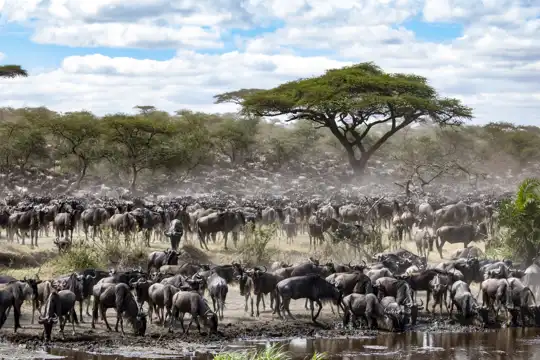
1 Serengeti Migration

Mara River crossings, Ndutu calving plains, Seronera cats, budget bush camping

Follow wildebeest herds across open grassland by shared safari vehicle, then camp close enough to hear them grunting and lions calling after dark.

Tanzania&Kenya - the Serengeti Migration

2 Ngorongoro Crater

Caldera floor safari, black rhino, soda lake flamingos, fever-tree forest, 2,200-meter rim

Descend a steep road into a walled volcanic bowl, then spend a morning tracking lions, hippos and distant rhinos across open grassland.

Loading the map 🌍

Expert viewInsights from Locals and Experts

How many landmarks to visit: Aim for four to six landmarks on a two-week trip. That number balances the big distances with the need to actually enjoy each place. Tanzania punishes a checklist approach, because each stop usually costs a half to a full day in transit, and the high-fee sites reward a longer stay. Fewer, deeper visits give a backpacker far more than a blur of ticks.
Choosing between kinds: Landmarks split into three kinds. Natural and wildlife sites deliver the most dramatic experience but also the highest cost and the least independence. Mountain climbs cost the most per day and need the most time, but give the stronger sense of achievement. Cultural and historical sites cost the least, can be done alone, and give you the best access to everyday Tanzanian life. For most backpackers, … read more 👉
How many landmarks to visit: Aim for four to six landmarks on a two-week trip. That number balances the big distances with the need to actually enjoy each place. Tanzania punishes a checklist approach, because each stop usually costs a half to a full day in transit, and the high-fee sites reward a longer stay. Fewer, deeper visits give a backpacker far more than a blur of ticks.
Choosing between kinds: Landmarks split into three kinds. Natural and wildlife sites deliver the most dramatic experience but also the highest cost and the least independence. Mountain climbs cost the most per day and need the most time, but give the stronger sense of achievement. Cultural and historical sites cost the least, can be done alone, and give you the best access to everyday Tanzanian life. For most backpackers, the best value comes from one big-ticket natural or mountain experience, paired with several cultural stops. A traveler short on time should choose the one big site and skip filler; a long-haul traveler can add the quieter inland places that few tourists reach.
What it costs: Plan on US$30 to 60 a day for independent travel between stops, covering a basic guesthouse at US$10 to 25, local meals at US$3 to 8, and buses or minibuses at US$5 to 20 per leg. Cultural and historical sites usually charge US$2 to 15 entry, and a local guide runs about US$5 to 20. Zanzibar’s stone town monuments and tours sit at the upper end of that range. Major protected areas are a different budget altogether, with national park fees commonly US$50 to 90 per adult per day, and mountain climbs often US$1,500 to 3,000 for several days when fees, guides, porters and food are included. Budget safaris on shared vehicles cost less per day than private ones, and the saving is worth taking, though the comfort of a private vehicle is far greater. Choose a registered operator with fair porter wages instead of the cheapest quote, since the cheapest often cuts food, gear and pay.
Safety: Tanzania is generally welcoming, but petty theft occurs in busy bus stations and on city streets, particularly Dar es Salaam, so keep valuables out of sight and avoid walking after dark. Use licensed guides and book through reputable agencies; touts in Arusha and Moshi sell cut-price trips that vanish or underdeliver. On mountains, altitude sickness is the main hazard. Longer routes with slower ascents give better odds of reaching the summit, and a few extra days cost less than a failed climb. Carry malaria prophylaxis advice from a doctor, and get a yellow fever certificate if your route requires it.
Cultural considerations: Dress modestly at mosques and in coastal towns, where much of the population is Muslim; cover shoulders and knees, and remove shoes before entering. Ask before photographing people, especially Maasai and other communities near the parks, as many expect payment and refusal should be respected. Bring small bills in Tanzanian shillings for tips and entry fees, since change is scarce. A greeting of “Habari” or “Jambo” makes a visible difference, and bargaining in markets should stay light and friendly. Drone use is restricted, and photographing government buildings and military sites can bring trouble.

✈️ The backpacker research shortcutTanzania Travel Guide

An offline-friendly backpacking guide with optimized travel routes, ranked highlights, transport advice, and the best areas to stay.
example page 0 from our offline Travel Guide for Tanzania
example page 1 from our offline Travel Guide for Tanzania
example page 2 from our offline Travel Guide for Tanzania
example page 3 from our offline Travel Guide for Tanzania
example page 4 from our offline Travel Guide for Tanzania
example page 5 from our offline Travel Guide for Tanzania
example page 6 from our offline Travel Guide for Tanzania
example page 7 from our offline Travel Guide for Tanzania
The digital guide (396 pages) contains:
✅ 103 highlights, ranked by travel appeal
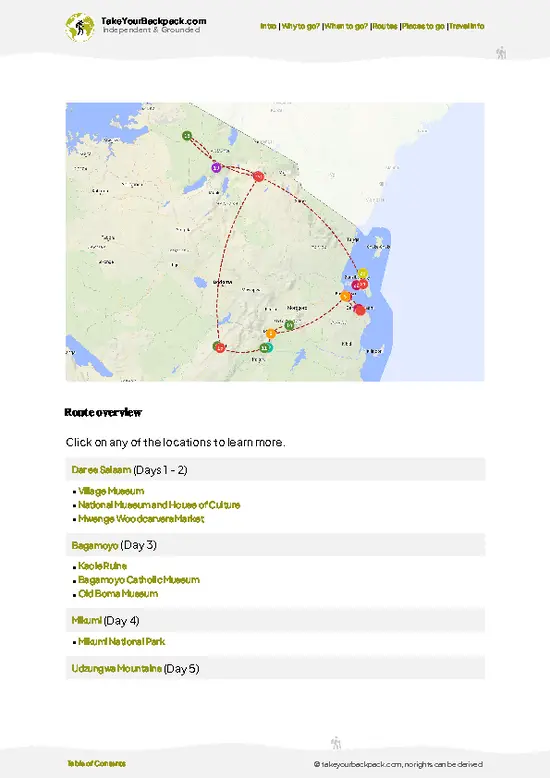
✅ Optimized 7, 14 & 21-day travel routes
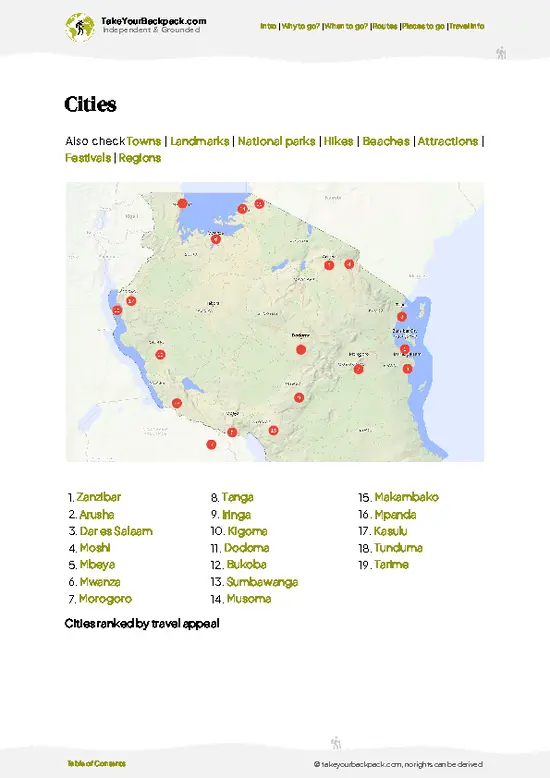
✅ Cities, national parks, landmarks, beaches
✅ How to get around
✅ Offline-friendly for travel without Wi-Fi
👉 Click to see all 30+ guide features

📅 Plan smarter in minutes, not weeks
✅ Month by month travel advice
✅ Festivals & national holidays
✅ Budget expectations

🗺️ Go to the right places, skip the overrated ones
✅ Honest pros & cons of destinations
✅ Top hikes, parks & viewpoints
✅ Lesser-known places most travelers miss
✅ Clear “worth it vs skip it” guidance

🛏️ Travel smoothly without rookie mistakes
✅ Best areas to stay
✅ Transport systems explained simply
✅ Common scams & safety advice
✅ SIM cards, money & practical tips

🌍 Understand the country, not just visit it
✅ Culture & traditions
✅ 52 Essential phrases & customs
✅ Festivals worth planning around
✅ Traveler-friendly historical context
✅ Insights that make places more meaningful

📱 Built for real travel conditions
✅ Fully downloadable PDF
✅ Works completely offline
✅ Optimized for phone use
✅ Useful in remote areas & buses
✅ Everything in one place
Stop searching, start planning
Get instant access to your full guide. 30‑day money-back guarantee.
+ Add another guide for just

By proceeding you agree to our terms.
Sent to your inbox immediately after payment • 100% Secure Checkout
Best Backpacking Travel Advisor 2025 tourism awardBest Backpacking
Travel Advisor
2025
What others say about Take Your Backpack Guides:
⭐⭐⭐⭐⭐
Fantastic, amazing amount of information!
⭐⭐⭐⭐⭐
My goodness this is amazing, it's what I've been looking for hats off too you!
⭐⭐⭐⭐⭐
I think this is absolutely BRILLIANT
⭐⭐⭐⭐
Very complete and informative. It's still missing places, but I gotta to commend you
⭐⭐⭐⭐⭐
This is truly amazing, thank you, can't wait to explore it with my kids!
⭐⭐⭐⭐⭐
Awesome resource, thank you!
⭐⭐⭐⭐⭐
This is amazing! Can't wait to explore the ones I haven't seen
⭐⭐⭐⭐
I love this! Well done, great idea.
⭐⭐⭐⭐⭐
Thanks for taking the time to make this gem!
⭐⭐⭐⭐⭐
This might be the best website I've ever seen.
⭐⭐⭐⭐⭐
Congratulations, and thank you so much for your work; it's incredibly valuable.
⭐⭐⭐⭐
In all seriousness I think you did a great job pointing out the important spots
⭐⭐⭐⭐⭐
10/10 very good
⭐⭐⭐⭐⭐
As someone who's only just starting to visit regularly this is awesome, thank you.
⭐⭐⭐⭐
Thank you very much! I'm going to visit my dad, it's going to be very useful!
⭐⭐⭐⭐⭐
This is really cool! We'll be travelling for the first time and this definitely come in handy.
⭐⭐⭐⭐⭐
You are now our minister of culture, congratulations 👨‍💼
⭐⭐⭐⭐⭐
Just wanted to tell you that this is a pearl! Going to follow your recommendations.
⭐⭐⭐⭐⭐
This is so cool. I'll definitely be using the resource for my travels soon.
⭐⭐⭐⭐⭐
This is very impressive! Good work.
⭐⭐⭐⭐⭐
This is an amazing and informative site. Very well done!

🛏️ Where to stay?Top Areas to Stay

Backpacking Tanzania is easy on a budget: every traveler hub has hostels and guesthouses, with dorm beds at roughly TSh 25,000 to 50,000 (US$10 to 20) and simple private rooms from about TSh 50,000 (US$20). On Zanzibar, Stone Town puts you within walking distance of the old town and the Forodhani night food market but comes with street noise and persistent touts. Paje on the east coast has the most social hostel scene and kitesurf bars, while Nungwi in the north lets you swim at any tide and parties late. On the mainland, Moshi town center is calm, safe on foot and closest to the Kilimanjaro gates, and central Arusha keeps you next to safari operators but is busier and better done by taxi after … read more 👉
Backpacking Tanzania is easy on a budget: every traveler hub has hostels and guesthouses, with dorm beds at roughly TSh 25,000 to 50,000 (US$10 to 20) and simple private rooms from about TSh 50,000 (US$20). On Zanzibar, Stone Town puts you within walking distance of the old town and the Forodhani night food market but comes with street noise and persistent touts. Paje on the east coast has the most social hostel scene and kitesurf bars, while Nungwi in the north lets you swim at any tide and parties late. On the mainland, Moshi town center is calm, safe on foot and closest to the Kilimanjaro gates, and central Arusha keeps you next to safari operators but is busier and better done by taxi after dark. In Dar es Salaam, the Msasani Peninsula is quieter and safer but pricier than the cheap, chaotic streets around Kariakoo.

If you enjoy meeting fellow travelers, consider choosing hostels with high ratings for atmosphere. On the other hand, if you prefer having your own space, a hotel might be a better option.

TanzaniaDiscover the Country

👋 Meet the founderWho’s Behind Take Your Backpack?

Johan, backpacker and founder of TakeYourBackpackHi, I’m Johan (Netherlands 🇳🇱), the creator of TakeYourBackpack. Over the past 3 decades, I’ve backpacked through 90+ countries across six continents, gaining extensive experience with independent travel, long-term trips, and overland routes.

This site is built on a combination of firsthand travel experience and carefully curated insights from other backpackers. Many guides are based on places I’ve personally visited, while others bring together tips, observations, and practical advice shared by trusted travelers I’ve met along the way.

The goal is to provide realistic, experience-driven guidance — not generic itineraries — so you can explore destinations with better context, clearer expectations, and more confidence.