How many cities to visit: I advise
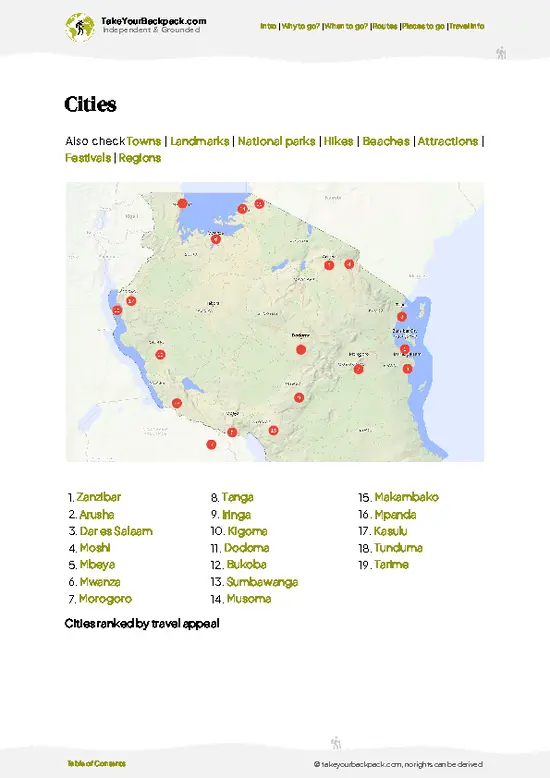
three cities on a trip of two to three weeks, and two if you have ten days or less. Tanzania is nearly twice the size of California, and the road between major urban areas often means 8 to 12 hours on a bus. Every extra city costs you a travel day, roughly US$15 to 30 in fares, and a morning lost to a bus station. Three stops let you spend two or three days in each, long enough to find the good local food and the people worth talking to. Five stops turns the trip into a series of arrivals. Fewer cities with more time per stop gives a backpacker the most for the money, because the time you save on buses goes to the things you actually came for.
Choosing between kinds of cities: Tanzanian cities fall into three types: the big commercial port, the Swahili coastal town, and the highland or lakeside hub. Pick based on how you travel.
If you want culture and history, lean toward the
Swahili coast. Old stone houses, carved doors, mosque calls and spiced seafood cost little, and the pace suits wandering on foot. It is the cheapest kind of city stop and the most comfortable for first-timers, though it is hot and humid for most of the year.
If you want energy, nightlife, live music and the best choice of food, the big port rewards you, but it costs more in time. Traffic can turn a 10 km ride into 90 minutes, and a decent private room runs US$25 to 45 against US$12 to 25 elsewhere. Give it two days, not four.
If you are heading for mountains, lakes or safari, the
highland and lakeside hubs are practical bases. They are cooler, easier to walk, and full of outfitters, so you can compare quotes in person. Expect to pay more here for tours than for anything else in a city, so spend your time haggling and checking operators, not sightseeing.
What it costs: A frugal backpacker can manage on
US$30 to 45 a day: a dorm bed or basic guesthouse room at US$8 to 20, local meals of rice, beans, grilled fish or chapati at TSh 3,000 to 8,000 (about US$1.20 to 3), and city minibuses (daladalas) at TSh 400 to 1,000 a ride. Step up to US$60 to 90 a day if you want a private room with air conditioning, restaurant dinners and taxis at night.
Per-visit extras add up. Museums and historic sites usually charge foreign visitors US$5 to 15. A licensed walking guide costs US$15 to 40 for a half day, and for a first visit to a big port that money is well spent, since it shortens the learning curve. Ride-hailing apps such as Bolt and Uber work in the larger cities and run TSh 3,000 to 10,000 (US$1.20 to 4) for most cross-town trips, usually cheaper and safer than flagging a taxi at night. Motorcycle taxis (bodabodas) cost about half as much, but the helmets are often poor and the risk is higher, so I would take a daladala by day and a Bolt after dark.
Carry cash in Tanzanian shillings for daily spending. ATMs are plentiful, with withdrawal limits of around TSh 400,000 to 1,000,000, and mobile money (M-Pesa, Tigo Pesa) is how most locals pay, though foreigners need a local SIM to use it.
Safety and cultural considerations: City crime in Tanzania is mostly opportunistic: bag snatching from car windows, pickpocketing in crowded bus stations and markets, and phone grabs from people walking while texting. Keep your phone in a front pocket, carry a decoy wallet with a small amount of cash, and do not walk alone after dark, even for short distances. Take a registered taxi or app ride instead.
At bus stations, touts will swarm you the moment you step off, claiming your ticket is invalid or offering a cheaper bus. Buy tickets directly from the company counter, and ignore anyone who says they are an official but has no ID. Fake safari guides, known as flycatchers, work the main tourist streets, so book with an operator that has a physical office and a TALA license.
Photography needs care. Do not photograph government buildings, police, soldiers, airports, bridges or ports, as this can bring a fine or a detention. Ask before photographing people, and expect to be asked for a small payment in some places.
Dress modestly, particularly along the coast and in Zanzibar-influenced neighborhoods, where the population is largely Muslim. Cover shoulders and knees, and during Ramadan avoid eating or drinking in public by day. Greet people before asking for anything: a Swahili “Hujambo” or “Habari” changes how the whole exchange goes, and “Shikamoo” is the respectful greeting for anyone clearly older than you. Use your right hand for giving and receiving. Plastic bags are banned, so a cloth bag will save you an awkward conversation at the airport.
Arrive with a yellow fever certificate if you are coming from an endemic country, take malaria prophylaxis, and use repellent at dusk in coastal cities, where mosquitoes are worst.


 Best Backpacking
 Hi, I’m Johan (Netherlands 🇳🇱), the creator of TakeYourBackpack. Over the past 3 decades, I’ve backpacked through 90+ countries across six continents, gaining extensive experience with independent travel, long-term trips, and overland routes.