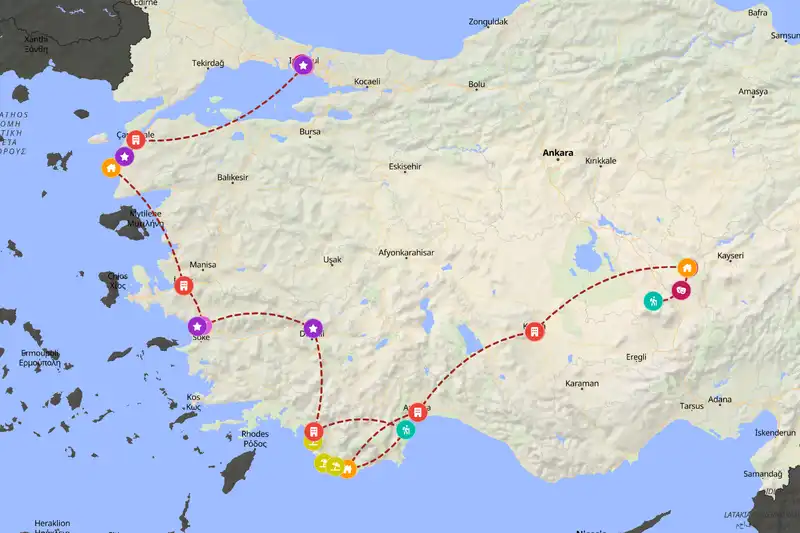
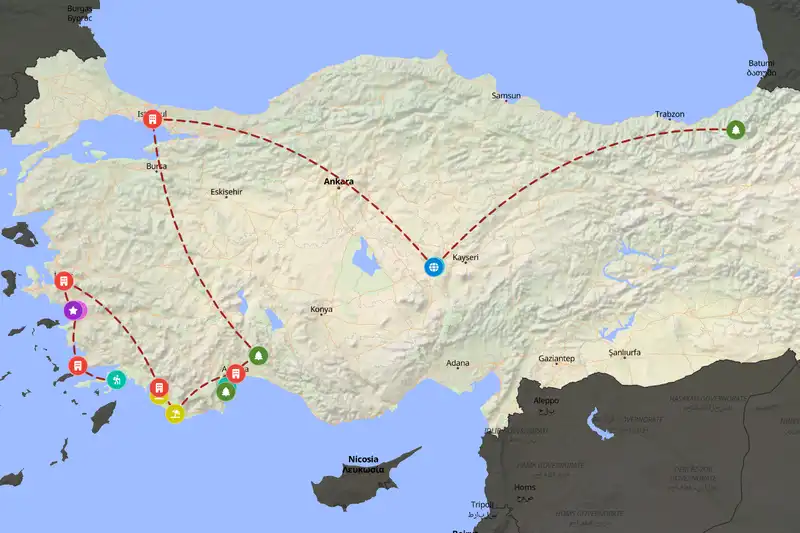
Yes, Türkiye is one of the easiest countries in the region to backpack on your own, thanks to a dense intercity bus network, cheap domestic flights and hostels at every major stop.
Buses link nearly every town, often with free servis minibuses from the otogar into the center. Istanbul to
Goreme takes 10 to 12 hours and costs roughly 1,000 to 1,500 TRY (US$24 to 36). Dorm beds in
Istanbul,
Goreme,
Fethiye and
Kas run about US$12 to 25 a night. English is common in tourist hubs and thinner in central and eastern cities, where a translation app helps. Load an Istanbulkart for trams, metros and ferries in Istanbul.
Two weeks is the right length for a first trip to Türkiye, enough for Istanbul, Cappadocia and a stretch of the Mediterranean coast without rushing.
With 7 days, stick to one region: an Aegean loop of
Izmir,
Ephesus and
Pamukkale, or 4 days in
Istanbul plus 3 in
Cappadocia, a 1 hour 15 minute flight apart. Fourteen days adds
Antalya,
Kas and
Fethiye. Three weeks lets you fold in
Troy,
Bozcaada and
Konya, while a fourth opens the southeast (
Gaziantep,
Mardin) or the
Kaçkar Mountains. Plan 2 to 3 nights per stop; buses between neighboring hubs take 2 to 5 hours.
Yes, you can travel all of Türkiye without a car, using intercity buses, domestic flights, high-speed trains and local dolmuş minibuses.
Buses reach almost everywhere:
Fethiye to
Kas takes about 2 hours,
Antalya to
Goreme 9 to 10 hours. Domestic flights on Pegasus, AJet and Turkish Airlines often cost US$30 to 80 one way and cut Istanbul to Kayseri to about 1 hour 15 minutes. High-speed trains run Istanbul to
Ankara in about 4.5 hours and continue to
Konya. A car only really helps in thinly served areas such as the remote Kaçkar valleys or
Lake Salda, where dolmuş services are sparse and often stop by late afternoon.
For a first trip to Türkiye, the essentials are Istanbul, Cappadocia, Ephesus, Pamukkale and the Lycian coast between Fethiye and Kaş.
Give
Istanbul 3 to 4 days for the Hagia Sophia, Topkapı Palace, the Süleymaniye Mosque and a Bosphorus ferry.
Cappadocia needs 3 nights in Goreme for valley hikes and the Goreme Open Air Museum.
Ephesus fills a long half day from Selçuk, about 1 hour 20 minutes by train from Izmir, and
Pamukkale sits roughly 3 hours further inland. On the coast,
Ölüdeniz Beach,
Kaputaş Beach and a day on the
Lycian Way justify 4 to 5 days. With extra time,
Mardin and
Gaziantep are the strongest picks in the southeast.
If you are short on time in Türkiye, you can skip Ankara, the resort beaches around Antalya, and the Black Sea lake of Uzungöl without missing the core experience.
Ankara is worth it mainly for Anıtkabir and the Museum of Anatolian Civilizations, so treat it as a stopover on the high-speed train corridor from Istanbul to Konya instead of a base.
Lara Beach and
Konyaaltı Beach are long hotel-lined strands;
Kaputaş or
Patara make far better beach days. In Istanbul, Dolmabahçe Palace covers similar ground to Topkapı, so pick one if you are pressed. In Cappadocia, one underground city such as
Derinkuyu is plenty.
Uzungöl means a 2-hour flight to Trabzon plus 1.5 hours by road for a hotel-ringed lake.
Yes, our itinerary-planner does exactly that. Set your trip length in days, give your interests and travel style, optionally give start- and end location and/or some mandatory stops you would like to include and the itinerary planner creates your personalized routes for Türkiye in seconds. Try it out!
Try the itinerary plannerv2.webp)
 Best Backpacking