×
Türkiye🇹🇷 | 21 days itinerary

A Complete 21-Day Plan for Türkiye

By Johan Kruseman 🇳🇱 | Updated May 6, 2026
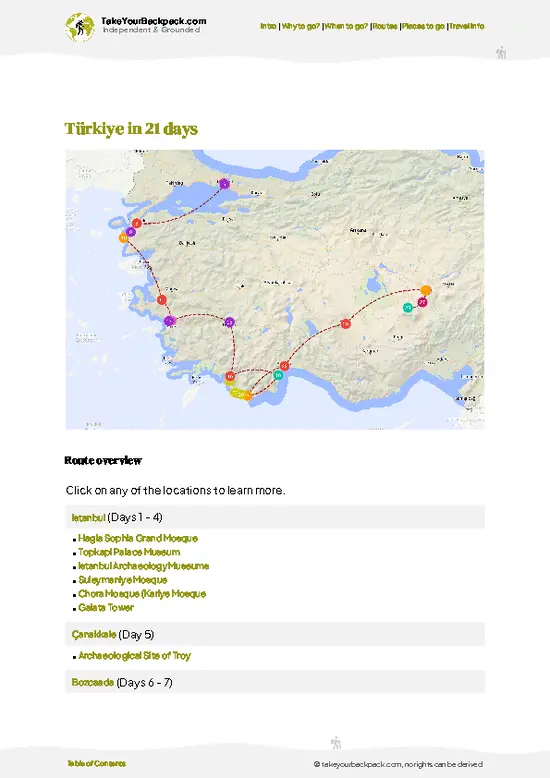
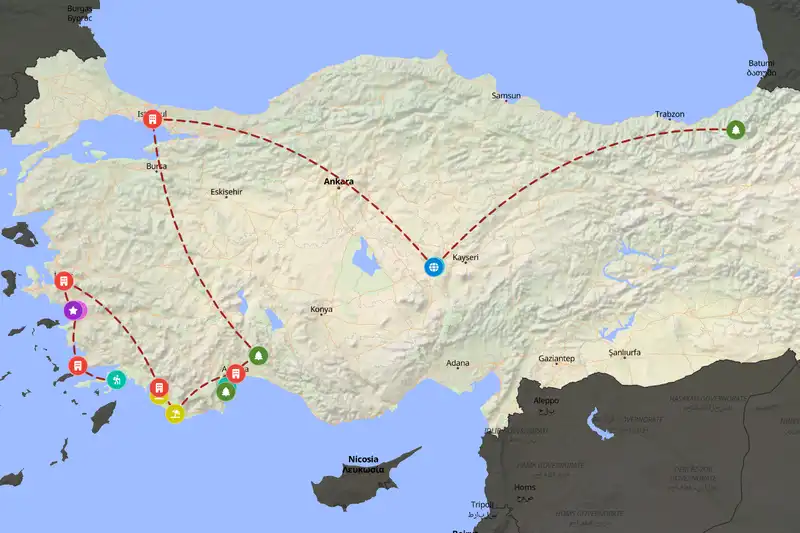
This 21-day route is for travelers who want to go beyond the greatest hits and really feel how Türkiye shifts from Aegean ruins to Cappadocian moonscapes to Black Sea forests, moving at a thoughtful, exploratory pace. You’ll use a mix of domestic flights, intercity buses, and a few scenic drives or dolmuş hops, with no back-to-back brutal travel days and plenty of two- to three-night stays.

Days 1-4: Istanbul Layers & Bosphorus Energy

Give yourself four nights in Istanbul to peel back the layers instead of just skimming the postcard views. Start in Sultanahmet with the Hagia Sophia Grand Mosque, the Blue Mosque, and the cool, echoing halls of the Basilica Cistern, then spend a half-day wandering the courtyards and treasury of the Topkapi Palace Museum to get a feel for Ottoman power. Dive into the Grand Bazaar for sensory overload, then balance it with a quieter afternoon at the Istanbul Archaeology Museums and the tile-rich calm of the Museum of Turkish and Islamic Arts. One evening, cross … read more 👉
This 21-day route is for travelers who want to go beyond the greatest hits and really feel how Türkiye shifts from Aegean ruins to Cappadocian moonscapes to Black Sea forests, moving at a thoughtful, exploratory pace. You’ll use a mix of domestic flights, intercity buses, and a few scenic drives or dolmuş hops, with no back-to-back brutal travel days and plenty of two- to three-night stays.

Days 1-4: Istanbul Layers & Bosphorus Energy

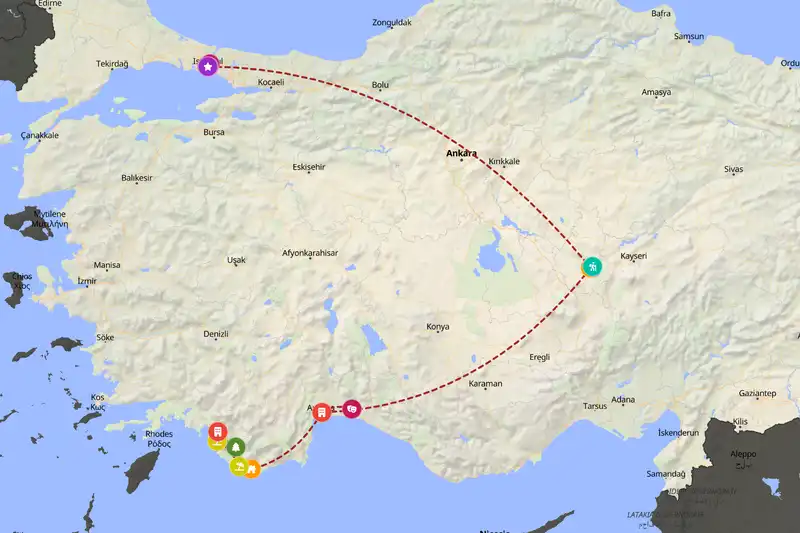
Give yourself four nights in Istanbul to peel back the layers instead of just skimming the postcard views. Start in Sultanahmet with the Hagia Sophia Grand Mosque, the Blue Mosque, and the cool, echoing halls of the Basilica Cistern, then spend a half-day wandering the courtyards and treasury of the Topkapi Palace Museum to get a feel for Ottoman power. Dive into the Grand Bazaar for sensory overload, then balance it with a quieter afternoon at the Istanbul Archaeology Museums and the tile-rich calm of the Museum of Turkish and Islamic Arts. One evening, cross the Golden Horn to climb the Galata Tower for a citywide view, and if you have a spare hour, step into the Suleymaniye Mosque to see how serene a huge imperial mosque can feel when it’s not the headline act.

Days 5-7: Çanakkale, Troy & Aegean Village Life

Head down to the Dardanelles and base for two nights in Çanakkale, a compact city that makes a good jumping-off point for ancient history. Spend a day at the Troya Historical National Park and the Archaeological Site of Troy, where the layers of settlement and the windswept setting do more of the storytelling than any wooden horse ever could. Then move along the coast for a night in the stone-built village of Assos, where you can wander the acropolis ruins above the sea and feel how the Aegean slows your pace without you even trying.

Days 8-10: Izmir, Ephesus & Şirince Hills

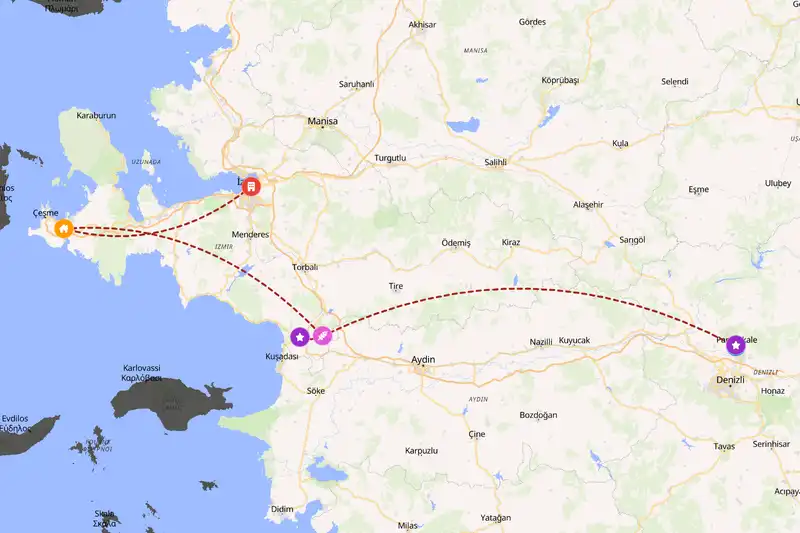
Continue south to spend two nights in Izmir, using the city as a modern, easygoing base for big-ticket ruins. Dedicate a full day to the Ephesus Archaeological Site and Ephesus itself, walking the marble streets past the Library of Celsus and the theatre that once held tens of thousands, then detour up into the hills to the village of Şirince for cobbled lanes and fruit wines before heading back to the city. On your way onward, stop at Aphrodisias if time and transport allow, where the stadium and sculptural details reward anyone willing to go one step beyond the standard Ephesus circuit.

Days 11-14: Pamukkale Terraces, Lakes & Fethiye Coast

Travel inland to Pamukkale for a night so you can see the Pamukkale Travertines and Hierapolis Archaeological Site and the broader Hierapolis-Pamukkale ruins in the softer light of early morning or late afternoon, when the white terraces glow and the Roman theatre feels less like a backdrop and more like a place. If you’re up for a small detour, swing by Kaklik Cave for a more enclosed, blue-green version of the travertine pools underground. Continue toward the southwest and spend a night near Lake Salda, whose pale shorelines and clear water have earned it “Turkish Maldives” comparisons, then roll on to Fethiye for three nights. From Fethiye, take a day to enjoy Ölüdeniz Beach, another to explore the narrow canyon of Saklıkent Gorge, and, if you like a challenge, sample a short section of the Lycian Way for cliffside sea views without committing to a full thru-hike.

Days 15-17: Datça Peninsula & Bodrum Nights

Shift your focus to the quieter Aegean by heading to the Datça Peninsula and spending two nights in or around Datça, where pine-covered hills drop into clear coves and the pace slows to long swims and longer meals. Then move on to Bodrum for two nights, trading sleepy harbors for a livelier waterfront and whitewashed lanes. Use one of your Bodrum days to escape the crowds at the Bodrum Peninsula (Gümüşlük), a more laid-back corner where you can eat fresh fish by the water and watch the sun sink behind low islands instead of neon signs.

Days 18-21: Black Sea Mountains, Uzungöl & Trabzon Monastery

Fly or bus northeast to the Black Sea and base yourself in Trabzon for three nights to explore a completely different side of the country. Take a day trip inland to the lakeside village of Uzungöl, ringed by steep green slopes that feel more alpine than Mediterranean, and another day to visit the cliff-hugging Sumela Monastery inside Altındere Valley National Park, where the frescoed monastery walls cling improbably to the rock face. If you have the legs and the weather, push higher into Kackar Mountains National Park for a day of hiking in the Kaçkar Mountains, trading ruins and beaches for glacial valleys and high meadows before looping back to Trabzon to end your trip.
The stretch that hooked me hardest on this route was standing in the quiet of Sumela Monastery’s cliffside courtyard after days of sun and sea in Datça and Bodrum, realizing just how many different worlds you can step into within one long, well-paced loop.
Loading the map 🌍
film
0
0
0a
Istanbul
Pixabay
film
1
1
1a
Blue Mosque
film
2
2
2a
Topkapi Palace Museum
film
3
3
3a
Suleymaniye Mosque
film
4
4
4a
Çanakkale
film
5
5
5a
Archaeological Site of Troy
film
6
6
6a
Ephesus
film
7
7
7a
Şirince
film
8
8
8a
Lycian Way
Pixabay

✈️ The backpacker research shortcutTürkiye Travel Guide

An offline-friendly backpacking guide with optimized travel routes, ranked highlights, transport advice, and the best areas to stay.
example page 0 from our offline Travel Guide for Türkiyeexample page 1 from our offline Travel Guide for Türkiyeexample page 2 from our offline Travel Guide for Türkiyeexample page 3 from our offline Travel Guide for Türkiyeexample page 4 from our offline Travel Guide for Türkiyeexample page 5 from our offline Travel Guide for Türkiye
The digital guide (414 pages) contains:
142 highlights, ranked by travel appeal
Optimized 7, 14 & 21-day travel routes
Best neighborhoods to stay
How to get around
Offline-friendly for travel without Wi-Fi
👉 See all 30+ guide features

📅 Plan smarter in minutes, not weeks
Month by month travel advice
Festivals & national holidays
Budget expectations

🗺️ Go to the right places, skip the overrated ones
Honest pros & cons of destinations
Top hikes, parks & viewpoints
Lesser-known places most travelers miss
Clear “worth it vs skip it” guidance

🛏️ Travel smoothly without rookie mistakes
Best areas to stay
Transport systems explained simply
Common scams & safety advice
SIM cards, money & practical tips

🌍 Understand the country, not just visit it
Culture & traditions
52 Essential phrases & customs
Festivals worth planning around
Traveler-friendly historical context
Insights that make places more meaningful

📱 Built for real travel conditions
Fully downloadable PDF
Works completely offline
Optimized for phone use
Useful in remote areas & buses
Everything in one place
Save weeks of stressful planning
Get instant access to the full guide directly. 30-day money-back guarantee.


Sent to your inbox immediately after payment • 100% Secure Checkout
Best Backpacking Travel Advisor 2025 tourism awardBest Backpacking
Travel Advisor
2025
What others say about Take Your Backpack Guides:
⭐⭐⭐⭐⭐
Fantastic, amazing amount of information!
⭐⭐⭐⭐⭐
My goodness this is amazing, it's what I've been looking for hats off too you!
⭐⭐⭐⭐⭐
I think this is absolutely BRILLIANT
⭐⭐⭐⭐
Very complete and informative. It's still missing places, but I gotta to commend you
⭐⭐⭐⭐⭐
This is truly amazing, thank you, can't wait to explore it with my kids!
⭐⭐⭐⭐⭐
Awesome resource, thank you!
⭐⭐⭐⭐⭐
This is amazing! Can't wait to explore the ones I haven't seen
⭐⭐⭐⭐
I love this! Well done, great idea.
⭐⭐⭐⭐⭐
Thanks for taking the time to make this gem!
⭐⭐⭐⭐⭐
This might be the best website I've ever seen.
⭐⭐⭐⭐⭐
Congratulations, and thank you so much for your work; it's incredibly valuable.
⭐⭐⭐⭐
In all seriousness I think you did a great job pointing out the important spots
⭐⭐⭐⭐⭐
10/10 very good
⭐⭐⭐⭐⭐
As someone who's only just starting to visit regularly this is awesome, thank you.
⭐⭐⭐⭐
Thank you very much! I'm going to visit my dad, it's going to be very useful!
⭐⭐⭐⭐⭐
This is really cool! We'll be travelling for the first time and this definitely come in handy.
⭐⭐⭐⭐⭐
You are now our minister of culture, congratulations 👨‍💼
⭐⭐⭐⭐⭐
Just wanted to tell you that this is a pearl! Going to follow your recommendations.
⭐⭐⭐⭐⭐
This is so cool. I'll definitely be using the resource for my travels soon.
⭐⭐⭐⭐⭐
This is very impressive! Good work.
⭐⭐⭐⭐⭐
This is an amazing and informative site. Very well done!

🧭 RouteChoose Your Itinerary

Travel Türkiye your way — from a quick highlights trip to a slow-paced adventure.

🙋 FAQFrequently Asked Questions

Short answer: yes, Türkiye is one of the easiest countries to backpack independently if you’re even mildly organized. The country is built for point-to-point travel: tons of intercity buses, frequent domestic flights, and a huge network of budget guesthouses and hostels in every major stop. English is common in tourist areas and among younger people, and when it isn’t, people still usually go out of their way to help.

For a budget traveler, the main learning curve is understanding how things actually work on the ground. Long-distance buses are your backbone: you usually buy tickets at the company’s office or online, then depart from the otogar (bus station). Most big bus companies include free tea, snacks, and sometimes a shuttle from the otogar into town. Overnight buses are safe and a classic way to save on accommodation, though they can wreck your sleep if you stack too many in a row.

Accommodation is straightforward: in backpacker hubs like Istanbul, Cappadocia, Antalya, Fethiye, and Izmir, you’ll find hostels with dorms, common rooms, and tour desks. In smaller towns, you’ll lean more on budget hotels and family-run pensions; they may not be fancy, but they’re usually clean and friendly. Booking ahead helps in peak season (June–September and major holidays), but outside those times you can often walk in and negotiate.

Safety-wise, Türkiye feels manageable for solo travelers, including solo women, as long as you use normal big-city awareness. Petty theft can happen in crowded areas of Istanbul and on packed buses, so keep valuables on you, not in the overhead. Dress codes are flexible in tourist zones, but modest clothing helps you blend in away from the coast and when visiting mosques.

The main challenges: distances are big, summer heat can be brutal inland and on the south coast, and some tourist tours are overpriced for what you get. Independent backpacking lets you dodge the worst of the tour-bus crowd: you can visit big-ticket sights early in the morning or late afternoon, use local buses instead of packaged day trips, and pick homier neighborhoods over the most touristy streets. If you’re comfortable reading bus timetables, using a map app offline, and learning a few Turkish basics (hello, thank you, how much), Türkiye is very easy to handle on your own.
If you’re backpacking, the sweet spot for Türkiye is 3–4 weeks, but you can do a solid intro in 10–14 days if you focus. Distances are long, and there’s a lot of variety: mega-city chaos, ancient ruins, beach towns, mountains, and weird lunar landscapes in Cappadocia. Rushing just means you spend your trip on buses instead of actually being anywhere.

For a tight 7–10 days, you can realistically do:
- Istanbul (3–4 nights): Old city sights, Bosphorus, neighborhoods like Kadıköy or Balat.
- Cappadocia (2–3 nights): Valleys, cave churches, sunrise viewpoints; balloon if your budget allows.
- One extra stop (2–3 nights): Either Ephesus via Izmir/Selçuk or a quick coastal taste like Fethiye or Antalya if flights line up.

With 2 weeks, you can breathe a bit:
- Istanbul: 4 nights.
- Cappadocia: 3 nights.
- Ephesus/Selçuk + Pamukkale: 3–4 nights combined.
- One coastal base (Fethiye, Kaş, or Antalya): 3–4 nights.
Use one or two overnight buses to save time and money, and one domestic flight if it cuts a brutal bus leg in half.

With 3–4 weeks, you can travel at backpacker pace and actually feel the country:
- Istanbul deep dive (5–6 nights, split between old city and Asian side).
- Cappadocia (4 nights, with a rest day).
- Central/western ruins (Ephesus, Hierapolis/Pamukkale, maybe Aphrodisias or Pergamon).
- Turquoise Coast (Fethiye–Kaş–Olympos–Antalya corridor, 7–10 days depending on how much you swim and hike).
- Extra flavor: Black Sea towns, Eastern Türkiye (Van, Kars, Ani), or the Lycian Way if you like long-distance hiking.

If you’re truly on a shoestring, more time actually saves money: you can take slower buses, chase midweek deals, and cook occasionally if your hostel allows it. The main mistake is trying to do Istanbul + Cappadocia + Ephesus + Pamukkale + the entire south coast in 10 days. Pick fewer regions, stay longer, and you’ll spend less and enjoy more.
You can absolutely get around Türkiye without a car, and for most backpackers it’s actually easier and cheaper to skip driving. The country runs on buses, domestic flights, and a patchwork of local minibuses that go almost everywhere you’d want to be.

For long distances, intercity buses are your workhorse. They’re frequent, relatively comfortable, and usually on time. You’ll find multiple companies on popular routes like Istanbul–Ankara, Istanbul–Cappadocia (via Nevşehir or Göreme), Cappadocia–Antalya, and the Aegean/Med coast. Overnight buses are common on these routes and can save you a night’s accommodation, though you’ll want earplugs and a warm layer because the air-con can be aggressive.

Domestic flights are the time-saver when you’re crossing half the country. Istanbul to Cappadocia, Izmir, Antalya, or the southeast can be surprisingly affordable if you book ahead or travel outside peak holidays. For a 2-week trip, using one or two flights to avoid 10–12 hour bus rides is usually worth it, even on a budget.

On the coast and between smaller towns, dolmuş (shared minibuses) and local buses fill the gaps. They run set routes but are flexible about stops; you usually pay the driver directly, and departures are often based on filling seats rather than strict timetables. This is how you’ll hop between places like Fethiye, Ölüdeniz, Kaş, Olympos, and Antalya, or reach trailheads and beaches.

Inside cities, public transport is solid. Istanbul has trams, metros, ferries, and buses; get an Istanbulkart and you’re set. In other cities, you’ll rely more on buses, trams where they exist, and walking. Taxis and ride-hailing apps are useful but not essential; always check that the meter is on or agree a price beforehand in smaller towns.

The only times a car is genuinely helpful are if you’re exploring very rural areas, doing a lot of spontaneous side trips in one region, or traveling as a group where splitting fuel and rental costs makes sense. For a classic backpacking loop—big cities, Cappadocia, ruins, and the Turquoise Coast—public transport plus the occasional shuttle or tour day is more than enough.
For a first or second backpacking trip to Türkiye, a few places really earn their spot on the itinerary because they combine history, landscapes, and backpacker-friendly vibes. If you’re watching your budget and time, these are the ones that punch above their weight.

Istanbul: This is non-negotiable. It’s the brain and heartbeat of the country. You get layers of history (Hagia Sophia, Blue Mosque, Topkapı Palace, Grand Bazaar), but the real magic is in the neighborhoods: tea houses, street food, ferries crossing between Europe and Asia, and side streets full of cats and tiny cafes. Stay at least 3–4 nights, ideally split time between the old city and somewhere like Kadıköy or Karaköy to see both the postcard and the everyday city.

Cappadocia (Göreme/Uçhisar/Ürgüp): Even if you skip the hot-air balloon to save money, Cappadocia is worth the detour. You can hike through valleys full of rock formations, explore cave churches and underground cities, and watch sunrise from a hilltop with balloons drifting overhead. It’s one of those rare places that feels different from almost anywhere else on earth, and it’s very backpacker-friendly with hostels, cheap set menus, and easy day tours if you don’t want to rent a scooter.

Ephesus and Selçuk: If you care even a little about ancient history, Ephesus is the big-ticket ruin. Selçuk is the chill, budget-friendly base town with hostels, guesthouses, and easy access to the site by minibus or taxi. You can also visit the nearby Basilica of St. John and the old fortress. One or two nights is enough, but it’s a strong stop between Istanbul and the coast or Pamukkale.

Pamukkale and Hierapolis: The white travertine terraces get crowded and over-photographed, but if you time it right (early morning or late afternoon) and combine them with the ruins of Hierapolis above, it’s a worthwhile stop. It’s not a place to linger for days, but one night is enough to soak in the pools, wander the ancient theater, and move on.

Turquoise Coast (Fethiye–Kaş–Olympos–Antalya corridor): This stretch of Mediterranean coast is where you slow down. You get clear water, cliffs, small coves, and a string of towns with different personalities. Fethiye is a good base for boat trips and paragliding if you’re splurging; Kaş is smaller and more relaxed with good swimming and diving; Olympos has treehouse-style hostels and beach access with ruins; Antalya mixes an old town with city comforts. Pick one or two bases for 4–7 days rather than trying to hop through all of them.

Lycian Way (for hikers): If you like trekking, even doing a 2–4 day section of the Lycian Way is worth it. It’s a long-distance coastal trail with sea views, small villages, and ruins scattered along the way. You can base yourself in Fethiye or Kaş and do day hikes or short overnights instead of committing to the full route.

If you have extra time or a second trip, places like the Black Sea region (Rize, Trabzon, mountain plateaus) and Eastern Türkiye (Van, Kars, Ani) add a very different flavor, but for a first backpacking run, Istanbul + Cappadocia + one ruins stop + one coastal base is the strongest value combo.
If you’re short on time or cash, the trick in Türkiye is not to see everything, but to skip the places that cost you a lot of transit or money without adding much beyond what you’ll see elsewhere. A few common candidates are easy to trim.

Multiple coastal towns that feel similar: The Turquoise Coast is long, and many towns share the same formula: clear water, boat trips, beach clubs, and a cute old quarter. You don’t need Fethiye, Ölüdeniz, Kaş, Kalkan, Olympos, and Antalya all in one trip. Pick one or two that match your style (for example, Fethiye + Kaş, or Kaş + Antalya) and skip the rest. Every extra coastal hop costs you bus time and usually a night of accommodation just to move your backpack 100 km down the road.

Overpriced boat tours and every single day trip: A single full-day boat trip on the coast is fun and worth it; doing three versions of the same thing (island hopping, blue lagoon, 12-island tour) just drains your budget and blurs together. Choose one well-reviewed, reasonably priced tour and skip the rest. Similarly, many packaged day trips from Cappadocia or Antalya bundle things you could see cheaply on your own; if you’re counting coins, do one organized tour and use local buses or walking for the rest.

Too many ruins: Ephesus and Hierapolis (Pamukkale) are strong picks; after that, only add more ruins if you’re genuinely into archaeology. Sites like Pergamon, Troy, or some smaller coastal ruins are interesting but can feel repetitive if you’re not a history nerd. If you’re short on time, prioritize Ephesus and maybe one more, and skip the rest of the ruin-hopping.

Extra days in Pamukkale: Pamukkale is a great 1-night stop, but staying 2–3 nights there rarely adds much for backpackers. Once you’ve walked the terraces and explored Hierapolis, you’re mostly killing time. If your schedule is tight, do an afternoon + morning and move on.

Shopping-heavy bazaars beyond Istanbul: The Grand Bazaar and Spice Market in Istanbul give you the full sensory overload. Smaller bazaars in other cities can be fun, but if you’re racing the clock, you don’t need to chase every market. They often sell similar souvenirs and textiles, and browsing can easily eat half a day.

Ultra-short detours to far-flung regions: Eastern Türkiye, the Black Sea highlands, and places like Mount Nemrut are fantastic but far. If you only have 10–14 days, flying out for one night in Van or Kars just to say you went is usually not worth the transit time and cost. Save those regions for a future trip when you can give them at least a week.

In general, skip anything that forces a long backtrack or a full day of travel just for one sight. Focus on a tight loop—say Istanbul → Cappadocia → Ephesus/Pamukkale → one coastal base—and you’ll spend more time actually living in Türkiye and less time staring out a bus window.

🇹🇷 TürkiyeExplore Türkiye

Ready to build a truly unique trip? Predefined routes are perfect for first-time visitors, but there is so much more to discover. Whether you are chasing a city trip, pristine national parks, local food scenes, or quiet beaches, pick a category to design your own path.