×

Türkiye🇹🇷 | best townsWhere to Find the 10 Best towns in Türkiye

Towns in Türkiye come with a built-in plot twist: you arrive expecting one country and find four. The Aegean and Mediterranean coast has polished harbors, pine-scented hills and prices that climb every summer. The Black Sea gets rain, tea terraces and almost no foreign visitors. Central Anatolia trades sea for fairy chimneys and stone, with crowds clustered around a handful of famous valleys. The southeast and east are cheaper, slower and far more conservative, with hospitality that arrives as a tea glass before you finish saying hello.

For backpacking or independent travel, that spread is the point. Coastal towns are easy, with frequent minibuses and plenty of hostels, but they cost more and fill up. Inland towns cost less, need patience with bus timetables, and hand you a quieter version of the country. Pick the kind of day you want, then pick the town.

By Johan Kruseman 🇳🇱 | Updated October 19, 2026
Explore the best villages in Türkiye

Why go?Key Factors That Shape the Experience

Türkiye is unusually good for towns because it has been continuously lived in for roughly ten thousand years, by Hittites, Greeks, Romans, Byzantines, Seljuks and Ottomans, and almost none of them tidied up after themselves. Ruins sit beside bus stations, and a Roman theater may share a fence with someone's vegetable patch. That layering means even small places have a mosque, a market, an old quarter and a story, which is hard to say of countries that urbanized in a rush.

Geography does the rest. Mountains, plateaus and three seas produce distinct regional identities, so the food, dialect, architecture and pace change every few hours by bus. The intercity bus network is the secret weapon: modern coaches, frequent departures and reasonable fares reach nearly every provincial center, with minibuses … read more 👉
Türkiye is unusually good for towns because it has been continuously lived in for roughly ten thousand years, by Hittites, Greeks, Romans, Byzantines, Seljuks and Ottomans, and almost none of them tidied up after themselves. Ruins sit beside bus stations, and a Roman theater may share a fence with someone's vegetable patch. That layering means even small places have a mosque, a market, an old quarter and a story, which is hard to say of countries that urbanized in a rush.

Geography does the rest. Mountains, plateaus and three seas produce distinct regional identities, so the food, dialect, architecture and pace change every few hours by bus. The intercity bus network is the secret weapon: modern coaches, frequent departures and reasonable fares reach nearly every provincial center, with minibuses (dolmuş) covering the last stretch. Few countries make it this easy to hop between small places without a car.

Before choosing, know a few things. The country is large; distances between regions are measured in overnight buses, not coffee breaks. Prices have risen sharply in tourist hotspots, and the lira's volatility means published figures age quickly, so budget with a margin. Smaller eastern and inland towns are much more conservative, and dress and behavior matter more there than on the coast. English is common in resorts and patchy elsewhere, though a handful of Turkish words earns outsized goodwill. Finally, the best-known places are crowded in summer for a reason, and the quieter alternatives are usually one province away.
How the List Was Created
The list of best towns in Türkiye is created based on charm, local culture, atmosphere, hidden gems, and visitor appeal. If you feel a town is missing in this list, please let us know.

When to go?Best Time to Visit Türkiye for towns

Best months: April to early June and September to October are the best months for towns in Türkiye, because daytime temperatures sit around 18 to 28°C, the sea is swimmable on the south and west coasts by late May, and the summer crowds have either not arrived or already left. Spring brings green hillsides and wildflowers; autumn brings warm water and cheaper rooms.

Summer and winter: July and August are hot. The Aegean and Mediterranean coasts regularly reach 33 to 40°C, the southeast can pass 40°C, and beach towns charge their highest prices, often 30 to 60 percent above shoulder-season rates. Domestic holidaymakers pack the coast, so book ahead and expect traffic jams that look suspiciously like parking lots. Inland highlands and the Black Sea are cooler in summer, around 22 to 28°C, though … read more 👉
Best months: April to early June and September to October are the best months for towns in Türkiye, because daytime temperatures sit around 18 to 28°C, the sea is swimmable on the south and west coasts by late May, and the summer crowds have either not arrived or already left. Spring brings green hillsides and wildflowers; autumn brings warm water and cheaper rooms.

Summer and winter: July and August are hot. The Aegean and Mediterranean coasts regularly reach 33 to 40°C, the southeast can pass 40°C, and beach towns charge their highest prices, often 30 to 60 percent above shoulder-season rates. Domestic holidaymakers pack the coast, so book ahead and expect traffic jams that look suspiciously like parking lots. Inland highlands and the Black Sea are cooler in summer, around 22 to 28°C, though the Black Sea is also the wettest part of the country and can drizzle in any month.

Winter is a different country. Central and eastern Anatolia sit under snow from December to March, with lows of minus 5 to minus 15°C in the east, and some mountain roads and guesthouses close. The Mediterranean and Aegean stay mild, around 8 to 15°C, but many seasonal hotels, beach bars and boat trips shut from November to March, leaving the odd town feeling like a stage after the show.

Holidays: Ramadan moves about eleven days earlier each year. Daytime restaurants in conservative towns may be quieter, though evening iftar meals are a highlight. The Kurban Bayramı holiday sends millions traveling and sells out buses and rooms, so avoid moving around the days either side of it.

town hoppingPlanning Your Route Efficiently

How long you need: A trip linking several towns in Türkiye works best with 10 to 21 days, because distances are large and the sensible way to cover them is by bus, not by cramming. Under 10 days, stick to one region.

Regions that cluster: The Aegean coast pairs well with the western Mediterranean, since hops of 1.5 to 4 hours by minibus or coach link them. Cappadocia and central Anatolia form another natural block. The Black Sea and the southeast each deserve their own trip, because they are far from everything else. A sensible direction is to start in Istanbul or İzmir, work down the coast, then swing inland by overnight bus, ending somewhere with an airport. Domestic flights from Ankara, Antalya or İzmir often cost US$30 to 80 if booked early and can save a day of travel.

Time per stop … read more 👉
How long you need: A trip linking several towns in Türkiye works best with 10 to 21 days, because distances are large and the sensible way to cover them is by bus, not by cramming. Under 10 days, stick to one region.

Regions that cluster: The Aegean coast pairs well with the western Mediterranean, since hops of 1.5 to 4 hours by minibus or coach link them. Cappadocia and central Anatolia form another natural block. The Black Sea and the southeast each deserve their own trip, because they are far from everything else. A sensible direction is to start in Istanbul or İzmir, work down the coast, then swing inland by overnight bus, ending somewhere with an airport. Domestic flights from Ankara, Antalya or İzmir often cost US$30 to 80 if booked early and can save a day of travel.

Time per stop and between regions: Allow two to three nights in most towns, enough to see the sights, eat properly and have an unplanned afternoon. Add a fourth night only if there is a trek, boat trip or valley to explore. Between regions, overnight buses take 8 to 12 hours, with Istanbul to Cappadocia around 10 to 11 hours and Antalya to Cappadocia around 9 to 10.

Planning mistakes: The classic error is trying to cover the whole country in two weeks, which converts a holiday into a bus timetable. Choose two regions and let the rest wait. Another is stacking every long overnight ride back to back; space them with a full night in a bed. Many travelers also assume small-town connections run all day, when late-afternoon services thin out quickly, so check the last departure when you arrive. Finally, ignore the instinct to hit every famous name in July, when the quieter towns one valley over cost less and breathe more.

The ListMust-Visit towns in Türkiye

1 Göreme

fairy chimneys, cave dwellings, open-air museum

Wake early to watch hot air balloons drift above a landscape carved by volcanic rock, then wander through ancient homes and frescoed chapels hidden in the valleys.

2 Alaçatı

windmills, stone houses, surf beaches

Stroll past blue-shuttered homes and windmills before heading to breezy shores where windsurfers and beach cafés set the pace.

3 Bozcaada

vineyards, fortress, pebble beaches

Cycle past vineyards and stone houses, then swim off pebbled shores or climb the island’s fortress for a view of the Aegean.

turkiye-city-bozcaada
© Google |

4 Kaş

rocky coves, Lycian tombs, diving spots

Swim in clear water beneath ancient tombs, then join divers exploring underwater caves or relax in a harbor ringed by small restaurants.

5 Amasra

harbor peninsula, Byzantine walls, seafood taverns

Cross a stone bridge to a compact peninsula where fishermen unload their catch and Byzantine walls frame Black Sea views.

6 Çeşme

thermal springs, marina, Genoese castle

Relax in thermal waters, stroll a lively marina, and explore a castle that once guarded the coast from pirates and invaders.

turkiye-city-cesme
© Google |

7 Datça

peninsula trails, almond orchards, ancient Knidos

Hike coastal paths between quiet coves, visit almond farms, and explore the ruins of Knidos at the peninsula’s tip.

8 Safranbolu

Ottoman mansions, cobbled lanes, saffron shops

Step into a preserved Ottoman town where timber-framed houses overlook a valley and local artisans still trade in saffron and handmade goods.

9 Foça

fishing harbor, stone quays, Mediterranean seals

Watch fishermen mend nets along the quay, then take a boat to spot rare seals or wander through the old town’s narrow streets.

10 Side

Roman theater, seaside ruins, sandy bays

Wander among ancient columns and a vast amphitheater, then relax on a long beach where ruins meet the Mediterranean.

11 Akyaka

Azmak River, kiteboarding, pine forests

Watch riverboats drift past reed beds, then paddleboard along the shallow bay before wandering shaded trails beneath mountain slopes.

12 Kızkalesi

offshore castle, sandy beach, Taurus foothills

Swim to a castle rising from the sea, then unwind on a broad sandy beach with the Taurus Mountains as a backdrop.

turkiye-city-kizkalesi
© Google |

13 Akçakoca

Black Sea cliffs, Genoese tower, hazelnut groves

Climb to a medieval tower for coastal views, then explore hazelnut orchards or swim beneath steep green cliffs.

14 Kalkan

Pebble shore, boutique hotels, hillside views

Swim from stone platforms below terraced villas, then climb winding lanes for panoramic views over a deep blue bay.

15 Kızılcahamam

thermal spas, pine forests, mountain park

Soak in mineral-rich waters, then hike through pine woods and rugged hills in a national park known for its wildlife.

Think you know Türkiye?

Prove you’re a true local — uncover 5 lesser-known towns in Türkiye that locals tend to keep to themselves.
Loading the map 🌍

Expert viewTips and Advice from Travelers

How many towns to visit: Visit four to six towns on a trip of two to three weeks, and fewer if you have less time. That number gives each place two to three nights, which is the minimum for getting past the main street and into the tea houses, markets and back lanes. Seven or eight towns means you spend your holiday carrying a backpack onto buses, and Turkish buses are comfortable enough that you will eventually fall asleep on them and miss the point.

Which kind suits you: If this is your first trip, favor coastal and western towns. They are easy to reach, have English speakers and hostels, and let you settle into Turkish habits gently. They are also the most crowded and most expensive, so they are worth the time but not worth a whole month. If you want character for your money, spend more … read more 👉
How many towns to visit: Visit four to six towns on a trip of two to three weeks, and fewer if you have less time. That number gives each place two to three nights, which is the minimum for getting past the main street and into the tea houses, markets and back lanes. Seven or eight towns means you spend your holiday carrying a backpack onto buses, and Turkish buses are comfortable enough that you will eventually fall asleep on them and miss the point.

Which kind suits you: If this is your first trip, favor coastal and western towns. They are easy to reach, have English speakers and hostels, and let you settle into Turkish habits gently. They are also the most crowded and most expensive, so they are worth the time but not worth a whole month. If you want character for your money, spend more time in inland Anatolian towns, where old quarters are intact, prices are lower and visitors still get stared at with friendly curiosity. Hikers and photographers should choose Black Sea and mountain towns, accepting rain and slower transport. The southeast is best for food and history lovers who are comfortable with heat, conservative dress and fewer foreign faces. Skip any town that exists mainly for souvenir shopping and package-tour coaches; the stop adds little that a quieter neighbor does not do better.

What it costs: Budget US$35 to 55 a day for a comfortable backpacker pace, covering a dorm bed or simple pension (US$12 to 30), local meals (US$5 to 10), and minibus rides. Coastal summer towns push that to US$50 to 80. Eastern towns can come in near US$30. Figures move with the lira and inflation, so keep a 15 to 20 percent buffer.

Per visit, expect museum and archaeological site entry at roughly US$5 to 20, with the best-known sites at the top of that range. Local guides cost US$30 to 80 for a half day and are worth it at large ruins, where context is the whole experience, and unnecessary in a town you can wander alone. Intercity buses run about US$8 to 25 per leg depending on distance, and dolmuş rides within a region are usually US$1 to 4. The Museum Pass Türkiye is good value only if you plan to visit many state-run sites in a short window; otherwise pay as you go.

Safety and etiquette: Türkiye is generally safe for independent travelers, and town life is orderly, with strong hospitality customs. Petty theft and overcharging are the usual troubles, mainly in tourist-heavy places: agree taxi fares or insist on the meter, check menu prices before ordering, and be wary of friendly strangers steering you toward a particular carpet shop. Check your government's travel advice for the far southeast and border areas before going.

Dress modestly in conservative inland and eastern towns. Cover shoulders and knees, and carry a scarf for mosque visits, where shoes come off at the door. Women traveling alone are common and usually fine, though expect more staring and unsolicited conversation away from the coast. Accept tea when offered, because refusing repeatedly reads as cold, but you are not obliged to buy anything afterward. Learn a few phrases, such as merhaba, teşekkürler and lütfen. During Ramadan, avoid eating or drinking openly in conservative towns at midday. Carry some cash, since small guesthouses and dolmuş drivers rarely take cards.

✈️ The backpacker research shortcutTürkiye Travel Guide

An offline-friendly backpacking guide with optimized travel routes, ranked highlights, transport advice, and the best areas to stay.
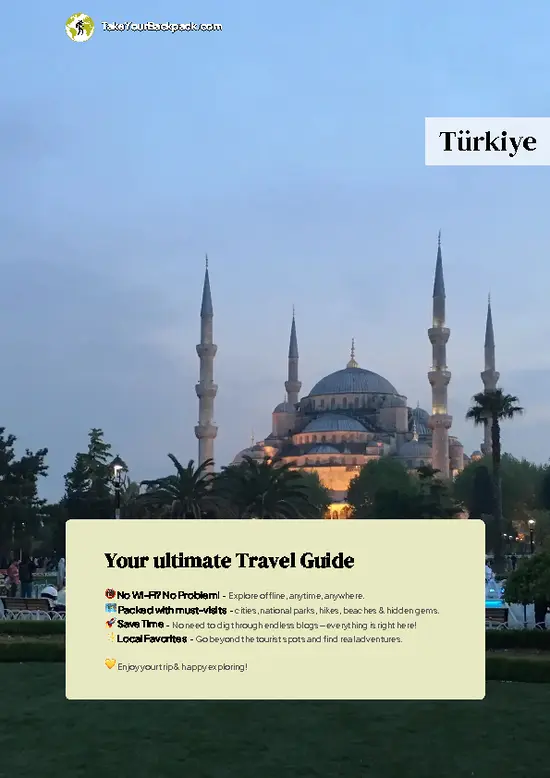
example page 0 from our offline Travel Guide for Türkiye
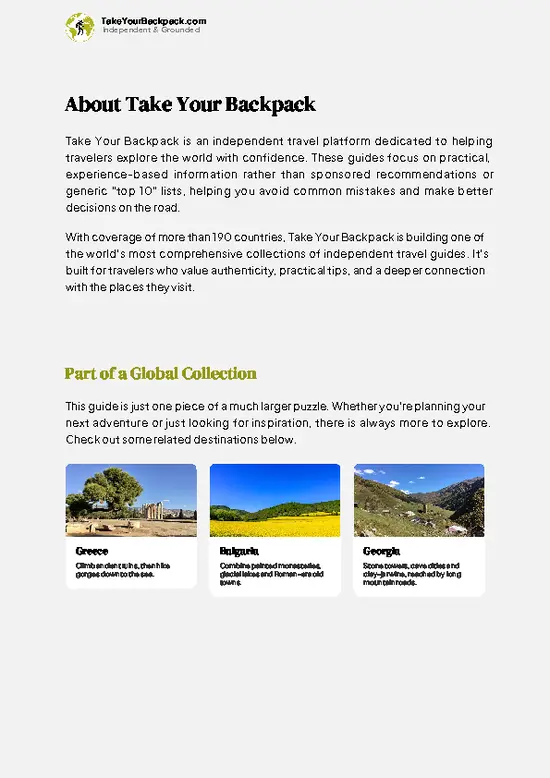
example page 1 from our offline Travel Guide for Türkiye
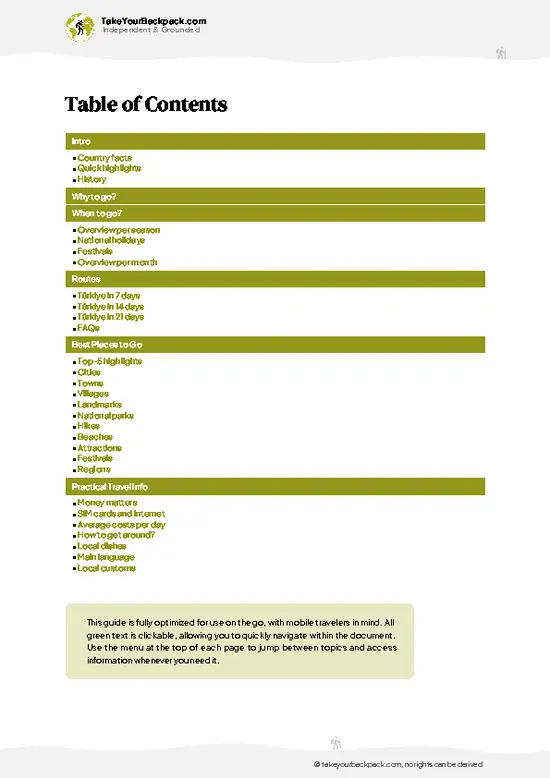
example page 2 from our offline Travel Guide for Türkiye
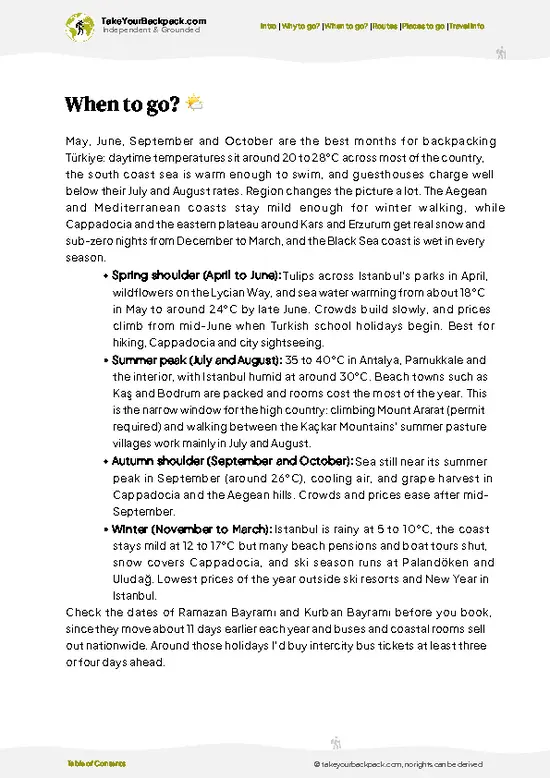
example page 3 from our offline Travel Guide for Türkiye
example page 4 from our offline Travel Guide for Türkiye
example page 5 from our offline Travel Guide for Türkiye
example page 6 from our offline Travel Guide for Türkiye
example page 7 from our offline Travel Guide for Türkiye
The digital guide (445 pages) contains:
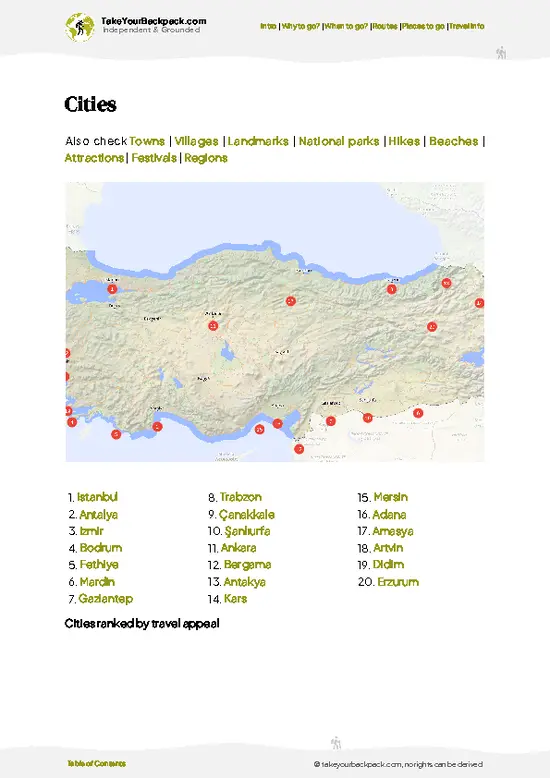
✅ 130 highlights, ranked by travel appeal
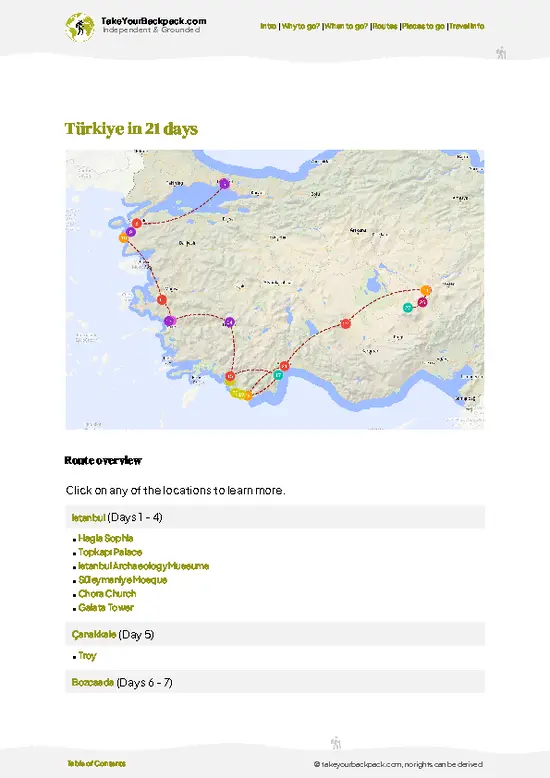
✅ Optimized 7, 14 & 21-day travel routes
✅ Cities, national parks, landmarks, beaches
✅ How to get around
✅ Offline-friendly for travel without Wi-Fi
👉 Click to see all 30+ guide features

📅 Plan smarter in minutes, not weeks
✅ Month by month travel advice
✅ Festivals & national holidays
✅ Budget expectations

🗺️ Go to the right places, skip the overrated ones
✅ Honest pros & cons of destinations
✅ Top hikes, parks & viewpoints
✅ Lesser-known places most travelers miss
✅ Clear “worth it vs skip it” guidance

🛏️ Travel smoothly without rookie mistakes
✅ Best areas to stay
✅ Transport systems explained simply
✅ Common scams & safety advice
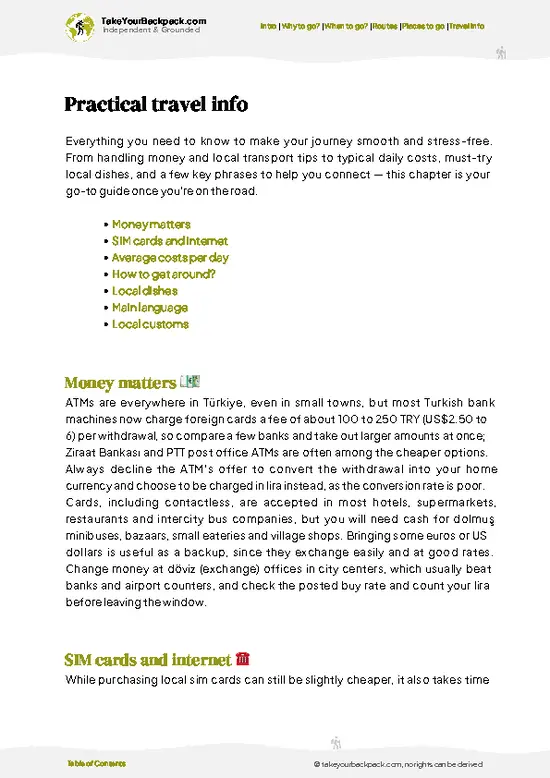
✅ SIM cards, money & practical tips

🌍 Understand the country, not just visit it
✅ Culture & traditions
✅ 52 Essential phrases & customs
✅ Festivals worth planning around
✅ Traveler-friendly historical context
✅ Insights that make places more meaningful

📱 Built for real travel conditions
✅ Fully downloadable PDF
✅ Works completely offline
✅ Optimized for phone use
✅ Useful in remote areas & buses
✅ Everything in one place
Stop searching, start planning
Get instant access to your full guide. 30‑day money-back guarantee.
+ Add another guide for just

By proceeding you agree to our terms.
Sent to your inbox immediately after payment • 100% Secure Checkout
Best Backpacking Travel Advisor 2025 tourism awardBest Backpacking
Travel Advisor
2025
What others say about Take Your Backpack Guides:
⭐⭐⭐⭐⭐
Fantastic, amazing amount of information!
⭐⭐⭐⭐⭐
My goodness this is amazing, it's what I've been looking for hats off too you!
⭐⭐⭐⭐⭐
I think this is absolutely BRILLIANT
⭐⭐⭐⭐
Very complete and informative. It's still missing places, but I gotta to commend you
⭐⭐⭐⭐⭐
This is truly amazing, thank you, can't wait to explore it with my kids!
⭐⭐⭐⭐⭐
Awesome resource, thank you!
⭐⭐⭐⭐⭐
This is amazing! Can't wait to explore the ones I haven't seen
⭐⭐⭐⭐
I love this! Well done, great idea.
⭐⭐⭐⭐⭐
Thanks for taking the time to make this gem!
⭐⭐⭐⭐⭐
This might be the best website I've ever seen.
⭐⭐⭐⭐⭐
Congratulations, and thank you so much for your work; it's incredibly valuable.
⭐⭐⭐⭐
In all seriousness I think you did a great job pointing out the important spots
⭐⭐⭐⭐⭐
10/10 very good
⭐⭐⭐⭐⭐
As someone who's only just starting to visit regularly this is awesome, thank you.
⭐⭐⭐⭐
Thank you very much! I'm going to visit my dad, it's going to be very useful!
⭐⭐⭐⭐⭐
This is really cool! We'll be travelling for the first time and this definitely come in handy.
⭐⭐⭐⭐⭐
You are now our minister of culture, congratulations 👨‍💼
⭐⭐⭐⭐⭐
Just wanted to tell you that this is a pearl! Going to follow your recommendations.
⭐⭐⭐⭐⭐
This is so cool. I'll definitely be using the resource for my travels soon.
⭐⭐⭐⭐⭐
This is very impressive! Good work.
⭐⭐⭐⭐⭐
This is an amazing and informative site. Very well done!

🛏️ Where to stay?Top Places to Consider Staying

Türkiye has plenty of hostels and budget guesthouses, with dorm beds in Istanbul typically running €10 to 20 a night and private doubles in family pensions from roughly €30 to 50. In Istanbul, Sultanahmet puts you within walking distance of Hagia Sophia and the Blue Mosque but goes quiet after dark, while Beyoğlu and Karaköy around Galata have the liveliest bars and late-night street noise to match, and Kadıköy on the Asian side trades sightseeing convenience for cheaper, more local nightlife a ferry ride away. Beyond the big city, Göreme in Cappadocia is packed with cave-room hostels steps from the valley trails (sleepy at night, with early balloon-launch wake-ups), and Kaleiçi, the walled … read more 👉
Türkiye has plenty of hostels and budget guesthouses, with dorm beds in Istanbul typically running €10 to 20 a night and private doubles in family pensions from roughly €30 to 50. In Istanbul, Sultanahmet puts you within walking distance of Hagia Sophia and the Blue Mosque but goes quiet after dark, while Beyoğlu and Karaköy around Galata have the liveliest bars and late-night street noise to match, and Kadıköy on the Asian side trades sightseeing convenience for cheaper, more local nightlife a ferry ride away. Beyond the big city, Göreme in Cappadocia is packed with cave-room hostels steps from the valley trails (sleepy at night, with early balloon-launch wake-ups), and Kaleiçi, the walled old town of Antalya, mixes pensions near the harbor and beaches with weekend bar noise along its lanes.

If you enjoy meeting fellow travelers, consider choosing hostels with high ratings for atmosphere. On the other hand, if you prefer having your own space, a hotel might be a better option.

TürkiyeMore Places Across Türkiye

👋 Meet the founderWho’s Behind Take Your Backpack?

Johan, backpacker and founder of TakeYourBackpackHi, I’m Johan (Netherlands 🇳🇱), the creator of TakeYourBackpack. Over the past 3 decades, I’ve backpacked through 90+ countries across six continents, gaining extensive experience with independent travel, long-term trips, and overland routes.

This site is built on a combination of firsthand travel experience and carefully curated insights from other backpackers. Many guides are based on places I’ve personally visited, while others bring together tips, observations, and practical advice shared by trusted travelers I’ve met along the way.

The goal is to provide realistic, experience-driven guidance — not generic itineraries — so you can explore destinations with better context, clearer expectations, and more confidence.