×

United Kingdom🇬🇧 | best hikesThe 10 Top hikes in the UK

Hiking in the United Kingdom (UK) means walking through a landscape that has been argued over, farmed, mined and photographed for centuries, and still manages to look wild. The big divide runs north to south. Scotland offers real remoteness, long-distance trails and right-to-roam freedom, with midges and a road network that sulks beyond the Highlands. England gives you well-signed national parks and national trails, often reachable by train, plus a pub at the end that makes the whole exercise feel reasonable. Wales packs steep mountains and coastline into a compact space, and buses reach more trailheads than you would guess. Northern Ireland is quieter, with fewer walkers and cheaper beds. For backpacking or independent travel, the choice comes down to how much solitude you want, how much you will pay for a bed and how far you are willing to ride a rural bus that comes twice a day. Pack a waterproof. Then pack another.

By Johan Kruseman 🇳🇱 | Updated October 18, 2026
Explore the best beaches in the UK

Why go?What Makes Them Special

The UK is unusual because its footpath network is a public inheritance. England and Wales hold well over 100,000 miles (160,000 km) of legally protected public rights of way, and Scotland’s right of responsible access lets you walk most unenclosed land, including wild camping in many areas. In much of the world, hiking means permits and gatekeepers. Here it often means a stile, a wooden signpost and a farmer’s sheep staring at you with mild disapproval.

The geography does the rest. Mountains are modest by global standards, with Ben Nevis at 1,345 m, yet the maritime climate makes them serious. Weather turns fast, cloud drops onto summits and a pleasant morning can finish in horizontal rain. Treat the hills with respect and they are superb. Treat them as a gentle stroll and mountain rescue … read more 👉
The UK is unusual because its footpath network is a public inheritance. England and Wales hold well over 100,000 miles (160,000 km) of legally protected public rights of way, and Scotland’s right of responsible access lets you walk most unenclosed land, including wild camping in many areas. In much of the world, hiking means permits and gatekeepers. Here it often means a stile, a wooden signpost and a farmer’s sheep staring at you with mild disapproval.

The geography does the rest. Mountains are modest by global standards, with Ben Nevis at 1,345 m, yet the maritime climate makes them serious. Weather turns fast, cloud drops onto summits and a pleasant morning can finish in horizontal rain. Treat the hills with respect and they are superb. Treat them as a gentle stroll and mountain rescue volunteers will meet you eventually.

Infrastructure is a strength. Ordnance Survey maps are superb, hostels and bunkhouses sit along many classic routes, and the National Trails are waymarked with an acorn symbol. Village pubs, campsites and baggage-transfer services make multi-day walking feasible without carrying everything. Public transport is the weak point. Trains serve gateway towns well, but remote trailheads in Scotland, Wales and northern England may rely on infrequent buses, especially on Sundays and outside summer.

Before choosing the UK, know three things. It is not cheap, particularly for accommodation in popular parks in July and August. Land is largely private or farmed, so gates, livestock and dog rules matter. And you will not find wilderness on the scale of Patagonia or Alaska. What you will find is dense variety, easy access and a walking culture so well established that nobody will look twice at you for wearing muddy boots in a restaurant.
Evaluating the Top Choices
The list of best hikes in the UK is created based on scenery, challenge, trail quality, landmarks, and overall enjoyment. If you feel a hike is missing in this list, please let us know.

When to go?Seasonal Guide to Visiting

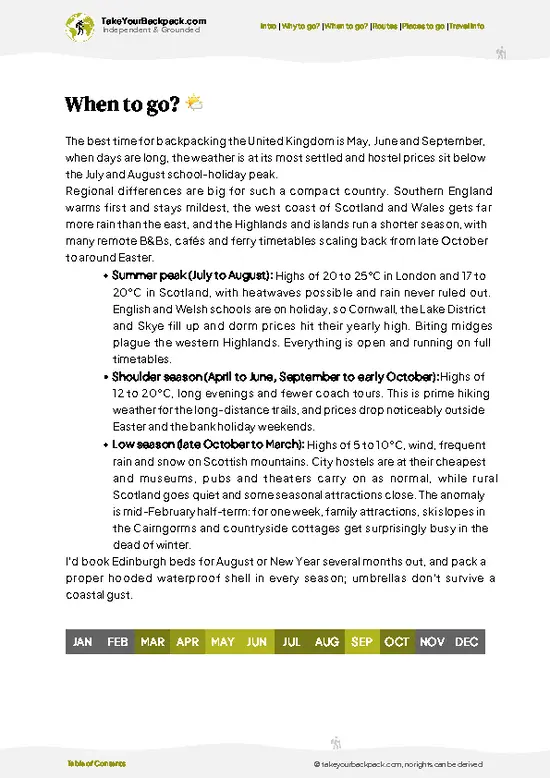
Best months for hiking: The best months for hiking in the UK are May, June and September, when daylight stretches to 15 to 17 hours in summer, temperatures sit around 12 to 20°C in lowland areas and the hills are less crowded than in peak summer. It will still rain, because this is Britain, but the odds of a dry day are better than in winter.
Summer peak and shoulder seasons: July and August bring the warmest weather, often 18 to 24°C, and the longest days, but also school holidays. Lake District, Snowdonia, Peak District and Cornish coastal paths fill up, parking becomes a competitive sport and accommodation can cost 30 to 60 percent more than in spring or autumn. In the Scottish Highlands, midges peak from roughly June to early September and are worst at dawn, dusk and in still, damp air. … read more 👉
Best months for hiking: The best months for hiking in the UK are May, June and September, when daylight stretches to 15 to 17 hours in summer, temperatures sit around 12 to 20°C in lowland areas and the hills are less crowded than in peak summer. It will still rain, because this is Britain, but the odds of a dry day are better than in winter.
Summer peak and shoulder seasons: July and August bring the warmest weather, often 18 to 24°C, and the longest days, but also school holidays. Lake District, Snowdonia, Peak District and Cornish coastal paths fill up, parking becomes a competitive sport and accommodation can cost 30 to 60 percent more than in spring or autumn. In the Scottish Highlands, midges peak from roughly June to early September and are worst at dawn, dusk and in still, damp air. April and October are workable shoulder months, with cooler temperatures of 6 to 14°C, fewer walkers and cheaper beds, though some rural cafes, hostels and ferries reduce services.
Winter hiking: From November to March, daylight shrinks to about 7 to 8 hours in England and Wales and even less in northern Scotland. Temperatures hover between 0 and 8°C in the lowlands, with snow, ice and strong winds on higher ground. Winter walking is rewarding, but it needs navigation skills, proper equipment and respect for avalanche and weather forecasts in the Scottish mountains. Western regions such as Snowdonia, the Lake District and the Highlands are wetter, often receiving 1,500 to over 3,000 mm of rain a year, while eastern England is far drier. Some campsites and hostels close from November to Easter, so check before building a plan around them.

hike hoppingPlanning Your Route Efficiently

Time needed and regional clusters: A trip combining several hikes in the UK needs 10 to 21 days, depending on whether you stick to one country or cross several. Regions group best by geography: northern England and southern Scotland connect easily along the West Coast and East Coast rail lines, while Wales pairs well with the English Midlands and the Peak District through Manchester, Chester or Birmingham. The Highlands and islands demand their own block of time. Southwest England sits well apart and suits a separate trip or a final stop.
Pacing and direction: Allow 2 to 4 days per region for day walks and short routes, or 5 to 7 days for a long-distance trail. Travel between regions usually takes 2 to 5 hours by train (London to Edinburgh is about 4.5 hours, Manchester to Glasgow around 3 … read more 👉
Time needed and regional clusters: A trip combining several hikes in the UK needs 10 to 21 days, depending on whether you stick to one country or cross several. Regions group best by geography: northern England and southern Scotland connect easily along the West Coast and East Coast rail lines, while Wales pairs well with the English Midlands and the Peak District through Manchester, Chester or Birmingham. The Highlands and islands demand their own block of time. Southwest England sits well apart and suits a separate trip or a final stop.
Pacing and direction: Allow 2 to 4 days per region for day walks and short routes, or 5 to 7 days for a long-distance trail. Travel between regions usually takes 2 to 5 hours by train (London to Edinburgh is about 4.5 hours, Manchester to Glasgow around 3 hours), while reaching remote Highland trailheads can add another 2 to 4 hours by bus or ferry. A sensible direction runs south to north, starting where the climate is milder and daylight lasts, then finishing in Scotland when your legs are trained and your waterproofs have proven themselves.
Common planning mistakes: The most frequent error is squeezing too many regions into too little time. The UK looks small on a map, but narrow roads, rural buses and ferry timetables stretch journeys. Plan for one rest or transit day after every long stretch of hiking, and leave slack for weather. Another mistake is assuming Sunday service matches weekday timetables, so check connections before arrival. Booking every night in advance also backfires when storms close a pass or a route proves slower than expected. Reserve only the key beds in high season and keep the rest flexible. Finally, do not underestimate midges, rain and short winter days when building a schedule.

The ListHighly Recommended hikes of the UK

1 South West Coast Path

steep headlands, fishing villages, tidal estuaries

Cover a vast and varied coastline, with frequent elevation changes and shifting terrain requiring stamina and attention to daily logistics.

United Kingdom - the South West Coast Path

2 West Highland Way

lochside paths, glens, mountain vistas

Experience Scotland’s changing landscapes, from wooded valleys to open moor, with reliable waymarking and a mix of wild and serviced stretches.

United Kingdom - the West Highland Way

3 Pennine Way

peat bogs, gritstone edges, upland plateaus

Traverse exposed high ground and remote moors, where unpredictable weather and long distances between settlements test endurance.

United Kingdom - the Pennine Way

4 Hadrian’s Wall Path

Roman ruins, rolling farmland, stone walls

Walk alongside ancient fortifications, passing through open countryside and scattered villages where history and rural scenery intersect.

united-kingdom-hike-hadrians-wall-path
© Google | Biggles

5 Pembrokeshire Coast Path

clifftop trails, sandy coves, seabird colonies

Trace a rugged coastline with frequent ascents and descents, encountering wildlife and tidal inlets that demand careful planning.

United Kingdom - the Pembrokeshire Coast Path

6 Cotswold Way

limestone hills, market towns, beech woodland

Follow gentle ridges and wooded slopes, linking rural villages and open fields with steady gradients and accessible trailheads.

7 Cape Wrath Trail

remote wilderness, river crossings, pathless moorland

Navigate untamed Scottish landscapes where navigation skills, solitude, and self-sufficiency are essential for crossing rugged, unmarked ground.

United Kingdom - the Cape Wrath Trail

8 Causeway Coast Way

basalt cliffs, sea arches, coastal grassland

Follow a dramatic shoreline past geological formations and open headlands, with shifting weather and exposed sections shaping each day’s progress.

united-kingdom-hike-causeway-coast-way
© Google | Luisle

9 Offa’s Dyke Path

earthwork border, patchwork farmland, wooded valleys

Walk the England–Wales border, encountering a mix of pastoral scenery and historic boundaries with frequent changes in elevation.

10 Ridgeway

chalk escarpments, ancient trackways, open downland

Travel a prehistoric route across gentle hills, passing burial mounds and panoramic viewpoints that reveal layers of human history.

11 St Cuthbert’s Way

border abbeys, Cheviot hills, tidal causeway

Journey from inland hills to the North Sea, timing your finish with the tides to reach the Holy Island’s shifting sands.

12 Glyndŵr’s Way

mid-Wales hills, remote hamlets, sheep pasture

Venture through quiet countryside, where infrequent services and winding routes require careful preparation and a flexible approach.

united-kingdom-hike-glyndwrs-way
© Google |

13 Southern Upland Way

open moorland, forest plantations, river valleys

Cross southern Scotland’s broad uplands, facing long, isolated stretches and variable weather with few settlements en route.

Think you know the UK?

Prove you’re a true local — uncover 3 lesser-known hikes in the UK that locals tend to keep to themselves.
Loading the map 🌍

Expert viewInsights from Locals and Experts

How Many Hikes Are Worth Doing:
Four to six hikes is the right number for a trip of two to three weeks, because the UK punishes overbooking in a way that sunny countries do not. A day of low cloud and sideways drizzle will cancel a summit, and you need slack to swap a day around. Pack in one hike a day and the first gale turns your plan into a spreadsheet of regrets. Four to six leaves two or three spare days for weather, rest and the slow train that was supposed to be a fast one.
Which Kind to Prioritize:
The UK offers three kinds of walking, and your travel style should pick the mix. Mountain days in Scotland, Snowdonia and the Lake District suit people who want exposure, scrambling and a proper summit. Coastal paths in Cornwall, Pembrokeshire and Northumberland suit those who like pubs, … read more 👉
How Many Hikes Are Worth Doing:
Four to six hikes is the right number for a trip of two to three weeks, because the UK punishes overbooking in a way that sunny countries do not. A day of low cloud and sideways drizzle will cancel a summit, and you need slack to swap a day around. Pack in one hike a day and the first gale turns your plan into a spreadsheet of regrets. Four to six leaves two or three spare days for weather, rest and the slow train that was supposed to be a fast one.
Which Kind to Prioritize:
The UK offers three kinds of walking, and your travel style should pick the mix. Mountain days in Scotland, Snowdonia and the Lake District suit people who want exposure, scrambling and a proper summit. Coastal paths in Cornwall, Pembrokeshire and Northumberland suit those who like pubs, ice cream and cliffs they can leave when the weather turns. Multi-day trails suit people who want rhythm and a sense of progress, and they are the best value per day once you are walking.
First-timers should lead with one coastal or low-hill walk and then step up to a mountain. Experienced hikers can invert that order, but should keep one gentle day in the mix, since legs and weather both have opinions. Budget travelers get the most from long trails and bothies, while those with more cash can swap a hostel for a guesthouse with a drying room, which is the real luxury of British hiking.
What It Costs:
Plan on £55 to 110 a day (US$70 to 140) for independent hiking. A hostel dorm runs £20 to 35 (US$25 to 45), a campsite pitch £10 to 25 per person (US$13 to 32), and a pub dinner £12 to 20 (US$15 to 25). Self-catering from a supermarket cuts food to £8 to 12 a day (US$10 to 15). Most trails and open hills are free to walk, so the money goes on transport, beds and food.
The costs that catch people out are parking and trains. Popular trailheads charge £5 to 15 (US$6 to 19) for a day, often in coins or via an app that needs phone signal the valley does not have. Rail fares bought on the day can cost three times the advance price, so book walk-up trains a few weeks ahead or use a railcard. Rural buses can cost £3 to 8 a ride (US$4 to 10) but may run only a few times a day, and many stop entirely on Sundays or in winter. Baggage transfer on long trails is £10 to 15 (US$13 to 19) per bag per stage, a fair price for walking without a 15 kilogram pack. Guides for mountain days cost roughly £150 to 250 (US$190 to 315) a day for a small group, worth paying in winter conditions or for serious scrambles.
Safety and Weather:
The hills are low by world standards and still kill people every year, mostly through cloud, cold and poor navigation. Summit temperatures can sit 10°C lower than the valley, and wind and wet cause hypothermia even in July. Carry a paper map and compass and know how to use them, since phone batteries die in cold and signal vanishes. Check the Mountain Weather Information Service forecasts rather than a town weather app. Waterproof trousers are not optional. In an emergency, call 999 and ask for the police, then mountain rescue.
Tides are the other trap. Coastal paths and causeways flood, and beaches can be cut off by an incoming sea. Read the tide tables before setting out, not while standing on the sand.
Etiquette and Access Rules:
Rules differ by nation. Scotland has a legal right of responsible access, including wild camping on most unenclosed land, so pitch out of sight, stay a night or two and take every scrap with you. In England and Wales, wild camping is generally illegal without landowner permission, with Dartmoor allowing it only in designated areas. Fires are best avoided everywhere, since upland peat can burn underground for days.
Shut every gate behind you. Keep dogs on leads near livestock, especially in spring lambing, and give cattle with calves a wide berth. In Scotland, check stalking notices from August to October before choosing a route, and expect midges from June to September near still water, where repellent and a head net earn their weight.
One practical note: a drying room is worth more than a view. Wet kit left in a pack overnight becomes a lifestyle choice you will regret by morning.

✈️ The backpacker research shortcutthe UK Travel Guide

An offline-friendly backpacking guide with optimized travel routes, ranked highlights, transport advice, and the best areas to stay.
example page 0 from our offline Travel Guide for United Kingdom
example page 1 from our offline Travel Guide for United Kingdom
example page 2 from our offline Travel Guide for United Kingdom
example page 3 from our offline Travel Guide for United Kingdom
example page 4 from our offline Travel Guide for United Kingdom
example page 5 from our offline Travel Guide for United Kingdom
example page 6 from our offline Travel Guide for United Kingdom
example page 7 from our offline Travel Guide for United Kingdom
The digital guide (526 pages) contains:
✅ 146 highlights, ranked by travel appeal
✅ Optimized 7, 14 & 21-day travel routes
✅ Cities, national parks, landmarks, beaches
✅ How to get around
✅ Offline-friendly for travel without Wi-Fi
👉 Click to see all 30+ guide features

📅 Plan smarter in minutes, not weeks
✅ Month by month travel advice
✅ Festivals & national holidays
✅ Budget expectations

🗺️ Go to the right places, skip the overrated ones
✅ Honest pros & cons of destinations
✅ Top hikes, parks & viewpoints
✅ Lesser-known places most travelers miss
✅ Clear “worth it vs skip it” guidance

🛏️ Travel smoothly without rookie mistakes
✅ Best areas to stay
✅ Transport systems explained simply
✅ Common scams & safety advice
✅ SIM cards, money & practical tips

🌍 Understand the country, not just visit it
✅ Culture & traditions
✅ Local customs
✅ Festivals worth planning around
✅ Traveler-friendly historical context
✅ Insights that make places more meaningful

📱 Built for real travel conditions
✅ Fully downloadable PDF
✅ Works completely offline
✅ Optimized for phone use
✅ Useful in remote areas & buses
✅ Everything in one place
Stop searching, start planning
Get instant access to your full guide. 30‑day money-back guarantee.
+ Add another guide for just

By proceeding you agree to our terms.
Sent to your inbox immediately after payment • 100% Secure Checkout
Best Backpacking Travel Advisor 2025 tourism awardBest Backpacking
Travel Advisor
2025
What others say about Take Your Backpack Guides:
⭐⭐⭐⭐⭐
Fantastic, amazing amount of information!
⭐⭐⭐⭐⭐
My goodness this is amazing, it's what I've been looking for hats off too you!
⭐⭐⭐⭐⭐
I think this is absolutely BRILLIANT
⭐⭐⭐⭐
Very complete and informative. It's still missing places, but I gotta to commend you
⭐⭐⭐⭐⭐
This is truly amazing, thank you, can't wait to explore it with my kids!
⭐⭐⭐⭐⭐
Awesome resource, thank you!
⭐⭐⭐⭐⭐
This is amazing! Can't wait to explore the ones I haven't seen
⭐⭐⭐⭐
I love this! Well done, great idea.
⭐⭐⭐⭐⭐
Thanks for taking the time to make this gem!
⭐⭐⭐⭐⭐
This might be the best website I've ever seen.
⭐⭐⭐⭐⭐
Congratulations, and thank you so much for your work; it's incredibly valuable.
⭐⭐⭐⭐
In all seriousness I think you did a great job pointing out the important spots
⭐⭐⭐⭐⭐
10/10 very good
⭐⭐⭐⭐⭐
As someone who's only just starting to visit regularly this is awesome, thank you.
⭐⭐⭐⭐
Thank you very much! I'm going to visit my dad, it's going to be very useful!
⭐⭐⭐⭐⭐
This is really cool! We'll be travelling for the first time and this definitely come in handy.
⭐⭐⭐⭐⭐
You are now our minister of culture, congratulations 👨‍💼
⭐⭐⭐⭐⭐
Just wanted to tell you that this is a pearl! Going to follow your recommendations.
⭐⭐⭐⭐⭐
This is so cool. I'll definitely be using the resource for my travels soon.
⭐⭐⭐⭐⭐
This is very impressive! Good work.
⭐⭐⭐⭐⭐
This is an amazing and informative site. Very well done!

🛏️ Where to stay?Best Places to Stay in the UK

The United Kingdom has plenty of hostels, with London dorm beds typically £25 to 50 (US$32 to 65) a night and most other cities closer to £18 to 35 (US$23 to 45), climbing sharply on summer weekends and during the Edinburgh festivals in August. In London, King’s Cross has the best transport links and the most beds, Camden and Shoreditch put you next to late bars and live music but are loud after midnight, and Earl’s Court is quieter and handy for Heathrow on the Piccadilly line, though it is a longer ride to the East End. In Edinburgh, the Old Town puts the castle and the Royal Mile outside your door at the cost of stag-party noise, while in Glasgow the West End is calmer and studenty, with … read more 👉
The United Kingdom has plenty of hostels, with London dorm beds typically £25 to 50 (US$32 to 65) a night and most other cities closer to £18 to 35 (US$23 to 45), climbing sharply on summer weekends and during the Edinburgh festivals in August. In London, King’s Cross has the best transport links and the most beds, Camden and Shoreditch put you next to late bars and live music but are loud after midnight, and Earl’s Court is quieter and handy for Heathrow on the Piccadilly line, though it is a longer ride to the East End. In Edinburgh, the Old Town puts the castle and the Royal Mile outside your door at the cost of stag-party noise, while in Glasgow the West End is calmer and studenty, with cheap food on Byres Road and a short subway ride to the center.

If you enjoy meeting fellow travelers, consider choosing hostels with high ratings for atmosphere. On the other hand, if you prefer having your own space, a hotel might be a better option.

the UKExplore the UK

👋 Meet the founderWho’s Behind Take Your Backpack?

Johan, backpacker and founder of TakeYourBackpackHi, I’m Johan (Netherlands 🇳🇱), the creator of TakeYourBackpack. Over the past 3 decades, I’ve backpacked through 90+ countries across six continents, gaining extensive experience with independent travel, long-term trips, and overland routes.

This site is built on a combination of firsthand travel experience and carefully curated insights from other backpackers. Many guides are based on places I’ve personally visited, while others bring together tips, observations, and practical advice shared by trusted travelers I’ve met along the way.

The goal is to provide realistic, experience-driven guidance — not generic itineraries — so you can explore destinations with better context, clearer expectations, and more confidence.