×

United Kingdom🇬🇧 | best beachesThe 10 Top beaches in the UK

Beaches in the United Kingdom (UK) are less a swimming proposition than a negotiation with the weather. Water temperatures top out around 16 to 19°C in summer, so the typical visit involves a windbreak, a flask and a brave toddler running into the sea. The reward is range. Cornwall and Devon have surf schools, hostels and traffic jams on single-lane roads. Wales and Northern Ireland offer long, empty sands and coastal paths, while Scotland’s west coast and islands deliver white sand that looks tropical until you touch the water. Eastern England trades drama for faded piers, chips and low prices. Access is easy by train in many places, tougher by bus in remote ones. For backpacking or independent travel, the south is busy and pricey in summer, the north and west quieter and cheaper. Pick your coast by mood, not by forecast.

By Johan Kruseman 🇳🇱 | Updated October 18, 2026
Explore the best attractions in the UK

Why go?What Makes Them Special

The UK is an island nation with no point further than about 120 miles (190 km) from the sea, so the coast is part of daily life, not a special trip. That gives beaches a very particular culture: seaside towns with Victorian piers, deckchairs, fish and chips, and a collective stubbornness about sitting outside in a cardigan. The Gulf Stream keeps winters mild, but it does not do much for sea temperature, which is why wetsuits are as common as swimsuits. A beach here is more about surfing, walking, wildlife and scenery than lounging in the heat.

Geography creates real variety in a small space. The Atlantic-facing west brings swell, cliffs and big tides, the North Sea side is flatter and gentler, and the Scottish and Irish Sea coasts mix sheltered bays with dramatic mountains behind. Tides can … read more 👉
The UK is an island nation with no point further than about 120 miles (190 km) from the sea, so the coast is part of daily life, not a special trip. That gives beaches a very particular culture: seaside towns with Victorian piers, deckchairs, fish and chips, and a collective stubbornness about sitting outside in a cardigan. The Gulf Stream keeps winters mild, but it does not do much for sea temperature, which is why wetsuits are as common as swimsuits. A beach here is more about surfing, walking, wildlife and scenery than lounging in the heat.

Geography creates real variety in a small space. The Atlantic-facing west brings swell, cliffs and big tides, the North Sea side is flatter and gentler, and the Scottish and Irish Sea coasts mix sheltered bays with dramatic mountains behind. Tides can be huge, especially in the Bristol Channel and parts of Wales, where the sea retreats hundreds of meters and returns fast.

Infrastructure is a strength. Most popular beaches have parking, toilets and a cafe, and many are served by trains or buses. Large stretches of coast are covered by public footpaths, including the South West Coast Path and the Wales Coast Path, so you can walk between sands without a car. Lifeguards from the RNLI patrol many beaches in summer, though not all, and not all day.

Before choosing the UK for beaches, accept that weather is the main variable. A sunny day can be crowded and expensive, a gray one empty and atmospheric, and both can happen before lunch. Pack layers, book summer accommodation early, and treat warm water as a lucky extra.
How the List Was Created
The list of best beaches in the UK is created based on beauty, vibe, water quality, activities, and surrounding scenery. If you feel a beach is missing in this list, please let us know.

When to go?Seasonal Guide to Visiting

Best months and the weather you will actually get: The best months for UK beaches are June to early September, when daytime air temperatures reach roughly 18 to 24°C and daylight lasts until 9:30 or 10 pm in the south and even later in northern Scotland. Sea temperatures peak in August at about 15 to 19°C in the south and 12 to 15°C in Scotland. Rain falls year-round, with the west (Wales, Cornwall, Scottish Highlands) noticeably wetter than the east and southeast, which is the driest part of the country.

Peak, shoulder and off-season: July and August, plus school holidays and bank holiday weekends (late May and late August), are peak season. Expect crowded car parks in Cornwall, Devon and Dorset, and accommodation that can cost two to three times the off-peak rate. Hostel dorms that run … read more 👉
Best months and the weather you will actually get: The best months for UK beaches are June to early September, when daytime air temperatures reach roughly 18 to 24°C and daylight lasts until 9:30 or 10 pm in the south and even later in northern Scotland. Sea temperatures peak in August at about 15 to 19°C in the south and 12 to 15°C in Scotland. Rain falls year-round, with the west (Wales, Cornwall, Scottish Highlands) noticeably wetter than the east and southeast, which is the driest part of the country.

Peak, shoulder and off-season: July and August, plus school holidays and bank holiday weekends (late May and late August), are peak season. Expect crowded car parks in Cornwall, Devon and Dorset, and accommodation that can cost two to three times the off-peak rate. Hostel dorms that run £20 to 30 in spring may reach £35 to 50 on a summer weekend. Book early or travel midweek.

May, June and September are the shoulder seasons and the smartest choice. Days are long, crowds are thinner, and prices are lower. May is often one of the sunniest months, though the sea is still cold at around 10 to 13°C. September has the warmest sea of the shoulder months and often settled weather.

October to March is for storm watching, dog walkers and surfers in thick wetsuits. Air temperatures sit around 4 to 10°C, and wind can be fierce on exposed Atlantic coasts. Many seaside cafes, kiosks, boat trips and some campsites close or cut hours between November and Easter, particularly in smaller resorts and on Scottish islands. Surfers do the opposite of everyone else: autumn brings the most consistent swell on the Atlantic coast, so September to November is prime time for waves.

beach hoppingPlanning Your Route Efficiently

How many days and in what order: A trip combining several UK beaches needs 7 to 14 days, and 10 is comfortable if you want more than a blur of car parks. The UK is small, but coastlines are long and roads are slow, so distances that look short on a map take real time.

Regions that group well: The southwest (Cornwall, Devon, Dorset) clusters well, with a handful of beach stops reachable by train and bus from Exeter, Plymouth or Penzance. Wales pairs naturally with the southwest via Bristol or Cardiff, and its Pembrokeshire and Gower coasts sit a few hours apart by bus or car. Northern Ireland’s Causeway Coast connects to Scotland by ferry from Belfast or Larne to Cairnryan. Scotland’s west coast and islands work from Glasgow, Oban or Mallaig. Travel in one direction, say south to north, to … read more 👉
How many days and in what order: A trip combining several UK beaches needs 7 to 14 days, and 10 is comfortable if you want more than a blur of car parks. The UK is small, but coastlines are long and roads are slow, so distances that look short on a map take real time.

Regions that group well: The southwest (Cornwall, Devon, Dorset) clusters well, with a handful of beach stops reachable by train and bus from Exeter, Plymouth or Penzance. Wales pairs naturally with the southwest via Bristol or Cardiff, and its Pembrokeshire and Gower coasts sit a few hours apart by bus or car. Northern Ireland’s Causeway Coast connects to Scotland by ferry from Belfast or Larne to Cairnryan. Scotland’s west coast and islands work from Glasgow, Oban or Mallaig. Travel in one direction, say south to north, to avoid backtracking.

Time per stop and between regions: Allow 1 to 3 nights per region and at least a full day at each beach area, since a morning on the sand can easily become a bus timetable negotiation. London to Cornwall by train takes about 4.5 to 5.5 hours, Cardiff to Pembrokeshire 2.5 to 3.5 hours, and Glasgow to Oban about 3 hours. Ferries to the Hebrides usually take 1 to 3 hours, with limited sailings.

Planning mistakes to avoid: The classic error is trying to cover Cornwall, Wales and Scotland in a week. Pick two regions at most. Another is ignoring tides, which can cut off access to some sands, so check tide tables before heading out. Rural buses can run only a few times a day and often not on Sundays, so check the timetable before you leave. Booking everything in advance in summer is wise, while in shoulder months you can afford flexibility. Leave one slack day for weather, because the UK will insist on one.

The ListHighly Recommended beaches of the UK

1 Rhossili Bay

Three-mile sand, tidal island, cliff walks

Walk a vast open beach with views of Worm’s Head, where tides and cliffs create a sense of scale and solitude.

2 Barafundle Bay

Secluded cove, golden sand, cliff path access

Reach a quiet bay on foot, where clear water meets soft sand and the only way in is along a coastal path.

united-kingdom-beach-barafundle-bay
© Google |

3 Luskentyre Beach

Expansive sands, shifting tides, mountain views

Cross wide, pale sands where the sea changes color with the weather, framed by distant hills and open sky.

united-kingdom-beach-luskentyre-beach
© Google |

4 Kynance Cove

Tidal pools, serpentine rocks, turquoise water

Descend to a cove where low tide reveals rock formations and clear pools, framed by dramatic cliffs and shifting light.

united-kingdom-beach-kynance-cove
© Google |

5 Durdle Door

Limestone arch, steep steps, Jurassic Coast

Descend to a shingle beach overlooked by a natural stone arch, with fossil-rich cliffs rising above the sea.

united-kingdom-beach-durdle-door
© Google |

6 Holkham Beach

Pine forest, vast dunes, tidal flats

Walk through woodland and dunes to reach a broad, empty shore where the sea retreats far at low tide.

7 Bamburgh Beach

Castle views, open sand, North Sea breeze

Face the wind on a broad beach with a medieval fortress rising above the dunes and the cold sea stretching north.

8 Camber Sands

Sand dunes, flat beach, kite sports

Explore a long, level stretch of sand popular for wind-powered activities, with high dunes sheltering the inland side.

9 Porthcurno Beach

Sheltered cove, fine sand, open-air theatre

Relax in a small bay with soft sand and turquoise water, overlooked by a cliffside amphitheatre carved from rock.

united-kingdom-beach-porthcurno-beach
© Google |

10 Sandwood Bay

Remote access, pink sand, sea stacks

Hike several miles to reach an isolated beach with distinctive colored sand and dramatic rock formations offshore.

11 Croyde Bay

Consistent surf, rocky headlands, village pubs

Catch waves or walk the headlands, then relax in a nearby village known for its welcoming pubs and local atmosphere.

12 Three Cliffs Bay

Limestone peaks, tidal river, salt marsh

Cross a meandering river and salt marsh to reach a bay framed by three rocky outcrops and open to the sea.

13 Achmelvich Beach

White sand, sheltered bay, crofting landscape

Arrive at a small bay with fine sand and shallow water, surrounded by rocky outcrops and scattered traditional houses.

united-kingdom-beach-achmelvich-beach
© Google |

14 Freshwater West

Rolling waves, seaweed beds, film location

Experience strong surf and shifting sands, with seaweed drying on the shore and cinematic scenery all around.

15 Marloes Sands

Layered cliffs, low tide pools, seabird colonies

Cross a wide beach bordered by sculpted cliffs, where low tide uncovers rock pools and the air is filled with bird calls.

united-kingdom-beach-marloes-sands
© Google |

16 Sennen Cove

Surf breaks, fishing boats, granite headlands

Watch surfers and boats share the bay, with granite cliffs enclosing a sandy shore at the far southwest of England.

17 West Wittering Beach

Salt marsh, grassy banks, family-friendly

Spend the day on a gently shelving beach with safe swimming, backed by marshland and open grassy areas.

18 Formby Beach

Pinewoods, red squirrels, shifting dunes

Walk through forest to reach a sandy shore, where wildlife and ever-changing dunes create a sense of discovery.

19 Tynemouth Longsands

Urban surf, lifeguard patrols, Victorian shelters

Surf or swim on a city beach with historic shelters and regular patrols, popular with locals and visitors alike.

20 Perranporth Beach

Surf schools, tidal pool, long promenade

Join surfers and swimmers on a lively stretch of sand, with a natural pool and a promenade for easy access.

united-kingdom-beach-perranporth-beach
© Google |

21 Embleton Bay

Castle backdrop, dune grass, gentle surf

Stroll along a quiet stretch of sand with views of a distant castle, where rolling dunes separate the beach from farmland.

22 Scarista Beach

Atlantic waves, machair grass, remote setting

Stand on windswept sands where the sea meets wild grasslands, with only distant mountains and the sound of surf for company.

23 Bournemouth Beach

Golden sand, Victorian pier, cliff lifts

Relax on a wide, sandy beach with easy access from the town, where gentle slopes and classic seaside features define the scene.

united-kingdom-beach-bournemouth-beach
© Google | Leandro Henrique

24 Brighton Beach

Pebble shore, Palace Pier, city backdrop

Sit on smooth stones facing the sea, with the buzz of city life and a historic pier just steps away.

25 Southwold Beach

Pier, beach huts, shingle shore

Walk past brightly painted huts and a traditional pier, with pebbles underfoot and a working lighthouse nearby.

26 Studland Bay

Heathland, naturist area, shallow water

Swim in calm, shallow sea or walk through heath and sand, with a section set aside for clothing-optional sunbathing.

27 Swanage Beach

Sheltered bay, Victorian promenade, chalk cliffs

Swim in calm waters or walk the promenade, with white cliffs and a gentle curve of sand framing the town.

28 Portstewart Strand

Dune walks, wide sands, Causeway Coast views

Walk along a broad expanse of sand backed by dunes, with panoramic views stretching toward the rugged coastline of Northern Ireland.

29 Ross Back Sands

Wildlife reserve, tidal flats, distant islands

Venture out to a remote, undeveloped shoreline where birdlife thrives and the horizon is dotted with offshore islands.

30 Talisker Bay

Pebble shore, waterfall, basalt columns

Reach a secluded bay where a stream tumbles down cliffs and dark rock formations line the edge of the water.

united-kingdom-beach-talisker-bay
© Google |

31 Llangennith Beach

Long surf beach, sand dunes, camping spots

Pitch a tent near rolling dunes and walk for miles along open sand, with consistent waves drawing surfers year-round.

32 Swansea Bay

Urban bay, tidal range, cycle path

Cycle or stroll along a sweeping bay where the tide recedes far out, revealing mudflats and city views.

33 Whitstable Beach

Oyster beds, groynes, sunset views

Sample fresh seafood by the water, with wooden groynes dividing the shingle and sunsets over the Thames Estuary.

34 Blackpool Beach

Promenade, amusement piers, urban seafront

Join crowds along a busy stretch of sand lined with entertainment, where the skyline is dominated by iconic towers and rides.

Think you know the UK?

Prove you’re a true local — uncover 24 lesser-known beaches in the UK that locals tend to keep to themselves.
Loading the map 🌍

Expert viewInsights from Locals and Experts

How many beaches to visit: Plan on 5 to 8 beaches in total across a trip of 7 to 14 days, and no more than one or two per day. The UK coastline is long, buses are infrequent, and the best days are often the ones where you stay put long enough to walk a headland, eat something fried and watch the weather change twice. Chasing a tick list means spending half your trip on timetables.

Which kind to prioritize: For surfers and social travelers, Atlantic-facing coasts in the southwest and Wales offer lessons, hostels and a lively evening scene. For walkers and photographers, the Scottish west coast, Northumberland and Wales deliver long empty sands and coastal paths. For budget travelers who want classic seaside culture, resorts on the east and north-west coasts offer arcades, piers and cheap food. … read more 👉
How many beaches to visit: Plan on 5 to 8 beaches in total across a trip of 7 to 14 days, and no more than one or two per day. The UK coastline is long, buses are infrequent, and the best days are often the ones where you stay put long enough to walk a headland, eat something fried and watch the weather change twice. Chasing a tick list means spending half your trip on timetables.

Which kind to prioritize: For surfers and social travelers, Atlantic-facing coasts in the southwest and Wales offer lessons, hostels and a lively evening scene. For walkers and photographers, the Scottish west coast, Northumberland and Wales deliver long empty sands and coastal paths. For budget travelers who want classic seaside culture, resorts on the east and north-west coasts offer arcades, piers and cheap food. If swimming is the goal, accept that the water is cold and choose sheltered bays and the warmest months.

What it costs: Budget about £45 to 70 (US$57 to 89) a day in shoulder season using hostels, supermarket meals and buses, and £70 to 110 (US$89 to 140) in July and August, when dorm beds and campsites climb. Most beaches are free. The costs that catch people out are parking (£5 to 15 a day in popular spots, often cash or app only), surf lessons (£30 to 50 for a group session), board and wetsuit hire (£10 to 25 for a half day), and boat trips (£15 to 40). Download the local parking app before you arrive, since patchy phone signal can leave you stuck at a machine that does not take your card.

Delays and money traps: Rural transport is the main time drain. Buses may run two to six times a day, and some stop entirely on Sundays or in winter. Check the last bus back before heading to a remote beach, because a taxi from a rural area can cost £30 to 60. In summer, accommodation near the coast sells out weeks ahead, and prices jump sharply for weekends. Book early or stay a few miles inland and take a bus in. Food at beachfront kiosks costs noticeably more than in the town, so buy picnic supplies at a supermarket.

Safety on the sand and in the water: The UK’s real beach hazards are tides, rip currents and cold water. Tides can cut off coves and flood sandbanks quickly, so check a tide table and leave time to spare. Swim between the red and yellow flags where RNLI lifeguards are on duty, which is usually from late May to September, and never swim alone in unpatrolled areas. If caught in a rip, swim parallel to the shore, not against it. Cold water shock is a risk even in summer, so enter slowly. Cliff edges are often unfenced, and rockfalls happen below crumbling cliffs, so stay away from the base. Jellyfish appear in summer and the occasional weever fish sting is a nuisance, so wear water shoes on sandy shallows.

Local habits that matter: British beach etiquette is mostly about space and quiet. Dogs may be restricted on popular beaches from May to September, so check signs. Barbecues and fires are banned on many beaches, and disposable barbecues are particularly unwelcome on dunes and cliff tops. Take your rubbish home, since many beaches have few bins. Wild camping is generally not allowed in England and Wales without landowner permission, while Scotland’s access rules are more generous but still require care. Nudity is tolerated only at designated beaches, so keep your swimsuit on elsewhere. Pack a windbreak, a waterproof layer and sun cream, because you may need all three before lunch.

✈️ The backpacker research shortcutthe UK Travel Guide

An offline-friendly backpacking guide with optimized travel routes, ranked highlights, transport advice, and the best areas to stay.
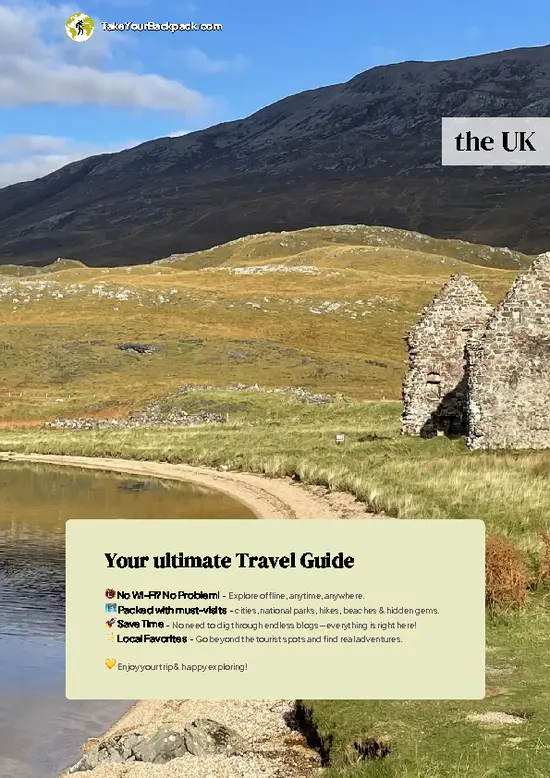
example page 0 from our offline Travel Guide for United Kingdom
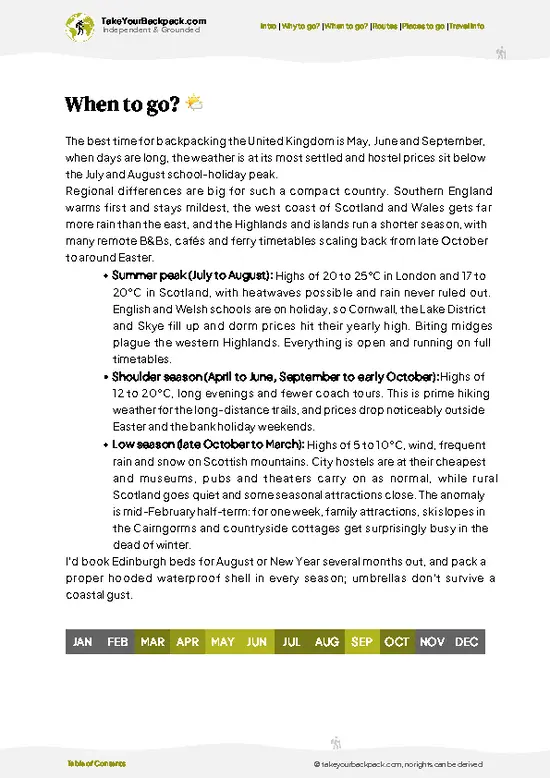
example page 1 from our offline Travel Guide for United Kingdom
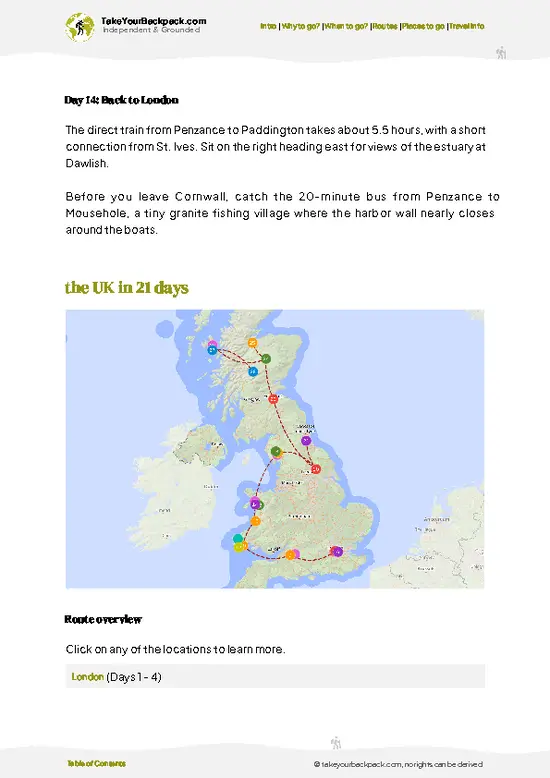
example page 2 from our offline Travel Guide for United Kingdom
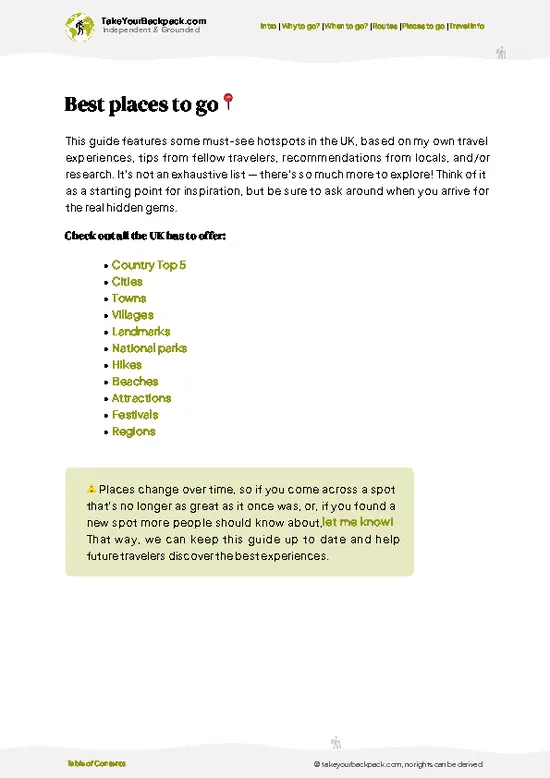
example page 3 from our offline Travel Guide for United Kingdom
example page 4 from our offline Travel Guide for United Kingdom
example page 5 from our offline Travel Guide for United Kingdom
example page 6 from our offline Travel Guide for United Kingdom
example page 7 from our offline Travel Guide for United Kingdom
The digital guide (526 pages) contains:
✅ 146 highlights, ranked by travel appeal
✅ Optimized 7, 14 & 21-day travel routes
✅ Cities, national parks, landmarks, beaches
✅ How to get around
✅ Offline-friendly for travel without Wi-Fi
👉 Click to see all 30+ guide features

📅 Plan smarter in minutes, not weeks
✅ Month by month travel advice
✅ Festivals & national holidays
✅ Budget expectations

🗺️ Go to the right places, skip the overrated ones
✅ Honest pros & cons of destinations
✅ Top hikes, parks & viewpoints
✅ Lesser-known places most travelers miss
✅ Clear “worth it vs skip it” guidance

🛏️ Travel smoothly without rookie mistakes
✅ Best areas to stay
✅ Transport systems explained simply
✅ Common scams & safety advice
✅ SIM cards, money & practical tips

🌍 Understand the country, not just visit it
✅ Culture & traditions
✅ Local customs
✅ Festivals worth planning around
✅ Traveler-friendly historical context
✅ Insights that make places more meaningful

📱 Built for real travel conditions
✅ Fully downloadable PDF
✅ Works completely offline
✅ Optimized for phone use
✅ Useful in remote areas & buses
✅ Everything in one place
Stop searching, start planning
Get instant access to your full guide. 30‑day money-back guarantee.
+ Add another guide for just

By proceeding you agree to our terms.
Sent to your inbox immediately after payment • 100% Secure Checkout
Best Backpacking Travel Advisor 2025 tourism awardBest Backpacking
Travel Advisor
2025
What others say about Take Your Backpack Guides:
⭐⭐⭐⭐⭐
Fantastic, amazing amount of information!
⭐⭐⭐⭐⭐
My goodness this is amazing, it's what I've been looking for hats off too you!
⭐⭐⭐⭐⭐
I think this is absolutely BRILLIANT
⭐⭐⭐⭐
Very complete and informative. It's still missing places, but I gotta to commend you
⭐⭐⭐⭐⭐
This is truly amazing, thank you, can't wait to explore it with my kids!
⭐⭐⭐⭐⭐
Awesome resource, thank you!
⭐⭐⭐⭐⭐
This is amazing! Can't wait to explore the ones I haven't seen
⭐⭐⭐⭐
I love this! Well done, great idea.
⭐⭐⭐⭐⭐
Thanks for taking the time to make this gem!
⭐⭐⭐⭐⭐
This might be the best website I've ever seen.
⭐⭐⭐⭐⭐
Congratulations, and thank you so much for your work; it's incredibly valuable.
⭐⭐⭐⭐
In all seriousness I think you did a great job pointing out the important spots
⭐⭐⭐⭐⭐
10/10 very good
⭐⭐⭐⭐⭐
As someone who's only just starting to visit regularly this is awesome, thank you.
⭐⭐⭐⭐
Thank you very much! I'm going to visit my dad, it's going to be very useful!
⭐⭐⭐⭐⭐
This is really cool! We'll be travelling for the first time and this definitely come in handy.
⭐⭐⭐⭐⭐
You are now our minister of culture, congratulations 👨‍💼
⭐⭐⭐⭐⭐
Just wanted to tell you that this is a pearl! Going to follow your recommendations.
⭐⭐⭐⭐⭐
This is so cool. I'll definitely be using the resource for my travels soon.
⭐⭐⭐⭐⭐
This is very impressive! Good work.
⭐⭐⭐⭐⭐
This is an amazing and informative site. Very well done!

🛏️ Where to stay?Where to Base Yourself

The United Kingdom has plenty of hostels, with London dorm beds typically £25 to 50 (US$32 to 65) a night and most other cities closer to £18 to 35 (US$23 to 45), climbing sharply on summer weekends and during the Edinburgh festivals in August. In London, King’s Cross has the best transport links and the most beds, Camden and Shoreditch put you next to late bars and live music but are loud after midnight, and Earl’s Court is quieter and handy for Heathrow on the Piccadilly line, though it is a longer ride to the East End. In Edinburgh, the Old Town puts the castle and the Royal Mile outside your door at the cost of stag-party noise, while in Glasgow the West End is calmer and studenty, with … read more 👉
The United Kingdom has plenty of hostels, with London dorm beds typically £25 to 50 (US$32 to 65) a night and most other cities closer to £18 to 35 (US$23 to 45), climbing sharply on summer weekends and during the Edinburgh festivals in August. In London, King’s Cross has the best transport links and the most beds, Camden and Shoreditch put you next to late bars and live music but are loud after midnight, and Earl’s Court is quieter and handy for Heathrow on the Piccadilly line, though it is a longer ride to the East End. In Edinburgh, the Old Town puts the castle and the Royal Mile outside your door at the cost of stag-party noise, while in Glasgow the West End is calmer and studenty, with cheap food on Byres Road and a short subway ride to the center.

If you enjoy meeting fellow travelers, consider choosing hostels with high ratings for atmosphere. On the other hand, if you prefer having your own space, a hotel might be a better option.

the UKExpand Your Journey

👋 Meet the founderWho’s Behind Take Your Backpack?

Johan, backpacker and founder of TakeYourBackpackHi, I’m Johan (Netherlands 🇳🇱), the creator of TakeYourBackpack. Over the past 3 decades, I’ve backpacked through 90+ countries across six continents, gaining extensive experience with independent travel, long-term trips, and overland routes.

This site is built on a combination of firsthand travel experience and carefully curated insights from other backpackers. Many guides are based on places I’ve personally visited, while others bring together tips, observations, and practical advice shared by trusted travelers I’ve met along the way.

The goal is to provide realistic, experience-driven guidance — not generic itineraries — so you can explore destinations with better context, clearer expectations, and more confidence.