×

Venezuela🇻🇪 | best hikesEssential 5 hikes to Explore in Venezuela

Hikes in Venezuela are tepui, Andes and coast routes, and each one is a different kind of trip. The tepui region of the Gran Sabana, in Bolívar state, gives you flat-topped sandstone mountains, waterfalls and the long Roraima approach. It is the one hike here worth building a trip around. The Andes around Mérida are cheaper, easier to reach and better for independent travel, with páramo trails, glacial lakes and Pico Bolívar (4,978 m). The Caribbean Henri Pittier and Ávila routes near Caracas and Maracay are short day walks. Skip them if time is tight. Crowds are thin everywhere, but logistics need real planning.

By Johan Kruseman 🇳🇱 | Updated October 20, 2026
Explore the best beaches in Venezuela

Why go?What Makes Them Special

Venezuela holds some of the oldest geology on Earth. The Guiana Shield tepuis are sandstone plateaus over a billion years old, rising from savanna to 2,000 to 2,800 m, and nothing in the Andes or the Alps compares with their cliffs and endemic plant life. The northern Andes add a second world: tropical páramo, with frailejón plants and cold lakes above 3,500 m, reached from a real mountain town with outfitters.

The country is strong on variety and weak on infrastructure. Trail marking, maps and rescue services are minimal outside the main national parks, and most serious routes require a licensed local guide or a permit through INPARQUES. That is not a flaw so much as a fact to budget for. Fuel shortages and irregular intercity buses mean you plan transport days ahead, and the Gran Sabana … read more 👉
Venezuela holds some of the oldest geology on Earth. The Guiana Shield tepuis are sandstone plateaus over a billion years old, rising from savanna to 2,000 to 2,800 m, and nothing in the Andes or the Alps compares with their cliffs and endemic plant life. The northern Andes add a second world: tropical páramo, with frailejón plants and cold lakes above 3,500 m, reached from a real mountain town with outfitters.

The country is strong on variety and weak on infrastructure. Trail marking, maps and rescue services are minimal outside the main national parks, and most serious routes require a licensed local guide or a permit through INPARQUES. That is not a flaw so much as a fact to budget for. Fuel shortages and irregular intercity buses mean you plan transport days ahead, and the Gran Sabana is far from everything else.

Travelers should also know that US dollars in small bills are the working currency for guides and food, and that card payments and ATMs are unreliable. Foreign-government travel advisories vary, so check your own before you commit. If you want polished huts, signposts and guaranteed schedules, Peru or Argentina suit you better. If you want remote, uncrowded mountains at low prices, Venezuela delivers.
Our Approach to Ranking
The list of best hikes in Venezuela is created based on scenery, challenge, trail quality, landmarks, and overall enjoyment. If you feel a hike is missing in this list, please let us know.

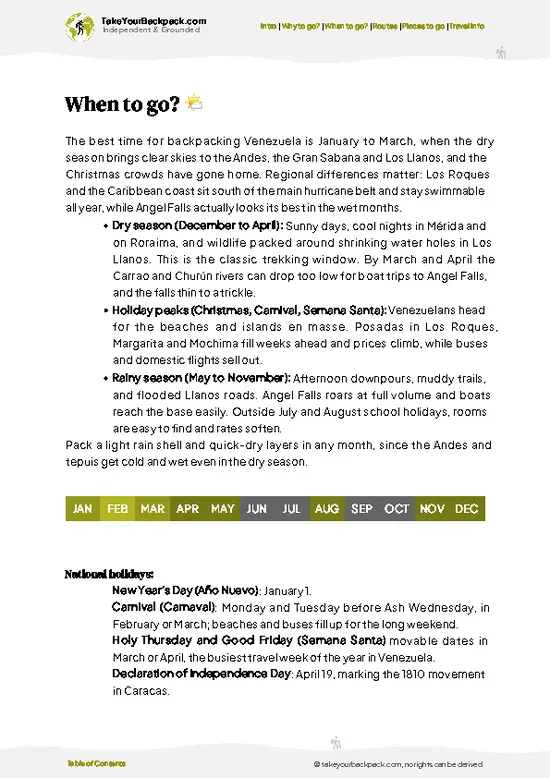
When to go?Best Time to Visit Venezuela for hikes

Best months for hiking: The best months for hikes in Venezuela are December to April, the dry season, when skies in the Andes and Gran Sabana are clearest and trails are firmest. Tepui trails stay wet even then, so expect rain showers on the plateaus at any time of year.
Weather by region: In the Mérida Andes, days at 3,500 to 4,000 m run roughly 8 to 15°C, and nights at the lakes and páramo often fall below freezing, especially from December to February. Pico Bolívar and the high routes need a proper sleeping bag and shell. In the Gran Sabana, valley temperatures sit around 20 to 28°C, but the summit plateaus drop to about 8 to 12°C at night and rain falls most days of the wet season.
Shoulder and wet season: May and November are workable shoulder months, with fewer people and slightly more … read more 👉
Best months for hiking: The best months for hikes in Venezuela are December to April, the dry season, when skies in the Andes and Gran Sabana are clearest and trails are firmest. Tepui trails stay wet even then, so expect rain showers on the plateaus at any time of year.
Weather by region: In the Mérida Andes, days at 3,500 to 4,000 m run roughly 8 to 15°C, and nights at the lakes and páramo often fall below freezing, especially from December to February. Pico Bolívar and the high routes need a proper sleeping bag and shell. In the Gran Sabana, valley temperatures sit around 20 to 28°C, but the summit plateaus drop to about 8 to 12°C at night and rain falls most days of the wet season.
Shoulder and wet season: May and November are workable shoulder months, with fewer people and slightly more afternoon cloud. June to October brings heavy rain, up to several hundred millimeters a month in the Gran Sabana. Rivers on the Roraima approach swell, crossings can be delayed or closed, and views disappear. Skip the tepuis in July and August unless you accept a fogged summit.
Crowds and prices: Peak pressure comes at Christmas, Carnival and Semana Santa, when Mérida buses and guesthouses fill and guide rates can rise. Outside those weeks, trails are quiet year-round.

hike hoppingTips for Visiting Multiple Destinations

How many days to plan: A trip combining several hikes in Venezuela needs 12 to 18 days, because the main regions are far apart and transport is slow. Anything shorter turns into bus time.
Regions and direction: Three clusters exist: the Andes around Mérida, the Gran Sabana near Santa Elena de Uairén, and the central coast near Caracas and Maracay. Start in the Andes to acclimatize at altitude, with 4 to 6 days for a páramo trek and a rest day in Mérida. Then head east for the tepuis, which need 6 to 8 days including the approach and a buffer for river levels. Use Caracas as the hub, since flights and long-distance buses connect through it.
Getting between regions: Mérida to Caracas by overnight bus takes roughly 11 to 14 hours. Caracas to Santa Elena de Uairén takes about 14 to 18 hours by road … read more 👉
How many days to plan: A trip combining several hikes in Venezuela needs 12 to 18 days, because the main regions are far apart and transport is slow. Anything shorter turns into bus time.
Regions and direction: Three clusters exist: the Andes around Mérida, the Gran Sabana near Santa Elena de Uairén, and the central coast near Caracas and Maracay. Start in the Andes to acclimatize at altitude, with 4 to 6 days for a páramo trek and a rest day in Mérida. Then head east for the tepuis, which need 6 to 8 days including the approach and a buffer for river levels. Use Caracas as the hub, since flights and long-distance buses connect through it.
Getting between regions: Mérida to Caracas by overnight bus takes roughly 11 to 14 hours. Caracas to Santa Elena de Uairén takes about 14 to 18 hours by road via Ciudad Bolívar, and delays are common. The coastal park near Maracay is 2 to 3 hours from Caracas and works as a single side day.
Planning mistakes: The first is cramming all three regions into ten days. Drop the coast and keep the other two. The second is booking an onward flight the day after a tepui return, when river delays can eat 24 hours. Leave a spare day. The third is going into the Andes without acclimatization: spend a night at 1,600 m in Mérida before climbing. Reserve guides and bus tickets two or three days ahead, and keep cash in small US bills for each leg.

The ListTop hikes of Venezuela

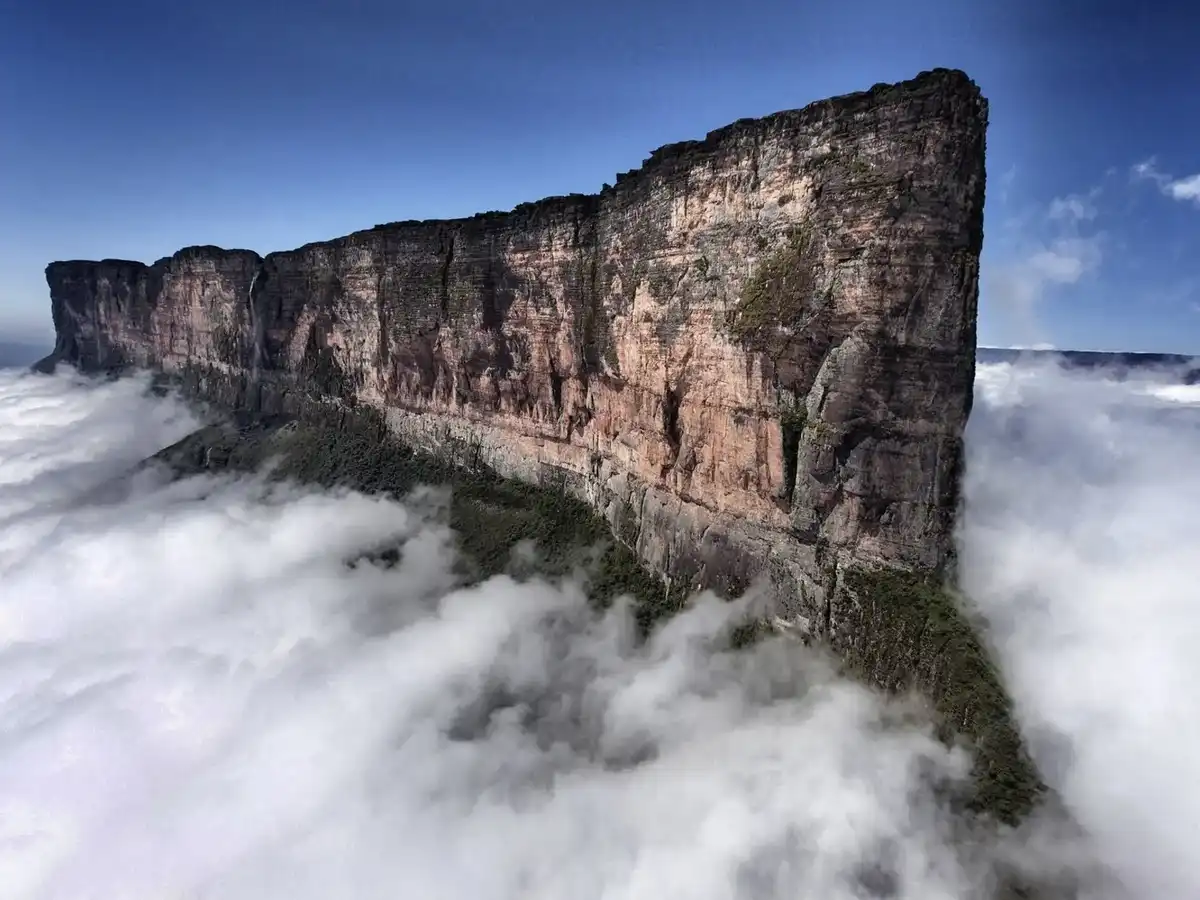
1 Mount Roraima

Tepui summit, Pemón-guided trek, quartz pools, Punto Triple

Climb a diagonal cliff ledge onto a black-rock plateau, where crystal fields, sunken pools and a three-country border marker await.

venezuela-hike-mount-roraima
© Google | Sayeh Co

2 Pico Humboldt

Guided ascent, 4,940 meter summit, glacial lakes, Mérida departure

Camp beside green-blue glacial lakes, then scramble over rock and ice remnants to a summit facing Pico Bolívar across the range.

3 Los Nevados Trail

Multi-day páramo trek, Pico Bolívar views, mule-track village, posada nights

Cross frosty highland plateaus beneath Venezuela’s tallest peak, passing glacial lagoons before sleeping in a whitewashed mountain village.

venezuela-hike-los-nevados-trail
© Google |

4 Laguna de Mucubají Trail

Alpine lakeshore loop, frailejón fields, Laguna Negra extension, mirror dawns

Circle a high-altitude lake on flat ground, then climb through silver-leaved páramo to a darker glacial pool beneath rock walls.

venezuela-hike-laguna-de-mucubaji-trail
© Google |

5 Pico Naiguatá

Coastal cordillera, cloud forest, exposed ridge, dawn camp

Push through dripping tree-fern forest onto a rocky crest, with the Caribbean on one side and the Caracas valley on the other.

venezuela-hike-pico-naiguata
© Google |
Loading the map 🌍

Expert viewInsights from Locals and Experts

How many hikes to do: I advise two or three hikes in total. That is enough to cover one tepui or high Andean objective plus a shorter acclimatization or coastal walk, without spending half the trip on buses. A fourth rarely adds anything because the travel between regions is slow and unpredictable.
Choosing by travel style: If you want the signature Venezuelan experience, prioritize a tepui trek in the Gran Sabana and give it the most days. If you are on a tight budget or short on time, prioritize the Mérida Andes, where trailheads are an hour or two from town and you can go with a small outfitter. Skip the busy Caracas-area routes if you have under two weeks. They are pleasant day walks, but nothing you will remember compared with the other two.
What it costs: Expect US$25 to 50 a day on the … read more 👉
How many hikes to do: I advise two or three hikes in total. That is enough to cover one tepui or high Andean objective plus a shorter acclimatization or coastal walk, without spending half the trip on buses. A fourth rarely adds anything because the travel between regions is slow and unpredictable.
Choosing by travel style: If you want the signature Venezuelan experience, prioritize a tepui trek in the Gran Sabana and give it the most days. If you are on a tight budget or short on time, prioritize the Mérida Andes, where trailheads are an hour or two from town and you can go with a small outfitter. Skip the busy Caracas-area routes if you have under two weeks. They are pleasant day walks, but nothing you will remember compared with the other two.
What it costs: Expect US$25 to 50 a day on the ground, with guesthouse beds at US$10 to 25 and meals at US$3 to 8. A guided multi-day tepui trek typically costs US$200 to 450 per person depending on group size, and includes guide, porters, food and camping. Andean guided treks run about US$60 to 120 a day. INPARQUES park fees are small, usually a few dollars, and are often collected in cash. Intercity buses run US$10 to 30 a leg, and a 4x4 or jeep transfer to a trailhead adds US$20 to 50 per person when shared. For a three-hike trip, plan US$700 to 1,300 in total, excluding international flights.
Costs and mistakes that catch people out: The biggest drain is cash. ATMs are unreliable and foreign cards often fail, so bring clean US$1, 5, 10 and 20 bills, enough for the whole trip. Prices quoted in bolívars shift fast, so agree rates in dollars in writing. Booking tepui trips with the first agency in Santa Elena without comparing two or three often adds US$50 to 100 for the same route. Confirm what is included, especially food and porters, before paying a deposit.
Safety and culture: Always hike with a licensed local guide on tepuis and above the treeline in the Andes. Weather turns fast, trails vanish in fog, and river crossings change by the hour. Check your government’s advisory and keep valuables out of sight in cities such as Caracas; travel in daylight and avoid night walking in towns. Carry a copy of your passport, because military and national guard checkpoints on main roads are routine and polite cooperation speeds them up. Ask before photographing Pemón communities in the Gran Sabana, and buy crafts directly from them. Pack out all trash, and carry altitude medication advice from your doctor for Andes treks above 4,000 m.

✈️ The backpacker research shortcutVenezuela Travel Guide

An offline-friendly backpacking guide with optimized travel routes, ranked highlights, transport advice, and the best areas to stay.
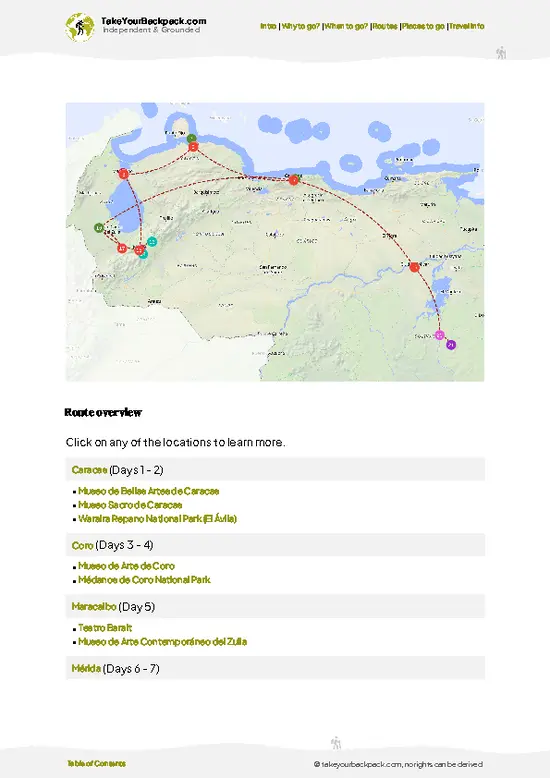
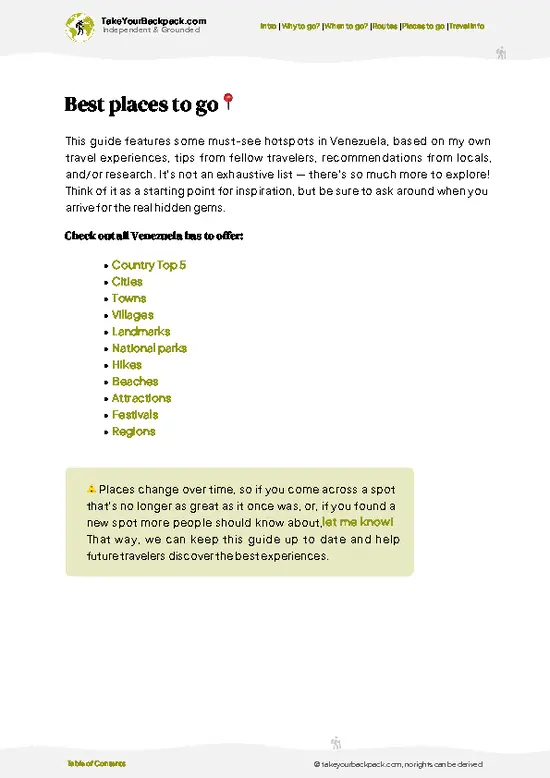
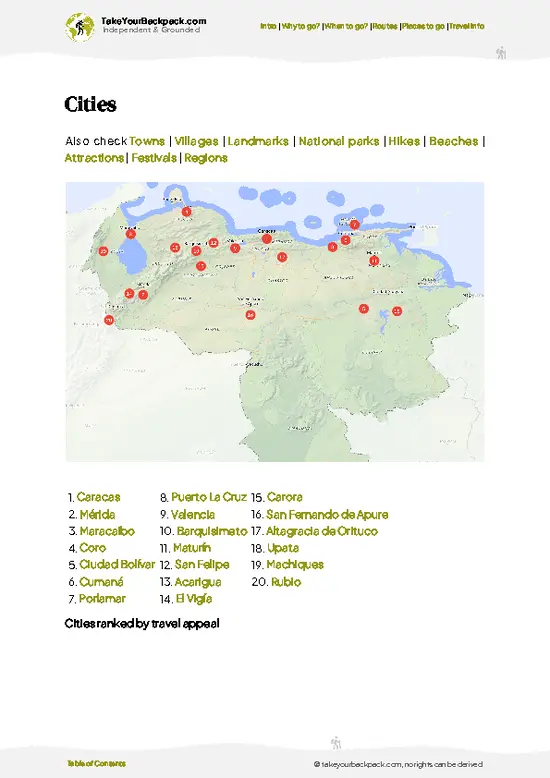
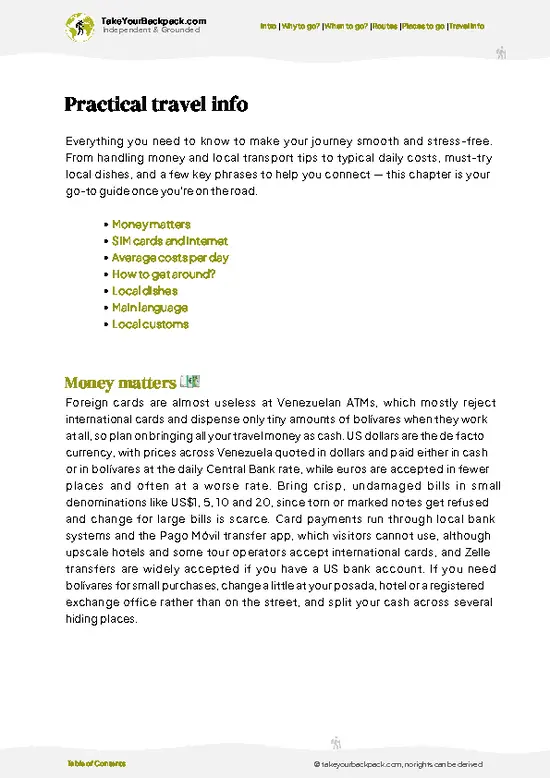
example page 0 from our offline Travel Guide for Venezuela
example page 1 from our offline Travel Guide for Venezuela
example page 2 from our offline Travel Guide for Venezuela
example page 3 from our offline Travel Guide for Venezuela
example page 4 from our offline Travel Guide for Venezuela
example page 5 from our offline Travel Guide for Venezuela
example page 6 from our offline Travel Guide for Venezuela
example page 7 from our offline Travel Guide for Venezuela
The digital guide (290 pages) contains:
✅ 91 highlights, ranked by travel appeal
✅ Optimized 5, 10 & 15-day travel routes
✅ Cities, national parks, landmarks, beaches
✅ How to get around
✅ Offline-friendly for travel without Wi-Fi
👉 Click to see all 30+ guide features

📅 Plan smarter in minutes, not weeks
✅ Month by month travel advice
✅ Festivals & national holidays
✅ Budget expectations

🗺️ Go to the right places, skip the overrated ones
✅ Honest pros & cons of destinations
✅ Top hikes, parks & viewpoints
✅ Lesser-known places most travelers miss
✅ Clear “worth it vs skip it” guidance

🛏️ Travel smoothly without rookie mistakes
✅ Best areas to stay
✅ Transport systems explained simply
✅ Common scams & safety advice
✅ SIM cards, money & practical tips

🌍 Understand the country, not just visit it
✅ Culture & traditions
✅ 52 Essential phrases & customs
✅ Festivals worth planning around
✅ Traveler-friendly historical context
✅ Insights that make places more meaningful

📱 Built for real travel conditions
✅ Fully downloadable PDF
✅ Works completely offline
✅ Optimized for phone use
✅ Useful in remote areas & buses
✅ Everything in one place
Stop searching, start planning
Get instant access to your full guide. 30‑day money-back guarantee.
+ Add another guide for just

By proceeding you agree to our terms.
Sent to your inbox immediately after payment • 100% Secure Checkout
Best Backpacking Travel Advisor 2025 tourism awardBest Backpacking
Travel Advisor
2025
What others say about Take Your Backpack Guides:
⭐⭐⭐⭐⭐
Fantastic, amazing amount of information!
⭐⭐⭐⭐⭐
My goodness this is amazing, it's what I've been looking for hats off too you!
⭐⭐⭐⭐⭐
I think this is absolutely BRILLIANT
⭐⭐⭐⭐
Very complete and informative. It's still missing places, but I gotta to commend you
⭐⭐⭐⭐⭐
This is truly amazing, thank you, can't wait to explore it with my kids!
⭐⭐⭐⭐⭐
Awesome resource, thank you!
⭐⭐⭐⭐⭐
This is amazing! Can't wait to explore the ones I haven't seen
⭐⭐⭐⭐
I love this! Well done, great idea.
⭐⭐⭐⭐⭐
Thanks for taking the time to make this gem!
⭐⭐⭐⭐⭐
This might be the best website I've ever seen.
⭐⭐⭐⭐⭐
Congratulations, and thank you so much for your work; it's incredibly valuable.
⭐⭐⭐⭐
In all seriousness I think you did a great job pointing out the important spots
⭐⭐⭐⭐⭐
10/10 very good
⭐⭐⭐⭐⭐
As someone who's only just starting to visit regularly this is awesome, thank you.
⭐⭐⭐⭐
Thank you very much! I'm going to visit my dad, it's going to be very useful!
⭐⭐⭐⭐⭐
This is really cool! We'll be travelling for the first time and this definitely come in handy.
⭐⭐⭐⭐⭐
You are now our minister of culture, congratulations 👨‍💼
⭐⭐⭐⭐⭐
Just wanted to tell you that this is a pearl! Going to follow your recommendations.
⭐⭐⭐⭐⭐
This is so cool. I'll definitely be using the resource for my travels soon.
⭐⭐⭐⭐⭐
This is very impressive! Good work.
⭐⭐⭐⭐⭐
This is an amazing and informative site. Very well done!

🛏️ Where to stay?Where to Base Yourself

Backpacking Venezuela means sleeping mostly in family-run posadas rather than dorm hostels, with private doubles typically around US$15 to 40 a night and only a handful of true dorms, mostly in the Andes and on the coast. In Caracas, Chacao, Altamira and Los Palos Grandes have the most options plus the city’s safest streets, walkable cafés and its best nightlife, though prices run higher and the historic center is a metro ride away. Mérida has the cheapest, most traveler-friendly posadas, clustered around the center near Plaza Bolívar close to tour agencies and the cable car, while beach towns like Choroní and the islands of Los Roques offer quiet posadas with little nightlife, and Los Roques … read more 👉
Backpacking Venezuela means sleeping mostly in family-run posadas rather than dorm hostels, with private doubles typically around US$15 to 40 a night and only a handful of true dorms, mostly in the Andes and on the coast. In Caracas, Chacao, Altamira and Los Palos Grandes have the most options plus the city’s safest streets, walkable cafés and its best nightlife, though prices run higher and the historic center is a metro ride away. Mérida has the cheapest, most traveler-friendly posadas, clustered around the center near Plaza Bolívar close to tour agencies and the cable car, while beach towns like Choroní and the islands of Los Roques offer quiet posadas with little nightlife, and Los Roques costs far more.

If you enjoy meeting fellow travelers, consider choosing hostels with high ratings for atmosphere. On the other hand, if you prefer having your own space, a hotel might be a better option.

VenezuelaExpand Your Journey

👋 Meet the founderWho’s Behind Take Your Backpack?

Johan, backpacker and founder of TakeYourBackpackHi, I’m Johan (Netherlands 🇳🇱), the creator of TakeYourBackpack. Over the past 3 decades, I’ve backpacked through 90+ countries across six continents, gaining extensive experience with independent travel, long-term trips, and overland routes.

This site is built on a combination of firsthand travel experience and carefully curated insights from other backpackers. Many guides are based on places I’ve personally visited, while others bring together tips, observations, and practical advice shared by trusted travelers I’ve met along the way.

The goal is to provide realistic, experience-driven guidance — not generic itineraries — so you can explore destinations with better context, clearer expectations, and more confidence.