×

Yemen🇾🇪 | best attractionsBest 10 attractions in Yemen

Attractions in Yemen are walled cities, mud-brick towers and island wilderness, not museums and ticket booths. The experience changes sharply by region. The northern highlands around Sana’a are cool, dense with medieval architecture and the easiest on foot. The Hadramawt valleys are hotter, quieter and far costlier to reach. Socotra is the only place with a working tourism setup, but it is pricey and arranged through operators. Crowds are close to zero everywhere. Independent backpacking is not realistic at present, because permits, escorts and shifting security lines decide what is open. Skip anything you cannot reach with a vetted local agent.

By Johan Kruseman 🇳🇱 | Updated October 19, 2026
Explore the best festivals in Yemen

Why go?Why Travelers Love These Spots

Yemen’s appeal comes from geography and isolation. Mountains above 2,000 meters held Himyarite and Islamic-era settlements, while desert wadis and the Indian Ocean shaped trading towns and a separate island ecosystem. That produced architecture and landscapes found nowhere else on the Arabian Peninsula, built in stone, mud brick and gypsum without foreign templates.

What it lacks is infrastructure and stability. Since the civil war escalated in 2015, the country has been split between rival authorities, and most governments advise against all travel. There are no independent tourist services, no reliable ATMs and no public information boards. Roads cross checkpoints, front lines and areas with landmines. Do not choose Yemen for a casual add-on to a regional trip. It is not worth the time unless … read more 👉
Yemen’s appeal comes from geography and isolation. Mountains above 2,000 meters held Himyarite and Islamic-era settlements, while desert wadis and the Indian Ocean shaped trading towns and a separate island ecosystem. That produced architecture and landscapes found nowhere else on the Arabian Peninsula, built in stone, mud brick and gypsum without foreign templates.

What it lacks is infrastructure and stability. Since the civil war escalated in 2015, the country has been split between rival authorities, and most governments advise against all travel. There are no independent tourist services, no reliable ATMs and no public information boards. Roads cross checkpoints, front lines and areas with landmines. Do not choose Yemen for a casual add-on to a regional trip. It is not worth the time unless you accept that plans can collapse at short notice.

Know three things before committing. Entry usually requires a visa and a local sponsor or licensed operator. Insurance is hard to obtain, and many policies exclude the country. Conditions differ between areas controlled by the Houthi authorities in the north and the internationally recognized government in the south, so paperwork for one does not cover the other.
Our Approach to Ranking
The list of best attractions in Yemen is created based on cultural significance or entertainment value. If you feel a attraction is missing in this list, please let us know.

When to go?Timing Your Visit for the Best Experience

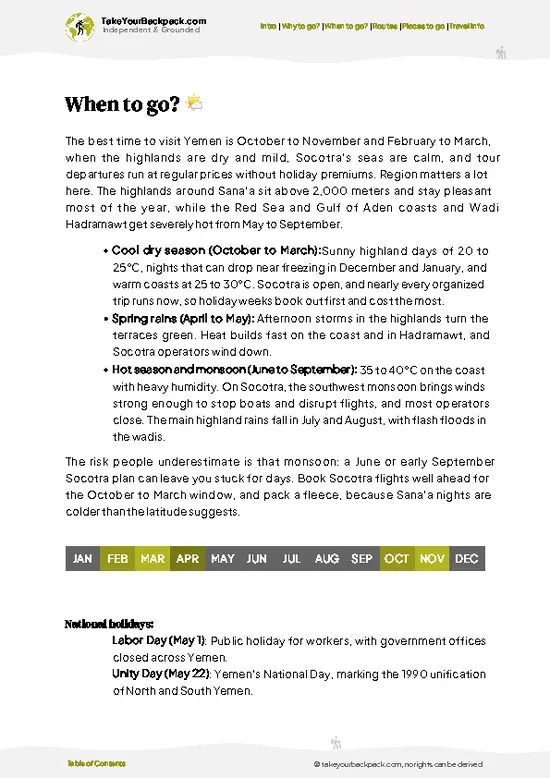
Best months for Yemen’s attractions: October to March is the best window across most of the country, because highland days sit around 18 to 26°C and rain is minimal, while the coast and desert drop below their punishing summer heat. Sana’a at roughly 2,250 meters gets cold nights in December and January, often 0 to 5°C, so pack a real jacket.

Regional differences: The highlands have a wet season from July to August, with a lighter one around March to April. Afternoon downpours can wash out mountain tracks and make dirt roads slow or impassable. Skip the Tihama coastal plain and the Red Sea lowlands between May and September, when temperatures reach 38 to 45°C with heavy humidity. Hadramawt’s interior also exceeds 40°C in summer, so visit from November to February.

Socotra has its own calendar. … read more 👉
Best months for Yemen’s attractions: October to March is the best window across most of the country, because highland days sit around 18 to 26°C and rain is minimal, while the coast and desert drop below their punishing summer heat. Sana’a at roughly 2,250 meters gets cold nights in December and January, often 0 to 5°C, so pack a real jacket.

Regional differences: The highlands have a wet season from July to August, with a lighter one around March to April. Afternoon downpours can wash out mountain tracks and make dirt roads slow or impassable. Skip the Tihama coastal plain and the Red Sea lowlands between May and September, when temperatures reach 38 to 45°C with heavy humidity. Hadramawt’s interior also exceeds 40°C in summer, so visit from November to February.

Socotra has its own calendar. The southwest monsoon from roughly June to September brings gale-force winds, rough seas and disrupted flights, so the island is not worth planning for then. October to April is the usable season, with the calmest conditions from about November to March.

Prices and crowds: Crowds do not exist, so timing never affects entry. Costs do change. Socotra tours priced for the dry season climb when flights are limited, and last-minute bookings in peak months can cost 10 to 20 percent more. Ramadan shortens working hours and slows local services, so schedule around it.

attraction hoppingHow to Combine attractions Into One Trip

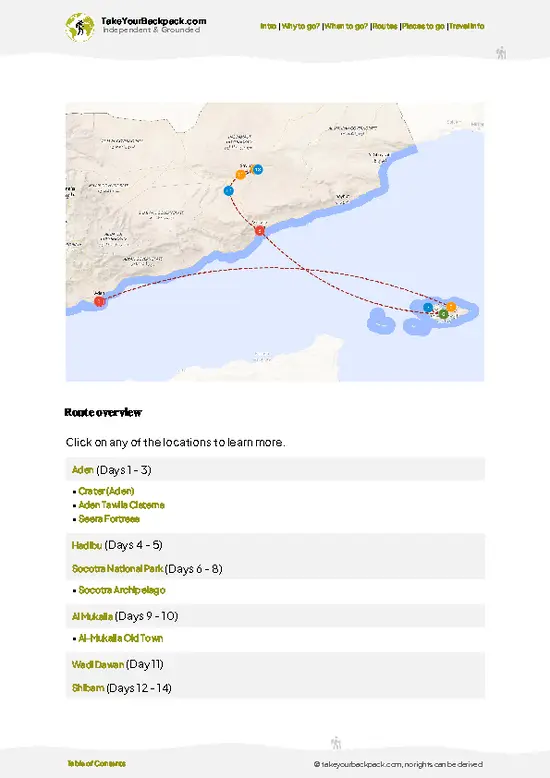
How long a combined trip takes: A trip combining several regions needs 10 to 14 days, and anything shorter forces long drives on poor roads. Combine by region, not by checklist. The northern highlands cluster naturally, with 3 to 4 days covering Sana’a and nearby mountain towns, and each stop deserves half a day to a full day. Socotra needs 5 to 7 days on its own because roads are rough and weather can delay movement. Hadramawt needs 3 to 4 days, plus buffer.

Direction and transport: Do not try to link north and south overland. Front lines and checkpoints make the crossing slow, unpredictable and sometimes closed, so treat them as separate trips. Fly between hubs where services run, such as Aden, Seiyun or Sana’a, and confirm schedules close to departure. Typical drive times are 4 to 6 hours … read more 👉
How long a combined trip takes: A trip combining several regions needs 10 to 14 days, and anything shorter forces long drives on poor roads. Combine by region, not by checklist. The northern highlands cluster naturally, with 3 to 4 days covering Sana’a and nearby mountain towns, and each stop deserves half a day to a full day. Socotra needs 5 to 7 days on its own because roads are rough and weather can delay movement. Hadramawt needs 3 to 4 days, plus buffer.

Direction and transport: Do not try to link north and south overland. Front lines and checkpoints make the crossing slow, unpredictable and sometimes closed, so treat them as separate trips. Fly between hubs where services run, such as Aden, Seiyun or Sana’a, and confirm schedules close to departure. Typical drive times are 4 to 6 hours between Sana’a and the Tihama coast, and 8 hours or more between Aden and Mukalla. Aden to the Hadramawt interior is a long day or more by road.

Planning mistakes: The biggest mistake is squeezing in too many stops. A single delayed escort or checkpoint can eat a day, so schedule one spare day for every four to five days planned. Another is booking tight onward flights after Socotra, since weather cancellations are common. Leave 24 to 48 hours of slack, and build the trip around one region rather than three.

The ListThe Best attractions of Yemen

1 Old City of Sana’a

mudbrick towers, stained glass windows, labyrinthine streets

Wander through a UNESCO-listed district where multi-story homes and intricate facades showcase centuries of urban tradition.

2 Old Walled City of Shibam

mud skyscrapers, fortified walls, desert oasis

Walk among vertical earthen towers rising from the desert, illustrating unique urban planning adapted to harsh environmental conditions.

3 Bab al-Yemen

stone gateway, market stalls, city entrance

Enter Sana’a’s old city through a monumental gate, then navigate a maze of market alleys filled with textiles, spices, and local crafts.

4 Historic Town of Zabid

brick alleys, ancient schools, mosque courtyards

Navigate a compact town center where educational institutions and religious sites reflect a long tradition of scholarship and community life.

5 Aden Tawila Cisterns

ancient reservoirs, volcanic rock, city backdrop

Trace the engineering of ancient water storage systems set against dramatic black cliffs, offering insight into Aden’s adaptation to arid terrain.

6 Al Saleh Mosque

grand prayer hall, marble courtyards, ornate minarets

Admire intricate architectural details and expansive interiors that reflect modern craftsmanship and religious significance in Yemen’s capital.

7 Seera Fortress

hilltop stronghold, sea views, stone battlements

Climb to a coastal fortress overlooking Aden’s harbor, where thick walls and vantage points recall its strategic maritime role.

8 Al-Mukalla Old Town

whitewashed facades, Indian Ocean harbor, narrow lanes

Stroll through a portside district where trade history, coastal architecture, and bustling alleys converge along the Arabian Sea.

9 Great Mosque of Sana’a

early Islamic architecture, carved wooden doors, prayer halls

Step inside one of the world’s oldest mosques, where understated design and historic inscriptions offer a glimpse into early Islamic culture.

10 Crater (Aden)

colonial facades, hillside streets, layered history

Survey a district shaped by foreign rule, where architectural styles and urban layout reflect shifting influences over centuries.

11 Bustan al-Qasimi

stepped fields, irrigation channels, mountain agriculture

Walk among cultivated terraces that demonstrate centuries-old farming techniques and sustainable water management in Yemen’s uplands.

12 National Museum of Yemen

pre-Islamic artifacts, royal regalia, Sana’a palace

View archaeological finds, ancient inscriptions, and objects from Yemen’s dynastic past housed in a former royal residence.

13 Military Museum

war relics, uniforms, national history exhibits

Browse displays of weaponry, documents, and artifacts that chart Yemen’s military evolution and pivotal moments in its modern era.

Think you know Yemen?

Prove you’re a true local — uncover 3 lesser-known attractions in Yemen that locals tend to keep to themselves.
Loading the map 🌍

Expert viewTips and Advice from Travelers

How many attractions to plan: Plan for one region and four to six sites in total. Permits, escorts and checkpoint delays consume hours, and every extra stop adds risk and cost. Anything beyond that gets rushed and ends up mostly as time in vehicles.

Choosing by travel style: First-timers to the country are better served by Socotra or the northern highlands, where operators already run set programs. History-focused travelers should put the old walled towns and mud-brick cities first, and skip anything lacking a confirmed local contact. Nature and hiking travelers should choose Socotra, but only in the dry season. Skip trips built around museums, which are often closed or damaged, and avoid areas near active fighting, even if an operator says they are safe.

What it costs: Expect US$100 to 250 … read more 👉
How many attractions to plan: Plan for one region and four to six sites in total. Permits, escorts and checkpoint delays consume hours, and every extra stop adds risk and cost. Anything beyond that gets rushed and ends up mostly as time in vehicles.

Choosing by travel style: First-timers to the country are better served by Socotra or the northern highlands, where operators already run set programs. History-focused travelers should put the old walled towns and mud-brick cities first, and skip anything lacking a confirmed local contact. Nature and hiking travelers should choose Socotra, but only in the dry season. Skip trips built around museums, which are often closed or damaged, and avoid areas near active fighting, even if an operator says they are safe.

What it costs: Expect US$100 to 250 a day for a vehicle, driver, guide, accommodation and escort when booked through an operator. Socotra packages commonly run US$1,200 to 2,500 for a week, usually including camping or basic guesthouses, meals and transfers, but not international flights. Entry fees at sites are small, usually US$2 to 10, with guide fees often US$30 to 60 a day on top. Bring a large reserve of clean US dollars in cash, since cards and ATMs for foreigners are unreliable. Rial exchange rates differ sharply between the north and the south, so agree on prices in dollars before you pay and check which rate applies.

Costs and delays that catch travelers out: Permit fees and sponsor arrangements are the most common surprise. Confirm in writing what the package covers, including escort fees, fuel and permits, and what happens if a flight is canceled. Weather and security delays are normal, so budget at least one extra day of accommodation and food, about US$50 to 100. Checkpoint stops can add hours, so keep passport copies, permit paperwork and the operator’s contact details handy at all times.

Safety and cultural considerations: Most governments advise against travel, and standard insurance often excludes it. Arrange specialist cover or an evacuation plan before you go. Kidnapping, landmines and militant activity are real risks in parts of the country, and the situation changes quickly, so follow your operator’s advice on routes and daily movement. Do not wander off-road or into areas without a local escort.

Dress modestly. Long trousers and sleeves are expected, and women should carry a headscarf and a loose long top. Ask before photographing people, and never photograph soldiers, checkpoints or military sites. Alcohol is unavailable, and public behavior is conservative. Afternoon qat sessions are a major social ritual, and declining politely is fine.

✈️ The backpacker research shortcutYemen Travel Guide

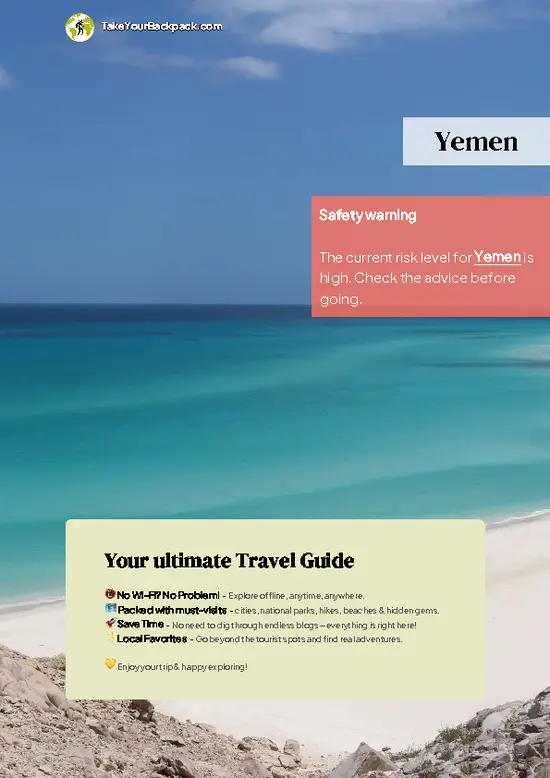
An offline-friendly backpacking guide with optimized travel routes, ranked highlights, transport advice, and the best areas to stay.
example page 0 from our offline Travel Guide for Yemen
example page 1 from our offline Travel Guide for Yemen
example page 2 from our offline Travel Guide for Yemen
example page 3 from our offline Travel Guide for Yemen
example page 4 from our offline Travel Guide for Yemen
example page 5 from our offline Travel Guide for Yemen
example page 6 from our offline Travel Guide for Yemen
example page 7 from our offline Travel Guide for Yemen
The digital guide (223 pages) contains:
✅ 54 highlights, ranked by travel appeal
✅ Optimized 5, 10 & 15-day travel routes
✅ Cities, national parks, landmarks, beaches
✅ How to get around
✅ Offline-friendly for travel without Wi-Fi
👉 Click to see all 30+ guide features

📅 Plan smarter in minutes, not weeks
✅ Month by month travel advice
✅ Festivals & national holidays
✅ Budget expectations

🗺️ Go to the right places, skip the overrated ones
✅ Honest pros & cons of destinations
✅ Top hikes, parks & viewpoints
✅ Lesser-known places most travelers miss
✅ Clear “worth it vs skip it” guidance

🛏️ Travel smoothly without rookie mistakes
✅ Best areas to stay
✅ Transport systems explained simply
✅ Common scams & safety advice
✅ SIM cards, money & practical tips

🌍 Understand the country, not just visit it
✅ Culture & traditions
✅ 52 Essential phrases & customs
✅ Festivals worth planning around
✅ Traveler-friendly historical context
✅ Insights that make places more meaningful

📱 Built for real travel conditions
✅ Fully downloadable PDF
✅ Works completely offline
✅ Optimized for phone use
✅ Useful in remote areas & buses
✅ Everything in one place
Stop searching, start planning
Get instant access to your full guide. 30‑day money-back guarantee.
+ Add another guide for just

By proceeding you agree to our terms.
Sent to your inbox immediately after payment • 100% Secure Checkout
Best Backpacking Travel Advisor 2025 tourism awardBest Backpacking
Travel Advisor
2025
What others say about Take Your Backpack Guides:
⭐⭐⭐⭐⭐
Fantastic, amazing amount of information!
⭐⭐⭐⭐⭐
My goodness this is amazing, it's what I've been looking for hats off too you!
⭐⭐⭐⭐⭐
I think this is absolutely BRILLIANT
⭐⭐⭐⭐
Very complete and informative. It's still missing places, but I gotta to commend you
⭐⭐⭐⭐⭐
This is truly amazing, thank you, can't wait to explore it with my kids!
⭐⭐⭐⭐⭐
Awesome resource, thank you!
⭐⭐⭐⭐⭐
This is amazing! Can't wait to explore the ones I haven't seen
⭐⭐⭐⭐
I love this! Well done, great idea.
⭐⭐⭐⭐⭐
Thanks for taking the time to make this gem!
⭐⭐⭐⭐⭐
This might be the best website I've ever seen.
⭐⭐⭐⭐⭐
Congratulations, and thank you so much for your work; it's incredibly valuable.
⭐⭐⭐⭐
In all seriousness I think you did a great job pointing out the important spots
⭐⭐⭐⭐⭐
10/10 very good
⭐⭐⭐⭐⭐
As someone who's only just starting to visit regularly this is awesome, thank you.
⭐⭐⭐⭐
Thank you very much! I'm going to visit my dad, it's going to be very useful!
⭐⭐⭐⭐⭐
This is really cool! We'll be travelling for the first time and this definitely come in handy.
⭐⭐⭐⭐⭐
You are now our minister of culture, congratulations 👨‍💼
⭐⭐⭐⭐⭐
Just wanted to tell you that this is a pearl! Going to follow your recommendations.
⭐⭐⭐⭐⭐
This is so cool. I'll definitely be using the resource for my travels soon.
⭐⭐⭐⭐⭐
This is very impressive! Good work.
⭐⭐⭐⭐⭐
This is an amazing and informative site. Very well done!

🛏️ Where to stay?Top Places to Consider Staying

Yemen has no backpacker hostel scene, so budget travel here means simple local hotels and guesthouses (roughly US$20 to 50 a night for a private room) plus tour-run campsites on Socotra, where most beds sit in Hadibu, the island’s small, quiet main town and the practical base for day trips to the beaches and plateaus. In Aden, Crater puts you among the old markets and the cheapest rooms but feels cramped and noisy, while Khormaksar is calmer, closer to the airport and the seafront, and has the newer, pricier hotels. Further east, Mukalla has the widest spread of mid-range rooms along its seafront corniche, and Seiyun is the best-equipped stop in Hadramawt for reaching Shibam and Tarim, though … read more 👉
Yemen has no backpacker hostel scene, so budget travel here means simple local hotels and guesthouses (roughly US$20 to 50 a night for a private room) plus tour-run campsites on Socotra, where most beds sit in Hadibu, the island’s small, quiet main town and the practical base for day trips to the beaches and plateaus. In Aden, Crater puts you among the old markets and the cheapest rooms but feels cramped and noisy, while Khormaksar is calmer, closer to the airport and the seafront, and has the newer, pricier hotels. Further east, Mukalla has the widest spread of mid-range rooms along its seafront corniche, and Seiyun is the best-equipped stop in Hadramawt for reaching Shibam and Tarim, though nightlife anywhere in the country is limited to evening tea and seafront strolls.

If you enjoy meeting fellow travelers, consider choosing hostels with high ratings for atmosphere. On the other hand, if you prefer having your own space, a hotel might be a better option.

YemenMore Places Across Yemen

👋 Meet the founderWho’s Behind Take Your Backpack?

Johan, backpacker and founder of TakeYourBackpackHi, I’m Johan (Netherlands 🇳🇱), the creator of TakeYourBackpack. Over the past 3 decades, I’ve backpacked through 90+ countries across six continents, gaining extensive experience with independent travel, long-term trips, and overland routes.

This site is built on a combination of firsthand travel experience and carefully curated insights from other backpackers. Many guides are based on places I’ve personally visited, while others bring together tips, observations, and practical advice shared by trusted travelers I’ve met along the way.

The goal is to provide realistic, experience-driven guidance — not generic itineraries — so you can explore destinations with better context, clearer expectations, and more confidence.