×

Yemen🇾🇪 | best landmarksBest landmarks in Yemen

Landmarks in Yemen fall into three groups, and only one is realistically open to a backpacker. Socotra is reached by flight from Abu Dhabi on arranged tours, with few crowds and almost no infrastructure. The northern highlands around Sanaa and the Hadramawt valleys hold the mud-brick towers and old walled cities Yemen is known for, but they sit in or near conflict zones, and most governments advise against all travel there. Independent travel on the mainland is not worth planning around right now. Costs run high for such a poor country, because permits, drivers and escorts are compulsory. Pick Socotra for access and keep the rest for later.

By Johan Kruseman 🇳🇱 | Updated October 19, 2026
Explore the best national parks in Yemen

Why go?Why Travelers Love These Spots

Yemen’s landmarks are exceptional for reasons of geography and history. The country sits on the old incense and spice routes between the Indian Ocean and the Mediterranean, so towns grew wealthy early and built tall, with multi-story earthen and stone architecture found nowhere else at this scale. The terrain is extreme: terraced highlands above 2,000 meters, desert wadis, a hot coastal plain and an island that has been isolated for millions of years. That variety produces landmarks of very different kinds within one small country.

What makes Yemen poorly suited right now is the civil war that began in 2014. Frontlines divide the country, airstrikes have damaged historic districts, and tourist infrastructure on the mainland has largely collapsed. There are no working visitor systems of the … read more 👉
Yemen’s landmarks are exceptional for reasons of geography and history. The country sits on the old incense and spice routes between the Indian Ocean and the Mediterranean, so towns grew wealthy early and built tall, with multi-story earthen and stone architecture found nowhere else at this scale. The terrain is extreme: terraced highlands above 2,000 meters, desert wadis, a hot coastal plain and an island that has been isolated for millions of years. That variety produces landmarks of very different kinds within one small country.

What makes Yemen poorly suited right now is the civil war that began in 2014. Frontlines divide the country, airstrikes have damaged historic districts, and tourist infrastructure on the mainland has largely collapsed. There are no working visitor systems of the kind found in neighboring countries: no reliable ticketing, little signage, few trained guides outside tour companies, and no dependable commercial flights to most regions. Official advisories from most governments warn against all travel, and travel insurance is often void.

Before choosing Yemen for landmarks, understand that access is controlled by authorities, not by your own planning. Visas, permits and movement depend on which faction holds the ground. Socotra is the one destination with a functioning, repeatable visitor route. Everything else is a gamble that is not worth the time or the risk for most travelers.
Our Approach to Ranking
The list of best unique sites in Yemen is created based on history or culture, wow factor, atmosphere, quirks, and memorability. If you feel a unique site is missing in this list, please let us know.

When to go?Timing Your Visit for the Best Experience

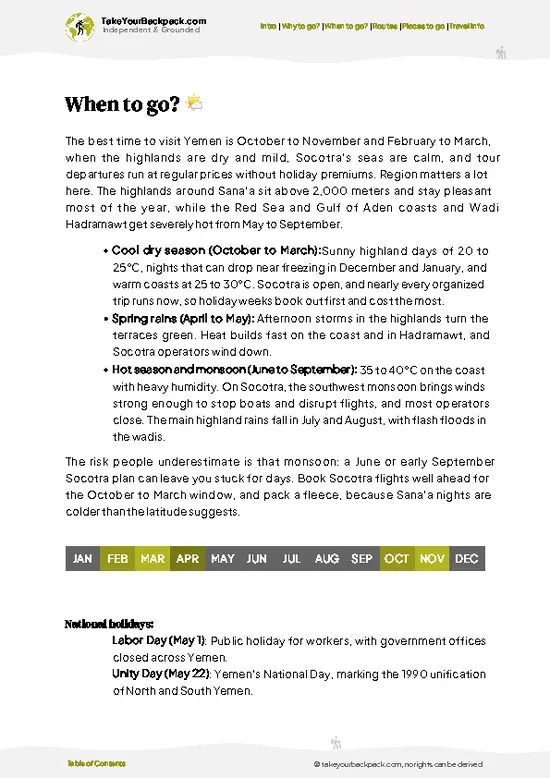
Best months by region: The best months for landmarks in Yemen are October to April, when the heat eases on the coast and desert and the monsoon winds that shut down Socotra have dropped. On Socotra, daytime temperatures sit around 25 to 30°C in this period, the sea is calm enough for boat transfers, and flights from Abu Dhabi run reliably. From June to September strong monsoon winds make the island rough, close the sea and disrupt flights, so skip it.

Highlands, desert and coast: The highlands around Sanaa sit at about 2,250 meters, so days are mild at 20 to 25°C, but winter nights can approach freezing. Rain falls mainly in March to April and again in July to August, which turns tracks to mud and makes afternoons unreliable. The Hadramawt desert valleys pass 40°C from May to September and … read more 👉
Best months by region: The best months for landmarks in Yemen are October to April, when the heat eases on the coast and desert and the monsoon winds that shut down Socotra have dropped. On Socotra, daytime temperatures sit around 25 to 30°C in this period, the sea is calm enough for boat transfers, and flights from Abu Dhabi run reliably. From June to September strong monsoon winds make the island rough, close the sea and disrupt flights, so skip it.

Highlands, desert and coast: The highlands around Sanaa sit at about 2,250 meters, so days are mild at 20 to 25°C, but winter nights can approach freezing. Rain falls mainly in March to April and again in July to August, which turns tracks to mud and makes afternoons unreliable. The Hadramawt desert valleys pass 40°C from May to September and are only comfortable from November to March. The Tihama coast and Aden are hot and humid for most of the year, with summer highs around 35 to 40°C, and winter (December to February) is the only pleasant stretch.

Crowds and prices: Crowds are not a factor anywhere in Yemen. Prices matter more: Socotra tour operators charge higher rates in the peak months of December to February and around holidays, and seats on the limited flights sell out weeks ahead. March, April and October offer the same weather with easier booking. Plan around Ramadan, when daytime services shut and travel is slower.

unique site hoppingHow to Combine landmarks Into One Trip

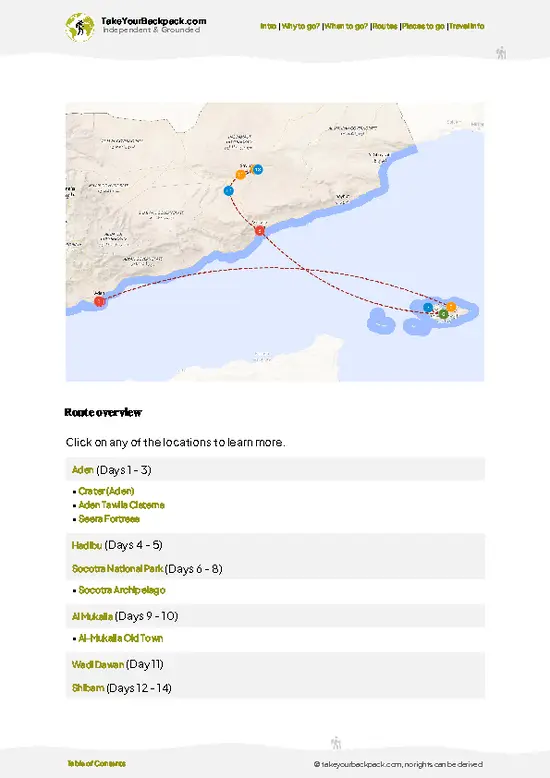
Trip length and structure: A trip combining several landmarks in Yemen needs 7 to 10 days, and for now that realistically means a single region, because mainland routes cross frontlines and checkpoints that make multi-region trips unworkable. Socotra is the practical base. Flights from Abu Dhabi run only about once or twice a week, so your trip length locks to a 7 or 14 day cycle. Pick the week that matches the flight, not the other way around.

Pacing on the island: Use Hadibu, the main town, as the hub and move out in loops. Allow one full day for each major area. Drives from Hadibu to the east, west or south coasts take roughly 1.5 to 3 hours each way on rough tracks, and 4x4 transport with a driver is required. Work from one end of the island to the other rather than returning to Hadibu … read more 👉
Trip length and structure: A trip combining several landmarks in Yemen needs 7 to 10 days, and for now that realistically means a single region, because mainland routes cross frontlines and checkpoints that make multi-region trips unworkable. Socotra is the practical base. Flights from Abu Dhabi run only about once or twice a week, so your trip length locks to a 7 or 14 day cycle. Pick the week that matches the flight, not the other way around.

Pacing on the island: Use Hadibu, the main town, as the hub and move out in loops. Allow one full day for each major area. Drives from Hadibu to the east, west or south coasts take roughly 1.5 to 3 hours each way on rough tracks, and 4x4 transport with a driver is required. Work from one end of the island to the other rather than returning to Hadibu each night, and spend two to three nights camping in the far areas to avoid six hours of daily driving. Five to six stops over a week is a sensible load.

Planning mistakes: The common error is cramming too many sites into one day. Tracks are slow, so a plan of three stops a day collapses by noon. Allow slack of at least half a day at the end, because weather or flight changes can delay departure. Another error is trying to add mainland stops after Socotra. Do not. Connections via Aden or Sanaa add days of uncertainty and risk for little return, and are not worth the time.

The ListThe Best landmarks of Yemen

1 Dar Al-Hajar

rock palace, royal residence, Wadi Dhahr

Stand beneath a palace carved into a towering rock outcrop, tracing the footsteps of imams and admiring intricate architecture above a fertile valley.

yemen-unique-site-dar-al-hajar
© Google |
Loading the map 🌍

Expert viewTips and Advice from Travelers

How many landmarks to visit: Plan on 5 to 8 landmarks, all on Socotra. That number matches one flight cycle of about a week, and the poor tracks mean each site eats half a day or more. Going beyond eight turns the trip into hours in a vehicle. Adding mainland stops is the single most expensive mistake: it brings security risk and permit delays that no itinerary can fix.

Which kinds to prioritize: Nature-based landmarks suit most backpackers, since they need no guide interpretation and few permits. Hikers and campers should choose the plateau and canyon areas and sleep outdoors. Travelers who care about built heritage should accept that Yemen’s famous towers and old cities are not currently practical, and should look at them from afar rather than risk a mainland trip. Photographers get the … read more 👉
How many landmarks to visit: Plan on 5 to 8 landmarks, all on Socotra. That number matches one flight cycle of about a week, and the poor tracks mean each site eats half a day or more. Going beyond eight turns the trip into hours in a vehicle. Adding mainland stops is the single most expensive mistake: it brings security risk and permit delays that no itinerary can fix.

Which kinds to prioritize: Nature-based landmarks suit most backpackers, since they need no guide interpretation and few permits. Hikers and campers should choose the plateau and canyon areas and sleep outdoors. Travelers who care about built heritage should accept that Yemen’s famous towers and old cities are not currently practical, and should look at them from afar rather than risk a mainland trip. Photographers get the best light at coastal sites early and late in the day. Skip anything described as a short stop in a town you cannot verify is open.

Budget: Expect US$150 to 250 per person per day on an organized Socotra tour, covering 4x4, driver, guide, camping gear and meals, and usually a group of two to six brings the rate down. A week on island therefore runs about US$1,000 to 1,700 before flights. Return flights from Abu Dhabi typically cost US$400 to 700, and visa and permit handling through the operator adds a modest fee, often US$50 to 100. Per-site entry fees are small or absent, but local guide and ranger fees can add US$10 to 30 per visit. A budget of US$20 to 35 a day is not possible on a self-run trip, since independent transport does not exist. Bring cash in US dollars, because cards and ATMs do not work on the island.

Costs and delays that catch travelers out: Cheap offers online are the first trap. Operators who undercut the field often skip permits or send you with unlicensed drivers, so book only through a company with a track record and written confirmation of what is included. Flight cancellations are the second. Wind or schedule changes can strand you for days, so keep a buffer of two to three days before any onward flight and buy insurance that covers it, if any insurer will. Third, fuel and food prices on the island rise sharply when supply ships are late, so confirm that all meals are in the price.

Safety and cultural considerations: Most governments advise against all travel to Yemen, so check your own government’s advice and insurance terms before paying a deposit. Never travel to the mainland on a plan you cannot verify through a licensed operator. On Socotra, dress modestly, with covered shoulders and knees for everyone and loose long clothing for women. Ask before photographing people, especially women, and avoid photographing military posts or checkpoints. Alcohol is not available and not appropriate. Respect local rules on collecting plants, shells and rocks, since removing them is illegal and the island’s species are protected.

✈️ The backpacker research shortcutYemen Travel Guide

An offline-friendly backpacking guide with optimized travel routes, ranked highlights, transport advice, and the best areas to stay.
example page 0 from our offline Travel Guide for Yemen
example page 1 from our offline Travel Guide for Yemen
example page 2 from our offline Travel Guide for Yemen
example page 3 from our offline Travel Guide for Yemen
example page 4 from our offline Travel Guide for Yemen
example page 5 from our offline Travel Guide for Yemen
example page 6 from our offline Travel Guide for Yemen
example page 7 from our offline Travel Guide for Yemen
The digital guide (223 pages) contains:
✅ 54 highlights, ranked by travel appeal
✅ Optimized 5, 10 & 15-day travel routes
✅ Cities, national parks, landmarks, beaches
✅ How to get around
✅ Offline-friendly for travel without Wi-Fi
👉 Click to see all 30+ guide features

📅 Plan smarter in minutes, not weeks
✅ Month by month travel advice
✅ Festivals & national holidays
✅ Budget expectations

🗺️ Go to the right places, skip the overrated ones
✅ Honest pros & cons of destinations
✅ Top hikes, parks & viewpoints
✅ Lesser-known places most travelers miss
✅ Clear “worth it vs skip it” guidance

🛏️ Travel smoothly without rookie mistakes
✅ Best areas to stay
✅ Transport systems explained simply
✅ Common scams & safety advice
✅ SIM cards, money & practical tips

🌍 Understand the country, not just visit it
✅ Culture & traditions
✅ 52 Essential phrases & customs
✅ Festivals worth planning around
✅ Traveler-friendly historical context
✅ Insights that make places more meaningful

📱 Built for real travel conditions
✅ Fully downloadable PDF
✅ Works completely offline
✅ Optimized for phone use
✅ Useful in remote areas & buses
✅ Everything in one place
Stop searching, start planning
Get instant access to your full guide. 30‑day money-back guarantee.
+ Add another guide for just

By proceeding you agree to our terms.
Sent to your inbox immediately after payment • 100% Secure Checkout
Best Backpacking Travel Advisor 2025 tourism awardBest Backpacking
Travel Advisor
2025
What others say about Take Your Backpack Guides:
⭐⭐⭐⭐⭐
Fantastic, amazing amount of information!
⭐⭐⭐⭐⭐
My goodness this is amazing, it's what I've been looking for hats off too you!
⭐⭐⭐⭐⭐
I think this is absolutely BRILLIANT
⭐⭐⭐⭐
Very complete and informative. It's still missing places, but I gotta to commend you
⭐⭐⭐⭐⭐
This is truly amazing, thank you, can't wait to explore it with my kids!
⭐⭐⭐⭐⭐
Awesome resource, thank you!
⭐⭐⭐⭐⭐
This is amazing! Can't wait to explore the ones I haven't seen
⭐⭐⭐⭐
I love this! Well done, great idea.
⭐⭐⭐⭐⭐
Thanks for taking the time to make this gem!
⭐⭐⭐⭐⭐
This might be the best website I've ever seen.
⭐⭐⭐⭐⭐
Congratulations, and thank you so much for your work; it's incredibly valuable.
⭐⭐⭐⭐
In all seriousness I think you did a great job pointing out the important spots
⭐⭐⭐⭐⭐
10/10 very good
⭐⭐⭐⭐⭐
As someone who's only just starting to visit regularly this is awesome, thank you.
⭐⭐⭐⭐
Thank you very much! I'm going to visit my dad, it's going to be very useful!
⭐⭐⭐⭐⭐
This is really cool! We'll be travelling for the first time and this definitely come in handy.
⭐⭐⭐⭐⭐
You are now our minister of culture, congratulations 👨‍💼
⭐⭐⭐⭐⭐
Just wanted to tell you that this is a pearl! Going to follow your recommendations.
⭐⭐⭐⭐⭐
This is so cool. I'll definitely be using the resource for my travels soon.
⭐⭐⭐⭐⭐
This is very impressive! Good work.
⭐⭐⭐⭐⭐
This is an amazing and informative site. Very well done!

🛏️ Where to stay?Best Stay Options in Yemen

Yemen has no backpacker hostel scene, so budget travel here means simple local hotels and guesthouses (roughly US$20 to 50 a night for a private room) plus tour-run campsites on Socotra, where most beds sit in Hadibu, the island’s small, quiet main town and the practical base for day trips to the beaches and plateaus. In Aden, Crater puts you among the old markets and the cheapest rooms but feels cramped and noisy, while Khormaksar is calmer, closer to the airport and the seafront, and has the newer, pricier hotels. Further east, Mukalla has the widest spread of mid-range rooms along its seafront corniche, and Seiyun is the best-equipped stop in Hadramawt for reaching Shibam and Tarim, though … read more 👉
Yemen has no backpacker hostel scene, so budget travel here means simple local hotels and guesthouses (roughly US$20 to 50 a night for a private room) plus tour-run campsites on Socotra, where most beds sit in Hadibu, the island’s small, quiet main town and the practical base for day trips to the beaches and plateaus. In Aden, Crater puts you among the old markets and the cheapest rooms but feels cramped and noisy, while Khormaksar is calmer, closer to the airport and the seafront, and has the newer, pricier hotels. Further east, Mukalla has the widest spread of mid-range rooms along its seafront corniche, and Seiyun is the best-equipped stop in Hadramawt for reaching Shibam and Tarim, though nightlife anywhere in the country is limited to evening tea and seafront strolls.

If you enjoy meeting fellow travelers, consider choosing hostels with high ratings for atmosphere. On the other hand, if you prefer having your own space, a hotel might be a better option.

YemenWhere to Go Next

👋 Meet the founderWho’s Behind Take Your Backpack?

Johan, backpacker and founder of TakeYourBackpackHi, I’m Johan (Netherlands 🇳🇱), the creator of TakeYourBackpack. Over the past 3 decades, I’ve backpacked through 90+ countries across six continents, gaining extensive experience with independent travel, long-term trips, and overland routes.

This site is built on a combination of firsthand travel experience and carefully curated insights from other backpackers. Many guides are based on places I’ve personally visited, while others bring together tips, observations, and practical advice shared by trusted travelers I’ve met along the way.

The goal is to provide realistic, experience-driven guidance — not generic itineraries — so you can explore destinations with better context, clearer expectations, and more confidence.