×

Yemen🇾🇪 | best national parksBest 2 national parks in Yemen

National parks in Yemen barely exist in the Western sense: no gates, no ranger networks, no trail maps. What you get are protected areas, and one of them, Socotra, is the only one a backpacker can realistically visit. It is an island 380 km off the mainland with a UNESCO-listed ecosystem, camping on beaches and plateaus, and fewer visitors than a single Alpine hut. Mainland reserves such as Bura and Hawf sit in areas where independent travel is not workable. Costs are high for the region because everything runs through licensed operators. Skip any hope of going it alone. Pick Socotra, book guided, and budget accordingly.

By Johan Kruseman 🇳🇱 | Updated October 19, 2026
Explore the best hikes in Yemen

Why go?Why Travelers Love These Spots

Yemen’s protected land is shaped by geography and conflict far more than by park policy. The country spans Red Sea coast, 3,000 m highlands, desert interior and offshore islands, and that range produced rare ecosystems with a high share of endemic plants and reptiles. The parks themselves are a different story. There is no functioning national park service of the kind you find in Kenya or Costa Rica, so expect no visitor centers, no marked trails and no ranger-led walks. Protection is patchy and often community-run.


The ongoing war decides everything. Most governments advise against travel to mainland Yemen, and the areas holding mainland reserves are poorly accessible, with checkpoints, unexploded ordnance risk and little emergency care. The Socotra Archipelago is the exception, administered … read more 👉
Yemen’s protected land is shaped by geography and conflict far more than by park policy. The country spans Red Sea coast, 3,000 m highlands, desert interior and offshore islands, and that range produced rare ecosystems with a high share of endemic plants and reptiles. The parks themselves are a different story. There is no functioning national park service of the kind you find in Kenya or Costa Rica, so expect no visitor centers, no marked trails and no ranger-led walks. Protection is patchy and often community-run.


The ongoing war decides everything. Most governments advise against travel to mainland Yemen, and the areas holding mainland reserves are poorly accessible, with checkpoints, unexploded ordnance risk and little emergency care. The Socotra Archipelago is the exception, administered separately and reached by commercial flights, which is why it dominates any realistic plan. Do not choose Yemen for variety of parks. Choose it for one extraordinary island.


Before committing, know that independent travel is effectively replaced by operator-run trips. Permits, vehicles, camping gear and a local guide come bundled, and flights are limited and weather-dependent. Infrastructure is basic: dirt tracks, no hotels in remote areas, and limited mobile signal. If you need predictable logistics, pick another country. If you can accept slow, rough, expensive and rewarding, this is unmatched.
How the List Was Created
The list of best national parks in Yemen is created based on landscapes, wildlife, adventure opportunities, facilities, and overall experience. If you feel a national park is missing in this list, please let us know.

When to go?Timing Your Visit for the Best Experience

Best months: The best months are October to April, when Socotra’s monsoon has ended, the sea is calm enough for flights and boat access, and daytime temperatures sit around 25 to 30°C. December to February is the most comfortable stretch, with cooler nights on the highland plateaus, sometimes 12 to 18°C, and the best chance of green after the autumn rains.
Shoulder and monsoon seasons: March to April and October to November are the shoulder months. They are still good for hiking and camping, with slightly higher heat and a few showers, and tour prices stay close to peak levels. Rainfall on Socotra is low overall, mostly falling between October and December.


From June to September the southwest monsoon brings sustained winds above 50 km/h, rough seas and regular flight cancellations. Beaches … read more 👉
Best months: The best months are October to April, when Socotra’s monsoon has ended, the sea is calm enough for flights and boat access, and daytime temperatures sit around 25 to 30°C. December to February is the most comfortable stretch, with cooler nights on the highland plateaus, sometimes 12 to 18°C, and the best chance of green after the autumn rains.
Shoulder and monsoon seasons: March to April and October to November are the shoulder months. They are still good for hiking and camping, with slightly higher heat and a few showers, and tour prices stay close to peak levels. Rainfall on Socotra is low overall, mostly falling between October and December.


From June to September the southwest monsoon brings sustained winds above 50 km/h, rough seas and regular flight cancellations. Beaches become unpleasant and boat trips stop. Skip this window for Socotra entirely. It is not worth the risk of being stranded.
Mainland regions: The Tihama coast and Al Mahra are very hot from May to September, often above 38 to 45°C, and the highlands receive rain mainly in spring and July to August. Mainland travel is not practical regardless of season, so timing only matters for Socotra.
Crowds and prices: Peak demand falls in December, January and around Easter. Flights and group departures fill early, and tour prices run roughly 10 to 20 percent above low-season rates. Book three to four months ahead for those weeks. Visitor numbers remain small in any month.

national park hoppingHow to Combine national parks Into One Trip

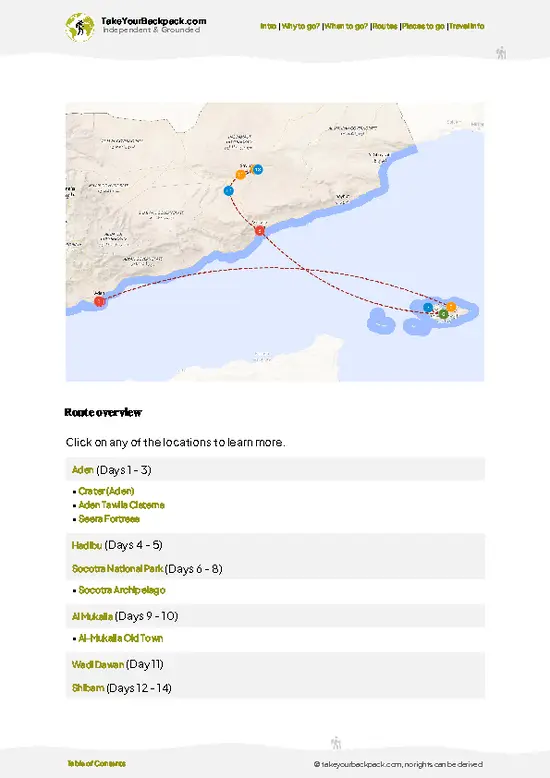
Trip length: A trip covering several protected areas needs 7 to 10 days, and in practice that means one island, Socotra, since mainland stops cannot be combined safely. Treat the island as a single base around the capital, Hadibu, and the airport nearby.
Direction and pacing: Split the island into east, center and west, and travel in one direction rather than doubling back. Starting east and finishing west, or the reverse, keeps vehicle time sensible. Give each region 2 to 3 days. Moving between them usually takes 2 to 4 hours on mixed paved and dirt roads, longer after rain. Camping at each stop saves hours of daily driving compared with returning to Hadibu every night.
Planning mistakes: The first mistake is cramming into 4 or 5 days. Roads are slow, hikes start early, and one lost day to … read more 👉
Trip length: A trip covering several protected areas needs 7 to 10 days, and in practice that means one island, Socotra, since mainland stops cannot be combined safely. Treat the island as a single base around the capital, Hadibu, and the airport nearby.
Direction and pacing: Split the island into east, center and west, and travel in one direction rather than doubling back. Starting east and finishing west, or the reverse, keeps vehicle time sensible. Give each region 2 to 3 days. Moving between them usually takes 2 to 4 hours on mixed paved and dirt roads, longer after rain. Camping at each stop saves hours of daily driving compared with returning to Hadibu every night.
Planning mistakes: The first mistake is cramming into 4 or 5 days. Roads are slow, hikes start early, and one lost day to weather wrecks the schedule. Allow 7 days minimum. The second is tying your onward flight to the last day. Socotra flights are limited, often a few per week, and cancellations happen, so add a buffer of 1 to 2 days before any international connection. The third is trying to add mainland Yemen. It adds risk, permits and delays without any realistic payoff.


Agree a rough sequence with your operator before arriving, but keep one spare day for wind, rain or vehicle trouble.

The ListThe Best national parks of Yemen

1 Socotra National Park

dragon blood trees, limestone plateaus, endemic wildlife

Encounter otherworldly landscapes where unique trees and rare animals thrive in isolation on windswept plateaus and rocky shores.

2 Jabal Bura National Park

mist forest, granite peaks, endemic plants

Ascend steep trails through cloud-draped woodlands and encounter rare flora clinging to ancient rock faces above terraced mountain villages.

yemen-national-park-jabal-bura-national-park
© Google |
Loading the map 🌍

Expert viewTips and Advice from Travelers

How many to visit: Visit one protected area system, Socotra, and plan to cover several parts of it over 7 to 10 days. That is the only version of Yemen’s parks a backpacker can reach with any reliability. Trying to add mainland reserves such as Bura or Hawf means checkpoints, no emergency services and no insurance cover, so skip them. Two or three stops on Socotra is too few to justify the flight cost. Four to five camps over a week gives time for wind or rain delays.
Which kind to prioritize: Hikers should put the highland plateaus and canyons first, where days are cool and walking is the main activity. Beach-focused travelers get the best value on the coast, where camping is free of fees and the water is clear, though shade is scarce. Anyone interested in plants should pick the highlands, … read more 👉
How many to visit: Visit one protected area system, Socotra, and plan to cover several parts of it over 7 to 10 days. That is the only version of Yemen’s parks a backpacker can reach with any reliability. Trying to add mainland reserves such as Bura or Hawf means checkpoints, no emergency services and no insurance cover, so skip them. Two or three stops on Socotra is too few to justify the flight cost. Four to five camps over a week gives time for wind or rain delays.
Which kind to prioritize: Hikers should put the highland plateaus and canyons first, where days are cool and walking is the main activity. Beach-focused travelers get the best value on the coast, where camping is free of fees and the water is clear, though shade is scarce. Anyone interested in plants should pick the highlands, since endemic trees such as the dragon’s blood cluster there. Cave visits are worth a half day, not more. Skip the capital’s shops and sights as a priority. They are minor next to the island’s wild areas.
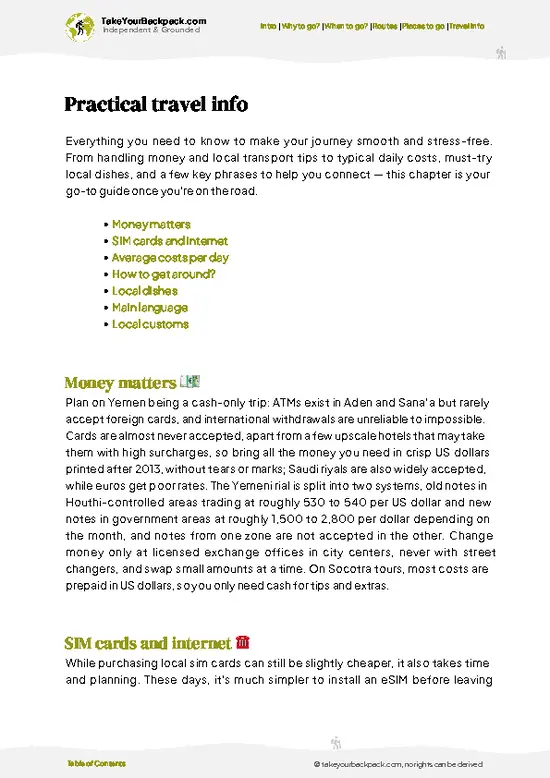
What it costs: Expect US$100 to 200 a day on an operator-run camping trip, covering vehicle, driver, guide, camping gear and meals. A 7 to 10 day package typically runs US$900 to 1,800. Flights are separate, around US$350 to 700 return from the Gulf or Cairo, depending on the season. Park or permit fees are usually small and rolled into the package, but confirm that when you book. Yemeni rial prices swing sharply, so operators quote in US dollars and want cash. Bring small bills, as there are almost no ATMs that accept foreign cards. Budget an extra US$100 to 200 for tips and a delayed flight night.
Costs and delays that catch people out: Beware unlicensed offers that undercut the range above. They cut corners on vehicles, water and emergency plans, and a breakdown far from Hadibu is expensive. Book with an operator that supplies written inclusions. Flight changes are the biggest delay. Buy refundable or flexible tickets where possible, and carry travel insurance that explicitly covers Yemen, which many providers exclude. Check this before paying anything.
Safety and cultural points: Most governments advise against all travel to Yemen, so check your home advisory and your insurer’s terms. On Socotra, day-to-day risk comes mainly from rough roads, heat and isolation, so carry a first-aid kit and 3 to 4 liters of water per person per day. Dress modestly, with covered shoulders and knees for everyone, and swim in clothes near villages. Ask before photographing people, especially women. Do not collect shells, plants or rocks. Alcohol is not available, and behaving respectfully during Ramadan matters, as meals and transport hours change. Use your guide to arrange village stops, since camping near homes needs local consent.

✈️ The backpacker research shortcutYemen Travel Guide

An offline-friendly backpacking guide with optimized travel routes, ranked highlights, transport advice, and the best areas to stay.
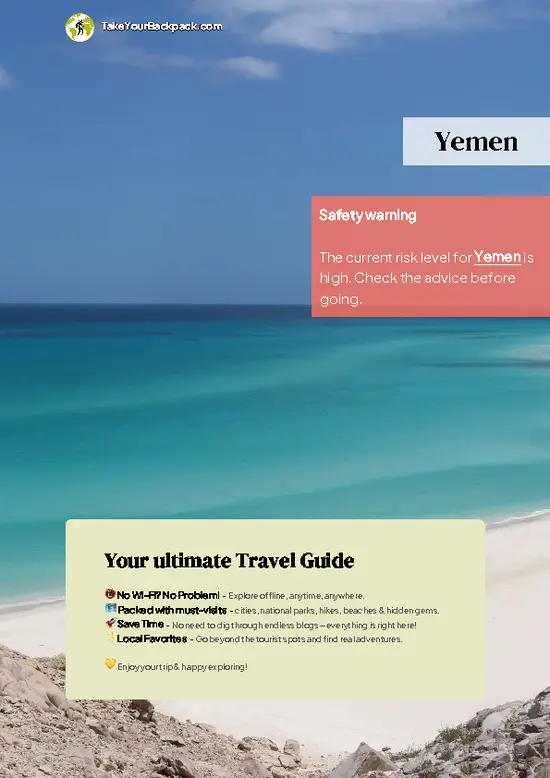
example page 0 from our offline Travel Guide for Yemen
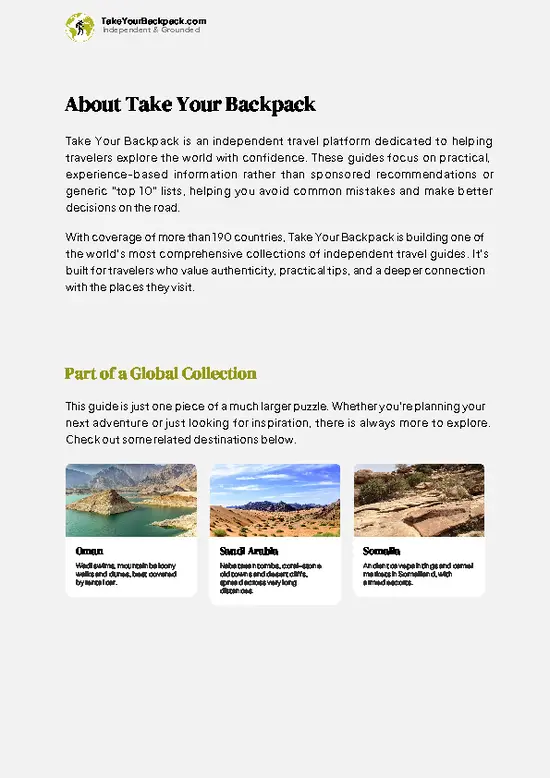
example page 1 from our offline Travel Guide for Yemen
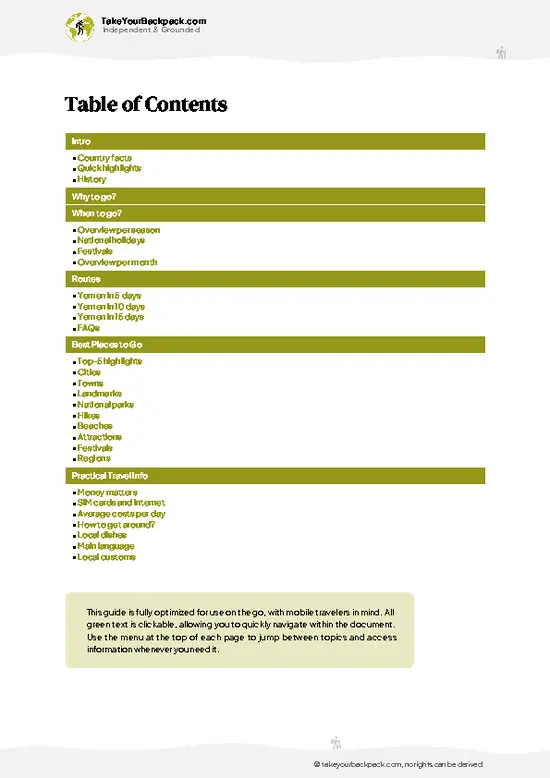
example page 2 from our offline Travel Guide for Yemen
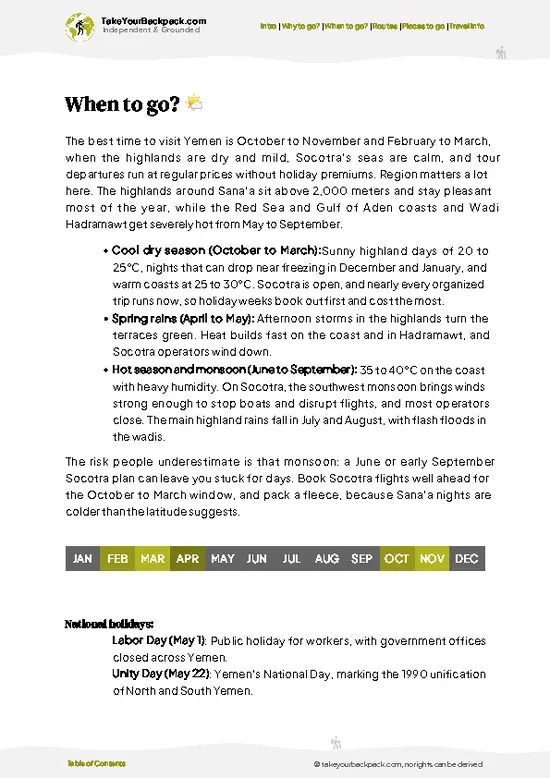
example page 3 from our offline Travel Guide for Yemen
example page 4 from our offline Travel Guide for Yemen
example page 5 from our offline Travel Guide for Yemen
example page 6 from our offline Travel Guide for Yemen
example page 7 from our offline Travel Guide for Yemen
The digital guide (223 pages) contains:
✅ 54 highlights, ranked by travel appeal
✅ Optimized 5, 10 & 15-day travel routes
✅ Cities, national parks, landmarks, beaches
✅ How to get around
✅ Offline-friendly for travel without Wi-Fi
👉 Click to see all 30+ guide features

📅 Plan smarter in minutes, not weeks
✅ Month by month travel advice
✅ Festivals & national holidays
✅ Budget expectations

🗺️ Go to the right places, skip the overrated ones
✅ Honest pros & cons of destinations
✅ Top hikes, parks & viewpoints
✅ Lesser-known places most travelers miss
✅ Clear “worth it vs skip it” guidance

🛏️ Travel smoothly without rookie mistakes
✅ Best areas to stay
✅ Transport systems explained simply
✅ Common scams & safety advice
✅ SIM cards, money & practical tips

🌍 Understand the country, not just visit it
✅ Culture & traditions
✅ 52 Essential phrases & customs
✅ Festivals worth planning around
✅ Traveler-friendly historical context
✅ Insights that make places more meaningful

📱 Built for real travel conditions
✅ Fully downloadable PDF
✅ Works completely offline
✅ Optimized for phone use
✅ Useful in remote areas & buses
✅ Everything in one place
Stop searching, start planning
Get instant access to your full guide. 30‑day money-back guarantee.
+ Add another guide for just

By proceeding you agree to our terms.
Sent to your inbox immediately after payment • 100% Secure Checkout
Best Backpacking Travel Advisor 2025 tourism awardBest Backpacking
Travel Advisor
2025
What others say about Take Your Backpack Guides:
⭐⭐⭐⭐⭐
Fantastic, amazing amount of information!
⭐⭐⭐⭐⭐
My goodness this is amazing, it's what I've been looking for hats off too you!
⭐⭐⭐⭐⭐
I think this is absolutely BRILLIANT
⭐⭐⭐⭐
Very complete and informative. It's still missing places, but I gotta to commend you
⭐⭐⭐⭐⭐
This is truly amazing, thank you, can't wait to explore it with my kids!
⭐⭐⭐⭐⭐
Awesome resource, thank you!
⭐⭐⭐⭐⭐
This is amazing! Can't wait to explore the ones I haven't seen
⭐⭐⭐⭐
I love this! Well done, great idea.
⭐⭐⭐⭐⭐
Thanks for taking the time to make this gem!
⭐⭐⭐⭐⭐
This might be the best website I've ever seen.
⭐⭐⭐⭐⭐
Congratulations, and thank you so much for your work; it's incredibly valuable.
⭐⭐⭐⭐
In all seriousness I think you did a great job pointing out the important spots
⭐⭐⭐⭐⭐
10/10 very good
⭐⭐⭐⭐⭐
As someone who's only just starting to visit regularly this is awesome, thank you.
⭐⭐⭐⭐
Thank you very much! I'm going to visit my dad, it's going to be very useful!
⭐⭐⭐⭐⭐
This is really cool! We'll be travelling for the first time and this definitely come in handy.
⭐⭐⭐⭐⭐
You are now our minister of culture, congratulations 👨‍💼
⭐⭐⭐⭐⭐
Just wanted to tell you that this is a pearl! Going to follow your recommendations.
⭐⭐⭐⭐⭐
This is so cool. I'll definitely be using the resource for my travels soon.
⭐⭐⭐⭐⭐
This is very impressive! Good work.
⭐⭐⭐⭐⭐
This is an amazing and informative site. Very well done!

🛏️ Where to stay?Best Places to Stay in Yemen

Yemen has no backpacker hostel scene, so budget travel here means simple local hotels and guesthouses (roughly US$20 to 50 a night for a private room) plus tour-run campsites on Socotra, where most beds sit in Hadibu, the island’s small, quiet main town and the practical base for day trips to the beaches and plateaus. In Aden, Crater puts you among the old markets and the cheapest rooms but feels cramped and noisy, while Khormaksar is calmer, closer to the airport and the seafront, and has the newer, pricier hotels. Further east, Mukalla has the widest spread of mid-range rooms along its seafront corniche, and Seiyun is the best-equipped stop in Hadramawt for reaching Shibam and Tarim, though … read more 👉
Yemen has no backpacker hostel scene, so budget travel here means simple local hotels and guesthouses (roughly US$20 to 50 a night for a private room) plus tour-run campsites on Socotra, where most beds sit in Hadibu, the island’s small, quiet main town and the practical base for day trips to the beaches and plateaus. In Aden, Crater puts you among the old markets and the cheapest rooms but feels cramped and noisy, while Khormaksar is calmer, closer to the airport and the seafront, and has the newer, pricier hotels. Further east, Mukalla has the widest spread of mid-range rooms along its seafront corniche, and Seiyun is the best-equipped stop in Hadramawt for reaching Shibam and Tarim, though nightlife anywhere in the country is limited to evening tea and seafront strolls.

If you enjoy meeting fellow travelers, consider choosing hostels with high ratings for atmosphere. On the other hand, if you prefer having your own space, a hotel might be a better option.

YemenExplore Yemen

👋 Meet the founderWho’s Behind Take Your Backpack?

Johan, backpacker and founder of TakeYourBackpackHi, I’m Johan (Netherlands 🇳🇱), the creator of TakeYourBackpack. Over the past 3 decades, I’ve backpacked through 90+ countries across six continents, gaining extensive experience with independent travel, long-term trips, and overland routes.

This site is built on a combination of firsthand travel experience and carefully curated insights from other backpackers. Many guides are based on places I’ve personally visited, while others bring together tips, observations, and practical advice shared by trusted travelers I’ve met along the way.

The goal is to provide realistic, experience-driven guidance — not generic itineraries — so you can explore destinations with better context, clearer expectations, and more confidence.