×

Afghanistan🇦🇫 | best townsBest 2 towns in Afghanistan

Towns in Afghanistan are working market centers, not resort stops. Expect mud-brick bazaars, kebab smoke, and guesthouses that serve a fixed meal. Polished tourist infrastructure does not exist, so skip anywhere promising it.

The regions differ sharply. The north is flat, dusty and relatively easy to reach by paved road, with the lowest prices and almost no other foreigners. The central highlands sit above 2,000 meters, are cooler, and are slower to reach, but quiet. The west has the strongest architecture and the best connections by air. The south and east are not worth planning around because access is restricted and security is unreliable. Independent travel works best when you pick one or two regions and accept that everything runs on local contacts and patience, not apps.

By Johan Kruseman 🇳🇱 | Updated October 19, 2026
Explore the best landmarks in Afghanistan

Why go?Why Travelers Love These Spots

Afghanistan suits towns better than almost any other kind of stop because the country is organized around them. Mountains split the land into river valleys and oases, and for thousands of years each valley grew a market town on the Silk Road trade routes between Persia, Central Asia and India. The result is a map of places with distinct dialects, food, and building styles, within a few hours of each other by road.

That same geography is the main limit. The Hindu Kush blocks direct travel, passes close with snow, and highways are rough. A town that looks close on a map can take most of a day to reach. Cities beyond the main corridors are not worth the time, since long drives and checkpoints eat the trip.

Before choosing Afghanistan, understand the conditions. Government travel advisories … read more 👉
Afghanistan suits towns better than almost any other kind of stop because the country is organized around them. Mountains split the land into river valleys and oases, and for thousands of years each valley grew a market town on the Silk Road trade routes between Persia, Central Asia and India. The result is a map of places with distinct dialects, food, and building styles, within a few hours of each other by road.

That same geography is the main limit. The Hindu Kush blocks direct travel, passes close with snow, and highways are rough. A town that looks close on a map can take most of a day to reach. Cities beyond the main corridors are not worth the time, since long drives and checkpoints eat the trip.

Before choosing Afghanistan, understand the conditions. Government travel advisories from most Western countries tell citizens not to travel here, and travel insurance is hard or impossible to get. Visas must be arranged in advance, and rules change. Foreign bank cards do not work, so you carry US dollars in cash and change it into afghanis at the bazaar. Women travelers face restrictions under Taliban rules, including limits on movement and public spaces, which shapes what is realistic. Tourist numbers are tiny, which means hospitality is real and personal, but there are no hostels, no tour desks and no safety net.

If you want an easy, comfortable trip, choose another country. If you can accept the risks, the towns show daily life that has changed little in generations.
Evaluating the Top Choices
The list of best towns in Afghanistan is created based on charm, local culture, atmosphere, hidden gems, and visitor appeal. If you feel a town is missing in this list, please let us know.

When to go?When to Plan Your Trip

Best months: April to May and September to October are the best months for towns in Afghanistan, because daytime highs sit between 18 and 30°C in most of the country and the mountain passes are clear of snow. Spring brings green hillsides and some rain, mostly between March and early May, while autumn is dry with fruit and nut harvests in the markets.

Summer: June to August is only worth it in the highlands. The north and west, including the Herat and Mazar plains, regularly reach 35 to 42°C, and the Jalalabad area in the east can top 45°C. Dust and heat make walking bazaars miserable by midday. Kabul, at about 1,800 meters, peaks near 33°C with cool nights, and the central highlands stay mild, with highs of 25 to 30°C. If you travel in summer, stay at altitude.

Winter: December to February … read more 👉
Best months: April to May and September to October are the best months for towns in Afghanistan, because daytime highs sit between 18 and 30°C in most of the country and the mountain passes are clear of snow. Spring brings green hillsides and some rain, mostly between March and early May, while autumn is dry with fruit and nut harvests in the markets.

Summer: June to August is only worth it in the highlands. The north and west, including the Herat and Mazar plains, regularly reach 35 to 42°C, and the Jalalabad area in the east can top 45°C. Dust and heat make walking bazaars miserable by midday. Kabul, at about 1,800 meters, peaks near 33°C with cool nights, and the central highlands stay mild, with highs of 25 to 30°C. If you travel in summer, stay at altitude.

Winter: December to February is not worth the time for a multi-town trip. Kabul falls to around -5°C at night, with snow likely, and the high central region can drop to -20°C or below. Roads over the Hindu Kush may close for days, guesthouses are often unheated, and flights get delayed by weather. The lower north and west are milder, with highs of 5 to 12°C, but gray and wet.

Holidays and prices: Ramadan moves about 11 days earlier each year. During it, restaurants are closed in daylight and eating in public is poor manners, so plan around it. Eid holidays shut businesses for several days and fill buses. Nowruz, around March 21, is a busy local holiday that draws domestic crowds. Prices barely follow a season, because foreign tourism is too small to create one. Fuel and food costs shift more with the economy than with the calendar, so book transport a day or two ahead in holiday weeks.

town hoppingSuggested Travel Strategies

How many days: A trip linking several towns in Afghanistan needs 10 to 14 days, and anything under a week turns into a blur of drives. Distances are the issue, not attractions. Roads are slow, and comfort is limited.

Grouping regions: Link places that share a road or a flight. Kabul is the transport hub for everything, so enter there. From Kabul, the central highlands are 5 to 8 hours by road, the northern plains around Mazar-i-Sharif are 8 to 10 hours over the Salang route, and the east toward Jalalabad is 3 to 4 hours. The west around Herat is a separate unit. Fly Kabul to Herat in roughly 1.5 hours (about US$80 to 150) instead of crossing the south by road, which takes 14 to 18 hours and passes through areas that are not worth the risk.

A sensible direction is a loop: Kabul, the highlands, … read more 👉
How many days: A trip linking several towns in Afghanistan needs 10 to 14 days, and anything under a week turns into a blur of drives. Distances are the issue, not attractions. Roads are slow, and comfort is limited.

Grouping regions: Link places that share a road or a flight. Kabul is the transport hub for everything, so enter there. From Kabul, the central highlands are 5 to 8 hours by road, the northern plains around Mazar-i-Sharif are 8 to 10 hours over the Salang route, and the east toward Jalalabad is 3 to 4 hours. The west around Herat is a separate unit. Fly Kabul to Herat in roughly 1.5 hours (about US$80 to 150) instead of crossing the south by road, which takes 14 to 18 hours and passes through areas that are not worth the risk.

A sensible direction is a loop: Kabul, the highlands, back through Kabul, north, then fly west and leave from Herat or cross to Iran. Reverse it if you arrive from Iran. Avoid the road from Mazar to Herat, which takes a long, rough day or two.

Time per stop: Give each region 2 to 4 nights. One night is not enough, since arrival, checkpoints and permits take half a day. More than four nights in one place adds little unless you use it for day trips.

Common mistakes: The first is cramming in too many stops. Pick three or four regions, not seven. The second is traveling after dark, when checkpoints and road risks increase, so start before 7 a.m. and arrive by mid-afternoon. The third is ignoring closures, since winter passes and holidays can strand you, so keep two spare days at the end. The fourth is assuming buses run on schedule, when shared taxis leave only once full. Hire a driver for tight links and keep cash for each leg, because no ATM will save you in a small town.

The ListTop towns of Afghanistan

1 Nili

central highlands, Hazara heartland, mountain air

Breathe crisp air in a highland town surrounded by Hazara villages, where mountain scenery frames every journey and encounter.

2 Qala-i-Naw

mud-brick fort, dry hills, Turkmen influence

Walk through a frontier town where Turkmen culture shapes daily life and the landscape is defined by arid hills and ancient fortifications.

Loading the map 🌍

Expert viewInsights from Locals and Experts

How many towns: Visit three to five towns on one trip. That number lets you spend two to three nights in each, which is what arrival formalities, slow roads and unplanned delays demand. Cramming in eight towns means eight checkpoints, eight guesthouse searches, and a lot of time sitting in cars. Fewer stops also reduce your exposure on the road, which is where most of the risk sits.

Choosing between kinds of towns: Pick by travel style. For history and architecture, favor the western oasis towns, which have the best preserved old quarters. For quiet landscapes and the cheapest, easiest-going stay, choose the highland and northern towns, where the pace is slow and tourists are few. For a first look at local life with the best services, base in Kabul and take short trips. Skip the south and … read more 👉
How many towns: Visit three to five towns on one trip. That number lets you spend two to three nights in each, which is what arrival formalities, slow roads and unplanned delays demand. Cramming in eight towns means eight checkpoints, eight guesthouse searches, and a lot of time sitting in cars. Fewer stops also reduce your exposure on the road, which is where most of the risk sits.

Choosing between kinds of towns: Pick by travel style. For history and architecture, favor the western oasis towns, which have the best preserved old quarters. For quiet landscapes and the cheapest, easiest-going stay, choose the highland and northern towns, where the pace is slow and tourists are few. For a first look at local life with the best services, base in Kabul and take short trips. Skip the south and the far east for tourism. Roads are unreliable, permits are harder, and the travel time buys little compared with what lies elsewhere.

What it costs: Budget US$40 to 80 a day if you travel by shared taxi and sleep in simple guesthouses (US$15 to 40 a night). A private car with a driver-guide usually runs US$80 to 150 a day including fuel, and it is the better choice for any long or remote leg. Shared intercity taxis cost roughly US$5 to 20 per seat depending on distance. Domestic flights are US$80 to 150 one way. Entry to local sites is usually a few dollars up to about US$10 for foreigners, and a local guide for a half day costs US$20 to 40. Meals in town eateries run US$3 to 8.

Bring all your money as clean, undamaged US dollar bills, since torn or old notes are refused. Change a small amount at a time in the bazaar, and compare two money changers. Foreign cards do not work, and a lack of cash is the most common way a trip stalls.

Delays and hidden costs: Expect checkpoints, registration with local authorities, and permits for some regions. These take time, so leave a buffer day between stops. Ask your guesthouse or guide to confirm requirements, and carry several copies of your passport and visa pages. Unplanned costs come from last-minute vehicle hire, extra nights when a pass closes, and fixer fees. Agree the price, route and what it covers before you leave, and pay the balance at the end.

Safety: Most governments advise against all travel here. Insurance is difficult to get, so arrange medical evacuation cover before you go if any provider will give it. Attacks by militant groups have hit public places in cities, so avoid crowds at markets on busy days and large religious gatherings. Do not travel at night, and keep someone informed of your plans.

Culture and conduct: Dress modestly. Men wear long trousers and a loose shirt, and women need a full-length garment and a headscarf. Women face real limits on travel and public access under current rules, and should plan with a trusted local operator and a male family companion. Ask before photographing people, and never photograph women, security staff, or checkpoints. Drones are a bad idea. Alcohol is banned, public displays of affection cause trouble, and music or loud behavior can draw attention. Use your right hand for eating and greeting. Accept tea when offered, since refusing repeatedly causes offense. Friday is the day of rest, with most shops closed until afternoon. Respect prayer times, and do not point a camera at worshippers.

One practical point from experience: carry small bills, because breaking US$100 notes at a roadside stop is slow and costly.

✈️ The backpacker research shortcutAfghanistan Travel Guide

An offline-friendly backpacking guide with optimized travel routes, ranked highlights, transport advice, and the best areas to stay.
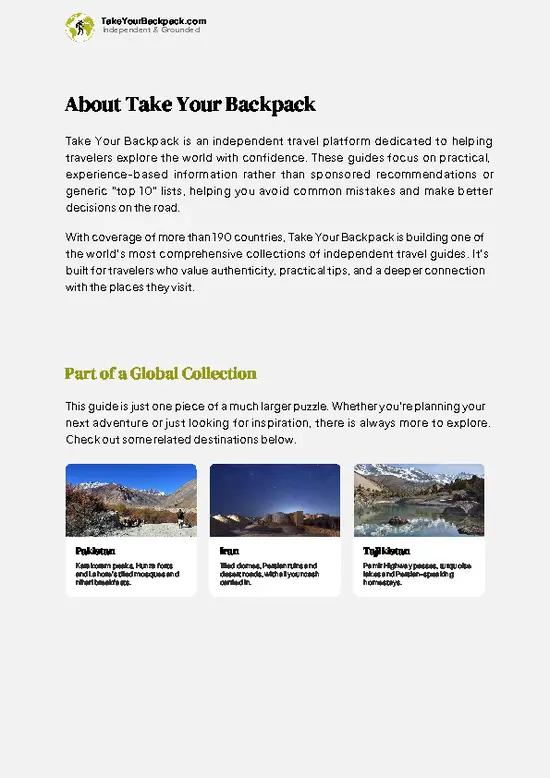
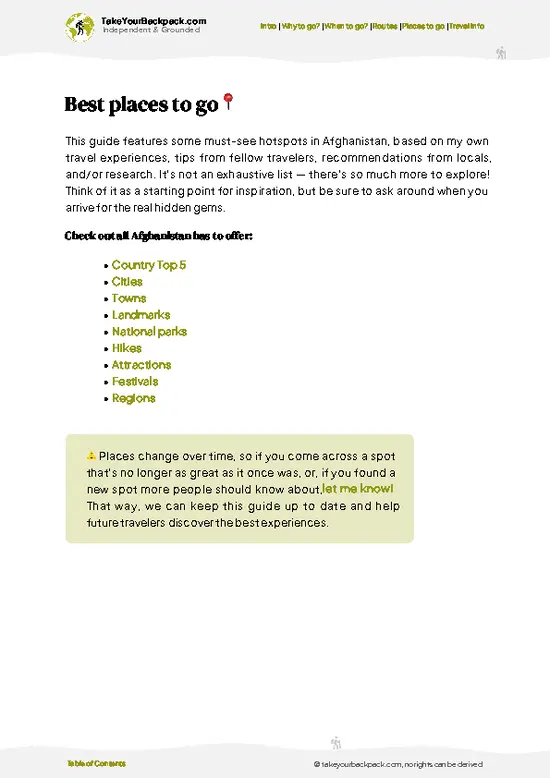
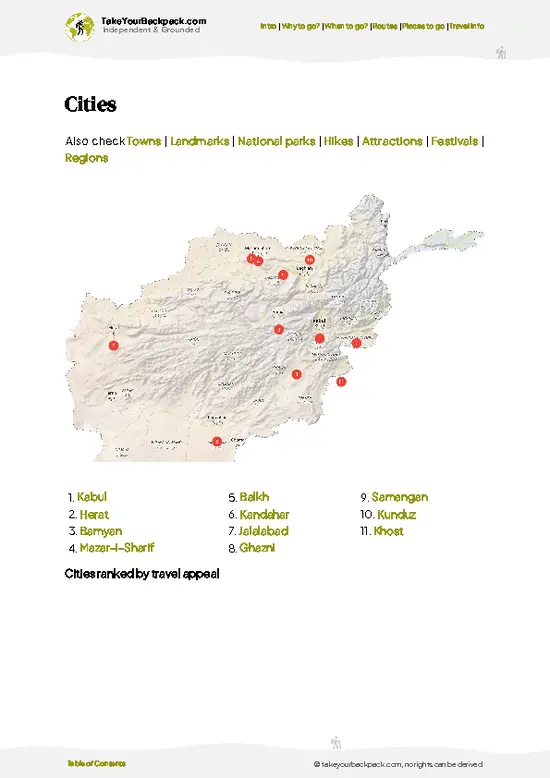
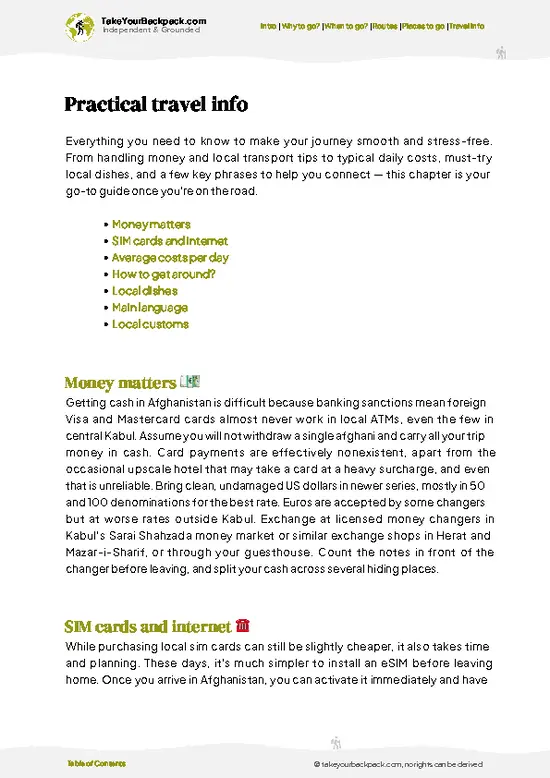
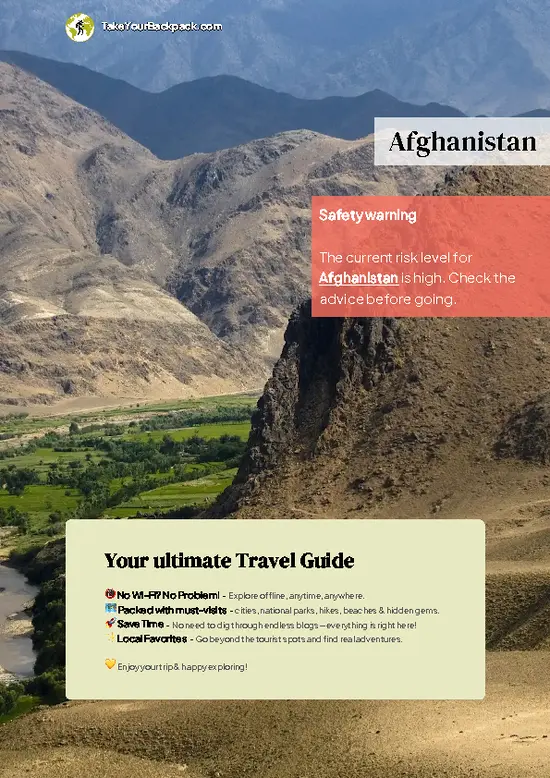
example page 0 from our offline Travel Guide for Afghanistan
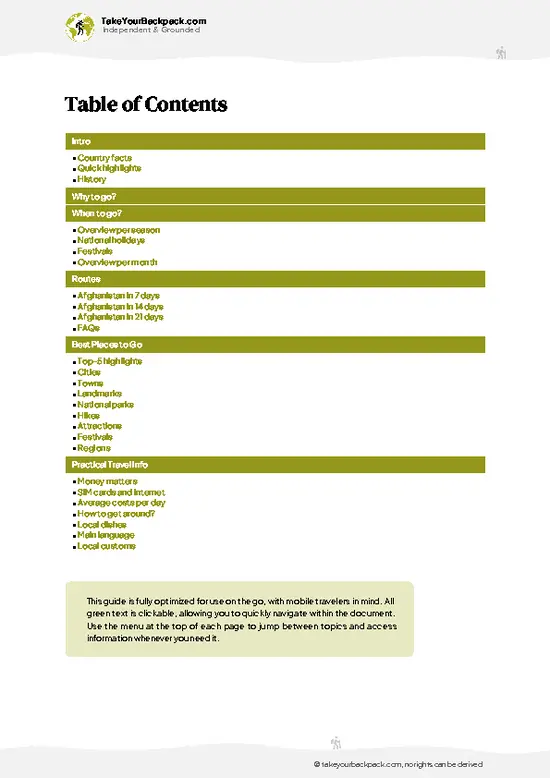
example page 1 from our offline Travel Guide for Afghanistan
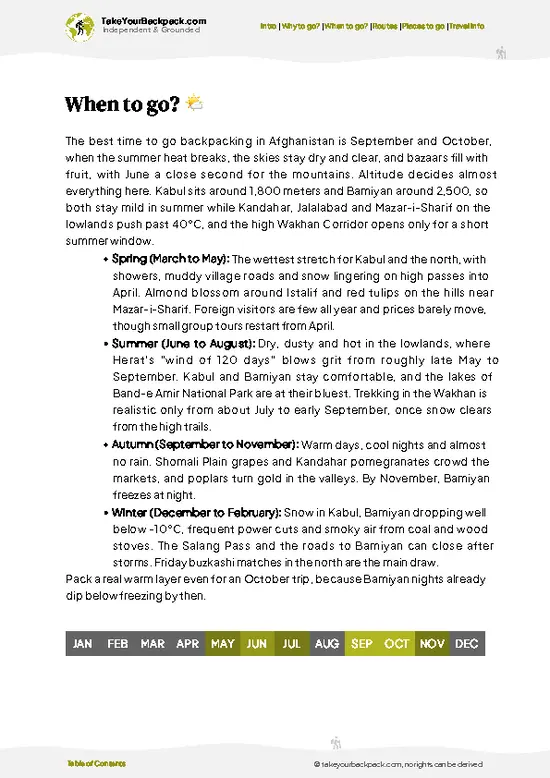
example page 2 from our offline Travel Guide for Afghanistan
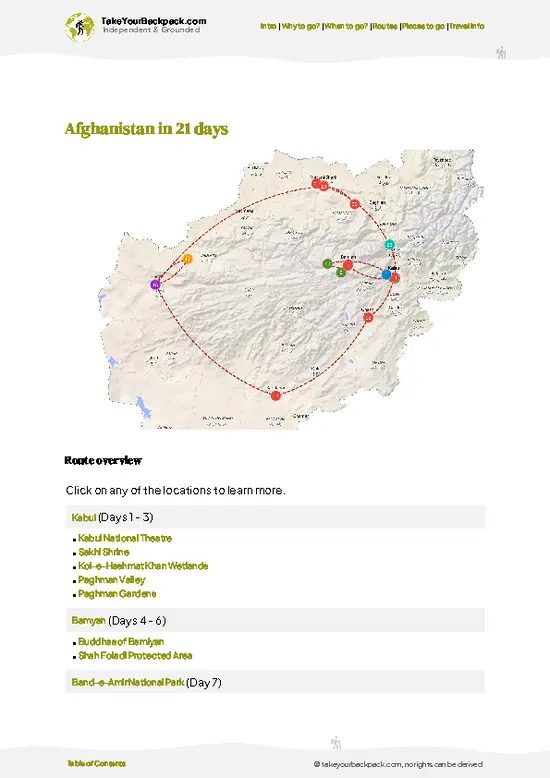
example page 3 from our offline Travel Guide for Afghanistan
example page 4 from our offline Travel Guide for Afghanistan
example page 5 from our offline Travel Guide for Afghanistan
example page 6 from our offline Travel Guide for Afghanistan
example page 7 from our offline Travel Guide for Afghanistan
The digital guide (204 pages) contains:
✅ 46 highlights, ranked by travel appeal
✅ Optimized 7, 14 & 21-day travel routes
✅ Cities, national parks, landmarks, beaches
✅ How to get around
✅ Offline-friendly for travel without Wi-Fi
👉 Click to see all 30+ guide features

📅 Plan smarter in minutes, not weeks
✅ Month by month travel advice
✅ Festivals & national holidays
✅ Budget expectations

🗺️ Go to the right places, skip the overrated ones
✅ Honest pros & cons of destinations
✅ Top hikes, parks & viewpoints
✅ Lesser-known places most travelers miss
✅ Clear “worth it vs skip it” guidance

🛏️ Travel smoothly without rookie mistakes
✅ Best areas to stay
✅ Transport systems explained simply
✅ Common scams & safety advice
✅ SIM cards, money & practical tips

🌍 Understand the country, not just visit it
✅ Culture & traditions
✅ 52 Essential phrases & customs
✅ Festivals worth planning around
✅ Traveler-friendly historical context
✅ Insights that make places more meaningful

📱 Built for real travel conditions
✅ Fully downloadable PDF
✅ Works completely offline
✅ Optimized for phone use
✅ Useful in remote areas & buses
✅ Everything in one place
Stop searching, start planning
Get instant access to your full guide. 30‑day money-back guarantee.
+ Add another guide for just

By proceeding you agree to our terms.
Sent to your inbox immediately after payment • 100% Secure Checkout
Best Backpacking Travel Advisor 2025 tourism awardBest Backpacking
Travel Advisor
2025
What others say about Take Your Backpack Guides:
⭐⭐⭐⭐⭐
Fantastic, amazing amount of information!
⭐⭐⭐⭐⭐
My goodness this is amazing, it's what I've been looking for hats off too you!
⭐⭐⭐⭐⭐
I think this is absolutely BRILLIANT
⭐⭐⭐⭐
Very complete and informative. It's still missing places, but I gotta to commend you
⭐⭐⭐⭐⭐
This is truly amazing, thank you, can't wait to explore it with my kids!
⭐⭐⭐⭐⭐
Awesome resource, thank you!
⭐⭐⭐⭐⭐
This is amazing! Can't wait to explore the ones I haven't seen
⭐⭐⭐⭐
I love this! Well done, great idea.
⭐⭐⭐⭐⭐
Thanks for taking the time to make this gem!
⭐⭐⭐⭐⭐
This might be the best website I've ever seen.
⭐⭐⭐⭐⭐
Congratulations, and thank you so much for your work; it's incredibly valuable.
⭐⭐⭐⭐
In all seriousness I think you did a great job pointing out the important spots
⭐⭐⭐⭐⭐
10/10 very good
⭐⭐⭐⭐⭐
As someone who's only just starting to visit regularly this is awesome, thank you.
⭐⭐⭐⭐
Thank you very much! I'm going to visit my dad, it's going to be very useful!
⭐⭐⭐⭐⭐
This is really cool! We'll be travelling for the first time and this definitely come in handy.
⭐⭐⭐⭐⭐
You are now our minister of culture, congratulations 👨‍💼
⭐⭐⭐⭐⭐
Just wanted to tell you that this is a pearl! Going to follow your recommendations.
⭐⭐⭐⭐⭐
This is so cool. I'll definitely be using the resource for my travels soon.
⭐⭐⭐⭐⭐
This is very impressive! Good work.
⭐⭐⭐⭐⭐
This is an amazing and informative site. Very well done!

🛏️ Where to stay?Where to Stay in Afghanistan

Backpacker hostels with dorms barely exist in Afghanistan, so budget travelers stay in small guesthouses and local hotels, with simple private rooms typically running 1,000 to 2,800 AFN (about US$15 to 40) a night. In Kabul, Shahr-e Naw has the densest cluster of cheap hotels, restaurants and money changers within walking distance, though traffic noise and crowds are constant. Leafier Wazir Akbar Khan is quieter but pricier and farther from the markets. In Herat, rooms near the Old City and the Friday Mosque put the citadel and bazaars on foot. In Mazar-i-Sharif, hotels around the Blue Mosque are the most convenient choice, while the outer districts are calmer but need a taxi everywhere. Nightlife … read more 👉
Backpacker hostels with dorms barely exist in Afghanistan, so budget travelers stay in small guesthouses and local hotels, with simple private rooms typically running 1,000 to 2,800 AFN (about US$15 to 40) a night. In Kabul, Shahr-e Naw has the densest cluster of cheap hotels, restaurants and money changers within walking distance, though traffic noise and crowds are constant. Leafier Wazir Akbar Khan is quieter but pricier and farther from the markets. In Herat, rooms near the Old City and the Friday Mosque put the citadel and bazaars on foot. In Mazar-i-Sharif, hotels around the Blue Mosque are the most convenient choice, while the outer districts are calmer but need a taxi everywhere. Nightlife does not exist anywhere in the country, so choose by access to sights and food.

If you enjoy meeting fellow travelers, consider choosing hostels with high ratings for atmosphere. On the other hand, if you prefer having your own space, a hotel might be a better option.

AfghanistanMore of Afghanistan

👋 Meet the founderWho’s Behind Take Your Backpack?

Johan, backpacker and founder of TakeYourBackpackHi, I’m Johan (Netherlands 🇳🇱), the creator of TakeYourBackpack. Over the past 3 decades, I’ve backpacked through 90+ countries across six continents, gaining extensive experience with independent travel, long-term trips, and overland routes.

This site is built on a combination of firsthand travel experience and carefully curated insights from other backpackers. Many guides are based on places I’ve personally visited, while others bring together tips, observations, and practical advice shared by trusted travelers I’ve met along the way.

The goal is to provide realistic, experience-driven guidance — not generic itineraries — so you can explore destinations with better context, clearer expectations, and more confidence.