×

Benin🇧🇯 | best national parksEssential 2 national parks to Explore in Benin

National parks in Benin are few, northern, and wild in the old sense: laterite tracks the color of rust, dry-season grass cracking underfoot, and the smell of woodsmoke and dust at dusk. The big savanna reserves sit in the Atacora in the northwest and along the Niger border in the northeast, a long day from Cotonou. Costs are modest by East African standards but climb once you add a 4x4 and a mandatory ranger. Facilities in the northwest are the most developed. The northeast is rougher and quieter. For independent travel, access is the real filter, since public transport stops at the park towns.

By Johan Kruseman 🇳🇱 | Updated October 23, 2026
Explore the best hikes in Benin

Why go?Why These national park Stand Out

Benin is a small country with a surprising amount of intact savanna, because its northern tip belongs to the W-Arly-Pendjari complex, one of the last large, connected wildlife areas in West Africa. That is the draw. Elephants, lions and hippos still live here, and the open Sudanian woodland lets you see them from a vehicle in the dry months. Expect harmattan haze that turns the light milky, the dry, resinous smell of burnt grass, and nights loud with insects.
The hard parts shape the experience. Infrastructure is thin. Roads north of Parakou deteriorate, park tracks wash out in the rains, and lodging is limited and priced accordingly. Wildlife is far less dense than in East or Southern Africa, so sightings are earned, not guaranteed.
Before choosing Benin, know that guides and rangers are compulsory, … read more 👉
Benin is a small country with a surprising amount of intact savanna, because its northern tip belongs to the W-Arly-Pendjari complex, one of the last large, connected wildlife areas in West Africa. That is the draw. Elephants, lions and hippos still live here, and the open Sudanian woodland lets you see them from a vehicle in the dry months. Expect harmattan haze that turns the light milky, the dry, resinous smell of burnt grass, and nights loud with insects.
The hard parts shape the experience. Infrastructure is thin. Roads north of Parakou deteriorate, park tracks wash out in the rains, and lodging is limited and priced accordingly. Wildlife is far less dense than in East or Southern Africa, so sightings are earned, not guaranteed.
Before choosing Benin, know that guides and rangers are compulsory, independent self-guided walking is not permitted, and fees are paid in CFA francs (about 600 XOF to US$1). The far north also borders areas with security concerns, so current government advisories and park-management guidance matter more here than in most countries. Go for quiet, rugged bush, not a polished safari.
Our Approach to Ranking
The list of best national parks in Benin is created based on landscapes, wildlife, adventure opportunities, facilities, and overall experience. If you feel a national park is missing in this list, please let us know.

When to go?Best Time to Visit Benin for national parks

Best months: January to April: The best months for national parks in Benin are January to April, when the northern savanna is dry, the grass is low and animals gather at the shrinking waterholes. Roads and tracks are passable, and sightings are most reliable.
Weather in the north: The north has one rainy season, roughly May to October, with about 900 to 1,100 mm of rain. Tracks turn to mud, grass grows head-high and many park areas close or become unusable from about July to October. From December to February the harmattan blows in from the Sahara. Mornings are cool, around 18 to 22°C, with dusty, hazy light that flattens photos but makes the sunsets glow red. March and April are the hottest, with afternoons of 36 to 40°C and little shade.
Shoulder seasons and the south: November and early December, … read more 👉
Best months: January to April: The best months for national parks in Benin are January to April, when the northern savanna is dry, the grass is low and animals gather at the shrinking waterholes. Roads and tracks are passable, and sightings are most reliable.
Weather in the north: The north has one rainy season, roughly May to October, with about 900 to 1,100 mm of rain. Tracks turn to mud, grass grows head-high and many park areas close or become unusable from about July to October. From December to February the harmattan blows in from the Sahara. Mornings are cool, around 18 to 22°C, with dusty, hazy light that flattens photos but makes the sunsets glow red. March and April are the hottest, with afternoons of 36 to 40°C and little shade.
Shoulder seasons and the south: November and early December, and May to early June, are shoulder periods. Parks may be open or opening, the landscape is greener, and vehicle hire is easier to haggle. The south, around Cotonou, has two rainy seasons, roughly April to July and September to November, with humidity that hangs at 80 percent or more.
Crowds and prices: Benin has no true peak crush. Visitor numbers are small even in January to March, though lodges in the northwest fill on weekends and around holidays. Rates are broadly flat through the year, but 4x4 operators ask more in the busiest dry months.

national park hoppingHow to Combine national parks Into One Trip

Plan 6 to 9 days: A trip that combines several national parks in Benin needs 6 to 9 days, because the distances are long and the roads are slow. Most of the time goes to the road, not the bush.
Regions and direction: Two clusters exist. The northwest (Natitingou and Tanguiéta in the Atacora) and the northeast (Kandi and Malanville in Alibori) are far apart by road. A sensible direction is Cotonou to Parakou (6 to 8 hours by bus), then north to the northeast, then west across to the Atacora via Djougou, ending near Natitingou. This keeps the longest road legs early, when you have energy. Kandi to Natitingou is typically 6 to 8 hours. Natitingou to the park gates takes 1 to 2 hours on dirt road.
Time per stop: Allow 2 to 3 days per park, which covers an early and a late game drive plus rest during … read more 👉
Plan 6 to 9 days: A trip that combines several national parks in Benin needs 6 to 9 days, because the distances are long and the roads are slow. Most of the time goes to the road, not the bush.
Regions and direction: Two clusters exist. The northwest (Natitingou and Tanguiéta in the Atacora) and the northeast (Kandi and Malanville in Alibori) are far apart by road. A sensible direction is Cotonou to Parakou (6 to 8 hours by bus), then north to the northeast, then west across to the Atacora via Djougou, ending near Natitingou. This keeps the longest road legs early, when you have energy. Kandi to Natitingou is typically 6 to 8 hours. Natitingou to the park gates takes 1 to 2 hours on dirt road.
Time per stop: Allow 2 to 3 days per park, which covers an early and a late game drive plus rest during the midday heat. One night is not enough, since you lose half a day to arrival and check-in.
Common mistakes: Travelers often pack both regions into too few days and spend them in a shared taxi or minibus. Pick one cluster if you have under five days. Another mistake is arriving without a pre-arranged vehicle and ranger, because transport at the gate is scarce. Book ahead from Natitingou or Kandi. Finally, do not plan travel after dark. Roads have unlit trucks, potholes and checkpoints, and the red dust hangs thick at dusk.

The ListMust-Visit national parks in Benin

1 Pendjari National Park

Elephant waterholes, hippo pools, lion drives, Somba clay houses

Drive red laterite tracks with a ranger to watch elephants wade through drying pools, then swim at Tanougou Falls outside the gates.

2 W National Park

Mékrou hippos, ranger walks, Niger River banks, empty tracks

Track elephants and roan antelope by 4x4 or on foot with an armed ranger, then watch pirogues drift along the Niger.

Loading the map 🌍

Expert viewExpert Commentary on national parks

How many parks to visit: I advise two parks at most on a single trip. Benin’s distances are long, and each park needs at least two nights to be worth the trouble. Seeing one well, with dawn drives when the air smells of cool dust and the animals are still moving, beats a rushed second one. Add a second only if you have more than a week and enjoy long, bumpy roads.
Which kind to prioritize: The country offers two kinds: the more developed northwest park, with lodges, a visitor center and better tracks, and the rougher northeast, with fewer visitors and fewer facilities. First-timers and anyone wanting reliable sightings should choose the developed one, where you finish the day with a cold drink on a terrace above a waterhole. Experienced bush travelers who prefer silence and do not mind basic … read more 👉
How many parks to visit: I advise two parks at most on a single trip. Benin’s distances are long, and each park needs at least two nights to be worth the trouble. Seeing one well, with dawn drives when the air smells of cool dust and the animals are still moving, beats a rushed second one. Add a second only if you have more than a week and enjoy long, bumpy roads.
Which kind to prioritize: The country offers two kinds: the more developed northwest park, with lodges, a visitor center and better tracks, and the rougher northeast, with fewer visitors and fewer facilities. First-timers and anyone wanting reliable sightings should choose the developed one, where you finish the day with a cold drink on a terrace above a waterhole. Experienced bush travelers who prefer silence and do not mind basic lodging will find the quiet one rewarding, since you may see no other vehicle all day.
What it costs: Budget US$60 to 110 a day on park days, far above Benin’s usual backpacker spend of US$25 to 40. Entry is roughly 10,000 to 15,000 XOF (US$17 to 25) per person per day, a vehicle fee is extra, and a mandatory ranger or guide runs about 10,000 to 20,000 XOF (US$17 to 33) per day. A 4x4 with driver costs around 60,000 to 100,000 XOF (US$100 to 165) a day, which is the biggest line, so split it among three or four people. Basic lodging near the gates runs 15,000 to 40,000 XOF (US$25 to 65) a night. Budget a total of US$250 to 450 per visit for two nights. Carry cash in CFA francs, since cards rarely work outside Cotonou.
Safety and etiquette: The far north border areas have faced armed-group activity, so check your government’s current advisory before booking and follow park management’s guidance on open zones. Stay with your ranger at all times and never walk alone, because elephants and hippos are dangerous. Nights are loud with insects and distant hooves. Take malaria prophylaxis, long sleeves at dusk, a hat and 3 liters of water per person, since the afternoon sun is relentless.
In villages along the way, ask before photographing people, and greet elders first with a handshake or a simple “bonjour”. A few words of French earn real warmth. Dress modestly, especially in the Muslim-majority northeast. Your reward is being welcomed at roadside stalls, where grilled yam with hot pepper sauce tastes best after a dusty morning.

✈️ The backpacker research shortcutBenin Travel Guide

An offline-friendly backpacking guide with optimized travel routes, ranked highlights, transport advice, and the best areas to stay.
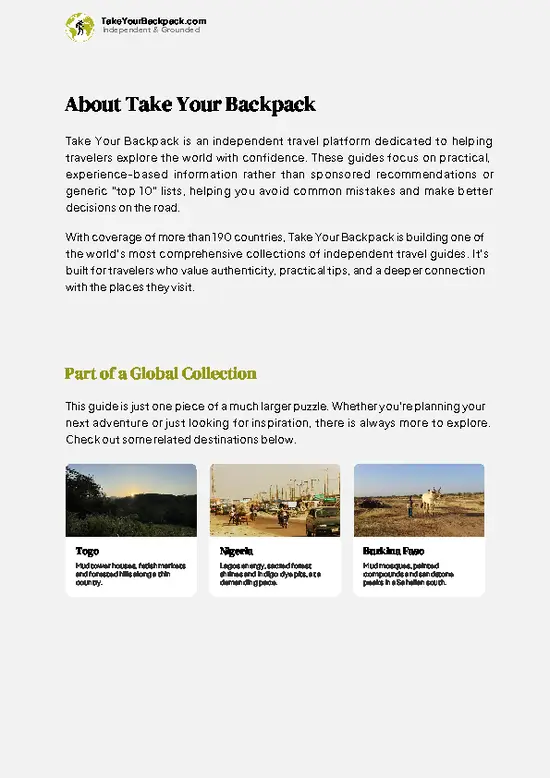
example page 0 from our offline Travel Guide for Benin
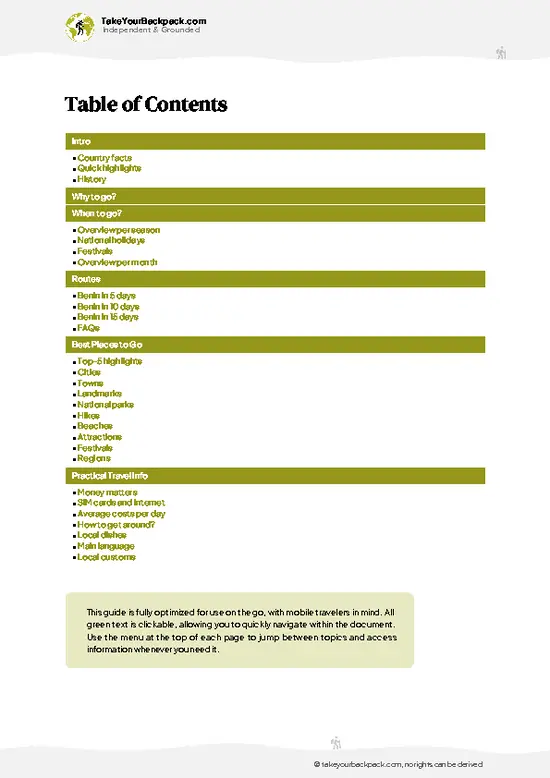
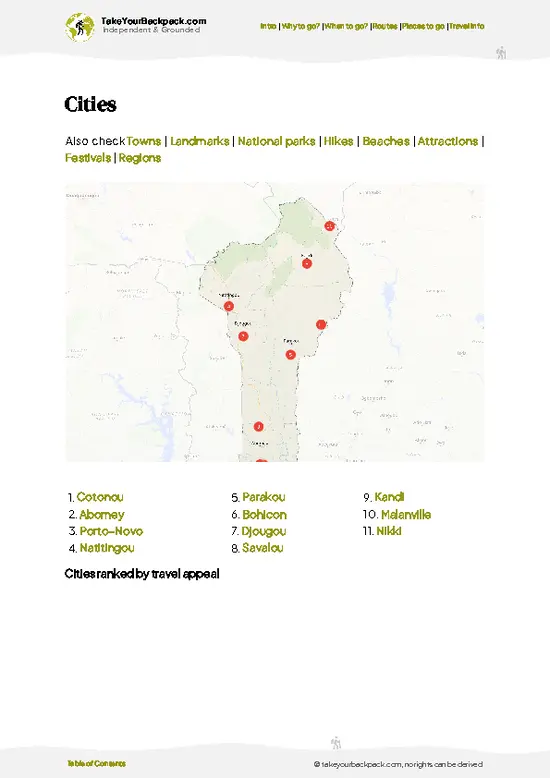
example page 1 from our offline Travel Guide for Benin
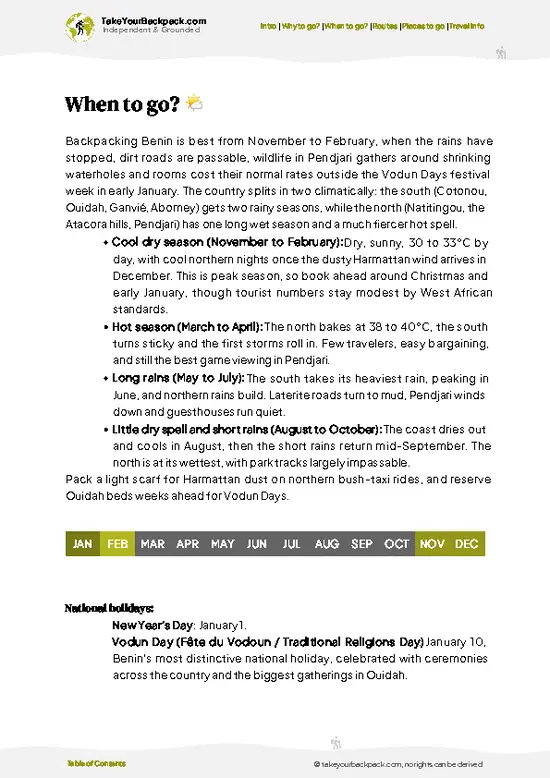
example page 2 from our offline Travel Guide for Benin
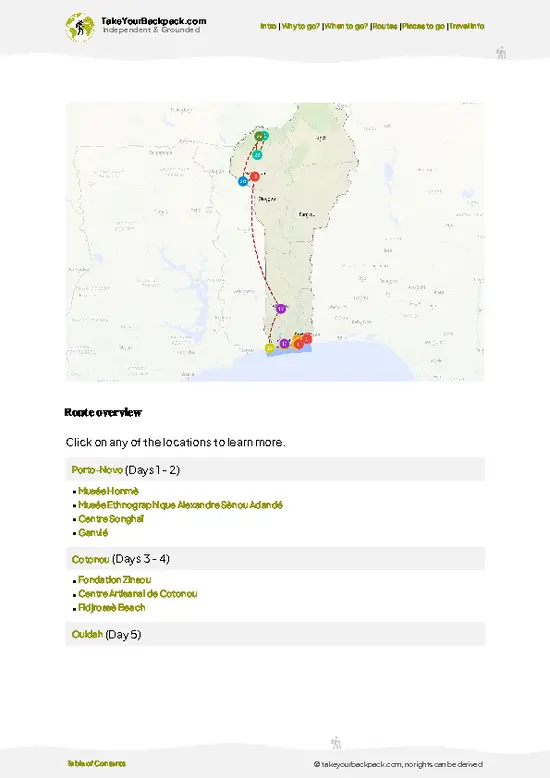
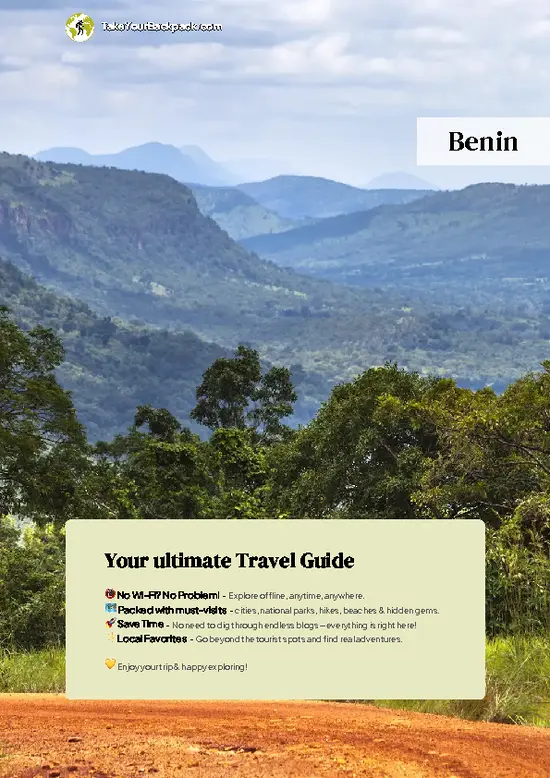
example page 3 from our offline Travel Guide for Benin
example page 4 from our offline Travel Guide for Benin
example page 5 from our offline Travel Guide for Benin
example page 6 from our offline Travel Guide for Benin
example page 7 from our offline Travel Guide for Benin
The digital guide (213 pages) contains:
✅ 48 highlights, ranked by travel appeal
✅ Optimized 5, 10 & 15-day travel routes
✅ Cities, national parks, landmarks, beaches
✅ How to get around
✅ Offline-friendly for travel without Wi-Fi
👉 Click to see all 30+ guide features

📅 Plan smarter in minutes, not weeks
✅ Month by month travel advice
✅ Festivals & national holidays
✅ Budget expectations

🗺️ Go to the right places, skip the overrated ones
✅ Honest pros & cons of destinations
✅ Top hikes, parks & viewpoints
✅ Lesser-known places most travelers miss
✅ Clear “worth it vs skip it” guidance

🛏️ Travel smoothly without rookie mistakes
✅ Best areas to stay
✅ Transport systems explained simply
✅ Common scams & safety advice
✅ SIM cards, money & practical tips

🌍 Understand the country, not just visit it
✅ Culture & traditions
✅ 52 Essential phrases & customs
✅ Festivals worth planning around
✅ Traveler-friendly historical context
✅ Insights that make places more meaningful

📱 Built for real travel conditions
✅ Fully downloadable PDF
✅ Works completely offline
✅ Optimized for phone use
✅ Useful in remote areas & buses
✅ Everything in one place
Stop searching, start planning
Get instant access to your full guide. 30‑day money-back guarantee.
+ Add another guide for just

By proceeding you agree to our terms.
Sent to your inbox immediately after payment • 100% Secure Checkout
Best Backpacking Travel Advisor 2025 tourism awardBest Backpacking
Travel Advisor
2025
What others say about Take Your Backpack Guides:
⭐⭐⭐⭐⭐
Fantastic, amazing amount of information!
⭐⭐⭐⭐⭐
My goodness this is amazing, it's what I've been looking for hats off too you!
⭐⭐⭐⭐⭐
I think this is absolutely BRILLIANT
⭐⭐⭐⭐
Very complete and informative. It's still missing places, but I gotta to commend you
⭐⭐⭐⭐⭐
This is truly amazing, thank you, can't wait to explore it with my kids!
⭐⭐⭐⭐⭐
Awesome resource, thank you!
⭐⭐⭐⭐⭐
This is amazing! Can't wait to explore the ones I haven't seen
⭐⭐⭐⭐
I love this! Well done, great idea.
⭐⭐⭐⭐⭐
Thanks for taking the time to make this gem!
⭐⭐⭐⭐⭐
This might be the best website I've ever seen.
⭐⭐⭐⭐⭐
Congratulations, and thank you so much for your work; it's incredibly valuable.
⭐⭐⭐⭐
In all seriousness I think you did a great job pointing out the important spots
⭐⭐⭐⭐⭐
10/10 very good
⭐⭐⭐⭐⭐
As someone who's only just starting to visit regularly this is awesome, thank you.
⭐⭐⭐⭐
Thank you very much! I'm going to visit my dad, it's going to be very useful!
⭐⭐⭐⭐⭐
This is really cool! We'll be travelling for the first time and this definitely come in handy.
⭐⭐⭐⭐⭐
You are now our minister of culture, congratulations 👨‍💼
⭐⭐⭐⭐⭐
Just wanted to tell you that this is a pearl! Going to follow your recommendations.
⭐⭐⭐⭐⭐
This is so cool. I'll definitely be using the resource for my travels soon.
⭐⭐⭐⭐⭐
This is very impressive! Good work.
⭐⭐⭐⭐⭐
This is an amazing and informative site. Very well done!

🛏️ Where to stay?Best Places to Stay in Benin

Benin has only a handful of true backpacker hostels, but simple guesthouses (auberges) and basic hotels are easy to find, with fan rooms at roughly 8,000 to 15,000 CFA (US$13 to 25) and air-conditioned doubles at 15,000 to 25,000 CFA (US$25 to 42). In Cotonou, Haie Vive has the most choice plus the best restaurants and bars, though prices run higher, while Ganhi puts you close to banks and the Dantokpa market but goes quiet after dark. Fidjrossè is a calmer beach-side option that gets lively on weekends. Beyond the capital, Ouidah and Grand-Popo offer relaxed, cheap beach lodges with little nightlife, and Abomey has basic rooms within walking distance of the royal palaces.

If you enjoy meeting … read more 👉
Benin has only a handful of true backpacker hostels, but simple guesthouses (auberges) and basic hotels are easy to find, with fan rooms at roughly 8,000 to 15,000 CFA (US$13 to 25) and air-conditioned doubles at 15,000 to 25,000 CFA (US$25 to 42). In Cotonou, Haie Vive has the most choice plus the best restaurants and bars, though prices run higher, while Ganhi puts you close to banks and the Dantokpa market but goes quiet after dark. Fidjrossè is a calmer beach-side option that gets lively on weekends. Beyond the capital, Ouidah and Grand-Popo offer relaxed, cheap beach lodges with little nightlife, and Abomey has basic rooms within walking distance of the royal palaces.

If you enjoy meeting fellow travelers, consider choosing hostels with high ratings for atmosphere. On the other hand, if you prefer having your own space, a hotel might be a better option.

BeninExplore Benin

👋 Meet the founderWho’s Behind Take Your Backpack?

Johan, backpacker and founder of TakeYourBackpackHi, I’m Johan (Netherlands 🇳🇱), the creator of TakeYourBackpack. Over the past 3 decades, I’ve backpacked through 90+ countries across six continents, gaining extensive experience with independent travel, long-term trips, and overland routes.

This site is built on a combination of firsthand travel experience and carefully curated insights from other backpackers. Many guides are based on places I’ve personally visited, while others bring together tips, observations, and practical advice shared by trusted travelers I’ve met along the way.

The goal is to provide realistic, experience-driven guidance — not generic itineraries — so you can explore destinations with better context, clearer expectations, and more confidence.