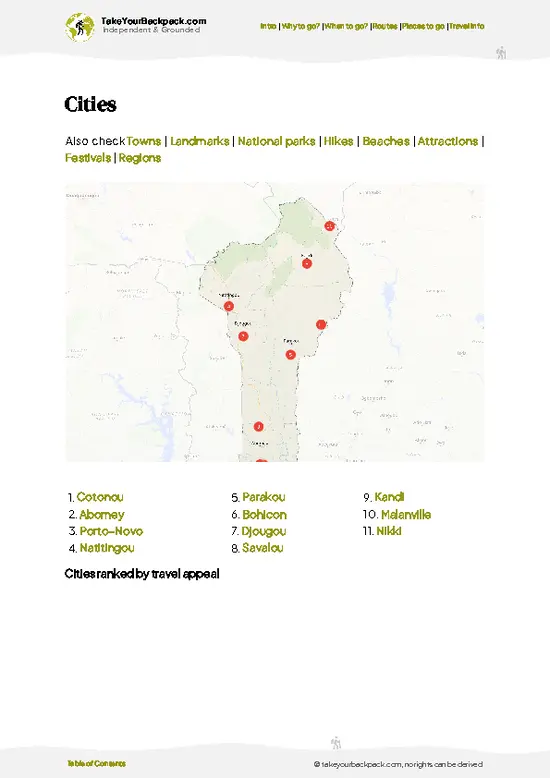
How many cities: I would advise
three to five cities. Benin’s roads are long, vehicles leave only when full, and a single transfer can eat a morning in diesel fumes and heat. Three gives you room to linger over a market, a palace courtyard or a lagoon evening. Five works if you have ten days or more. Beyond that you are mostly watching the window.
Choosing the kind: Benin offers roughly three types:
coastal commercial cities with noise, food and nightlife,
historic royal towns with museums and Vodun culture, and
northern cities with earthen architecture and a drier, slower rhythm. Culture-focused travelers should put the royal towns first, since the guided palace visits explain what you see. Food and music lovers belong on the coast, where grilled fish, pâte and street stalls glow under lamplight. …
read more 👉 How many cities: I would advise
three to five cities. Benin’s roads are long, vehicles leave only when full, and a single transfer can eat a morning in diesel fumes and heat. Three gives you room to linger over a market, a palace courtyard or a lagoon evening. Five works if you have ten days or more. Beyond that you are mostly watching the window.
Choosing the kind: Benin offers roughly three types:
coastal commercial cities with noise, food and nightlife,
historic royal towns with museums and Vodun culture, and
northern cities with earthen architecture and a drier, slower rhythm. Culture-focused travelers should put the royal towns first, since the guided palace visits explain what you see. Food and music lovers belong on the coast, where grilled fish, pâte and street stalls glow under lamplight. If you want space and quiet, go north, but expect longer, hotter journeys and less choice at night.
What it costs: A comfortable backpacker budget is
US$25 to 45 a day. Basic guesthouses run about US$10 to 25 a night, with air-conditioned rooms toward the top. Street meals of rice, beans or grilled fish cost US$1.50 to 4, and restaurant dishes US$5 to 10. Short zemidjan rides cost US$0.50 to 2. Shared taxis and minibuses between regions run about US$5 to 20. Palace and museum entry usually costs US$2 to 8, and a local guide US$10 to 25 for a half day. Bring more cash than seems sensible and carry West African CFA francs in small notes, since change is scarce.
Safety and etiquette: Benin is generally calm, but cities have
petty theft, especially at crowded markets and bus stations. Keep your phone away from the road edge on a bike, and agree the zemidjan fare before you climb on. Wear the helmet if offered. Avoid walking alone late in unlit streets. The far north near the borders of Burkina Faso and Niger has had security concerns, so check current government advice before heading there.
Cultural care: Greet everyone, with a handshake and a “bonjour”, before asking anything. Always ask before photographing people, and especially
Vodun ceremonies and shrines, where a fee or permission is expected. Use your right hand for giving and receiving. Dress modestly in towns, with shoulders and knees covered. Learning a few French phrases will win you better prices and warmer exchanges than any haggling.


 Best Backpacking
 Hi, I’m Johan (Netherlands 🇳🇱), the creator of TakeYourBackpack. Over the past 3 decades, I’ve backpacked through 90+ countries across six continents, gaining extensive experience with independent travel, long-term trips, and overland routes.