×

Benin🇧🇯 | best festivalsEssential 6 festivals to Explore in Benin

Festivals in Benin are not staged for visitors. They happen in courtyards, on beaches and along red laterite roads, driven by drums, palm-oil smoke and the flash of raffia and cloth. The south, around Ouidah, Cotonou and Abomey, is home to Vodun ceremonies that are easy to reach by shared taxi and zémidjan (motorbike taxi), though the sun is fierce and the crowds dense. The north offers quieter, dustier gatherings, with longer journeys and fewer foreigners. Independent travelers can attend most events for little or nothing, but should expect heat, noise, and a lot of waiting.

By Johan Kruseman 🇳🇱 | Updated October 23, 2026
Explore the best regions in Benin

Why go?Why These festival Stand Out

Benin is the birthplace of Vodun, and that shapes everything. Here it is a living religion practiced by millions, so ceremonies are woven into the calendar, family obligations and village life rather than put on for tourists. The former Kingdom of Dahomey left a legacy of royal ritual, masquerade and ancestral worship, while the Atlantic slave trade through Ouidah gave many gatherings a layer of remembrance. Expect drums that rattle your ribs, the sour-sweet smell of palm wine and sodabi (local spirit), and costumes of raffia, cowries and bright wax-print cloth.

The geography matters too. The country is long and narrow, so the humid, coastal south and the drier, hotter north host quite different traditions, from Vodun to Gelede masks and Muslim celebrations. Infrastructure is basic. Roads … read more 👉
Benin is the birthplace of Vodun, and that shapes everything. Here it is a living religion practiced by millions, so ceremonies are woven into the calendar, family obligations and village life rather than put on for tourists. The former Kingdom of Dahomey left a legacy of royal ritual, masquerade and ancestral worship, while the Atlantic slave trade through Ouidah gave many gatherings a layer of remembrance. Expect drums that rattle your ribs, the sour-sweet smell of palm wine and sodabi (local spirit), and costumes of raffia, cowries and bright wax-print cloth.

The geography matters too. The country is long and narrow, so the humid, coastal south and the drier, hotter north host quite different traditions, from Vodun to Gelede masks and Muslim celebrations. Infrastructure is basic. Roads to rural ceremonies can be rutted and dusty, signage is rare, and dates often follow lunar or ritual calendars that shift year to year or are confirmed only days ahead. Many sacred moments are closed to outsiders or forbid photography. Travelers should plan around flexibility, local guides and respect for hosts, rather than rigid schedules. The payoff is access to ceremonies that feel lived-in and unrehearsed.
Why These Made the Cut
The list of best festivals in Benin is created based on energy, traditions, crowd experience, activities, and overall excitement. If you feel a festival is missing in this list, please let us know.

When to go?Best Time to Visit Benin for festivals

Best months and weather: The best months for festivals in Benin are December to February, when the dry season brings clear skies, firm roads and fewer mosquitoes, though the harmattan wind from the Sahara fills the air with a pale dust haze. Temperatures in the south sit around 24 to 32°C, and in the north days can reach 35 to 40°C with cool nights near 15 to 20°C in the harmattan. Heat and dust are real parts of the experience, so expect gritty eyes, dry throats and a film of red powder on everything.

Shoulder seasons and the rains: March to May are hot and humid, with the south building toward its first rains. The main rainy season runs roughly April to July in the south, with heavy downpours that turn laterite tracks to slick orange mud and slow zémidjan rides. A shorter wet spell returns … read more 👉
Best months and weather: The best months for festivals in Benin are December to February, when the dry season brings clear skies, firm roads and fewer mosquitoes, though the harmattan wind from the Sahara fills the air with a pale dust haze. Temperatures in the south sit around 24 to 32°C, and in the north days can reach 35 to 40°C with cool nights near 15 to 20°C in the harmattan. Heat and dust are real parts of the experience, so expect gritty eyes, dry throats and a film of red powder on everything.

Shoulder seasons and the rains: March to May are hot and humid, with the south building toward its first rains. The main rainy season runs roughly April to July in the south, with heavy downpours that turn laterite tracks to slick orange mud and slow zémidjan rides. A shorter wet spell returns around September and October. Even then, rain tends to come in bursts, with sunny stretches between. Coastal Cotonou and Ouidah see roughly 800 to 1,300 mm of rain a year.

The north and prices: The north has a single rainy season, about May to October, so its roads are most reliable from November to April. Accommodation prices barely shift with the seasons, but rooms in Ouidah and Cotonou fill and rise by perhaps 20 to 50 percent around major gatherings, especially in January. Book ahead then.

festival hoppingHow to Combine festivals Into One Trip

How long to allow: A trip linking several festivals in Benin needs 7 to 12 days, because ceremonies hinge on fixed dates and the roads are slow. The south clusters tightly: Cotonou, Ouidah, Porto-Novo and Abomey are all within roughly 30 minutes to 3 hours of one another by shared taxi, minibus or private driver. The north, around Natitingou, Parakou and Kandi, lies a long way off. Cotonou to Parakou takes about 6 to 8 hours by bus, and on to Natitingou another 3 to 4.

Direction and pacing: Starting in Cotonou and working north suits most travelers, since the capital has the airport, the best transport links and a chance to adjust to the heat. Spend one to two days at each southern stop, with an extra day in hand for events that start late or run overnight. Northern stops need two to three … read more 👉
How long to allow: A trip linking several festivals in Benin needs 7 to 12 days, because ceremonies hinge on fixed dates and the roads are slow. The south clusters tightly: Cotonou, Ouidah, Porto-Novo and Abomey are all within roughly 30 minutes to 3 hours of one another by shared taxi, minibus or private driver. The north, around Natitingou, Parakou and Kandi, lies a long way off. Cotonou to Parakou takes about 6 to 8 hours by bus, and on to Natitingou another 3 to 4.

Direction and pacing: Starting in Cotonou and working north suits most travelers, since the capital has the airport, the best transport links and a chance to adjust to the heat. Spend one to two days at each southern stop, with an extra day in hand for events that start late or run overnight. Northern stops need two to three days each, as distances and rough tracks eat into daylight.

Common planning mistakes: The biggest mistake is packing too many stops into too few days. Buses leave only when full, tracks wash out in the rains, and a drum-filled night leaves you wrecked the next morning. Build in buffer days and confirm dates locally, since ritual schedules change. Travel in daylight, as night roads have potholes, unlit trucks and police checkpoints.

The ListMust-Visit festivals in Benin

1 Voodoo Festival

Ouidah, Door of No Return, Zangbeto, January 10

Gather in Ouidah’s squares and on the beach for libations, spinning Egungun masks and thatched Zangbeto figures, with ceremonies ending at the Door of No Return.

2 Gelede Festival

Efe night songs, carved headdresses, satire, Iya Nla

Catch a masked singer mocking greed and gossip after dark, then return by day for carved headdresses and fast stamping dancers honoring elder women.

3 Fête de la Gaani

Bariba horsemen, Nikki palace, court trumpets, new year rites

Stand at a bend in Nikki’s streets as Bariba riders gallop past the palace walls, with long drums and horns marking the new year.

4 Fête de la Nonvitcha

Grand-Popo processions, beach road, dance circles, grilled fish

Follow drummers and dancers in matching cloth through Grand-Popo’s sandy lanes, then ease into an evening circle or a fish plate by the Atlantic.

5 Fête de l’Igname

New yam offering, pounded yam, Savalou elders, courtyard drumming

Join Savalou’s harvest celebration, where elders present the first yams to ancestors before families pound, share and eat, and the dancing opens to newcomers.

6 Egun Festival

Egungun masks, talking drums, ancestor shrines, Porto-Novo lanes

Watch ancestors take form as towering cloth-layered dancers, then step back fast as the drums quicken through Porto-Novo’s narrow streets and family compounds.

Loading the map 🌍

Expert viewExpert Commentary on festivals

How many festivals to attend: I would advise two to four festivals in a single trip. Ceremonies run long, often through the night, and the heat, noise and dust are tiring. Two or three give you time to rest, talk with locals and absorb the drumming, the palm-oil smoke and the swirl of raffia. More than four and you spend your days in transit, watching the clock instead of the dancers.

Choosing between kinds: First-timers and those short on time should favor Vodun gatherings in the south, where transport is easy, guides are plentiful and the atmosphere is intense but well-known to visitors. Travelers with more time and a taste for dusty roads should add one northern event, where crowds are smaller and the welcome often warmer because foreigners are rare. Photographers and culture-focused travelers … read more 👉
How many festivals to attend: I would advise two to four festivals in a single trip. Ceremonies run long, often through the night, and the heat, noise and dust are tiring. Two or three give you time to rest, talk with locals and absorb the drumming, the palm-oil smoke and the swirl of raffia. More than four and you spend your days in transit, watching the clock instead of the dancers.

Choosing between kinds: First-timers and those short on time should favor Vodun gatherings in the south, where transport is easy, guides are plentiful and the atmosphere is intense but well-known to visitors. Travelers with more time and a taste for dusty roads should add one northern event, where crowds are smaller and the welcome often warmer because foreigners are rare. Photographers and culture-focused travelers should choose masquerade-heavy events, while anyone sensitive to crowds is better off at smaller village ceremonies. Either way, you leave with the memory of a drum beat felt in your chest.

What it costs: Budget about US$25 to 45 a day for food, a simple room and local transport, with food at roadside stalls running only US$2 to 5 a meal. Most public events are free, but some ask for a donation or entry of roughly US$5 to 15, and photo or video permission can add US$5 to 20. A local guide costs about US$20 to 40 a day, and is worth the money for translation and introductions. Zémidjan rides in town cost US$0.50 to 2, while a day of private car hire with a driver runs about US$60 to 100. Carry small CFA franc notes, since change is scarce.

Safety and etiquette: Ceremonies are religious acts, so dress modestly, covering shoulders and knees, and avoid wearing red or black to sacred sites unless your guide says it is fine. Always ask before photographing people, shrines or masked dancers, and never touch ritual objects. Some moments are closed to outsiders, and accepting that gracefully earns respect. Crowds draw pickpockets, so carry little cash and keep your phone secure. Drink only bottled or treated water, bring sun protection and a hat, and stay hydrated. In the far north, check current security advice for border areas near Pendjari and Burkina Faso before travelling. Do not drive at night.


✈️ The backpacker research shortcutBenin Travel Guide

An offline-friendly backpacking guide with optimized travel routes, ranked highlights, transport advice, and the best areas to stay.
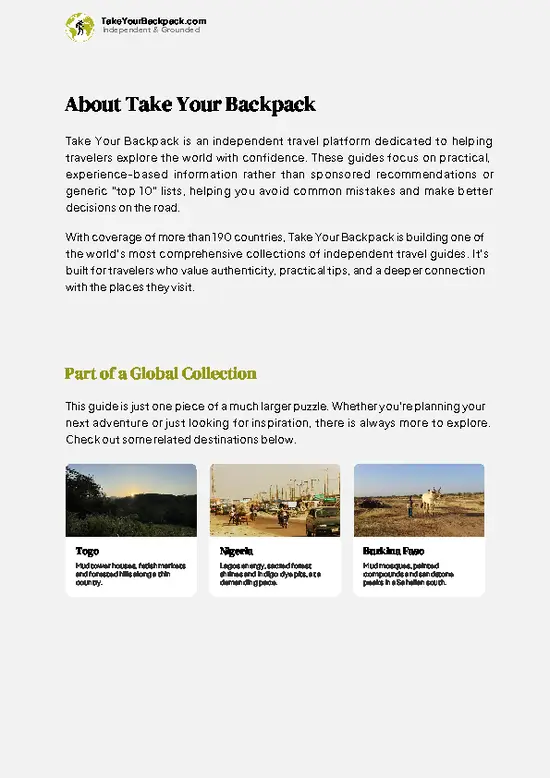
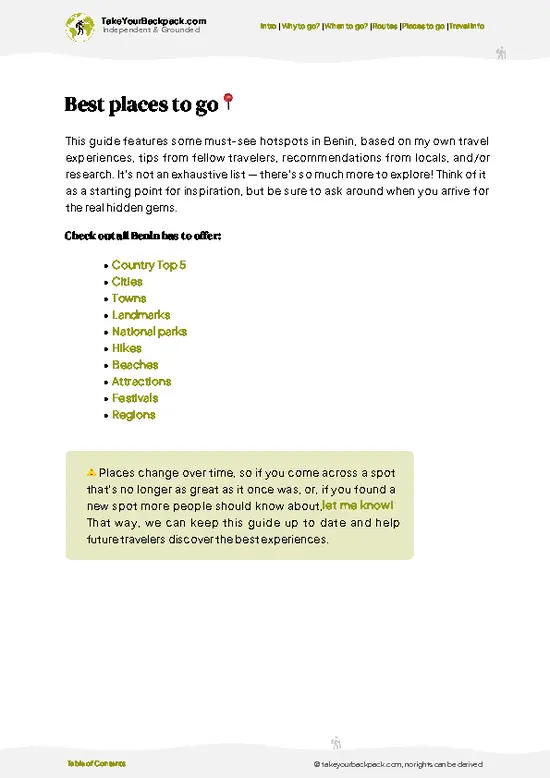
example page 0 from our offline Travel Guide for Benin
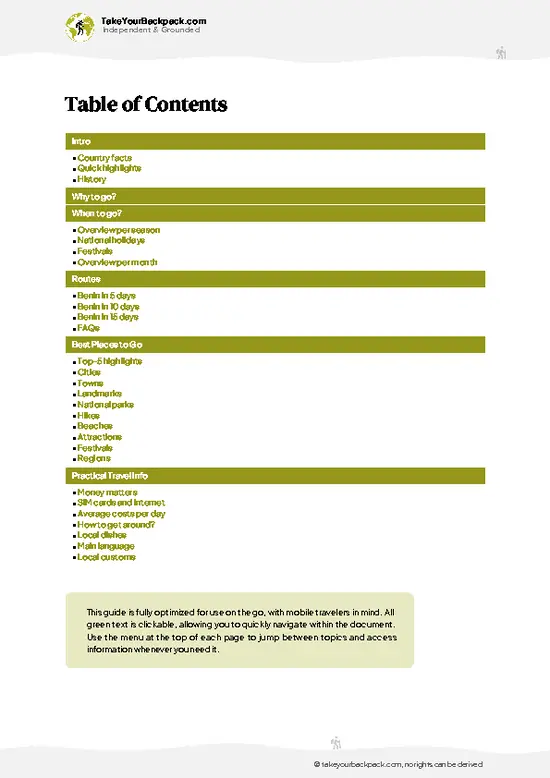
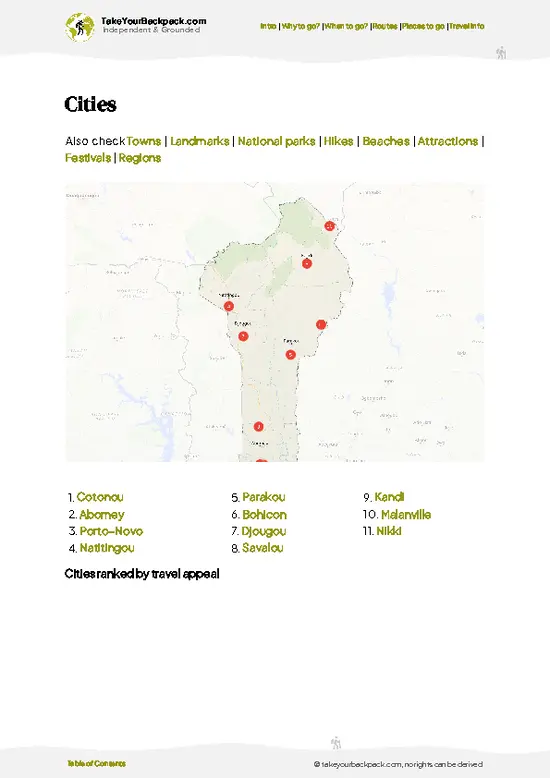
example page 1 from our offline Travel Guide for Benin
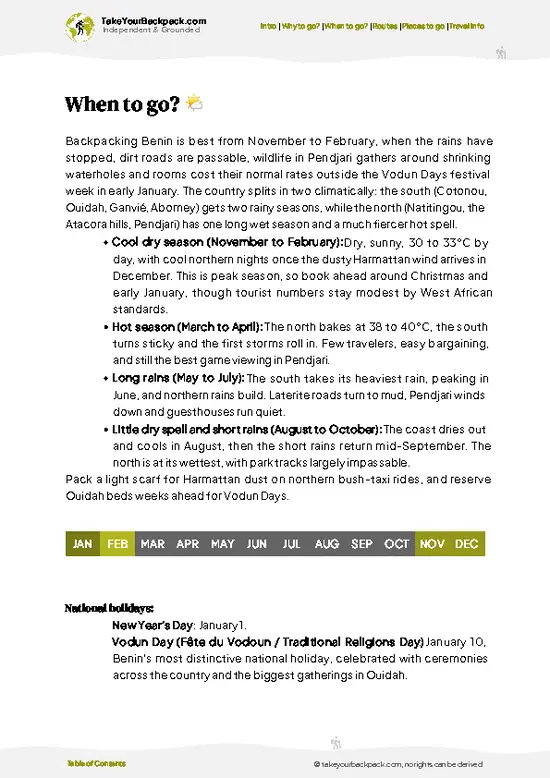
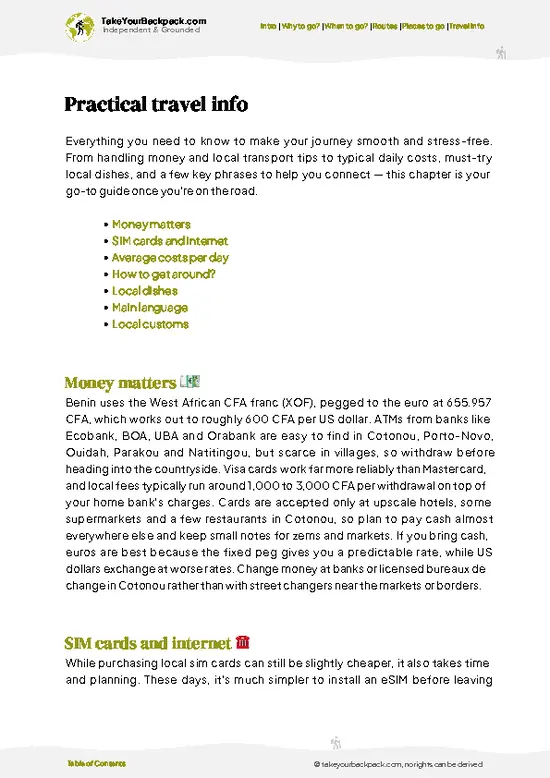
example page 2 from our offline Travel Guide for Benin
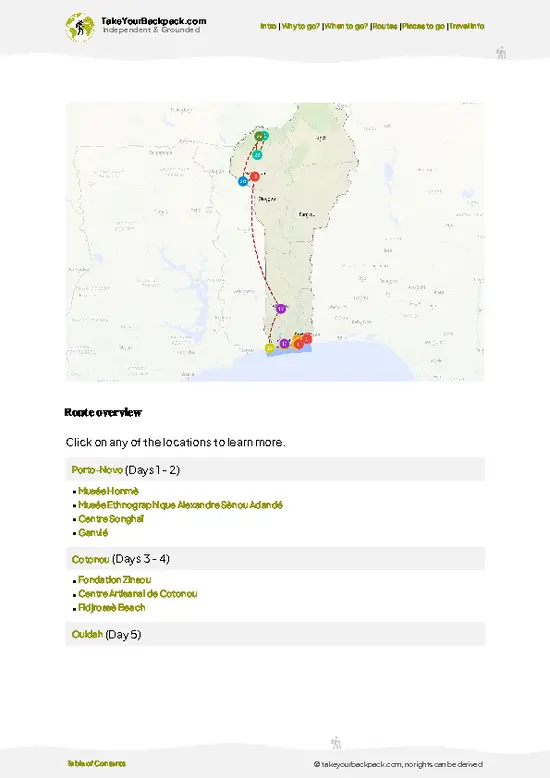
example page 3 from our offline Travel Guide for Benin
example page 4 from our offline Travel Guide for Benin
example page 5 from our offline Travel Guide for Benin
example page 6 from our offline Travel Guide for Benin
example page 7 from our offline Travel Guide for Benin
The digital guide (213 pages) contains:
✅ 48 highlights, ranked by travel appeal
✅ Optimized 5, 10 & 15-day travel routes
✅ Cities, national parks, landmarks, beaches
✅ How to get around
✅ Offline-friendly for travel without Wi-Fi
👉 Click to see all 30+ guide features

📅 Plan smarter in minutes, not weeks
✅ Month by month travel advice
✅ Festivals & national holidays
✅ Budget expectations

🗺️ Go to the right places, skip the overrated ones
✅ Honest pros & cons of destinations
✅ Top hikes, parks & viewpoints
✅ Lesser-known places most travelers miss
✅ Clear “worth it vs skip it” guidance

🛏️ Travel smoothly without rookie mistakes
✅ Best areas to stay
✅ Transport systems explained simply
✅ Common scams & safety advice
✅ SIM cards, money & practical tips

🌍 Understand the country, not just visit it
✅ Culture & traditions
✅ 52 Essential phrases & customs
✅ Festivals worth planning around
✅ Traveler-friendly historical context
✅ Insights that make places more meaningful

📱 Built for real travel conditions
✅ Fully downloadable PDF
✅ Works completely offline
✅ Optimized for phone use
✅ Useful in remote areas & buses
✅ Everything in one place
Stop searching, start planning
Get instant access to your full guide. 30‑day money-back guarantee.
+ Add another guide for just

By proceeding you agree to our terms.
Sent to your inbox immediately after payment • 100% Secure Checkout
Best Backpacking Travel Advisor 2025 tourism awardBest Backpacking
Travel Advisor
2025
What others say about Take Your Backpack Guides:
⭐⭐⭐⭐⭐
Fantastic, amazing amount of information!
⭐⭐⭐⭐⭐
My goodness this is amazing, it's what I've been looking for hats off too you!
⭐⭐⭐⭐⭐
I think this is absolutely BRILLIANT
⭐⭐⭐⭐
Very complete and informative. It's still missing places, but I gotta to commend you
⭐⭐⭐⭐⭐
This is truly amazing, thank you, can't wait to explore it with my kids!
⭐⭐⭐⭐⭐
Awesome resource, thank you!
⭐⭐⭐⭐⭐
This is amazing! Can't wait to explore the ones I haven't seen
⭐⭐⭐⭐
I love this! Well done, great idea.
⭐⭐⭐⭐⭐
Thanks for taking the time to make this gem!
⭐⭐⭐⭐⭐
This might be the best website I've ever seen.
⭐⭐⭐⭐⭐
Congratulations, and thank you so much for your work; it's incredibly valuable.
⭐⭐⭐⭐
In all seriousness I think you did a great job pointing out the important spots
⭐⭐⭐⭐⭐
10/10 very good
⭐⭐⭐⭐⭐
As someone who's only just starting to visit regularly this is awesome, thank you.
⭐⭐⭐⭐
Thank you very much! I'm going to visit my dad, it's going to be very useful!
⭐⭐⭐⭐⭐
This is really cool! We'll be travelling for the first time and this definitely come in handy.
⭐⭐⭐⭐⭐
You are now our minister of culture, congratulations 👨‍💼
⭐⭐⭐⭐⭐
Just wanted to tell you that this is a pearl! Going to follow your recommendations.
⭐⭐⭐⭐⭐
This is so cool. I'll definitely be using the resource for my travels soon.
⭐⭐⭐⭐⭐
This is very impressive! Good work.
⭐⭐⭐⭐⭐
This is an amazing and informative site. Very well done!

🛏️ Where to stay?Best Places to Stay in Benin

Benin has only a handful of true backpacker hostels, but simple guesthouses (auberges) and basic hotels are easy to find, with fan rooms at roughly 8,000 to 15,000 CFA (US$13 to 25) and air-conditioned doubles at 15,000 to 25,000 CFA (US$25 to 42). In Cotonou, Haie Vive has the most choice plus the best restaurants and bars, though prices run higher, while Ganhi puts you close to banks and the Dantokpa market but goes quiet after dark. Fidjrossè is a calmer beach-side option that gets lively on weekends. Beyond the capital, Ouidah and Grand-Popo offer relaxed, cheap beach lodges with little nightlife, and Abomey has basic rooms within walking distance of the royal palaces.

If you enjoy meeting … read more 👉
Benin has only a handful of true backpacker hostels, but simple guesthouses (auberges) and basic hotels are easy to find, with fan rooms at roughly 8,000 to 15,000 CFA (US$13 to 25) and air-conditioned doubles at 15,000 to 25,000 CFA (US$25 to 42). In Cotonou, Haie Vive has the most choice plus the best restaurants and bars, though prices run higher, while Ganhi puts you close to banks and the Dantokpa market but goes quiet after dark. Fidjrossè is a calmer beach-side option that gets lively on weekends. Beyond the capital, Ouidah and Grand-Popo offer relaxed, cheap beach lodges with little nightlife, and Abomey has basic rooms within walking distance of the royal palaces.

If you enjoy meeting fellow travelers, consider choosing hostels with high ratings for atmosphere. On the other hand, if you prefer having your own space, a hotel might be a better option.

BeninExplore Benin

👋 Meet the founderWho’s Behind Take Your Backpack?

Johan, backpacker and founder of TakeYourBackpackHi, I’m Johan (Netherlands 🇳🇱), the creator of TakeYourBackpack. Over the past 3 decades, I’ve backpacked through 90+ countries across six continents, gaining extensive experience with independent travel, long-term trips, and overland routes.

This site is built on a combination of firsthand travel experience and carefully curated insights from other backpackers. Many guides are based on places I’ve personally visited, while others bring together tips, observations, and practical advice shared by trusted travelers I’ve met along the way.

The goal is to provide realistic, experience-driven guidance — not generic itineraries — so you can explore destinations with better context, clearer expectations, and more confidence.