×

Benin🇧🇯 | best landmarksEssential 4 landmarks to Explore in Benin

Benin’s landmarks are split by latitude, and the split shapes your trip. In the south, Ouidah, Abomey and Porto-Novo sit close together on red laterite roads, where mud-brick palace walls, drumming and the smell of palm oil and woodsmoke mix with moto-taxi exhaust. Entry fees are small, and guides are easy to hire. In the north, the Pendjari and Tata Somba country mean dust, harmattan haze and long, hot hauls on rough roads, with almost no crowds. Backpacking here is feasible, but independent travelers should expect slow bush taxis and sweaty waits. Rewards are quiet places and few other visitors.

By Johan Kruseman 🇳🇱 | Updated October 23, 2026
Explore the best national parks in Benin

Why go?Why These unique site Stand Out

Benin rewards travelers who want landmarks tied to living culture. The country was home to the Dahomey kingdom, and it is the birthplace of Vodun, so many sites are still used for ceremonies rather than preserved behind glass. You hear drums, smell incense and burnt palm oil, and feel packed clay underfoot. The Atlantic slave trade also left a heavy mark on the coast, and some places carry that weight in ways that are quiet and hard.

The country is narrow and long, so landmarks run in a north-south line, with the south dense and the north sparse. Infrastructure follows that pattern. Southern roads are mostly paved and busy with motorbikes, while northern tracks turn to red dust in the dry season and to mud in the rains. Signage is thin, English is rare outside tourist hotels, and French is … read more 👉
Benin rewards travelers who want landmarks tied to living culture. The country was home to the Dahomey kingdom, and it is the birthplace of Vodun, so many sites are still used for ceremonies rather than preserved behind glass. You hear drums, smell incense and burnt palm oil, and feel packed clay underfoot. The Atlantic slave trade also left a heavy mark on the coast, and some places carry that weight in ways that are quiet and hard.

The country is narrow and long, so landmarks run in a north-south line, with the south dense and the north sparse. Infrastructure follows that pattern. Southern roads are mostly paved and busy with motorbikes, while northern tracks turn to red dust in the dry season and to mud in the rains. Signage is thin, English is rare outside tourist hotels, and French is the working language, so a few phrases help.

Know before you choose Benin that facilities are basic. Few sites have museum-style labeling, cash is the rule, and an informed local guide often makes the difference between seeing a wall and understanding it. Photography rules around sacred sites are strict, and a fee or permission is often required.
How the List Was Created
The list of best unique sites in Benin is created based on history or culture, wow factor, atmosphere, quirks, and memorability. If you feel a unique site is missing in this list, please let us know.

When to go?Best Time to Visit Benin for landmarks

Best months and the dry season: The best months for landmarks in Benin are November to February, when rain is rare and roads are firm, with daytime highs of about 29 to 33°C in the south. In the north, the harmattan wind brings dry, dusty haze from December to February, so photos look flat and your throat stays scratchy, yet nights drop to 15 to 20°C and the heat is easier to bear.
Shoulder seasons and rains: March to May turns hot and sticky, with 32 to 38°C in the north and heavy humidity along the coast. Walking through unshaded courtyards at midday is punishing, so go early. The south has two rainy seasons, roughly April to July and a shorter one in September to November, with Cotonou getting about 1,200 mm of rain a year. Downpours flood unpaved lanes and slow transport. The north has … read more 👉
Best months and the dry season: The best months for landmarks in Benin are November to February, when rain is rare and roads are firm, with daytime highs of about 29 to 33°C in the south. In the north, the harmattan wind brings dry, dusty haze from December to February, so photos look flat and your throat stays scratchy, yet nights drop to 15 to 20°C and the heat is easier to bear.
Shoulder seasons and rains: March to May turns hot and sticky, with 32 to 38°C in the north and heavy humidity along the coast. Walking through unshaded courtyards at midday is punishing, so go early. The south has two rainy seasons, roughly April to July and a shorter one in September to November, with Cotonou getting about 1,200 mm of rain a year. Downpours flood unpaved lanes and slow transport. The north has one wet season, June to October, when dirt tracks can become impassable and wildlife areas shut or limit access.
Peak periods: Crowds are never big, but Vodun Day on January 10 brings large ceremonies and busy lodging around Ouidah, and prices can rise 20 to 50 percent. Book ahead and expect noise, smoke and dense, drumming crowds.

unique site hoppingHow to Combine landmarks Into One Trip

How long and in which direction: A trip linking several landmarks in Benin needs 7 to 10 days, and 12 to 14 if you add the north. Start in Cotonou, where most flights and buses arrive, then work north so the long, rough stretches come once you have adjusted to the heat.
Regional clusters: The south groups well. Ouidah is about 40 to 60 minutes from Cotonou by shared taxi or minibus, and Porto-Novo is 40 to 90 minutes depending on traffic. Abomey is about 2.5 to 3.5 hours from Cotonou along a paved road, with bush taxis leaving when full. Give each southern stop half a day to a full day, and a full day is better where a guide walks you through ceremonial grounds. From Abomey, the central hub of Dassa-Zoumè or Parakou breaks the journey. Parakou to the northwest is a further 5 to 8 hours by road, … read more 👉
How long and in which direction: A trip linking several landmarks in Benin needs 7 to 10 days, and 12 to 14 if you add the north. Start in Cotonou, where most flights and buses arrive, then work north so the long, rough stretches come once you have adjusted to the heat.
Regional clusters: The south groups well. Ouidah is about 40 to 60 minutes from Cotonou by shared taxi or minibus, and Porto-Novo is 40 to 90 minutes depending on traffic. Abomey is about 2.5 to 3.5 hours from Cotonou along a paved road, with bush taxis leaving when full. Give each southern stop half a day to a full day, and a full day is better where a guide walks you through ceremonial grounds. From Abomey, the central hub of Dassa-Zoumè or Parakou breaks the journey. Parakou to the northwest is a further 5 to 8 hours by road, and the park and Somba villages need two to three days with a 4x4 and driver.
Planning mistakes: Travelers often cram three sites into one day and spend it sitting in a minibus waiting for seats to fill. Pick one or two per day instead. Others leave the north late and hit the rains, so go in the dry months. Travel by day only, as night roads are potholed and poorly lit.

The ListMust-Visit landmarks in Benin

1 Royal Palaces of Abomey

Clay bas-reliefs, thatched royal halls, Gezo’s throne, appliqué workshops

Follow a guide through earthen palace halls where painted panels name kings by animal, then visit artisans who stitch Dahomey’s history into cloth.

benin-unique-site-royal-palaces-of-abomey
© Google |

2 Temple of Pythons

Royal pythons, Dangbé shrine, basilica across the square, slave route

Hold a cool, heavy python in a dim shrine room, then cross the square to the basilica and continue toward the fort museum and beach.

benin-unique-site-temple-of-pythons
© Google |

3 Sacred Forest of Kpassè

Kpassè tree, Vodun sculptures, cloth-wrapped Loko trees, offering spots

Walk a small ritual grove with a local guardian, who explains the king-turned-tree, the taboos and the offerings left among the trunks.

benin-unique-site-sacred-forest-of-kpasse
© Google |

4 Mount Sokbaro

Rocky Atacora summit, Donga savanna view, village guide, farm-path descent

Climb bare rock and loose stone with a guide from Sokbaro village, rest among boulders, then look over the Donga savanna and return through farm plots.

Loading the map 🌍

Expert viewExpert Commentary on landmarks

How many landmarks to aim for: I advise four to six landmarks on one trip. Benin’s sites sit far apart, roads are often red dirt shoulders shared with trucks and motorbikes, and the midday heat (30 to 35°C in the south) flattens your appetite for anything past a morning and an early evening. Past six, you are mostly watching the road through a dusty windshield. With five, each place gets a slow hour with a guide, a cold drink in the shade, and time for the sound of drums or a market next door to sink in.

Which kind to prioritize: Match the kind of landmark to how you travel. If history is your reason for coming, put the memorial and royal heritage sites first. They carry the weight of the Dahomey kingdom and the slave trade, and a good local guide turns bare clay walls and sandy tracks into … read more 👉
How many landmarks to aim for: I advise four to six landmarks on one trip. Benin’s sites sit far apart, roads are often red dirt shoulders shared with trucks and motorbikes, and the midday heat (30 to 35°C in the south) flattens your appetite for anything past a morning and an early evening. Past six, you are mostly watching the road through a dusty windshield. With five, each place gets a slow hour with a guide, a cold drink in the shade, and time for the sound of drums or a market next door to sink in.

Which kind to prioritize: Match the kind of landmark to how you travel. If history is your reason for coming, put the memorial and royal heritage sites first. They carry the weight of the Dahomey kingdom and the slave trade, and a good local guide turns bare clay walls and sandy tracks into something you can feel. If you travel for culture, choose the Vodun sites and ceremonies, where incense, palm oil, red cloth and the smell of fermenting sodabi (local spirit) hang in the air. If you want wilderness, the northern natural and rock-built landmarks give you dry-season dust, baobab shade and long silent views, but cost more in transport. Stilt-village and lagoon visits suit anyone who wants water, birdsong and a break from the heat on a paddled boat.

What it costs: Plan on US$25 to 45 a day all in as a backpacker: a guesthouse bed at 8,000 to 15,000 CFA francs (US$13 to 25), street meals of rice, grilled fish or pâte at 1,000 to 2,500 CFA francs (US$2 to 4), and the rest for sites. Per visit, entry usually runs 1,000 to 5,000 CFA francs (US$2 to 8), and a local guide adds 2,000 to 5,000 CFA francs (US$3 to 8), which is money well spent because the stories live with the guide, not the signage. Moto-taxis (zemidjans) cost 300 to 1,000 CFA francs (US$0.50 to 1.70) for town hops, while shared taxis and buses between towns run roughly 1,500 to 6,000 CFA francs (US$2.50 to 10). National park entry and the required guide or vehicle in the north push a single day to US$60 to 100 or more. Carry small notes, since change is scarce and cards are rarely accepted.

Safety and etiquette: Southern and central Benin is generally relaxed, but the far north near the borders with Burkina Faso and Niger has had security warnings, so check your government’s current travel advice before going and stay with licensed park operators. A yellow fever certificate is required, and malaria prophylaxis is sensible. Wear a helmet on zems, and keep your phone out of sight on crowded roads.

At Vodun sites, ask before you photograph anything, especially shrines, priests and people in trance. Expect a small fee or offering, often 1,000 to 5,000 CFA francs (US$2 to 8), and take it as the price of being welcomed, not a scam. Dress covered at shoulders and knees, stand where you are told, and never touch sacred objects. At memorial sites, keep your voice low. Drink only bottled or filtered water, carry sun protection, and visit early, before the white midday light drains the color from everything.

✈️ The backpacker research shortcutBenin Travel Guide

An offline-friendly backpacking guide with optimized travel routes, ranked highlights, transport advice, and the best areas to stay.
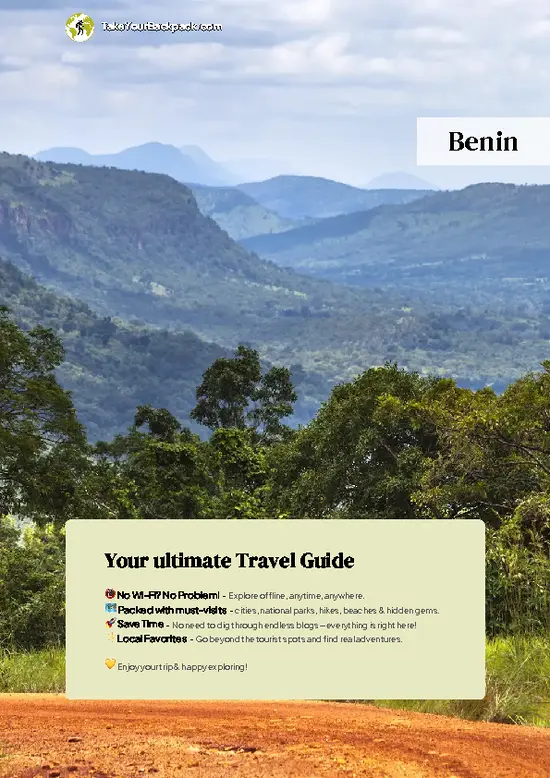
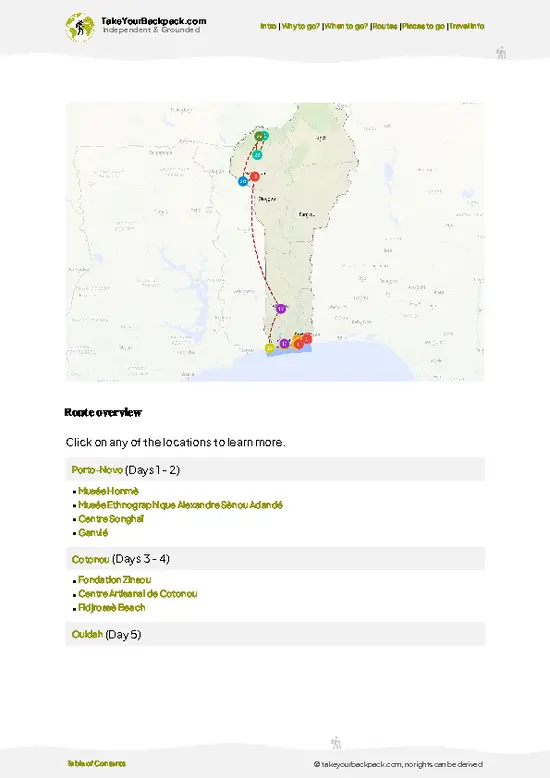
example page 0 from our offline Travel Guide for Benin
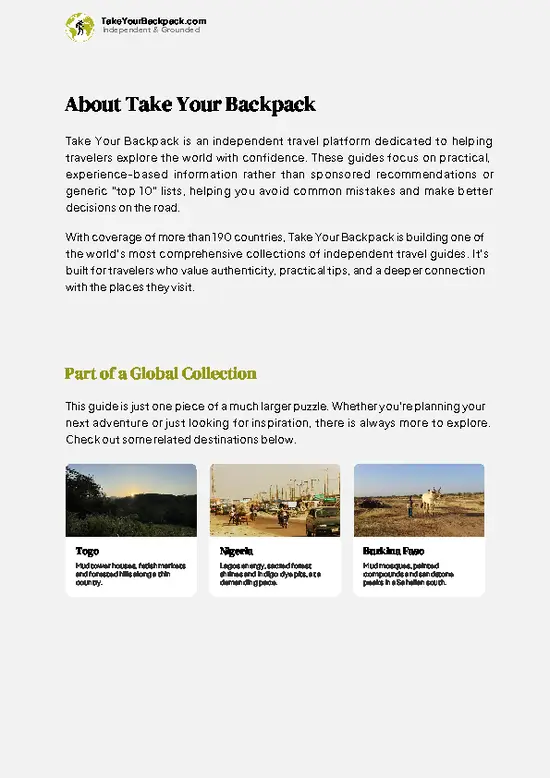
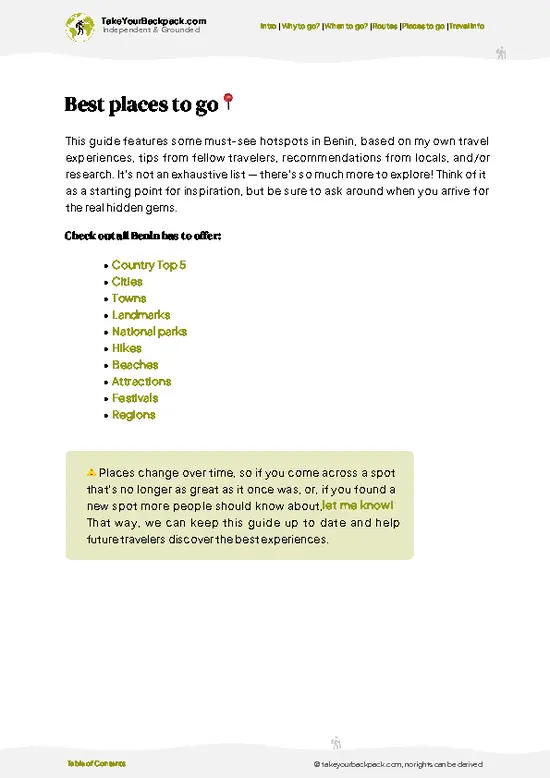
example page 1 from our offline Travel Guide for Benin
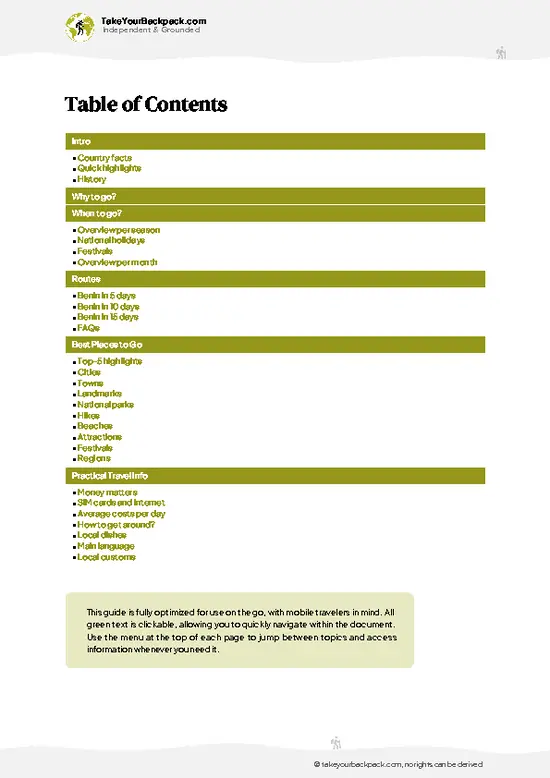
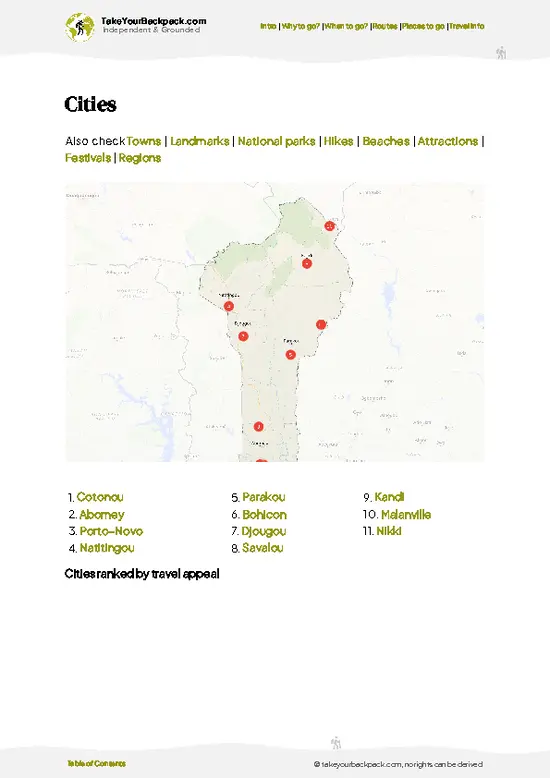
example page 2 from our offline Travel Guide for Benin
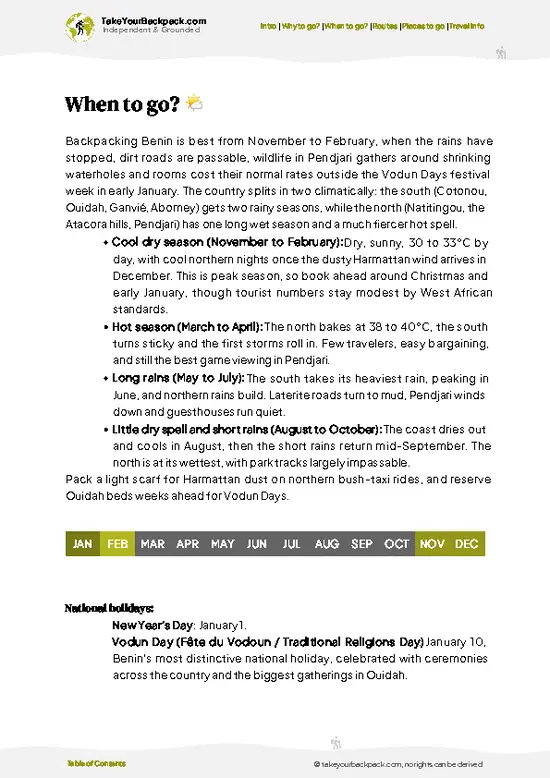
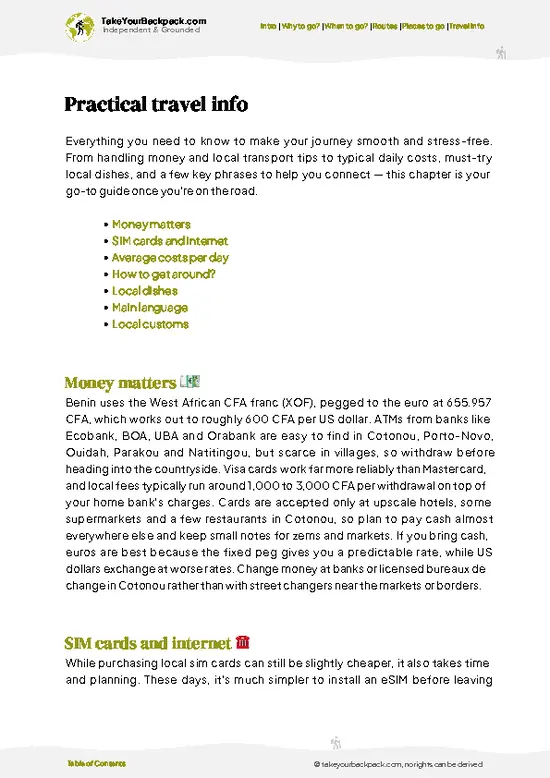
example page 3 from our offline Travel Guide for Benin
example page 4 from our offline Travel Guide for Benin
example page 5 from our offline Travel Guide for Benin
example page 6 from our offline Travel Guide for Benin
example page 7 from our offline Travel Guide for Benin
The digital guide (213 pages) contains:
✅ 48 highlights, ranked by travel appeal
✅ Optimized 5, 10 & 15-day travel routes
✅ Cities, national parks, landmarks, beaches
✅ How to get around
✅ Offline-friendly for travel without Wi-Fi
👉 Click to see all 30+ guide features

📅 Plan smarter in minutes, not weeks
✅ Month by month travel advice
✅ Festivals & national holidays
✅ Budget expectations

🗺️ Go to the right places, skip the overrated ones
✅ Honest pros & cons of destinations
✅ Top hikes, parks & viewpoints
✅ Lesser-known places most travelers miss
✅ Clear “worth it vs skip it” guidance

🛏️ Travel smoothly without rookie mistakes
✅ Best areas to stay
✅ Transport systems explained simply
✅ Common scams & safety advice
✅ SIM cards, money & practical tips

🌍 Understand the country, not just visit it
✅ Culture & traditions
✅ 52 Essential phrases & customs
✅ Festivals worth planning around
✅ Traveler-friendly historical context
✅ Insights that make places more meaningful

📱 Built for real travel conditions
✅ Fully downloadable PDF
✅ Works completely offline
✅ Optimized for phone use
✅ Useful in remote areas & buses
✅ Everything in one place
Stop searching, start planning
Get instant access to your full guide. 30‑day money-back guarantee.
+ Add another guide for just

By proceeding you agree to our terms.
Sent to your inbox immediately after payment • 100% Secure Checkout
Best Backpacking Travel Advisor 2025 tourism awardBest Backpacking
Travel Advisor
2025
What others say about Take Your Backpack Guides:
⭐⭐⭐⭐⭐
Fantastic, amazing amount of information!
⭐⭐⭐⭐⭐
My goodness this is amazing, it's what I've been looking for hats off too you!
⭐⭐⭐⭐⭐
I think this is absolutely BRILLIANT
⭐⭐⭐⭐
Very complete and informative. It's still missing places, but I gotta to commend you
⭐⭐⭐⭐⭐
This is truly amazing, thank you, can't wait to explore it with my kids!
⭐⭐⭐⭐⭐
Awesome resource, thank you!
⭐⭐⭐⭐⭐
This is amazing! Can't wait to explore the ones I haven't seen
⭐⭐⭐⭐
I love this! Well done, great idea.
⭐⭐⭐⭐⭐
Thanks for taking the time to make this gem!
⭐⭐⭐⭐⭐
This might be the best website I've ever seen.
⭐⭐⭐⭐⭐
Congratulations, and thank you so much for your work; it's incredibly valuable.
⭐⭐⭐⭐
In all seriousness I think you did a great job pointing out the important spots
⭐⭐⭐⭐⭐
10/10 very good
⭐⭐⭐⭐⭐
As someone who's only just starting to visit regularly this is awesome, thank you.
⭐⭐⭐⭐
Thank you very much! I'm going to visit my dad, it's going to be very useful!
⭐⭐⭐⭐⭐
This is really cool! We'll be travelling for the first time and this definitely come in handy.
⭐⭐⭐⭐⭐
You are now our minister of culture, congratulations 👨‍💼
⭐⭐⭐⭐⭐
Just wanted to tell you that this is a pearl! Going to follow your recommendations.
⭐⭐⭐⭐⭐
This is so cool. I'll definitely be using the resource for my travels soon.
⭐⭐⭐⭐⭐
This is very impressive! Good work.
⭐⭐⭐⭐⭐
This is an amazing and informative site. Very well done!

🛏️ Where to stay?Where to Stay: Benin Edition

Benin has only a handful of true backpacker hostels, but simple guesthouses (auberges) and basic hotels are easy to find, with fan rooms at roughly 8,000 to 15,000 CFA (US$13 to 25) and air-conditioned doubles at 15,000 to 25,000 CFA (US$25 to 42). In Cotonou, Haie Vive has the most choice plus the best restaurants and bars, though prices run higher, while Ganhi puts you close to banks and the Dantokpa market but goes quiet after dark. Fidjrossè is a calmer beach-side option that gets lively on weekends. Beyond the capital, Ouidah and Grand-Popo offer relaxed, cheap beach lodges with little nightlife, and Abomey has basic rooms within walking distance of the royal palaces.

If you enjoy meeting … read more 👉
Benin has only a handful of true backpacker hostels, but simple guesthouses (auberges) and basic hotels are easy to find, with fan rooms at roughly 8,000 to 15,000 CFA (US$13 to 25) and air-conditioned doubles at 15,000 to 25,000 CFA (US$25 to 42). In Cotonou, Haie Vive has the most choice plus the best restaurants and bars, though prices run higher, while Ganhi puts you close to banks and the Dantokpa market but goes quiet after dark. Fidjrossè is a calmer beach-side option that gets lively on weekends. Beyond the capital, Ouidah and Grand-Popo offer relaxed, cheap beach lodges with little nightlife, and Abomey has basic rooms within walking distance of the royal palaces.

If you enjoy meeting fellow travelers, consider choosing hostels with high ratings for atmosphere. On the other hand, if you prefer having your own space, a hotel might be a better option.

BeninExplore Beyond This Category

👋 Meet the founderWho’s Behind Take Your Backpack?

Johan, backpacker and founder of TakeYourBackpackHi, I’m Johan (Netherlands 🇳🇱), the creator of TakeYourBackpack. Over the past 3 decades, I’ve backpacked through 90+ countries across six continents, gaining extensive experience with independent travel, long-term trips, and overland routes.

This site is built on a combination of firsthand travel experience and carefully curated insights from other backpackers. Many guides are based on places I’ve personally visited, while others bring together tips, observations, and practical advice shared by trusted travelers I’ve met along the way.

The goal is to provide realistic, experience-driven guidance — not generic itineraries — so you can explore destinations with better context, clearer expectations, and more confidence.