×

Benin🇧🇯 | best regionsEssential 2 regions to Explore in Benin

Benin runs as a long, narrow strip from the Atlantic to the Niger River, and the regions change character fast. The coastal south is humid, loud with zemidjan (moto-taxi) engines, and smells of palm oil, woodsmoke and salt. It has the best roads, the most guesthouses and the most visitors. Heading north, the red laterite roads of the center give way to dry savanna, cooler harmattan mornings and far fewer foreigners. Costs drop and transport thins out. For backpacking or any independent travel here, the real difference is between easy, dense, humid south and sparse, dusty, rewarding north.

By Johan Kruseman 🇳🇱 | Updated October 23, 2026
Explore the best cities in Benin

Why go?Why These region Stand Out

Benin suits regional travel because history, belief and landscape change every few hours by road. The country is the birthplace of Vodun, and shrines, masked ceremonies and drumming are part of daily life, not staged shows. The old Dahomey kingdom and the Atlantic slave trade left a deep historical layer, while the north carries different peoples, building styles and food. Distances are short, so a single trip can cross humid coast, red-earth plateau and dry savanna.

The infrastructure is basic but workable. Paved main roads link the big towns, shared taxis and buses run on a leave-when-full basis, and moto-taxis fill every gap. Expect heat, dust in the dry season, and rutted tracks that turn to mud in the rains. Tourism is small, so you will meet locals rather than other travelers, and prices … read more 👉
Benin suits regional travel because history, belief and landscape change every few hours by road. The country is the birthplace of Vodun, and shrines, masked ceremonies and drumming are part of daily life, not staged shows. The old Dahomey kingdom and the Atlantic slave trade left a deep historical layer, while the north carries different peoples, building styles and food. Distances are short, so a single trip can cross humid coast, red-earth plateau and dry savanna.

The infrastructure is basic but workable. Paved main roads link the big towns, shared taxis and buses run on a leave-when-full basis, and moto-taxis fill every gap. Expect heat, dust in the dry season, and rutted tracks that turn to mud in the rains. Tourism is small, so you will meet locals rather than other travelers, and prices stay low. English is rarely spoken, so French basics matter a great deal. The currency is the West African CFA franc (about 600 XOF to US$1). Cash is king outside Cotonou, and cards are rarely accepted. A yellow fever certificate is required for entry, and malaria prophylaxis is advised throughout the country.
How the List Was Created
The list of best regions in Benin is created based on landscapes, local culture, attractions, vibes, and overall appeal. If you feel a region is missing in this list, please let us know.

When to go?Best Time to Visit Benin for regions

Best months and the dry season: The best months are November to February, when the rains have stopped and daytime highs sit around 28 to 33°C. In the north the harmattan wind carries fine Saharan dust, so mornings are cool (as low as 15 to 20°C) and the sun appears as a pale disc through a haze that dulls photos. Roads are firm and dry, and rivers are low.

Shoulder seasons and rains: March to May is hot and sticky, with the south at 30 to 35°C and the north often above 38°C before the first storms. The south has two rainy seasons, roughly April to July and a shorter one in September to November, with total annual rainfall around 1,200 mm on the coast. Downpours are short but heavy, and laterite roads become slippery orange mud. The north has one rainy season, roughly June to September, when … read more 👉
Best months and the dry season: The best months are November to February, when the rains have stopped and daytime highs sit around 28 to 33°C. In the north the harmattan wind carries fine Saharan dust, so mornings are cool (as low as 15 to 20°C) and the sun appears as a pale disc through a haze that dulls photos. Roads are firm and dry, and rivers are low.

Shoulder seasons and rains: March to May is hot and sticky, with the south at 30 to 35°C and the north often above 38°C before the first storms. The south has two rainy seasons, roughly April to July and a shorter one in September to November, with total annual rainfall around 1,200 mm on the coast. Downpours are short but heavy, and laterite roads become slippery orange mud. The north has one rainy season, roughly June to September, when savanna roads can turn impassable and some tracks close. Humidity also makes the coast heavy and sweaty then.

Crowds and prices: Benin never gets truly crowded. Guesthouse prices barely shift with the season, although rooms fill in Cotonou and Ouidah around the national Vodun Day on January 10, when festivals draw visitors and diaspora pilgrims. Book ahead for that week.

region hoppingHow to Combine regions Into One Trip

How many days to plan: A trip linking several regions of Benin needs 10 to 14 days, and two weeks is comfortable if you want time to rest. The simplest pattern is a single line from the coast to the north: start around Cotonou, move inland through the central plateau, and finish in the savanna. Going south to north means the long, tiring stretches come after you have adjusted to the heat, and you end where the park access is.

Pace and transfers: Allow two to three nights at most stops, and four or five in the north if you plan to visit a park with a guide. Between the coast and the central towns, expect about 3 to 5 hours by bus or shared taxi. From the center to the far north, count 5 to 8 hours on the long paved route out of Parakou, with a mid-day stop for grilled fish, fried yam and cold … read more 👉
How many days to plan: A trip linking several regions of Benin needs 10 to 14 days, and two weeks is comfortable if you want time to rest. The simplest pattern is a single line from the coast to the north: start around Cotonou, move inland through the central plateau, and finish in the savanna. Going south to north means the long, tiring stretches come after you have adjusted to the heat, and you end where the park access is.

Pace and transfers: Allow two to three nights at most stops, and four or five in the north if you plan to visit a park with a guide. Between the coast and the central towns, expect about 3 to 5 hours by bus or shared taxi. From the center to the far north, count 5 to 8 hours on the long paved route out of Parakou, with a mid-day stop for grilled fish, fried yam and cold drinks by the road.

Planning mistakes: The most common error is cramming too much in, assuming short distances mean short journeys. Vehicles wait until full, roadblocks and breakdowns are routine, and afternoon heat saps you by 2 p.m. Travel early, since the best departures leave between 6 and 8 a.m. Another mistake is leaving the north for the last day with a flight home from Cotonou. Build in a buffer day, and always carry spare cash, as ATMs are scarce in smaller towns.

The ListMust-Visit regions in Benin

1 Koutammakou

Takienta mud houses, Batammariba farms, sorghum beer, Atacora ridges

Walk between fortified clay compounds with granary turrets, join a host over calabash beer and watch the valley fill with cooking smoke.

benin-region-koutammakou
© Google |

2 Kouffo

Red laterite roads, palm and maize markets, sodabi stills, Adja villages

Ride moto-taxis between market towns, walk the Couffo River banks and visit family distilleries where palm wine becomes spirit over wood fires.

Loading the map 🌍

Expert viewExpert Commentary on regions

How many regions to visit: I advise three regions on a first trip of two weeks, and two if you have ten days or less. Benin looks small on a map, but the roads are slow, vehicles leave when full, and every hop costs most of a day. Three lets you settle in, talk to people and still finish a long conversation over a plate of pounded yam with peanut sauce.

Choosing by travel style: If your main interest is culture and history, prioritize the south: shrines, palace museums, Afro-Brazilian architecture and the sound of drums at dusk. If you want wildlife and wide skies, go north, where you walk or drive through dry savanna in the hush of early morning. The central plateau suits slower travelers who like markets, hills and rural life, with fewer facilities and more conversation. Pick your main … read more 👉
How many regions to visit: I advise three regions on a first trip of two weeks, and two if you have ten days or less. Benin looks small on a map, but the roads are slow, vehicles leave when full, and every hop costs most of a day. Three lets you settle in, talk to people and still finish a long conversation over a plate of pounded yam with peanut sauce.

Choosing by travel style: If your main interest is culture and history, prioritize the south: shrines, palace museums, Afro-Brazilian architecture and the sound of drums at dusk. If you want wildlife and wide skies, go north, where you walk or drive through dry savanna in the hush of early morning. The central plateau suits slower travelers who like markets, hills and rural life, with fewer facilities and more conversation. Pick your main interest first, then add a second kind for contrast.

What it costs: Plan on US$25 to 45 a day (roughly 15,000 to 27,000 XOF) on a backpacker budget. A basic guesthouse room costs US$12 to 25, a plate of rice or fish at a local spot US$2 to 5, and a moto-taxi hop US$0.50 to 2. Bus fares between major towns run about US$5 to 15. Add entry fees and guides: park entry and a compulsory guide commonly total US$30 to 60 per visit, and museum or cultural site tickets are typically US$3 to 10. Shrine and ceremony visits usually involve a small donation or guide fee of US$5 to 15. Cash only, so withdraw in the big cities.

Safety and culture: The south and center are generally easy for independent travelers, but petty theft and phone snatching happen in Cotonou, so keep valuables out of sight on a moto. Many foreign governments advise against travel to the far northern border areas near the parks because of security risks, so check current advice before booking the north. Roads at night are hazardous, with unlit trucks and animals, so arrive before dark.

Vodun is a living religion. Always ask before photographing a shrine, a priest or a ceremony, and expect to pay a small fee or leave a gift. Dress modestly, greet everyone with a few words of French (Bonjour, then a handshake), and use only your right hand for eating and passing money. Do this and doors open, and you get an invitation to stay for the drumming.

✈️ The backpacker research shortcutBenin Travel Guide

An offline-friendly backpacking guide with optimized travel routes, ranked highlights, transport advice, and the best areas to stay.
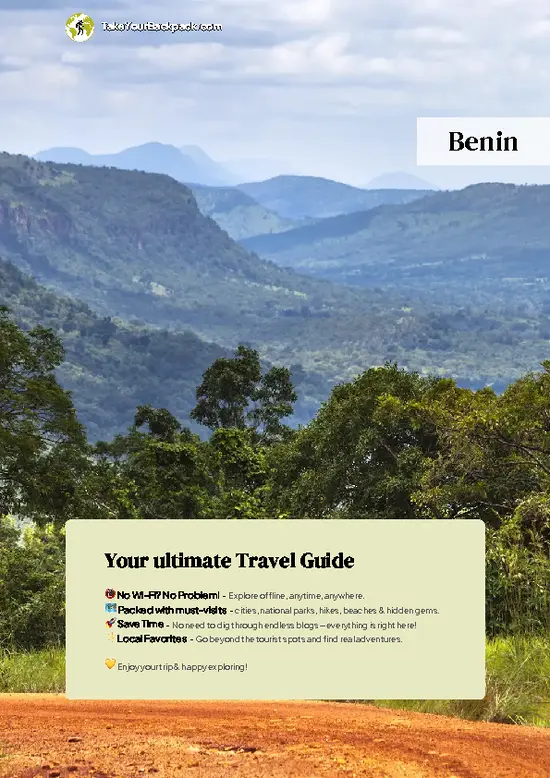
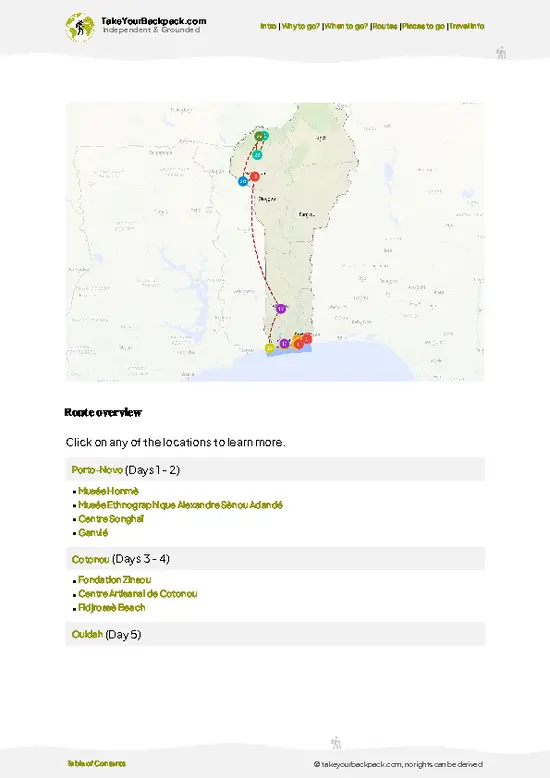
example page 0 from our offline Travel Guide for Benin
example page 1 from our offline Travel Guide for Benin
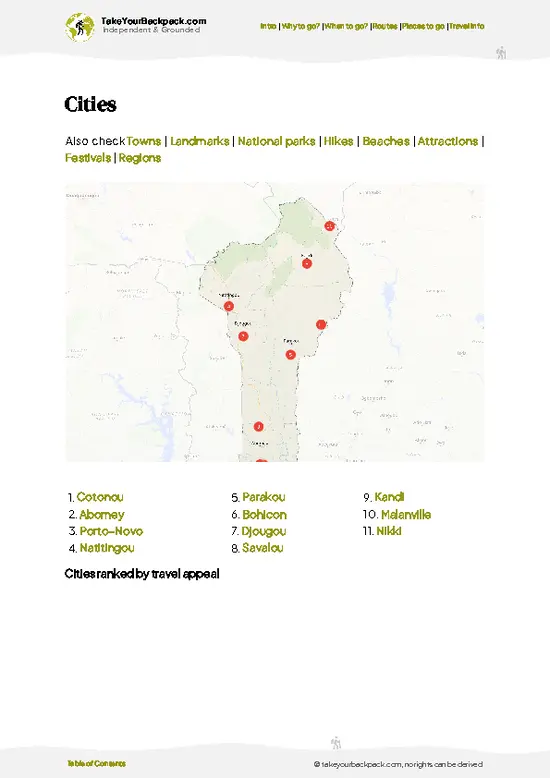
example page 2 from our offline Travel Guide for Benin
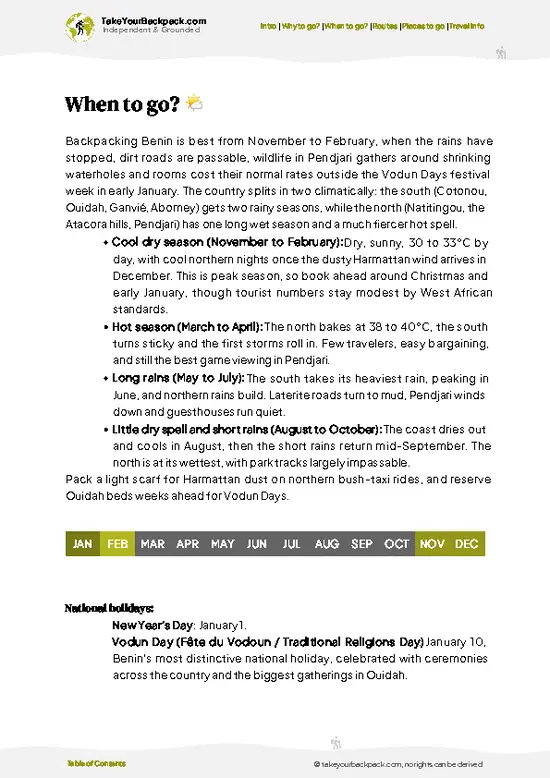
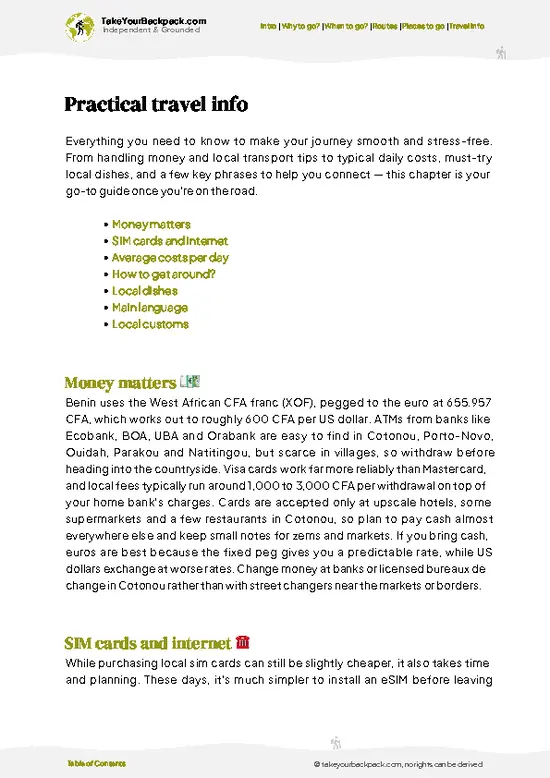
example page 3 from our offline Travel Guide for Benin
example page 4 from our offline Travel Guide for Benin
example page 5 from our offline Travel Guide for Benin
example page 6 from our offline Travel Guide for Benin
example page 7 from our offline Travel Guide for Benin
The digital guide (213 pages) contains:
✅ 48 highlights, ranked by travel appeal
✅ Optimized 5, 10 & 15-day travel routes
✅ Cities, national parks, landmarks, beaches
✅ How to get around
✅ Offline-friendly for travel without Wi-Fi
👉 Click to see all 30+ guide features

📅 Plan smarter in minutes, not weeks
✅ Month by month travel advice
✅ Festivals & national holidays
✅ Budget expectations

🗺️ Go to the right places, skip the overrated ones
✅ Honest pros & cons of destinations
✅ Top hikes, parks & viewpoints
✅ Lesser-known places most travelers miss
✅ Clear “worth it vs skip it” guidance

🛏️ Travel smoothly without rookie mistakes
✅ Best areas to stay
✅ Transport systems explained simply
✅ Common scams & safety advice
✅ SIM cards, money & practical tips

🌍 Understand the country, not just visit it
✅ Culture & traditions
✅ 52 Essential phrases & customs
✅ Festivals worth planning around
✅ Traveler-friendly historical context
✅ Insights that make places more meaningful

📱 Built for real travel conditions
✅ Fully downloadable PDF
✅ Works completely offline
✅ Optimized for phone use
✅ Useful in remote areas & buses
✅ Everything in one place
Stop searching, start planning
Get instant access to your full guide. 30‑day money-back guarantee.
+ Add another guide for just

By proceeding you agree to our terms.
Sent to your inbox immediately after payment • 100% Secure Checkout
Best Backpacking Travel Advisor 2025 tourism awardBest Backpacking
Travel Advisor
2025
What others say about Take Your Backpack Guides:
⭐⭐⭐⭐⭐
Fantastic, amazing amount of information!
⭐⭐⭐⭐⭐
My goodness this is amazing, it's what I've been looking for hats off too you!
⭐⭐⭐⭐⭐
I think this is absolutely BRILLIANT
⭐⭐⭐⭐
Very complete and informative. It's still missing places, but I gotta to commend you
⭐⭐⭐⭐⭐
This is truly amazing, thank you, can't wait to explore it with my kids!
⭐⭐⭐⭐⭐
Awesome resource, thank you!
⭐⭐⭐⭐⭐
This is amazing! Can't wait to explore the ones I haven't seen
⭐⭐⭐⭐
I love this! Well done, great idea.
⭐⭐⭐⭐⭐
Thanks for taking the time to make this gem!
⭐⭐⭐⭐⭐
This might be the best website I've ever seen.
⭐⭐⭐⭐⭐
Congratulations, and thank you so much for your work; it's incredibly valuable.
⭐⭐⭐⭐
In all seriousness I think you did a great job pointing out the important spots
⭐⭐⭐⭐⭐
10/10 very good
⭐⭐⭐⭐⭐
As someone who's only just starting to visit regularly this is awesome, thank you.
⭐⭐⭐⭐
Thank you very much! I'm going to visit my dad, it's going to be very useful!
⭐⭐⭐⭐⭐
This is really cool! We'll be travelling for the first time and this definitely come in handy.
⭐⭐⭐⭐⭐
You are now our minister of culture, congratulations 👨‍💼
⭐⭐⭐⭐⭐
Just wanted to tell you that this is a pearl! Going to follow your recommendations.
⭐⭐⭐⭐⭐
This is so cool. I'll definitely be using the resource for my travels soon.
⭐⭐⭐⭐⭐
This is very impressive! Good work.
⭐⭐⭐⭐⭐
This is an amazing and informative site. Very well done!

🛏️ Where to stay?Where to Base Yourself

Benin has only a handful of true backpacker hostels, but simple guesthouses (auberges) and basic hotels are easy to find, with fan rooms at roughly 8,000 to 15,000 CFA (US$13 to 25) and air-conditioned doubles at 15,000 to 25,000 CFA (US$25 to 42). In Cotonou, Haie Vive has the most choice plus the best restaurants and bars, though prices run higher, while Ganhi puts you close to banks and the Dantokpa market but goes quiet after dark. Fidjrossè is a calmer beach-side option that gets lively on weekends. Beyond the capital, Ouidah and Grand-Popo offer relaxed, cheap beach lodges with little nightlife, and Abomey has basic rooms within walking distance of the royal palaces.

If you enjoy meeting … read more 👉
Benin has only a handful of true backpacker hostels, but simple guesthouses (auberges) and basic hotels are easy to find, with fan rooms at roughly 8,000 to 15,000 CFA (US$13 to 25) and air-conditioned doubles at 15,000 to 25,000 CFA (US$25 to 42). In Cotonou, Haie Vive has the most choice plus the best restaurants and bars, though prices run higher, while Ganhi puts you close to banks and the Dantokpa market but goes quiet after dark. Fidjrossè is a calmer beach-side option that gets lively on weekends. Beyond the capital, Ouidah and Grand-Popo offer relaxed, cheap beach lodges with little nightlife, and Abomey has basic rooms within walking distance of the royal palaces.

If you enjoy meeting fellow travelers, consider choosing hostels with high ratings for atmosphere. On the other hand, if you prefer having your own space, a hotel might be a better option.

BeninExpand Your Journey

👋 Meet the founderWho’s Behind Take Your Backpack?

Johan, backpacker and founder of TakeYourBackpackHi, I’m Johan (Netherlands 🇳🇱), the creator of TakeYourBackpack. Over the past 3 decades, I’ve backpacked through 90+ countries across six continents, gaining extensive experience with independent travel, long-term trips, and overland routes.

This site is built on a combination of firsthand travel experience and carefully curated insights from other backpackers. Many guides are based on places I’ve personally visited, while others bring together tips, observations, and practical advice shared by trusted travelers I’ve met along the way.

The goal is to provide realistic, experience-driven guidance — not generic itineraries — so you can explore destinations with better context, clearer expectations, and more confidence.