×

Chile🇨🇱 | best landmarksYour Guide to the 3 Best landmarks in Chile

Landmarks in Chile are shaped by the country’s absurd geometry: roughly 4,300 kilometers long and rarely more than 200 wide. That strip produces three very different kinds of sites. In the far north, the Atacama’s dry air preserves ancient geoglyphs, mummies and adobe villages, but sights sit at altitude and are spread across long desert distances, so tours or rental cars drive costs up. The central valley holds colonial-era cities, hillside neighborhoods and wine estates, with dense bus links, low entry fees and the heaviest crowds in Santiago and Valparaíso. The south and Patagonia deliver glaciers, granite towers and fjords, where weather, ferry schedules and park fees decide everything, and independent travelers must book ahead in summer. Remote Easter Island adds a Polynesian layer, with a national park ticket and flights that cost far more than anything on the mainland. Backpackers do best by choosing the region first, then matching budget and flexibility to it.

By Johan Kruseman 🇳🇱 | Updated October 20, 2026
Explore the best national parks in Chile

Why go?Understanding Their Importance

Chile’s landmarks make sense once you see how geography sorts them. The Andes, the Pacific and the Atacama create sharp natural boundaries, so each region developed its own character and almost nothing overlaps. The Atacama is among the driest places on earth, which is why organic remains, rock art and early mining sites survive in the north when they would vanish elsewhere. Further south, rainfall, ice and tectonic activity built the glaciated landscapes that now define Patagonia. Active volcanoes and frequent earthquakes also mean that many colonial buildings were rebuilt, so central Chile’s historic sites are often reconstructions or layered survivors instead of untouched originals.

The cultural layers are just as distinct. Indigenous Aymara, Mapuche and Rapa Nui heritage sits beside Spanish … read more 👉
Chile’s landmarks make sense once you see how geography sorts them. The Andes, the Pacific and the Atacama create sharp natural boundaries, so each region developed its own character and almost nothing overlaps. The Atacama is among the driest places on earth, which is why organic remains, rock art and early mining sites survive in the north when they would vanish elsewhere. Further south, rainfall, ice and tectonic activity built the glaciated landscapes that now define Patagonia. Active volcanoes and frequent earthquakes also mean that many colonial buildings were rebuilt, so central Chile’s historic sites are often reconstructions or layered survivors instead of untouched originals.

The cultural layers are just as distinct. Indigenous Aymara, Mapuche and Rapa Nui heritage sits beside Spanish colonial and nitrate-era remains, and the story is told in different ways in each region. Several sites carry UNESCO recognition, but recognition does not guarantee big infrastructure, so expect simple visitor facilities at many of them.

Before choosing Chile, understand the scale and cost. Distances are huge, domestic flights are often the practical answer between regions, and remote areas have limited accommodation and food options. Parks and managed sites frequently use timed entry, online booking or guide requirements to protect fragile ground, particularly in Patagonia, the Atacama and Easter Island. Chile is also among the more expensive South American countries, with Patagonia and Rapa Nui pricing well above the mainland average. On the plus side, the country is safe, well organized and easy to move around by bus, which makes planning more predictable than in many neighbors. Travelers who accept that the country rewards selection over completeness will have the best experience.
How the List Was Created
The list of best unique sites in Chile is created based on history or culture, wow factor, atmosphere, quirks, and memorability. If you feel a unique site is missing in this list, please let us know.

When to go?Optimal Periods for Travel

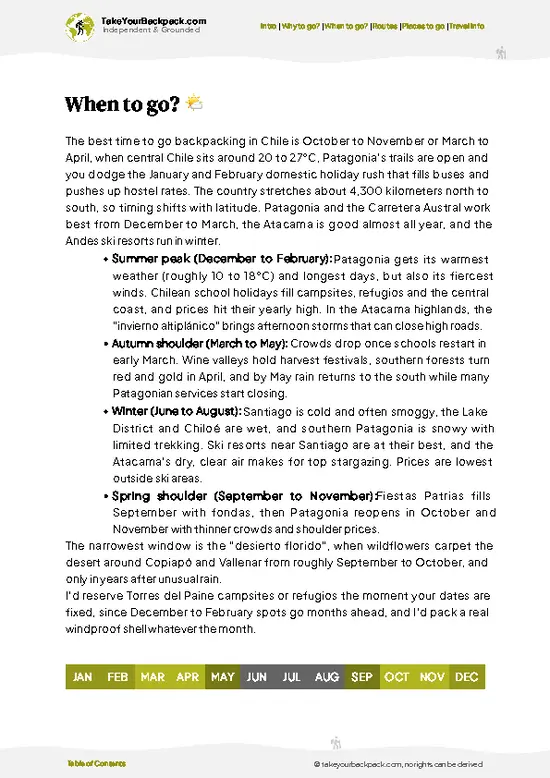
Best months by region: The best months for landmarks in Chile are November to March in the south and September to November or March to May in the center and north, because those periods balance long daylight, stable weather and open services. Patagonia peaks from December to February, with daytime highs of about 12 to 20°C, up to 17 hours of daylight and strong wind year-round. Rain falls often in the southern fjords and forests, where annual totals can pass 3,000 millimeters in places, so even summer needs waterproofs.
Shoulder seasons and prices: In October and April, Patagonia is quieter and accommodation can cost 20 to 40 percent less, but some refuges, ferries and shuttle services run reduced schedules or close. Between May and September, many high-mountain and trekking areas are snowbound … read more 👉
Best months by region: The best months for landmarks in Chile are November to March in the south and September to November or March to May in the center and north, because those periods balance long daylight, stable weather and open services. Patagonia peaks from December to February, with daytime highs of about 12 to 20°C, up to 17 hours of daylight and strong wind year-round. Rain falls often in the southern fjords and forests, where annual totals can pass 3,000 millimeters in places, so even summer needs waterproofs.
Shoulder seasons and prices: In October and April, Patagonia is quieter and accommodation can cost 20 to 40 percent less, but some refuges, ferries and shuttle services run reduced schedules or close. Between May and September, many high-mountain and trekking areas are snowbound or closed, though glacier and city sights stay accessible.

The Atacama is a different system. Its clear skies and low humidity make it visitable all year, with daytime temperatures of 20 to 30°C and nights that can drop below freezing at altitude. The main wrinkle is the altiplano winter from January to March, when afternoon storms can close high roads and cut off sights above 4,000 meters. Central Chile, around Santiago and Valparaíso, has a Mediterranean climate: dry summers reaching 30°C or higher, and cooler wetter winters of 8 to 15°C from June to August, with most rain falling then.
Peak periods that matter: Chilean school holidays in January and February push domestic demand up on the coast and in the Lakes District, while Easter Island fills during the Tapati festival in early February, so flights and rooms should be booked months ahead. Long weekends around national holidays, especially September 18 and 19, also spike bus fares and sell out coastal lodging.

unique site hoppingOptimizing Your Multi-Stop Itinerary

How many days to plan: A trip linking several landmarks in Chile needs 14 to 21 days, and fewer than 10 forces you to choose a single region. The country’s shape makes routes linear, so the efficient pattern is one long north-to-south or south-to-north line with a few flights doing the heavy lifting.
Which regions pair well: The Atacama and Santiago pair through the airport at Calama, with flights of roughly 2 hours. Santiago and Valparaíso sit about 1.5 to 2 hours apart by bus, so they combine easily. Santiago to the Lakes District is a 9 to 12 hour bus or a 1.5 hour flight into Puerto Montt or Temuco. From Puerto Montt, Patagonia needs another flight or a long ferry-and-road combination, and Punta Arenas is the main hub for the far south. Easter Island is reached only by a 5 hour flight from … read more 👉
How many days to plan: A trip linking several landmarks in Chile needs 14 to 21 days, and fewer than 10 forces you to choose a single region. The country’s shape makes routes linear, so the efficient pattern is one long north-to-south or south-to-north line with a few flights doing the heavy lifting.
Which regions pair well: The Atacama and Santiago pair through the airport at Calama, with flights of roughly 2 hours. Santiago and Valparaíso sit about 1.5 to 2 hours apart by bus, so they combine easily. Santiago to the Lakes District is a 9 to 12 hour bus or a 1.5 hour flight into Puerto Montt or Temuco. From Puerto Montt, Patagonia needs another flight or a long ferry-and-road combination, and Punta Arenas is the main hub for the far south. Easter Island is reached only by a 5 hour flight from Santiago and works best as a separate add-on of 4 to 5 days.

A sensible direction is north to south in the southern summer, starting in the dry Atacama while altitude adjustment is easiest, then ending in Patagonia when the weather is at its best. Reverse it if your dates fall in the shoulder months, so you reach Patagonia before services shut.
Time per stop and common mistakes: Allow 2 to 3 days in the Atacama, 1 to 2 in Santiago, 1 to 2 in Valparaíso and 4 to 6 in Patagonia. The usual mistake is underestimating distance, treating a map as if everything were a short hop; instead, count overnight buses as lost days and fly the long legs. Another is skipping buffers, since wind and weather delay ferries and flights in the south, so keep a spare day before any international departure. Arriving at altitude and immediately exerting yourself is a third; spend a night in San Pedro before going higher.

The ListThe Best landmarks of Chile

1 Ojos del Salado

6,893 m summit, crater pond, Refugio Atacama, flamingo lagoons

Cross salt flats and turquoise lagoons to acclimatize, then push up scree and a final rim scramble to the crater.

chile-unique-site-ojos-del-salado
© Google | Betty Greg

2 Cerro San Cristóbal

Funicular and cable car, summit Virgin, city-basin views, hillside gardens and pools

Ride the 1925 funicular or climb the road to a white statue and terraces facing the Andes over Santiago.

chile-unique-site-cerro-san-cristobal
© Google | Shyam Barú

3 Cascada de las Ánimas

Private canyon reserve, stream cascades, snowmelt pools, horseback and rafting

Hike marked trails above a mountain stream to the falls, then add a wade in cold pools or a guided ride.

Loading the map 🌍

Expert viewWhat You Should Know

How many landmarks to visit: Aim for one major landmark per two days, and no more than 6 to 8 across a three-week trip. Chile’s sites are separated by long transfers, and weather, altitude and booking systems cut into flexibility. A tight list gives you time to absorb places and to absorb delays. Backpackers who try to tick off 12 usually spend half the trip on buses.
Prioritizing by travel style: If you are on a tight budget, favor central Chile’s urban and coastal sites, where entry is often free to US$10 and buses connect everything cheaply. If nature and hiking drive your trip, put your money and time into Patagonia, where the parks are the main attraction and good weather decides the quality of the visit. For history and culture, the northern desert and Easter Island offer the deepest … read more 👉
How many landmarks to visit: Aim for one major landmark per two days, and no more than 6 to 8 across a three-week trip. Chile’s sites are separated by long transfers, and weather, altitude and booking systems cut into flexibility. A tight list gives you time to absorb places and to absorb delays. Backpackers who try to tick off 12 usually spend half the trip on buses.
Prioritizing by travel style: If you are on a tight budget, favor central Chile’s urban and coastal sites, where entry is often free to US$10 and buses connect everything cheaply. If nature and hiking drive your trip, put your money and time into Patagonia, where the parks are the main attraction and good weather decides the quality of the visit. For history and culture, the northern desert and Easter Island offer the deepest layers, though they cost the most per day. Many experienced travelers choose one expensive region and fill the rest with low-cost city days, which keeps the total manageable.
What it costs: Plan US$40 to 70 a day in central Chile on hostels, buses and market meals, and US$70 to 120 in the Atacama and Patagonia, where food, lodging and transfers all cost more. Easter Island runs higher still, often US$100 to 160 a day, plus a national park ticket of roughly US$80 for foreigners. Typical per-visit costs: city sites US$0 to 10, national park entry US$10 to 40 depending on the park, guided tours in the desert US$40 to 100, and Patagonia shuttle or boat transfers US$15 to 80. Foreigners often pay higher park fees than Chileans. Check this before budgeting.

Credit cards are widely accepted, but small kiosks and remote villages still prefer cash in Chilean pesos. Carry some, as ATMs in tiny desert and Patagonian towns can run dry or charge steep fees.
Booking and access: Many popular sites now require advance reservations or a registered guide, so the smarter move is to book as soon as dates are firm, not on arrival. This matters most in Torres del Paine, Atacama’s geysers and lagoons, and Easter Island’s protected areas, where daily visitor numbers are capped to limit erosion.
Safety on the ground: Chile is among South America’s safer countries, but petty theft is common in Santiago and Valparaíso, so keep phones and cameras tucked away in crowds and on steep hillside streets. In the wild, the real danger is the environment: altitude sickness above 3,500 meters, intense UV and fast weather changes in Patagonia. Drink water, rest on arrival and carry layers even in summer. Check conditions with park offices, since route closures happen quickly after storms, fires or snow.

The country also sits on a major fault line, so learn the evacuation signs in coastal areas. After any strong quake, move to high ground without waiting for an alert.
Cultural considerations: Many northern and southern sites are on Indigenous land or sacred ground. Stay on marked paths, never touch or remove rock art or artifacts, and ask before photographing people, especially in Aymara and Mapuche communities. On Easter Island, climbing on the stone platforms is prohibited and enforced with fines. Chileans value punctuality less strictly in social settings but follow tour times closely, so arrive early. A few words of Spanish go a long way outside the main hubs, where English is limited.

✈️ The backpacker research shortcutChile Travel Guide

An offline-friendly backpacking guide with optimized travel routes, ranked highlights, transport advice, and the best areas to stay.
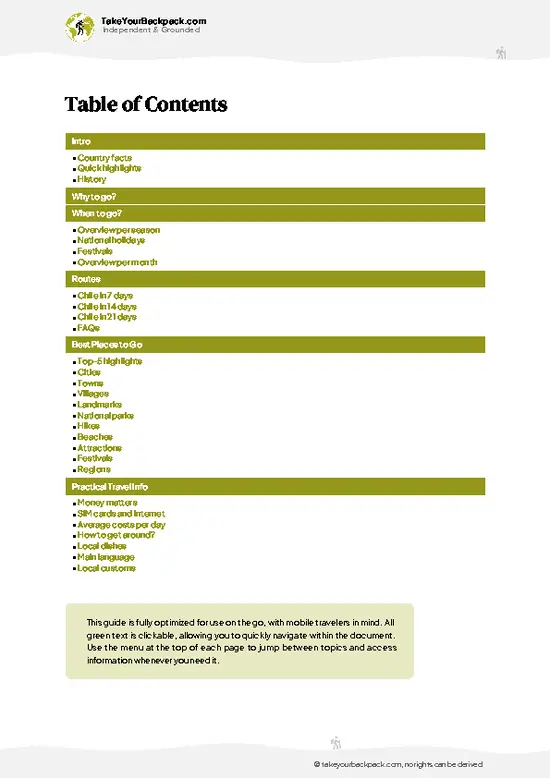
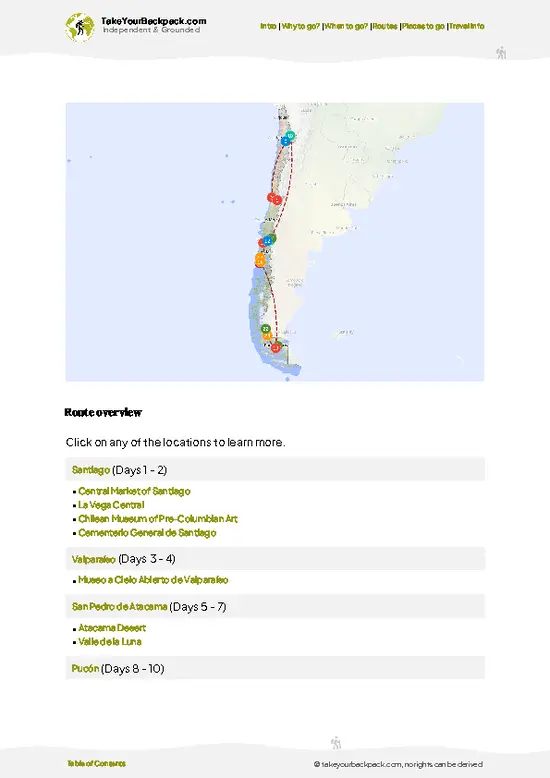
example page 0 from our offline Travel Guide for Chile
example page 1 from our offline Travel Guide for Chile
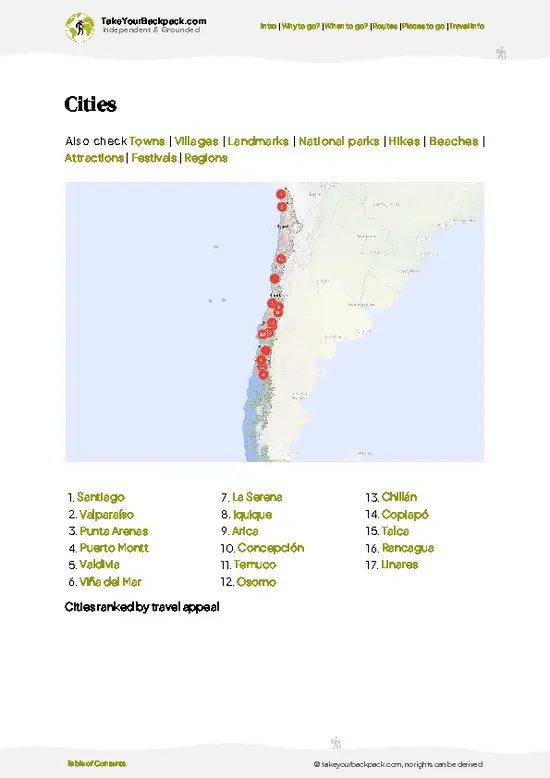
example page 2 from our offline Travel Guide for Chile
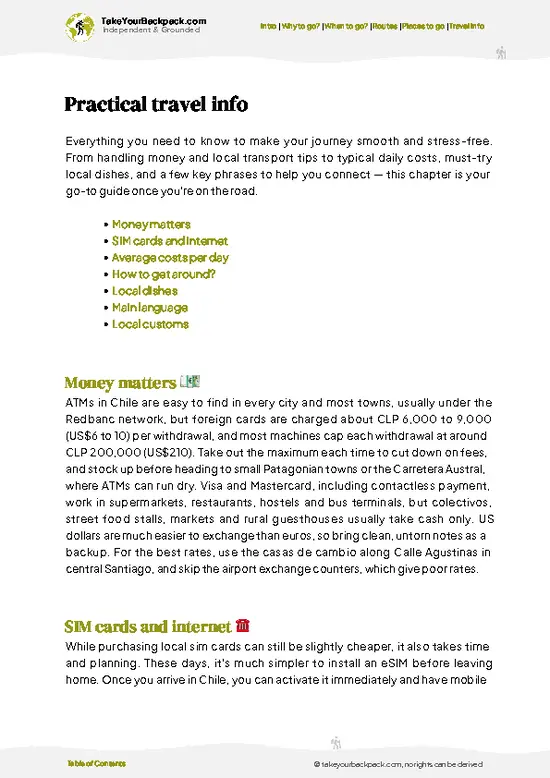
example page 3 from our offline Travel Guide for Chile
example page 4 from our offline Travel Guide for Chile
example page 5 from our offline Travel Guide for Chile
example page 6 from our offline Travel Guide for Chile
example page 7 from our offline Travel Guide for Chile
The digital guide (333 pages) contains:
✅ 107 highlights, ranked by travel appeal
✅ Optimized 7, 14 & 21-day travel routes
✅ Cities, national parks, landmarks, beaches
✅ How to get around
✅ Offline-friendly for travel without Wi-Fi
👉 Click to see all 30+ guide features

📅 Plan smarter in minutes, not weeks
✅ Month by month travel advice
✅ Festivals & national holidays
✅ Budget expectations

🗺️ Go to the right places, skip the overrated ones
✅ Honest pros & cons of destinations
✅ Top hikes, parks & viewpoints
✅ Lesser-known places most travelers miss
✅ Clear “worth it vs skip it” guidance

🛏️ Travel smoothly without rookie mistakes
✅ Best areas to stay
✅ Transport systems explained simply
✅ Common scams & safety advice
✅ SIM cards, money & practical tips

🌍 Understand the country, not just visit it
✅ Culture & traditions
✅ 52 Essential phrases & customs
✅ Festivals worth planning around
✅ Traveler-friendly historical context
✅ Insights that make places more meaningful

📱 Built for real travel conditions
✅ Fully downloadable PDF
✅ Works completely offline
✅ Optimized for phone use
✅ Useful in remote areas & buses
✅ Everything in one place
Stop searching, start planning
Get instant access to your full guide. 30‑day money-back guarantee.
+ Add another guide for just

By proceeding you agree to our terms.
Sent to your inbox immediately after payment • 100% Secure Checkout
Best Backpacking Travel Advisor 2025 tourism awardBest Backpacking
Travel Advisor
2025
What others say about Take Your Backpack Guides:
⭐⭐⭐⭐⭐
Fantastic, amazing amount of information!
⭐⭐⭐⭐⭐
My goodness this is amazing, it's what I've been looking for hats off too you!
⭐⭐⭐⭐⭐
I think this is absolutely BRILLIANT
⭐⭐⭐⭐
Very complete and informative. It's still missing places, but I gotta to commend you
⭐⭐⭐⭐⭐
This is truly amazing, thank you, can't wait to explore it with my kids!
⭐⭐⭐⭐⭐
Awesome resource, thank you!
⭐⭐⭐⭐⭐
This is amazing! Can't wait to explore the ones I haven't seen
⭐⭐⭐⭐
I love this! Well done, great idea.
⭐⭐⭐⭐⭐
Thanks for taking the time to make this gem!
⭐⭐⭐⭐⭐
This might be the best website I've ever seen.
⭐⭐⭐⭐⭐
Congratulations, and thank you so much for your work; it's incredibly valuable.
⭐⭐⭐⭐
In all seriousness I think you did a great job pointing out the important spots
⭐⭐⭐⭐⭐
10/10 very good
⭐⭐⭐⭐⭐
As someone who's only just starting to visit regularly this is awesome, thank you.
⭐⭐⭐⭐
Thank you very much! I'm going to visit my dad, it's going to be very useful!
⭐⭐⭐⭐⭐
This is really cool! We'll be travelling for the first time and this definitely come in handy.
⭐⭐⭐⭐⭐
You are now our minister of culture, congratulations 👨‍💼
⭐⭐⭐⭐⭐
Just wanted to tell you that this is a pearl! Going to follow your recommendations.
⭐⭐⭐⭐⭐
This is so cool. I'll definitely be using the resource for my travels soon.
⭐⭐⭐⭐⭐
This is very impressive! Good work.
⭐⭐⭐⭐⭐
This is an amazing and informative site. Very well done!

🛏️ Where to stay?Where to Stay: Chile Edition

Chile has a solid hostel scene, with dorm beds typically running CLP 12,000 to 25,000 (about US$13 to 27) a night and more in Patagonia and San Pedro de Atacama. In Santiago, Bellavista puts you on top of the nightlife but gets loud on weekends, Lastarria is walkable to the center and calmer, and Barrio Brasil is the cheapest of the three but feels rougher after dark. In Valparaíso, Cerro Alegre and Cerro Concepción hold most hostels, with views and street art right outside but steep hills and petty theft to keep in mind, while Puerto Natales and Pucón are compact, quiet bases for trekking and volcano trips.

If you enjoy meeting fellow travelers, consider choosing hostels with high ratings for … read more 👉
Chile has a solid hostel scene, with dorm beds typically running CLP 12,000 to 25,000 (about US$13 to 27) a night and more in Patagonia and San Pedro de Atacama. In Santiago, Bellavista puts you on top of the nightlife but gets loud on weekends, Lastarria is walkable to the center and calmer, and Barrio Brasil is the cheapest of the three but feels rougher after dark. In Valparaíso, Cerro Alegre and Cerro Concepción hold most hostels, with views and street art right outside but steep hills and petty theft to keep in mind, while Puerto Natales and Pucón are compact, quiet bases for trekking and volcano trips.

If you enjoy meeting fellow travelers, consider choosing hostels with high ratings for atmosphere. On the other hand, if you prefer having your own space, a hotel might be a better option.

ChileExplore Beyond This Category

👋 Meet the founderWho’s Behind Take Your Backpack?

Johan, backpacker and founder of TakeYourBackpackHi, I’m Johan (Netherlands 🇳🇱), the creator of TakeYourBackpack. Over the past 3 decades, I’ve backpacked through 90+ countries across six continents, gaining extensive experience with independent travel, long-term trips, and overland routes.

This site is built on a combination of firsthand travel experience and carefully curated insights from other backpackers. Many guides are based on places I’ve personally visited, while others bring together tips, observations, and practical advice shared by trusted travelers I’ve met along the way.

The goal is to provide realistic, experience-driven guidance — not generic itineraries — so you can explore destinations with better context, clearer expectations, and more confidence.