×

Chile🇨🇱 | best national parksYour Guide to the 10 Best national parks in Chile

Chile’s national parks follow the country’s shape: a ribbon about 4,300 km long, squeezed between the Andes and the Pacific, so climate and character change with latitude. In the arid north, parks sit at high altitude, draw few visitors and reward people who handle thin air and long drives. The central zone offers Andean day-hike terrain close to Santiago, which keeps costs low and access simple. The Lakes District and northern Patagonia have temperate rainforest, volcanoes and good bus links, with moderate crowds outside summer. Far southern Patagonia is the headline region, and also the priciest, because of distance, short seasons and heavy demand for refugios and campsites. Some parks are run by CONAF, others by private concessions, which explains why fees, booking rules and facilities vary so much. For backpacking or independent travel, the practical question is how much planning you accept: the south requires reservations months ahead, while most northern and central parks can be handled on short notice.

By Johan Kruseman 🇳🇱 | Updated October 20, 2026
Explore the best hikes in Chile

Why go?Understanding Their Importance

Chile suits national parks unusually well because of its geography. The Andes, a long Pacific coastline, the Atacama Desert and the southern ice fields create extreme contrasts within one country, and steep, remote, hard-to-farm terrain is the reason so much wilderness stayed intact. Much of the far south is sparsely populated, so protected land is large and continuous rather than fragmented. The state agency CONAF manages the public system, and several parks also form part of larger UNESCO-recognized reserves.

Infrastructure is a strong point. Roads are paved to most major gateways, long-distance buses are comfortable and frequent on the main north-south axis, and trails in popular areas are marked and maintained. Chile is also among the safer, more orderly countries in South America for … read more 👉
Chile suits national parks unusually well because of its geography. The Andes, a long Pacific coastline, the Atacama Desert and the southern ice fields create extreme contrasts within one country, and steep, remote, hard-to-farm terrain is the reason so much wilderness stayed intact. Much of the far south is sparsely populated, so protected land is large and continuous rather than fragmented. The state agency CONAF manages the public system, and several parks also form part of larger UNESCO-recognized reserves.

Infrastructure is a strong point. Roads are paved to most major gateways, long-distance buses are comfortable and frequent on the main north-south axis, and trails in popular areas are marked and maintained. Chile is also among the safer, more orderly countries in South America for independent travel.

Before choosing Chile, understand three things. First, distance is the main cost. Flights or long bus rides between regions eat budget and time, and the far south is expensive compared with the rest of the country. Second, the most famous parks operate on reservation systems: campsites and refugios on popular circuits sell out well in advance, and some routes require booking before arrival, so spontaneity works against you there. Third, weather is a design factor, not a detail. Patagonian wind and rapid changes can close trails or ferries, while the north brings altitude and strong sun. Some parks charge foreigners more than Chileans, and fees and rules have shifted over the years, so check official booking pages before you commit. Plan with flexibility and the system works well.
Why These Made the Cut
The list of best national parks in Chile is created based on landscapes, wildlife, adventure opportunities, facilities, and overall experience. If you feel a national park is missing in this list, please let us know.

When to go?Optimal Periods for Travel

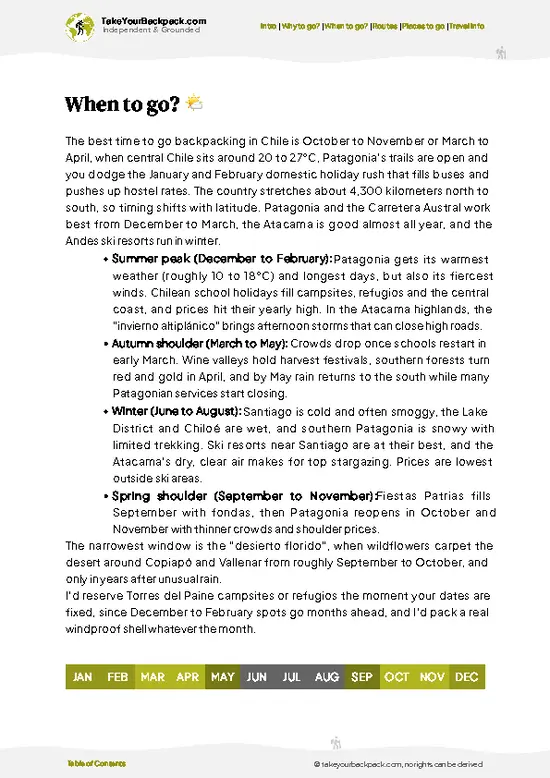
Best months: The best months for Chilean national parks are November to March in most of the country, because the long southern summer days (up to 16 or 17 hours of light in Patagonia), open trails and running ferries all coincide. Temperatures in Patagonia then range roughly 5 to 18°C by day, with wind the real challenge.
Shoulder seasons: October and April are the shoulder months. Prices dip, crowds thin and autumn color arrives in Patagonia in April, but some refugios, ferries and campsites close or run reduced services, and snow can block higher passes. Booking is easier and accommodation can be noticeably cheaper, though daylight shrinks quickly.
Peak periods: January and February are the peak, especially in the south and among Chilean holidaymakers. Campsites and refugios on popular circuits … read more 👉
Best months: The best months for Chilean national parks are November to March in most of the country, because the long southern summer days (up to 16 or 17 hours of light in Patagonia), open trails and running ferries all coincide. Temperatures in Patagonia then range roughly 5 to 18°C by day, with wind the real challenge.
Shoulder seasons: October and April are the shoulder months. Prices dip, crowds thin and autumn color arrives in Patagonia in April, but some refugios, ferries and campsites close or run reduced services, and snow can block higher passes. Booking is easier and accommodation can be noticeably cheaper, though daylight shrinks quickly.
Peak periods: January and February are the peak, especially in the south and among Chilean holidaymakers. Campsites and refugios on popular circuits book out months ahead, and lodging prices can run 30 to 100 percent above shoulder rates. Santiago empties during the same weeks, while coastal areas fill.
Regional differences: The north is the exception. The Atacama and Altiplano parks are accessible all year, with the best conditions from April to October, when days are dry and clear. Nights drop below freezing at altitude, and the “Altiplanic winter” rains from December to March can cause flooding and road closures at higher elevations. The central zone has a Mediterranean climate: hike from October to April, while winter (June to August) brings snow at elevation and ski traffic near Santiago. The Lakes District is wettest from May to September, with rainfall that can top 2,000 mm a year, so December to March gives the most reliable views of volcanoes. In winter in Patagonia (June to August), temperatures hover around 0°C, daylight falls to about 8 hours, and many services shut, though wildlife viewing and low prices appeal to a few.

national park hoppingOptimizing Your Multi-Stop Itinerary

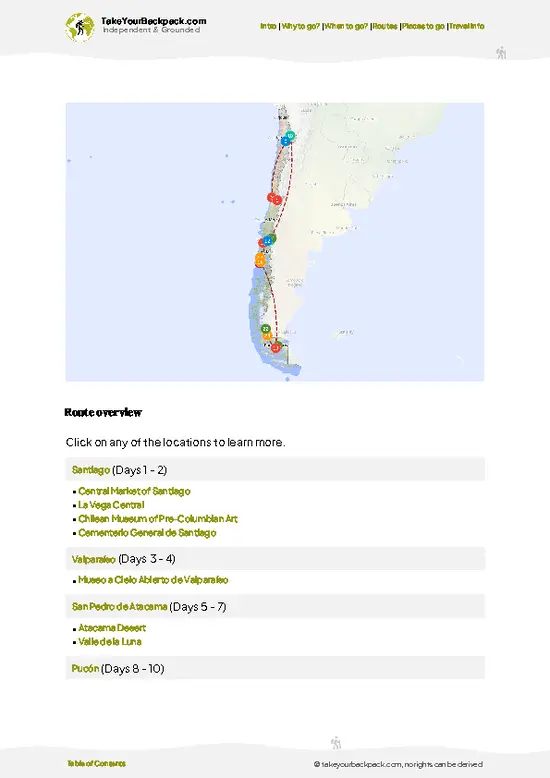
How many days to plan: A trip combining several Chilean national parks needs about 14 to 21 days, because the country is long and the best parks sit in separate climate zones. Trying to fit three regions into a week means spending more time in transit than on trails.
Regional clusters and direction: Group parks by region. The north clusters around Calama or Arica, the central zone around Santiago, the Lakes District around Puerto Varas, Pucón and Puerto Montt, and Patagonia around Punta Arenas and Puerto Natales. A south-to-north or north-to-south direction matters less than season: in summer, many travelers start in Patagonia while trails are open, then move north as autumn arrives, finishing in the dry north where April to October is ideal. Santiago is the natural hub, with domestic flights … read more 👉
How many days to plan: A trip combining several Chilean national parks needs about 14 to 21 days, because the country is long and the best parks sit in separate climate zones. Trying to fit three regions into a week means spending more time in transit than on trails.
Regional clusters and direction: Group parks by region. The north clusters around Calama or Arica, the central zone around Santiago, the Lakes District around Puerto Varas, Pucón and Puerto Montt, and Patagonia around Punta Arenas and Puerto Natales. A south-to-north or north-to-south direction matters less than season: in summer, many travelers start in Patagonia while trails are open, then move north as autumn arrives, finishing in the dry north where April to October is ideal. Santiago is the natural hub, with domestic flights to Calama, Puerto Montt and Punta Arenas.
Time per stop and travel times: Plan 2 to 3 days for each northern or central stop, 3 to 4 days for a Lakes District base, and 4 to 8 days for multi-day Patagonian circuits. Santiago to Puerto Montt is around 12 to 14 hours by bus or roughly 1.5 hours by plane. Puerto Montt to Punta Arenas is about 2 hours by air; overland it requires a long route through Argentina or a ferry. Santiago to Calama is about 2 hours by air, with the overland trip taking over 20 hours.
Common planning mistakes: The most frequent error is underestimating distances and relying on buses between distant regions. Fly the long legs and use buses for regional hops. Another is leaving no buffer for wind and weather delays. Keep at least one spare day in the south, and avoid scheduling an international flight the day after a trek. Finally, many travelers book transport before securing the campsite or refugio reservations that cap the whole itinerary. Secure those first, then build flights around them.

The ListThe Best national parks of Chile

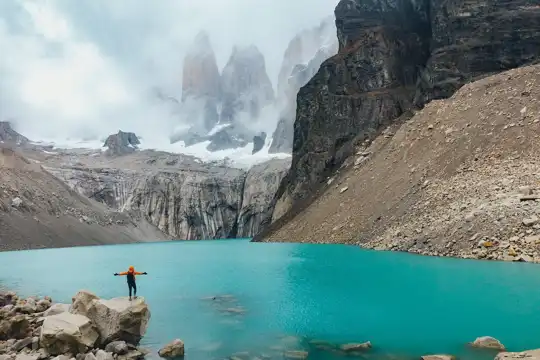
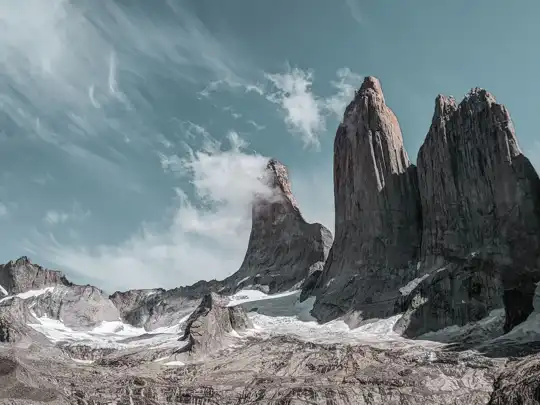
1 Torres del Paine National Park

Granite towers, W and O circuits, Grey Glacier, refugio booking

Plan your days and reservations early, then hike to spires above a turquoise lagoon, a blue glacier face and the wind-swept John Gardner Pass.

Chile - Torres del Paine National Park

2 Patagonia National Park

Chacabuco Valley, roadside guanacos, Jeinimeni turquoise, Cochrane gravel

Drive or cycle the valley road past grazing guanacos, then walk up to high lagoons and ridges watched by condors.

Argentina&Chile - Patagonia National Park

3 Pumalín Douglas Tompkins National Park

Chaitén crater, alerce groves, fjord ferries, free trails

Hike wet, well-built trails to waterfalls and alerce stands, or climb a steaming volcano rim above the Gulf of Corcovado.

chile-national-park-pumalin-douglas-tompkins-national-park
© Google |

4 Laguna San Rafael National Park

Calving glacier, iceberg lagoon, Aysén fjords, boat access only

Cross the fjords by boat or small plane to a blue ice wall, then take a zodiac among drifting icebergs.

chile-national-park-laguna-san-rafael-national-park
© Google |

5 Queulat National Park

Hanging glacier, iceberg lake, suspension bridge, Puyuhuapi rainforest

Follow a short, mossy trail to a lookout facing a glacier perched on a cliff, then reach a lake of small icebergs.

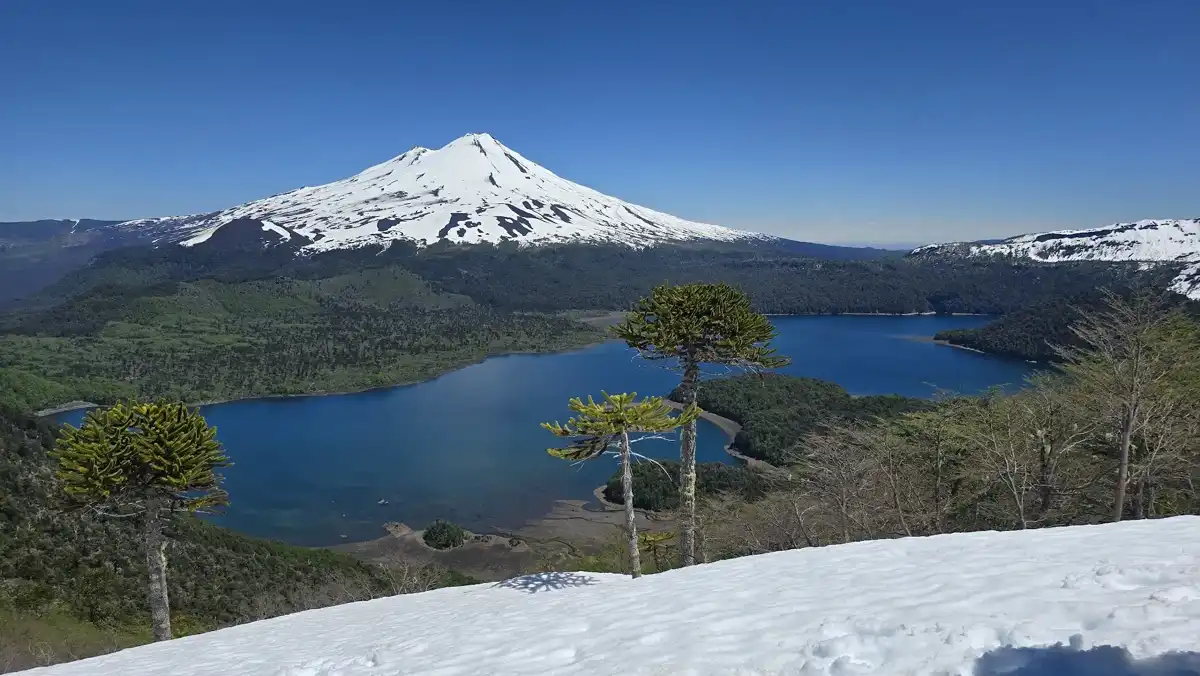
6 Conguillío National Park

Llaima volcano, lava-dammed lake, monkey puzzle trees, Sierra Nevada trail

Drive a single gravel loop past a smoking volcano and a blue lake, then climb through araucaria forest for long Andean views.

7 Alerce Andino National Park

3,000-year-old alerce, boardwalk forest, drizzle, Lago Chaiquenes

Walk a gentle boardwalk path to a giant alerce over 3,000 years old, then continue to a quiet lake with a small beach.

chile-national-park-alerce-andino-national-park
© Google |

8 Altos de Lircay National Reserve

Basalt plateau, Descabezado views, Claro River, condor ridges

Hike from the ranger post across lenga forest to a plateau of hand-laid basalt slabs with flat-topped volcano views on the horizon.

9 Vicente Pérez Rosales National Park

Osorno cone, Petrohué basalt falls, emerald lake, Peulla crossing

Watch turquoise water squeeze through black lava channels beneath a snow-capped volcano, then cross Lago Todos los Santos by boat.

chile-national-park-vicente-perez-rosales-national-park
© Google |

10 Huerquehue National Park

Steep lake chain, Villarrica lookout, waterfalls, Pucón hike

Climb from the entrance past two waterfalls to a string of forest lakes, with araucarias and a ridge viewpoint toward Villarrica.

11 Corcovado National Park

Carretera Austral, Valdivian rainforest, pudú, backcountry silence

Test your self-reliance beneath moss-draped trunks and a rugged volcanic cone, on thinly marked trails where tracks of puma and pudú outnumber people.

chile-national-park-corcovado-national-park
© Google |

12 Pan de Azúcar National Park

Humboldt penguins, fog-fed cacti, fishing cove, Atacama coast

Pitch a tent behind a sheltered beach, take a fisherman’s boat to the penguin island, and wander cactus slopes and rocky shore.

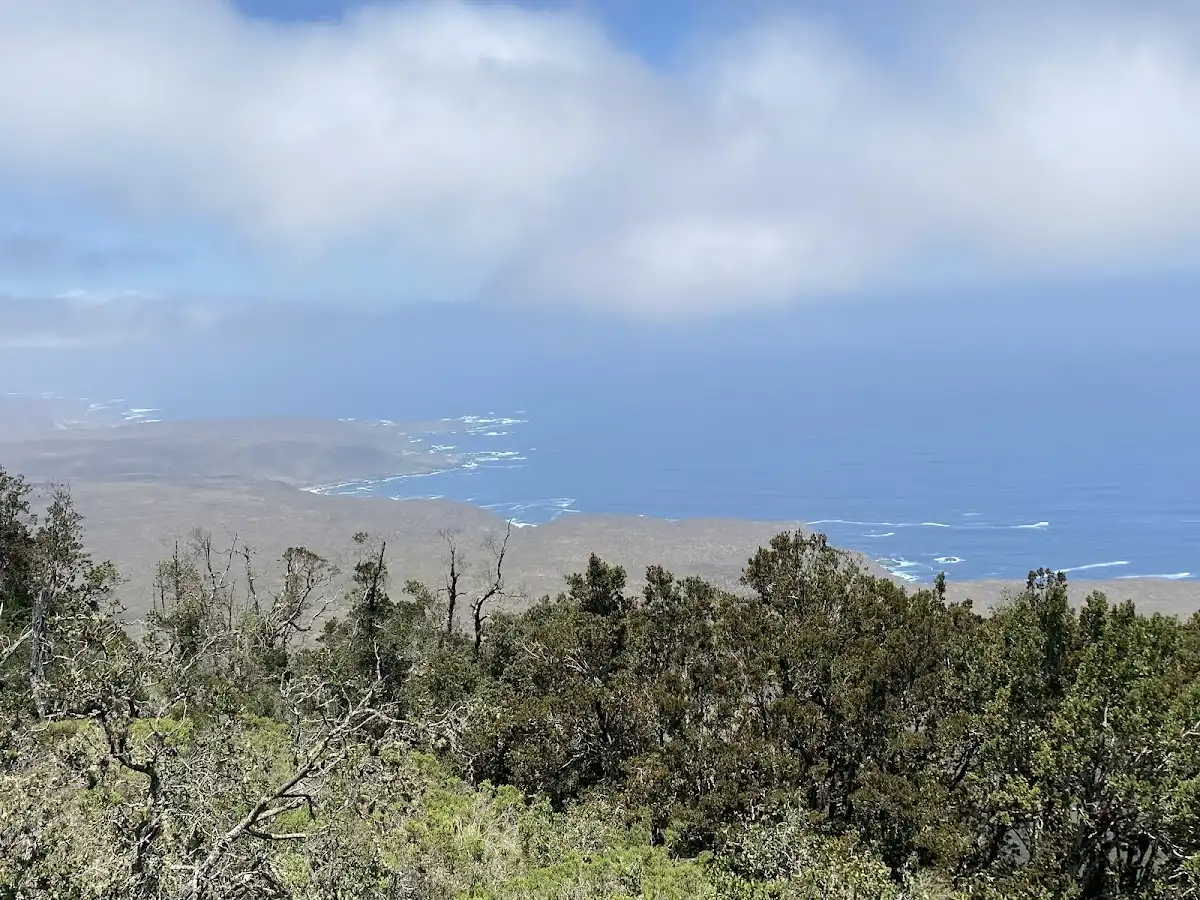
13 Bosque Fray Jorge National Park

Fog forest, camanchaca mist, semi-desert ridge, culpeo fox

Follow a boardwalk through ferns and dripping canopy on a dry coastal ridge, where sea fog waters a forest that rain never would.

chile-national-park-bosque-fray-jorge-national-park
© Google |

14 Radal Siete Tazas National Park

Basalt pools, green cascades, Claro River gorge, Molina foothills

Step along viewing platforms above seven round basalt pools, then walk short trails to the tall, thin waterfalls nearby.

15 Nahuelbuta National Park

Thousand-year araucarias, coastal range, Magellanic woodpecker, Piedra del Águila

Walk short, well-marked trails among ancient monkey puzzle trees and giant coihues, then climb a rocky summit for Andes and Pacific views.

16 Llanos de Challe National Park

Flowering desert, white-sand cove, sea caves, guanacos

Time a visit after wet winters for red-pink flowers on the hills, then drop to a pale beach and boom-filled coastal caves.

17 Los Pingüinos Natural Monument

Magellanic penguin burrows, island landing, 1902 lighthouse, strait crossing

Cross the Strait of Magellan by boat and walk a flat roped path through thousands of penguins nesting in sandy burrows.

18 Cabo de Hornos National Park

Cape Horn cliff, albatross sculpture, Drake Passage, naval lighthouse

Sail from Puerto Williams to land on Hornos Island, climb the wooden stairs to the albatross memorial and look out over the Drake Passage.

chile-national-park-cabo-de-hornos-national-park
© Google | Luis Gomez

Think you know Chile?

Prove you’re a true local — uncover 8 lesser-known national parks in Chile that locals tend to keep to themselves.
Loading the map 🌍

Expert viewWhat You Should Know

How many parks to visit: I advise three to five parks on a single trip, spread across two or at most three regions. That number reflects how Chile works: access involves long transfers, many of the best experiences are multi-day, and weather can eat a day. Fewer parks with more time each generally gives better hiking than a checklist. Anything beyond five turns into transit.
Prioritizing by travel style: Choose by what you want from the trail. For big multi-day treks and glaciers, prioritize southern Patagonia, accepting higher cost and advance booking. For volcanoes, lakes and forests at moderate cost, the Lakes District is easiest, with frequent buses and plenty of hostels. For altitude, desert and starry skies, choose the north, where crowds are low but acclimatization matters. For short … read more 👉
How many parks to visit: I advise three to five parks on a single trip, spread across two or at most three regions. That number reflects how Chile works: access involves long transfers, many of the best experiences are multi-day, and weather can eat a day. Fewer parks with more time each generally gives better hiking than a checklist. Anything beyond five turns into transit.
Prioritizing by travel style: Choose by what you want from the trail. For big multi-day treks and glaciers, prioritize southern Patagonia, accepting higher cost and advance booking. For volcanoes, lakes and forests at moderate cost, the Lakes District is easiest, with frequent buses and plenty of hostels. For altitude, desert and starry skies, choose the north, where crowds are low but acclimatization matters. For short trips from the capital, central Andean parks work as day hikes. Many experienced travelers pick one headline park plus two quieter ones, which spreads costs and avoids the busiest trails.
Budget: A backpacker doing it cheaply can expect roughly US$40 to 70 a day in the north, central and Lakes regions (dorm beds around US$15 to 30, set lunches US$6 to 10, camping US$5 to 15 per person). Patagonia costs more, roughly US$70 to 120 a day, because food, hostels and transport all carry a remoteness premium. Park entry for foreigners generally runs from about US$5 to 40 per visit depending on the park, with the most famous ones at the upper end. Guided day tours cost around US$60 to 150, and multi-day guided treks several hundred dollars. Camping and refugio prices vary widely, and refugio beds on popular circuits cost far more than public campsites, so self-catering and camping are how experienced travelers keep costs down. Bus fares between regions often run US$20 to 60, while domestic flights vary from about US$50 to 200 depending on how early you book. Cash and cards are both used, though remote kiosks may not take cards, so carry some Chilean pesos.
Safety: The main hazards are weather and terrain, not crime. Patagonian wind can exceed 100 km/h in gusts, and conditions can change within an hour, so carry a windproof shell, warm layers and extra food. Rivers swell after rain, and trails can close without much notice. In the north, altitude sickness is a real risk above 3,000 meters. Spend a day or two at elevation before pushing higher, drink plenty of water and use strong sun protection. Tell your accommodation your plan and register where required, since rescue services are limited in remote areas. Fire is a serious concern: the dry season brings strict bans, and wildfires have caused park closures in recent years, so camp stoves are often the only permitted heat source in many areas. Chile is also earthquake and volcano country, so follow local alerts and evacuation signage near active volcanoes.
Cultural considerations: Many parks overlap with Indigenous territory, including Mapuche lands in the south and Atacameño communities in the north. Respect access rules, use local guides where offered and pay community-run entrance fees. Follow leave-no-trace practice strictly, as most trails have no bins and you pack out everything. Reserve ahead, because CONAF and concessionaires enforce quotas, and arriving without a booking at the busiest parks often means being turned away. Learn basic Spanish greetings, since English is limited outside tourist hubs. Finally, buy travel insurance that covers trekking and evacuation, because medical transport from remote areas is costly.

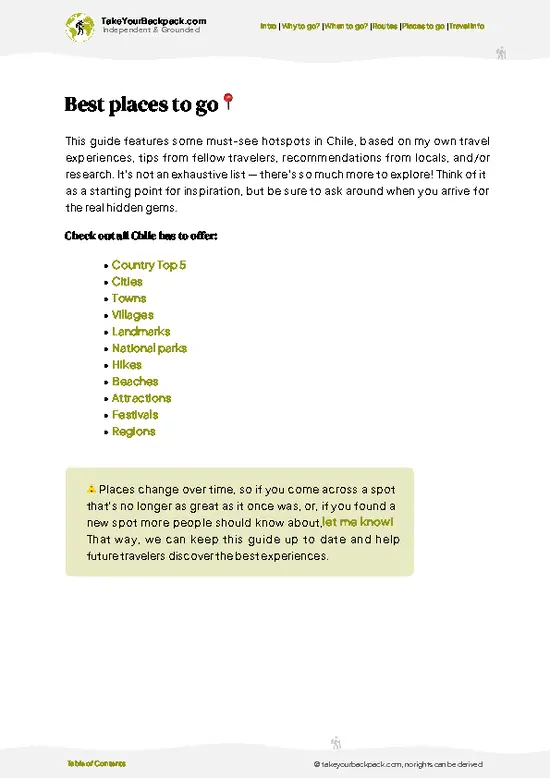
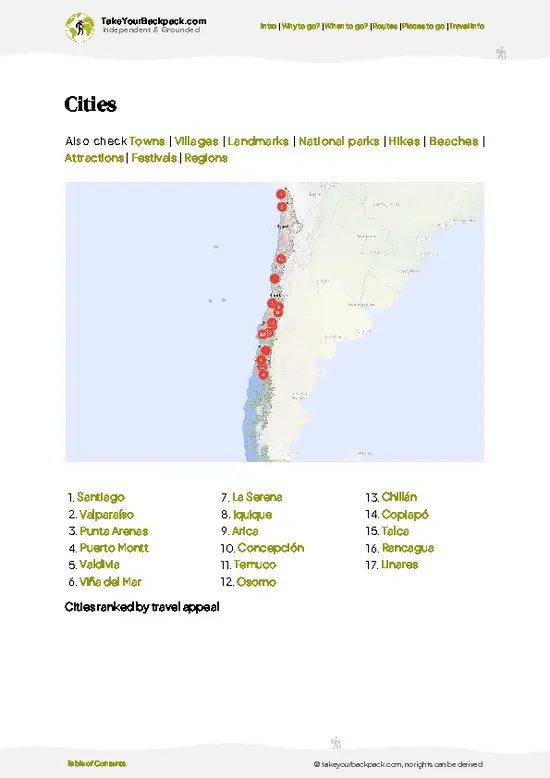
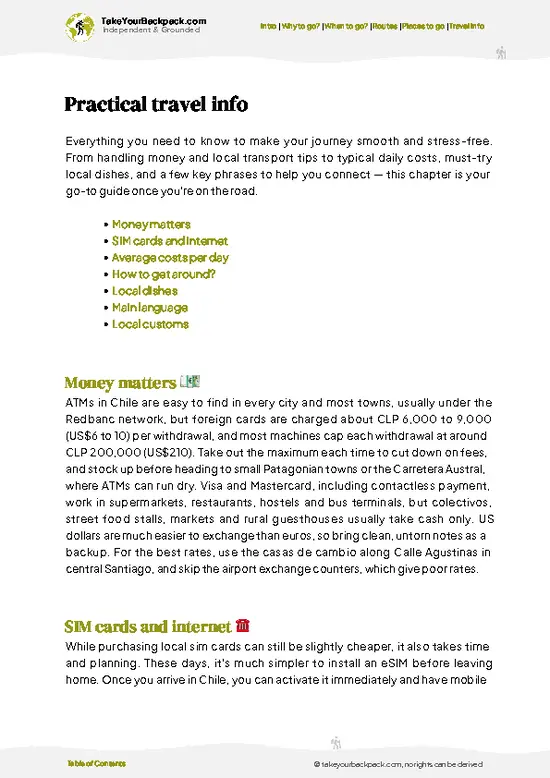
✈️ The backpacker research shortcutChile Travel Guide

An offline-friendly backpacking guide with optimized travel routes, ranked highlights, transport advice, and the best areas to stay.
example page 0 from our offline Travel Guide for Chile
example page 1 from our offline Travel Guide for Chile
example page 2 from our offline Travel Guide for Chile
example page 3 from our offline Travel Guide for Chile
example page 4 from our offline Travel Guide for Chile
example page 5 from our offline Travel Guide for Chile
example page 6 from our offline Travel Guide for Chile
example page 7 from our offline Travel Guide for Chile
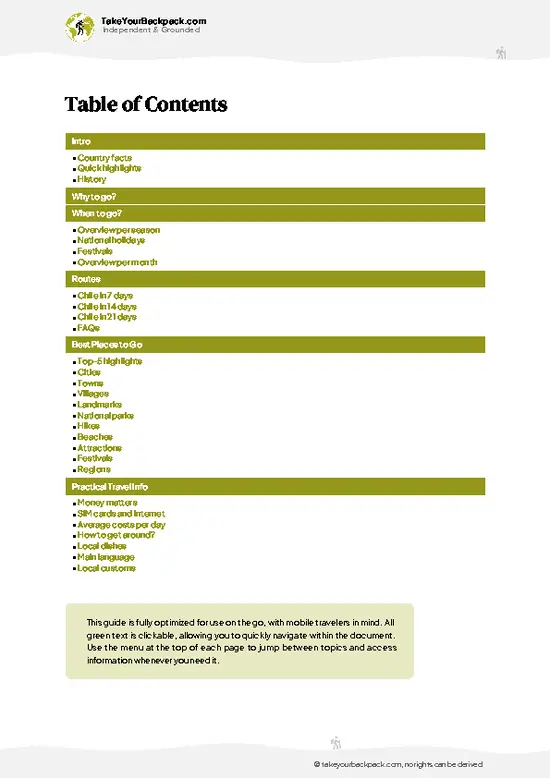
The digital guide (333 pages) contains:
✅ 107 highlights, ranked by travel appeal
✅ Optimized 7, 14 & 21-day travel routes
✅ Cities, national parks, landmarks, beaches
✅ How to get around
✅ Offline-friendly for travel without Wi-Fi
👉 Click to see all 30+ guide features

📅 Plan smarter in minutes, not weeks
✅ Month by month travel advice
✅ Festivals & national holidays
✅ Budget expectations

🗺️ Go to the right places, skip the overrated ones
✅ Honest pros & cons of destinations
✅ Top hikes, parks & viewpoints
✅ Lesser-known places most travelers miss
✅ Clear “worth it vs skip it” guidance

🛏️ Travel smoothly without rookie mistakes
✅ Best areas to stay
✅ Transport systems explained simply
✅ Common scams & safety advice
✅ SIM cards, money & practical tips

🌍 Understand the country, not just visit it
✅ Culture & traditions
✅ 52 Essential phrases & customs
✅ Festivals worth planning around
✅ Traveler-friendly historical context
✅ Insights that make places more meaningful

📱 Built for real travel conditions
✅ Fully downloadable PDF
✅ Works completely offline
✅ Optimized for phone use
✅ Useful in remote areas & buses
✅ Everything in one place
Stop searching, start planning
Get instant access to your full guide. 30‑day money-back guarantee.
+ Add another guide for just

By proceeding you agree to our terms.
Sent to your inbox immediately after payment • 100% Secure Checkout
Best Backpacking Travel Advisor 2025 tourism awardBest Backpacking
Travel Advisor
2025
What others say about Take Your Backpack Guides:
⭐⭐⭐⭐⭐
Fantastic, amazing amount of information!
⭐⭐⭐⭐⭐
My goodness this is amazing, it's what I've been looking for hats off too you!
⭐⭐⭐⭐⭐
I think this is absolutely BRILLIANT
⭐⭐⭐⭐
Very complete and informative. It's still missing places, but I gotta to commend you
⭐⭐⭐⭐⭐
This is truly amazing, thank you, can't wait to explore it with my kids!
⭐⭐⭐⭐⭐
Awesome resource, thank you!
⭐⭐⭐⭐⭐
This is amazing! Can't wait to explore the ones I haven't seen
⭐⭐⭐⭐
I love this! Well done, great idea.
⭐⭐⭐⭐⭐
Thanks for taking the time to make this gem!
⭐⭐⭐⭐⭐
This might be the best website I've ever seen.
⭐⭐⭐⭐⭐
Congratulations, and thank you so much for your work; it's incredibly valuable.
⭐⭐⭐⭐
In all seriousness I think you did a great job pointing out the important spots
⭐⭐⭐⭐⭐
10/10 very good
⭐⭐⭐⭐⭐
As someone who's only just starting to visit regularly this is awesome, thank you.
⭐⭐⭐⭐
Thank you very much! I'm going to visit my dad, it's going to be very useful!
⭐⭐⭐⭐⭐
This is really cool! We'll be travelling for the first time and this definitely come in handy.
⭐⭐⭐⭐⭐
You are now our minister of culture, congratulations 👨‍💼
⭐⭐⭐⭐⭐
Just wanted to tell you that this is a pearl! Going to follow your recommendations.
⭐⭐⭐⭐⭐
This is so cool. I'll definitely be using the resource for my travels soon.
⭐⭐⭐⭐⭐
This is very impressive! Good work.
⭐⭐⭐⭐⭐
This is an amazing and informative site. Very well done!

🛏️ Where to stay?Best Places to Stay in Chile

Chile has a solid hostel scene, with dorm beds typically running CLP 12,000 to 25,000 (about US$13 to 27) a night and more in Patagonia and San Pedro de Atacama. In Santiago, Bellavista puts you on top of the nightlife but gets loud on weekends, Lastarria is walkable to the center and calmer, and Barrio Brasil is the cheapest of the three but feels rougher after dark. In Valparaíso, Cerro Alegre and Cerro Concepción hold most hostels, with views and street art right outside but steep hills and petty theft to keep in mind, while Puerto Natales and Pucón are compact, quiet bases for trekking and volcano trips.

If you enjoy meeting fellow travelers, consider choosing hostels with high ratings for … read more 👉
Chile has a solid hostel scene, with dorm beds typically running CLP 12,000 to 25,000 (about US$13 to 27) a night and more in Patagonia and San Pedro de Atacama. In Santiago, Bellavista puts you on top of the nightlife but gets loud on weekends, Lastarria is walkable to the center and calmer, and Barrio Brasil is the cheapest of the three but feels rougher after dark. In Valparaíso, Cerro Alegre and Cerro Concepción hold most hostels, with views and street art right outside but steep hills and petty theft to keep in mind, while Puerto Natales and Pucón are compact, quiet bases for trekking and volcano trips.

If you enjoy meeting fellow travelers, consider choosing hostels with high ratings for atmosphere. On the other hand, if you prefer having your own space, a hotel might be a better option.

ChileExplore Chile

👋 Meet the founderWho’s Behind Take Your Backpack?

Johan, backpacker and founder of TakeYourBackpackHi, I’m Johan (Netherlands 🇳🇱), the creator of TakeYourBackpack. Over the past 3 decades, I’ve backpacked through 90+ countries across six continents, gaining extensive experience with independent travel, long-term trips, and overland routes.

This site is built on a combination of firsthand travel experience and carefully curated insights from other backpackers. Many guides are based on places I’ve personally visited, while others bring together tips, observations, and practical advice shared by trusted travelers I’ve met along the way.

The goal is to provide realistic, experience-driven guidance — not generic itineraries — so you can explore destinations with better context, clearer expectations, and more confidence.