×

Colombia🇨🇴 | best hikesEssential 6 hikes to Explore in Colombia

Hiking in Colombia means high-altitude, equatorial terrain where elevation, not distance, sets the difficulty. The Andes split into three ranges, and most routes sit between 2,000 and 4,500 meters, so lungs matter more than legs. Skip any plan that treats the country as one trail network. It is a set of very different regions.

The coffee region and Antioquia are the easiest to reach: day hikes start from towns with frequent buses, cost little, and draw weekend crowds of Colombian families. The Sierra Nevada and the northern coast are hot, humid and wild, with multi-day treks that need a guide or permit and cost far more. The páramo highlands around Bogotá and Boyacá are cold, misty and quiet, with cheap access but unreliable weather. For independent travelers, the coffee region suits a first trip. The Caribbean treks suit people with time, budget and tolerance for sweat.

By Johan Kruseman 🇳🇱 | Updated October 20, 2026
Explore the best beaches in Colombia

Why go?Why Travelers Love These Spots

Colombia sits on the equator and is crossed by three Andean cordilleras, so a single country gives you tropical rainforest, cloud forest, páramo and glacial peaks within a day or two of travel. That compression is the real advantage. Elevation, not latitude, decides temperature, which means you pick your climate by choosing your altitude. Few countries let you hike in a T-shirt in the morning and a rain shell by noon without changing region.

Infrastructure is uneven, and that shapes everything. Trail marking and maps are thin compared with Peru or Patagonia. Many routes cross private farmland or Indigenous territory, so access depends on permits, local guides or community agreements, not a public right of way. The Sierra Nevada’s most famous trek, for example, is run by licensed operators because … read more 👉
Colombia sits on the equator and is crossed by three Andean cordilleras, so a single country gives you tropical rainforest, cloud forest, páramo and glacial peaks within a day or two of travel. That compression is the real advantage. Elevation, not latitude, decides temperature, which means you pick your climate by choosing your altitude. Few countries let you hike in a T-shirt in the morning and a rain shell by noon without changing region.

Infrastructure is uneven, and that shapes everything. Trail marking and maps are thin compared with Peru or Patagonia. Many routes cross private farmland or Indigenous territory, so access depends on permits, local guides or community agreements, not a public right of way. The Sierra Nevada’s most famous trek, for example, is run by licensed operators because the land belongs to Indigenous communities. Treat that as a rule, not an inconvenience.

Colombia’s conflict history also matters. Security has improved sharply, and the main hiking areas are well visited, but a few remote regions remain off limits because of armed groups. Check current local advice before heading to any border area or unfamiliar valley, and favor routes with established guides.

Expect no hut networks and few cheap guidebooks. Public transport reaches trailheads in popular regions, but remote ones need a jeep or motorbike taxi. Weather swings are fast, and afternoon rain is common in many highland areas. Anyone wanting well-engineered, self-guided long-distance trails will be frustrated. Anyone happy to hire local knowledge, move slowly and let the landscape change every few hours will find Colombia hard to beat.
Behind the Scenes of Selection
The list of best hikes in Colombia is created based on scenery, challenge, trail quality, landmarks, and overall enjoyment. If you feel a hike is missing in this list, please let us know.

When to go?When to Plan Your Trip

Best months for hiking in Colombia: The best months are December to March, with a second drier window from July to August, because the Andes and the Caribbean coast see the least rain and clearest mountain views then. Colombia has no summer or winter. It has wet and dry spells, and altitude controls temperature.

Andes and coffee region: In Bogotá, Boyacá and the coffee region, the two rainy seasons run roughly April to May and October to November. Trails turn to mud, clouds close in by early afternoon and river crossings get risky. Highland páramo is cold year-round, around 0 to 12°C, and can drop below freezing at night above 3,800 meters. Coffee-region valleys sit at about 18 to 26°C. Do not plan a páramo trip in October or November unless you enjoy fog.

Caribbean coast and Sierra Nevada: … read more 👉
Best months for hiking in Colombia: The best months are December to March, with a second drier window from July to August, because the Andes and the Caribbean coast see the least rain and clearest mountain views then. Colombia has no summer or winter. It has wet and dry spells, and altitude controls temperature.

Andes and coffee region: In Bogotá, Boyacá and the coffee region, the two rainy seasons run roughly April to May and October to November. Trails turn to mud, clouds close in by early afternoon and river crossings get risky. Highland páramo is cold year-round, around 0 to 12°C, and can drop below freezing at night above 3,800 meters. Coffee-region valleys sit at about 18 to 26°C. Do not plan a páramo trip in October or November unless you enjoy fog.

Caribbean coast and Sierra Nevada: The Caribbean is hottest and driest from December to April, with lowland temperatures of 30 to 35°C and high humidity. Multi-day treks here are better in the dry months, when trails are firmer and river crossings lower. From May onward, heavy rain makes some routes slippery or hard to pass, and operators sometimes cancel departures.

Crowds and prices: Colombian holidays drive crowds more than foreign tourism. Christmas to mid-January, Holy Week and long weekends fill towns and push lodging up by roughly 20 to 50 percent, especially in popular coffee and Andean villages. Midweek trips outside those periods are quieter and cheaper. Shoulder months like June and September give decent weather, empty trails and lower rates, which makes them the smartest choice for flexible independent travelers.

hike hoppingPlanning Your Route Efficiently

How many days to plan: A trip combining several hikes in Colombia needs 14 to 21 days, because internal travel eats more time than most maps suggest. Distances look short, but mountain roads are slow, and a 300-kilometer journey often takes 8 to 10 hours.

Which regions cluster well: Group by terrain. The coffee region and Medellín area pair easily, with 5 to 7 hours by bus between them and frequent departures. Bogotá and Boyacá form another natural pair, with 3 to 5 hours of road travel between them. The Caribbean coast, centered on Santa Marta, sits far from both, so treat it as a separate block reached by flight, not an overland add-on.

Direction and pacing: Start in Bogotá to acclimatize at 2,600 meters, move through Boyacá, then fly or bus to the coffee region and Medellín, and finish on … read more 👉
How many days to plan: A trip combining several hikes in Colombia needs 14 to 21 days, because internal travel eats more time than most maps suggest. Distances look short, but mountain roads are slow, and a 300-kilometer journey often takes 8 to 10 hours.

Which regions cluster well: Group by terrain. The coffee region and Medellín area pair easily, with 5 to 7 hours by bus between them and frequent departures. Bogotá and Boyacá form another natural pair, with 3 to 5 hours of road travel between them. The Caribbean coast, centered on Santa Marta, sits far from both, so treat it as a separate block reached by flight, not an overland add-on.

Direction and pacing: Start in Bogotá to acclimatize at 2,600 meters, move through Boyacá, then fly or bus to the coffee region and Medellín, and finish on the Caribbean coast, where heat and humidity suit the end of a trip. Flights between Bogotá, Medellín and Santa Marta or Barranquilla take about 1 to 1.5 hours and often cost US$30 to 90 if booked early. Allow 2 to 3 days per hiking base for day hikes, and 4 to 6 days for a multi-day trek plus rest.

Planning mistakes: The most common error is stacking a long overland leg right before a trek. Add a buffer day, because landslides and rain delays are routine. Another is skipping acclimatization and starting high-altitude walks within a day of landing, which brings headaches and wasted days. Travelers also try to cover all three regions in under ten days and spend most of it on buses. Pick two regions instead and do them properly. Finally, book guided treks ahead in dry season, since licensed groups have limited spots.

The ListHighly Recommended hikes of Colombia

1 Lost City Trek (Ciudad Perdida)

Jungle terraces, river crossings, Kogi lands, multi-day camps

Wade the Buritaca, sleep in riverside camps and finish on 1,200 mossy steps to circular stone terraces in the Sierra Nevada de Santa Marta.

Colombia - the Lost City Trek (Ciudad Perdida)

2 Laguna de Iguaque

Dark páramo lake, oak forest, booked entry

Climb about 9.5 kilometers round trip through mossy oak woods and frailejones to a small lake sacred in Muisca tradition.

colombia-hike-laguna-de-iguaque
© Google |

3 Páramo de Ocetá Trail

Frailejón slopes, Laguna Negra, colonial stone path

Follow a worn Camino Real out of Monguí, then grind uphill through silver frailejones to a black lake and a long day's turnaround.

4 Puracé Volcano Trail

Active crater plume, sulfur fumaroles, condor ridges, thermal pools

Walk marked páramo trail past hissing yellow vents to a viewpoint over a gas-venting crater, then soak in hot springs below.

colombia-hike-purace-volcano-trail
© Google |

5 Quebrada La Vieja Trail

Creek ravine, stone stairs, Bogotá overlooks

Climb steep stone steps beside a rushing creek through eucalyptus and native forest, with gaps in the trees opening onto Bogotá's eastern neighborhoods.

colombia-hike-quebrada-la-vieja-trail
© Google |

6 Cerro Machín Volcano

Caldera rim, lava dome, cloud forest, steam vents

Hike a short moderate route from Cajamarca through mossy forest to a wide collapsed crater, a rounded lava dome and sulfur-scented steam.

colombia-hike-cerro-machin-volcano
© Google | Gabo Cruz
Loading the map 🌍

Expert viewInsights from Locals and Experts

How many hikes to plan: Plan three to five hikes on a two to three week trip. Colombia’s elevation and humidity make back-to-back big days tiring, and rain can erase a day without warning. That count leaves room for rest days and weather swaps. Packing in eight or more means you will spend more time recovering and on buses than on trails.

Choosing the kind of hike: Easy-access day hikes in the coffee region and around Bogotá suit first-timers and tight budgets, since they need no permit and little gear. Cold páramo walks suit people who want solitude and don’t mind mist. Multi-day treks on the Caribbean side suit those with time and money, and they are worth it only if you enjoy heat, humidity and community-run camps. Skip any trek sold mainly on a famous name if your schedule is under ten … read more 👉
How many hikes to plan: Plan three to five hikes on a two to three week trip. Colombia’s elevation and humidity make back-to-back big days tiring, and rain can erase a day without warning. That count leaves room for rest days and weather swaps. Packing in eight or more means you will spend more time recovering and on buses than on trails.

Choosing the kind of hike: Easy-access day hikes in the coffee region and around Bogotá suit first-timers and tight budgets, since they need no permit and little gear. Cold páramo walks suit people who want solitude and don’t mind mist. Multi-day treks on the Caribbean side suit those with time and money, and they are worth it only if you enjoy heat, humidity and community-run camps. Skip any trek sold mainly on a famous name if your schedule is under ten days. Day hikes give better value.

What it costs: Budget US$30 to 60 a day for independent hiking, covering dorms or simple guesthouses, local meals and buses. Entry fees to national parks and reserves typically run COP 20,000 to 70,000 (about US$5 to 17), with higher rates for foreigners. Local guides for day hikes cost roughly COP 100,000 to 250,000 (US$25 to 60) per group. Multi-day guided treks run roughly US$300 to 450 per person, usually including food, camps and permits. Jeep or motorbike transfers to trailheads cost about COP 10,000 to 60,000 (US$2.50 to 15). Carry cash, because many rural parks and villages have no card machines.

Costs and delays that catch people out: Weekend and holiday prices jump, so hike midweek. Last-minute bookings for popular treks often fail in dry season, so reserve early. Transport to trailheads can run only once or twice a day, and missing the return jeep means an unplanned night, so confirm times locally. Altitude sickness costs days, so rest on arrival and drink water. Cheap operators sometimes cut corners on food and safety, so choose registered ones.

Safety and cultural considerations: Hire licensed local guides for remote or Indigenous-territory routes, both for safety and because access is often legally restricted. Respect community rules, including bans on drones and photography in some areas, and never leave the marked path on private land. Avoid hiking at night, and start early, because afternoon storms and fog arrive fast. Watch the weather, since flash floods hit river valleys. Check current security advice for the region before departing, and avoid remote border zones. Tell your hostel your route, carry a rain shell and a headlamp, and keep valuables out of sight on the way to trailheads. Dress modestly in small villages and greet people politely. A few Spanish phrases go a long way, and locals respond warmly to the effort.

✈️ The backpacker research shortcutColombia Travel Guide

An offline-friendly backpacking guide with optimized travel routes, ranked highlights, transport advice, and the best areas to stay.
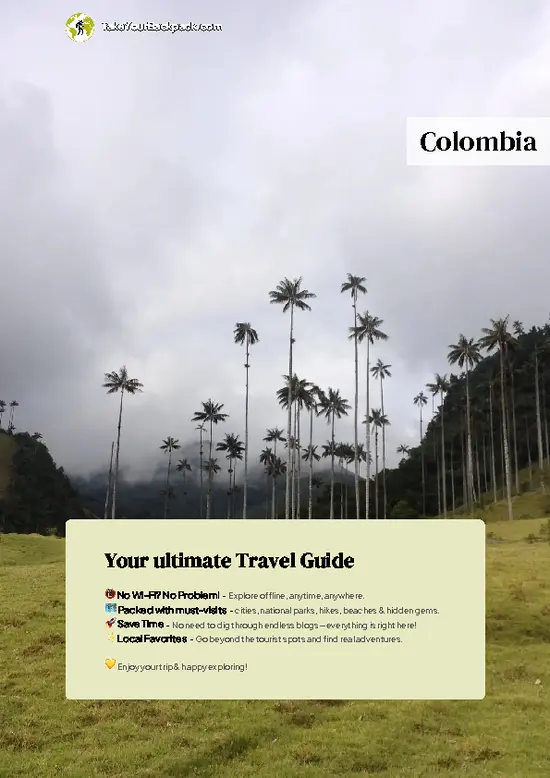
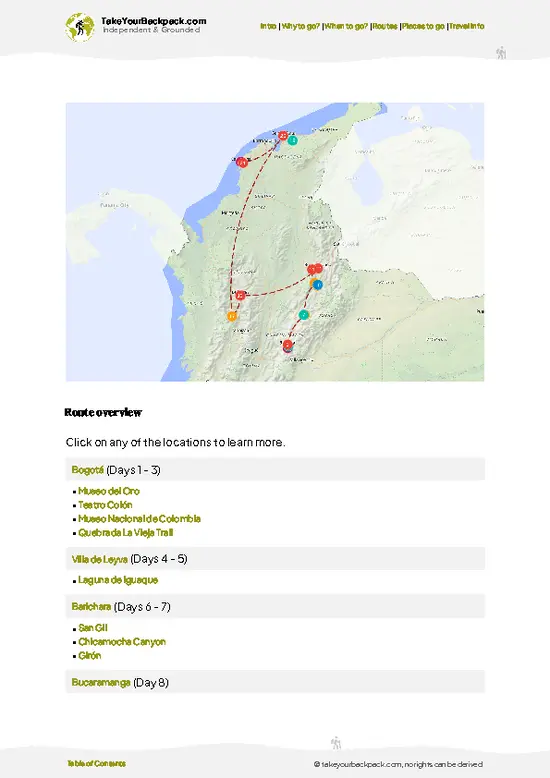
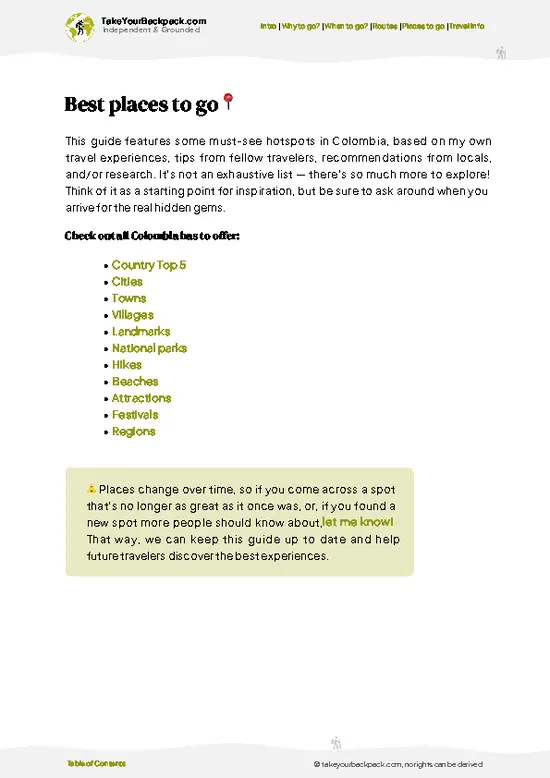
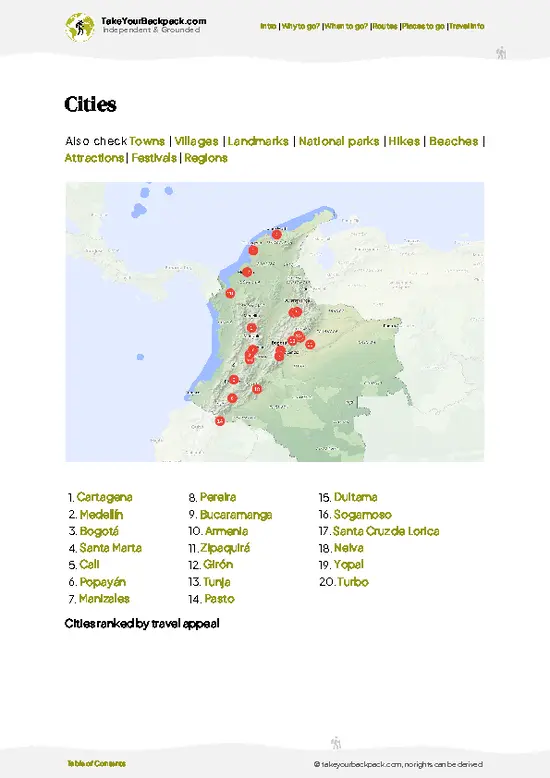
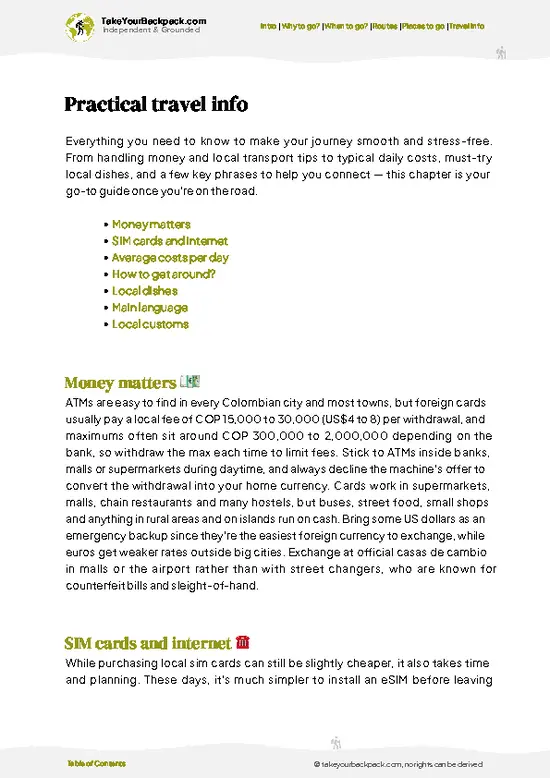
example page 0 from our offline Travel Guide for Colombia
example page 1 from our offline Travel Guide for Colombia
example page 2 from our offline Travel Guide for Colombia
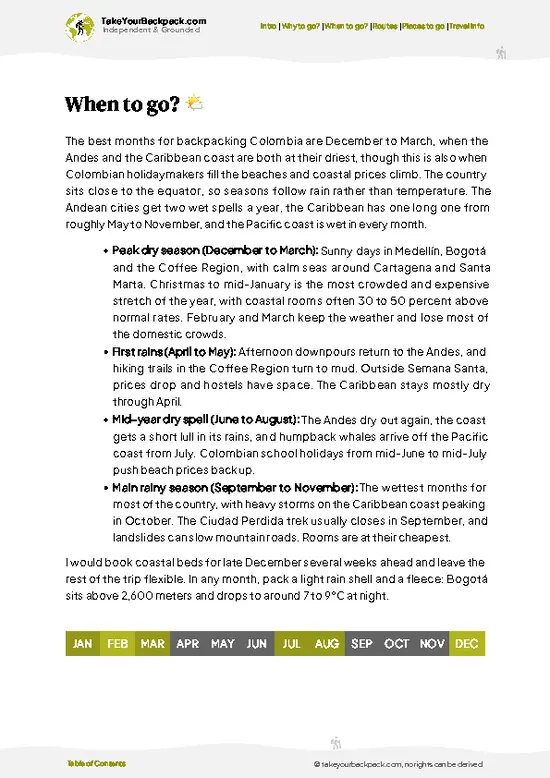
example page 3 from our offline Travel Guide for Colombia
example page 4 from our offline Travel Guide for Colombia
example page 5 from our offline Travel Guide for Colombia
example page 6 from our offline Travel Guide for Colombia
example page 7 from our offline Travel Guide for Colombia
The digital guide (349 pages) contains:
✅ 115 highlights, ranked by travel appeal
✅ Optimized 7, 14 & 21-day travel routes
✅ Cities, national parks, landmarks, beaches
✅ How to get around
✅ Offline-friendly for travel without Wi-Fi
👉 Click to see all 30+ guide features

📅 Plan smarter in minutes, not weeks
✅ Month by month travel advice
✅ Festivals & national holidays
✅ Budget expectations

🗺️ Go to the right places, skip the overrated ones
✅ Honest pros & cons of destinations
✅ Top hikes, parks & viewpoints
✅ Lesser-known places most travelers miss
✅ Clear “worth it vs skip it” guidance

🛏️ Travel smoothly without rookie mistakes
✅ Best areas to stay
✅ Transport systems explained simply
✅ Common scams & safety advice
✅ SIM cards, money & practical tips

🌍 Understand the country, not just visit it
✅ Culture & traditions
✅ 52 Essential phrases & customs
✅ Festivals worth planning around
✅ Traveler-friendly historical context
✅ Insights that make places more meaningful

📱 Built for real travel conditions
✅ Fully downloadable PDF
✅ Works completely offline
✅ Optimized for phone use
✅ Useful in remote areas & buses
✅ Everything in one place
Stop searching, start planning
Get instant access to your full guide. 30‑day money-back guarantee.
+ Add another guide for just

By proceeding you agree to our terms.
Sent to your inbox immediately after payment • 100% Secure Checkout
Best Backpacking Travel Advisor 2025 tourism awardBest Backpacking
Travel Advisor
2025
What others say about Take Your Backpack Guides:
⭐⭐⭐⭐⭐
Fantastic, amazing amount of information!
⭐⭐⭐⭐⭐
My goodness this is amazing, it's what I've been looking for hats off too you!
⭐⭐⭐⭐⭐
I think this is absolutely BRILLIANT
⭐⭐⭐⭐
Very complete and informative. It's still missing places, but I gotta to commend you
⭐⭐⭐⭐⭐
This is truly amazing, thank you, can't wait to explore it with my kids!
⭐⭐⭐⭐⭐
Awesome resource, thank you!
⭐⭐⭐⭐⭐
This is amazing! Can't wait to explore the ones I haven't seen
⭐⭐⭐⭐
I love this! Well done, great idea.
⭐⭐⭐⭐⭐
Thanks for taking the time to make this gem!
⭐⭐⭐⭐⭐
This might be the best website I've ever seen.
⭐⭐⭐⭐⭐
Congratulations, and thank you so much for your work; it's incredibly valuable.
⭐⭐⭐⭐
In all seriousness I think you did a great job pointing out the important spots
⭐⭐⭐⭐⭐
10/10 very good
⭐⭐⭐⭐⭐
As someone who's only just starting to visit regularly this is awesome, thank you.
⭐⭐⭐⭐
Thank you very much! I'm going to visit my dad, it's going to be very useful!
⭐⭐⭐⭐⭐
This is really cool! We'll be travelling for the first time and this definitely come in handy.
⭐⭐⭐⭐⭐
You are now our minister of culture, congratulations 👨‍💼
⭐⭐⭐⭐⭐
Just wanted to tell you that this is a pearl! Going to follow your recommendations.
⭐⭐⭐⭐⭐
This is so cool. I'll definitely be using the resource for my travels soon.
⭐⭐⭐⭐⭐
This is very impressive! Good work.
⭐⭐⭐⭐⭐
This is an amazing and informative site. Very well done!

🛏️ Where to stay?Accommodation Highlights

Hostels and budget guesthouses are easy to find across Colombia, with dorm beds typically running COP 40,000 to 80,000 (US$12 to 25) and private rooms from about COP 100,000 (US$31). In Bogotá, La Candelaria puts you within walking distance of the museums and old-town streets but empties out after dark, while Chapinero has better restaurants, bars and a safer evening feel; in Medellín, El Poblado is the party hub with the highest prices and noise, and Laureles is calmer, greener and more local. In Cartagena, Getsemaní has the densest cluster of hostels, street art and plaza nightlife a few minutes from the walled Centro Histórico, which is prettier and quieter but costs noticeably more.

If you … read more 👉
Hostels and budget guesthouses are easy to find across Colombia, with dorm beds typically running COP 40,000 to 80,000 (US$12 to 25) and private rooms from about COP 100,000 (US$31). In Bogotá, La Candelaria puts you within walking distance of the museums and old-town streets but empties out after dark, while Chapinero has better restaurants, bars and a safer evening feel; in Medellín, El Poblado is the party hub with the highest prices and noise, and Laureles is calmer, greener and more local. In Cartagena, Getsemaní has the densest cluster of hostels, street art and plaza nightlife a few minutes from the walled Centro Histórico, which is prettier and quieter but costs noticeably more.

If you enjoy meeting fellow travelers, consider choosing hostels with high ratings for atmosphere. On the other hand, if you prefer having your own space, a hotel might be a better option.

ColombiaSee More of Colombia

👋 Meet the founderWho’s Behind Take Your Backpack?

Johan, backpacker and founder of TakeYourBackpackHi, I’m Johan (Netherlands 🇳🇱), the creator of TakeYourBackpack. Over the past 3 decades, I’ve backpacked through 90+ countries across six continents, gaining extensive experience with independent travel, long-term trips, and overland routes.

This site is built on a combination of firsthand travel experience and carefully curated insights from other backpackers. Many guides are based on places I’ve personally visited, while others bring together tips, observations, and practical advice shared by trusted travelers I’ve met along the way.

The goal is to provide realistic, experience-driven guidance — not generic itineraries — so you can explore destinations with better context, clearer expectations, and more confidence.