×

Colombia🇨🇴 | best beachesEssential 5 beaches to Explore in Colombia

Beaches in Colombia split into two coasts that feel like different countries. The Caribbean coast is the main draw: warm, shallow water, hostel-priced beach towns, and a fair bit of hustle from vendors. The Pacific coast is wild, dark-sand and rain-soaked, and getting there takes real effort. Skip any idea of a quick, polished resort strip, because Colombia mostly doesn’t work that way.

The Caribbean splits again. Cartagena’s city beaches are crowded and not worth your swim time. Better water sits near Tayrona and the Guajira desert coast, along the Morrosquillo Gulf, and on the San Andrés and Providencia islands, which cost the most. For backpacking and independent travel, the Caribbean is easy and cheap, while the Pacific suits whale-watching and jungle, not sunbathing. Pick by how much comfort, money and travel time you want to spend.

By Johan Kruseman 🇳🇱 | Updated October 20, 2026
Explore the best attractions in Colombia

Why go?Why Travelers Love These Spots

Colombia is the only South American country with long coastlines on both the Caribbean Sea and the Pacific Ocean, and the two coasts behave like different countries. The Caribbean side (roughly 1,600 km of shoreline) gets the postcard conditions: warm, clear water, white and golden sand, and reefs around the offshore islands. The Pacific side (about 1,300 km) is wet, wild and dark-sand, with humpback whales and jungle running to the tide line. If you want swimming and snorkeling, the Caribbean is the answer. The Pacific is not a swimming coast, and it is worth the time only if wildlife and remoteness are the point.

Geography explains the gaps. The Andes cut the interior off from the sea, so the coasts developed separately, and the Pacific stayed thinly populated, with few roads and many villages … read more 👉
Colombia is the only South American country with long coastlines on both the Caribbean Sea and the Pacific Ocean, and the two coasts behave like different countries. The Caribbean side (roughly 1,600 km of shoreline) gets the postcard conditions: warm, clear water, white and golden sand, and reefs around the offshore islands. The Pacific side (about 1,300 km) is wet, wild and dark-sand, with humpback whales and jungle running to the tide line. If you want swimming and snorkeling, the Caribbean is the answer. The Pacific is not a swimming coast, and it is worth the time only if wildlife and remoteness are the point.

Geography explains the gaps. The Andes cut the interior off from the sea, so the coasts developed separately, and the Pacific stayed thinly populated, with few roads and many villages reachable only by boat or small plane. That means access costs real money and time there, while the Caribbean has airports, buses and a dense tourist network.

The Caribbean also has a long dry season, while the Pacific sees heavy rain nearly all year (often above 3,000 mm). Reefs and clear water are best where rivers are small, which is why the sea near the large river mouths is brown and not worth a beach day.

Before choosing Colombia for beaches, accept that this is not a country of one easy beach strip. Distances are large, flights are often cheaper than buses, and the best sand is frequently an island or a boat ride away, so boat transfers and entry fees become part of the budget. Many popular coves are crowded on weekends and during national holidays, when Colombians themselves head to the coast. Sun is strong at roughly 10 degrees north of the equator, and rip currents occur on open Caribbean beaches with few lifeguards. Colombia suits travelers who want beach time mixed with cities, mountains and culture. It suits poorly anyone who wants a single, cheap, resort-style beach week.
Behind the Scenes of Selection
The list of best beaches in Colombia is created based on beauty, vibe, water quality, activities, and surrounding scenery. If you feel a beach is missing in this list, please let us know.

When to go?When to Plan Your Trip

Best months and weather: The best months for Caribbean beaches in Colombia are December to March, when the dry season brings sunny days, low humidity and calmer seas, with highs of 30 to 33°C. The Caribbean also has a shorter, lighter dry spell around June to August, known as veranillo, which is a decent second window. Most rain falls from September to November, with October the wettest, and heavy downpours can cancel boat transfers and turn dirt tracks to mud.

Shoulder seasons and crowds: April to May and late November are the shoulder months. Expect warm water, some afternoon storms, and noticeably fewer people. They are a smart choice if you want lower prices and don’t mind a wet afternoon. Peak pressure comes at Christmas to New Year, Semana Santa (the week before Easter) and the mid-year … read more 👉
Best months and weather: The best months for Caribbean beaches in Colombia are December to March, when the dry season brings sunny days, low humidity and calmer seas, with highs of 30 to 33°C. The Caribbean also has a shorter, lighter dry spell around June to August, known as veranillo, which is a decent second window. Most rain falls from September to November, with October the wettest, and heavy downpours can cancel boat transfers and turn dirt tracks to mud.

Shoulder seasons and crowds: April to May and late November are the shoulder months. Expect warm water, some afternoon storms, and noticeably fewer people. They are a smart choice if you want lower prices and don’t mind a wet afternoon. Peak pressure comes at Christmas to New Year, Semana Santa (the week before Easter) and the mid-year school holiday in late June and July. In those weeks Colombian families fill the coast, and room rates can run 30 to 100 percent above low-season prices. Book ahead and avoid weekends if you can, since long holiday weekends (puentes) also fill buses and beach towns.

Regional differences: The Pacific coast follows its own logic. It is wet year-round, with rainfall often passing 3,000 millimeters a year, and temperatures sit around 26 to 30°C. Humpback whales arrive from about July to October, which makes that the best window for the region, while sunny beach days are rare at any time. The islands of San Andrés and Providencia are driest from roughly January to April, and hurricane season runs June to November, though direct hits are uncommon. The Guajira desert is hot and dry for most of the year, so go early or late in the day.

beach hoppingPlanning Your Route Efficiently

How long you need: A trip that combines several beaches in Colombia needs 10 to 16 days, and fewer than 10 will leave you spending half your time on buses and boats. The Caribbean coast alone works in 7 to 10 days. Adding the islands or the Pacific pushes it toward two weeks or more.

Which regions go together: The mainland Caribbean coast clusters well because everything runs along one road. Cartagena is the usual hub, with Santa Marta as the second hub about 4 to 5 hours east by road, and the Guajira peninsula another 5 to 8 hours beyond that, depending on the route and the track. Travel in one direction, either Cartagena to Santa Marta and then Guajira, or the reverse, and fly out from the far end (Riohacha, Santa Marta or Barranquilla) rather than backtracking. The Morrosquillo Gulf sits … read more 👉
How long you need: A trip that combines several beaches in Colombia needs 10 to 16 days, and fewer than 10 will leave you spending half your time on buses and boats. The Caribbean coast alone works in 7 to 10 days. Adding the islands or the Pacific pushes it toward two weeks or more.

Which regions go together: The mainland Caribbean coast clusters well because everything runs along one road. Cartagena is the usual hub, with Santa Marta as the second hub about 4 to 5 hours east by road, and the Guajira peninsula another 5 to 8 hours beyond that, depending on the route and the track. Travel in one direction, either Cartagena to Santa Marta and then Guajira, or the reverse, and fly out from the far end (Riohacha, Santa Marta or Barranquilla) rather than backtracking. The Morrosquillo Gulf sits south of Cartagena, so it fits best at the start. The islands need a flight from Cartagena, Bogotá or Medellín, roughly 1.5 to 2 hours. The Pacific is a separate trip: reach it by flight from Medellín or Cali, then a boat, and treat it as an add-on, not a stop on the way.

Time per stop: Give each mainland beach area 2 to 4 nights. One night is rarely enough once transfers eat the morning. The islands deserve 3 to 5 nights, and the Pacific 4 to 6, since weather can delay boats and flights.

Planning mistakes: The most common error is packing too many stops, which turns the trip into a transport marathon. Pick three or four bases and do day trips from them. Another is crossing the Guajira without allowing for slow tracks and variable tours, so add a buffer day. Travelers also book tight flights after a boat leg, and sea conditions can cancel boats. Leave a spare day before any international departure, and avoid holiday weekends when buses fill.

The ListHighly Recommended beaches of Colombia

1 Cabo San Juan

Boulder-ringed bay, rock hammock hut, Tayrona jungle trail, calm swimming

Swim in a sheltered cove of pale sand, then hike the steep forest path to the Tayrona terraces of Pueblito Chairama.

colombia-beach-cabo-san-juan
© Google | Lucas

2 Playa Blanca

Powder-white sand, knee-deep shallows, thatched huts, Barú day boats

Wade through calm turquoise shallows, sleep in a hammock after the day boats leave, and take a boat out to Cholón.

colombia-beach-playa-blanca
© Google | J Marvin Viajero

3 Nuquí

Dark volcanic sand, humpback season, Pacific jungle, fly-in only

Time a visit for July to October to watch humpbacks with calves, then soak in jungle hot springs reached by boat.

colombia-beach-nuqui
© Google |

4 Cabo de la Vela

Kitesurf wind, desert-meets-sea, Pilón de Azúcar, hammock rancherías

Ride the steady bay wind on flat shallow water, then climb to the lighthouse for a late-afternoon view over desert and sea.

colombia-beach-cabo-de-la-vela
© Google | Diego Rocha

5 Isla Fuerte

Car-free island, reef snorkeling, grilled snapper, boat access

Snorkel clear shallows over reef and seagrass, circle the shoreline on foot, and eat the day’s catch with coconut rice.

Loading the map 🌍

Expert viewInsights from Locals and Experts

How many beaches to visit: Plan on three to five beach stops in Colombia, and no more. Each one needs a day lost to transport, and after four or five the sand starts to blur. Three bases with a day trip or two from each give you far better variety than ten rushed visits. Skip the city beaches in Cartagena and Santa Marta for swimming, since water quality and vendors make them poor value of your time.

Which kind suits your style: If you want cheap and social, choose Caribbean hostel beaches, where hammocks and dorm beds cost little and boat trips are easy to share. If you want wild and quiet, pick the Guajira or the Pacific, but accept slow transport and basic lodging. If you want clear water and snorkeling, the islands deliver, at roughly double mainland prices. The Pacific is for whales … read more 👉
How many beaches to visit: Plan on three to five beach stops in Colombia, and no more. Each one needs a day lost to transport, and after four or five the sand starts to blur. Three bases with a day trip or two from each give you far better variety than ten rushed visits. Skip the city beaches in Cartagena and Santa Marta for swimming, since water quality and vendors make them poor value of your time.

Which kind suits your style: If you want cheap and social, choose Caribbean hostel beaches, where hammocks and dorm beds cost little and boat trips are easy to share. If you want wild and quiet, pick the Guajira or the Pacific, but accept slow transport and basic lodging. If you want clear water and snorkeling, the islands deliver, at roughly double mainland prices. The Pacific is for whales and jungle, so skip it if you only want to swim.

What it costs: A mainland Caribbean backpacker can manage on US$25 to 45 a day (about COP 100,000 to 180,000): a dorm bed of US$8 to 15, meals of US$8 to 15, and local transport. The islands run US$50 to 90 a day. Pacific lodging and boats push daily costs to US$45 to 80, because fuel makes every transfer expensive.

Per visit, national park entry at Tayrona is higher for foreigners, roughly COP 70,000 to 90,000 (US$17 to 22), and hammock or tent spots inside cost around US$8 to 20 a night. Boat taxis to nearby coves usually run COP 20,000 to 60,000 per person each way (US$5 to 15), depending on distance. Guajira tours often cost US$100 to 250 for multi-day trips with transport. Snorkel gear rentals and island tax add up, so ask what is included before paying. Whale-watching outings are commonly US$35 to 70.

Money mistakes to avoid: Cash is a problem on remote coasts. Withdraw pesos before you go, as machines are scarce and often empty. Beach vendors quote inflated starting prices, so agree on a price before a massage, tour or boat ride. Holiday weekends can double prices, so book early or shift your dates. Changing a boat or flight at the last minute because of weather can cost you a night of lodging, which a spare day in your plan avoids.

Safety and cultural points: The biggest beach danger is the water. Many beaches have strong rip currents and no lifeguards, and drownings happen, particularly at wild coves. Swim only where locals do, and stay out when red flags are up. Take sun seriously, since the equatorial sun burns fast, and carry a refillable bottle.

Theft happens on busy sand, so leave valuables at your lodging and never leave a bag unattended while swimming. Use licensed boat operators with life jackets, and don’t board overloaded boats. Avoid isolated beaches at night. Drug offers are common, and buying carries real legal risk.

Culturally, some Caribbean sites sit on Indigenous land. Respect closures, ask before photographing people, and dress modestly away from the sand. Keep to marked trails in national parks, and take your trash out. Topless sunbathing is not accepted at most beaches. Spanish helps a lot outside the main hubs, and even a few phrases get you better prices and warmer service.

✈️ The backpacker research shortcutColombia Travel Guide

An offline-friendly backpacking guide with optimized travel routes, ranked highlights, transport advice, and the best areas to stay.
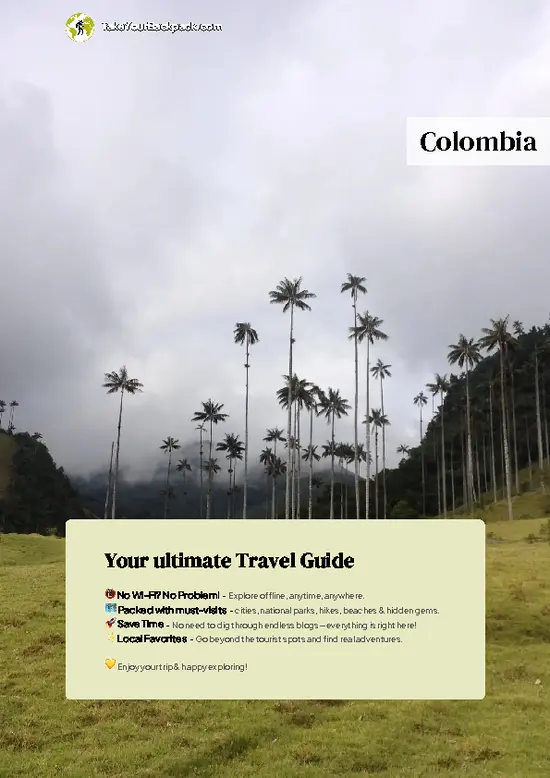
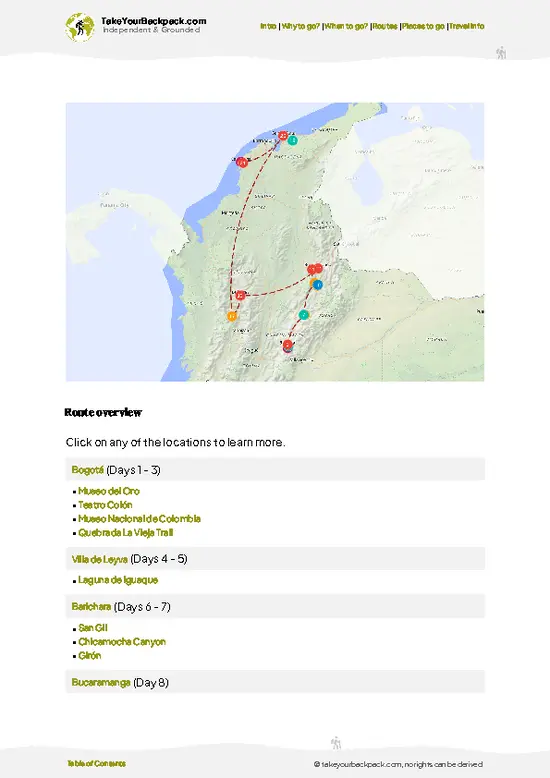
example page 0 from our offline Travel Guide for Colombia
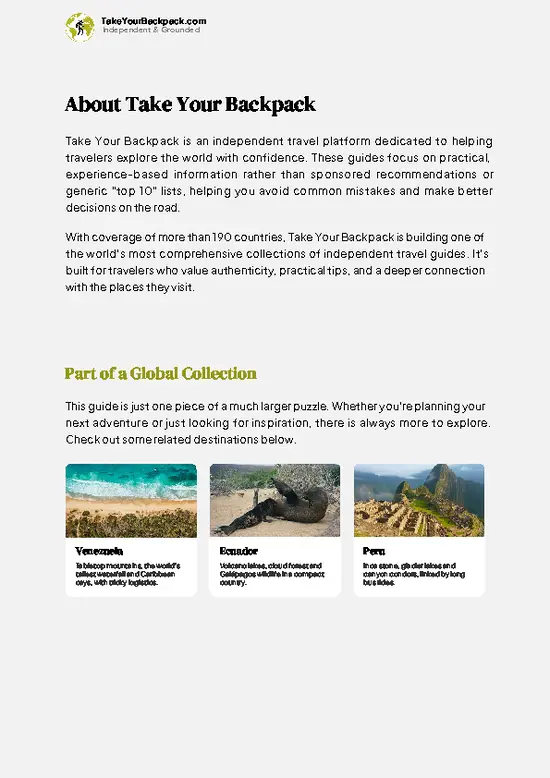
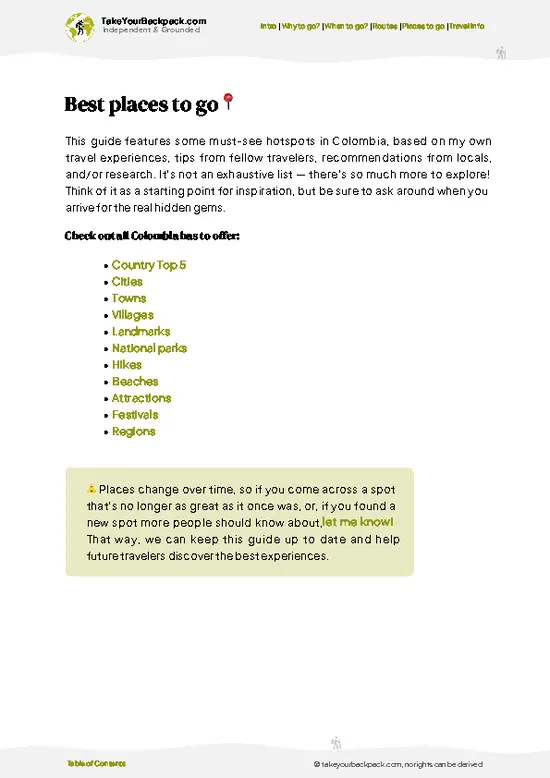
example page 1 from our offline Travel Guide for Colombia
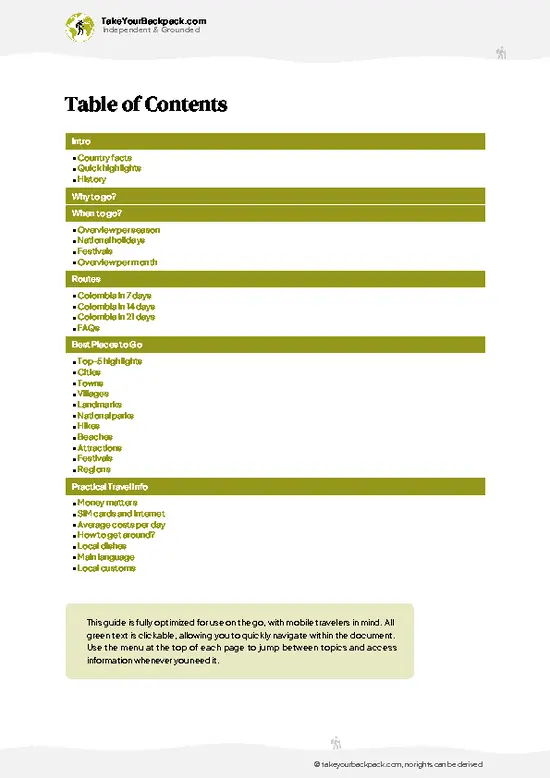
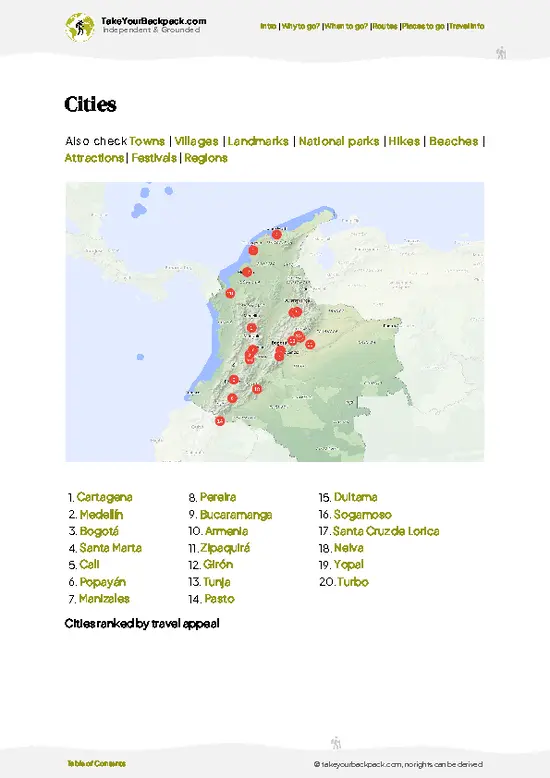
example page 2 from our offline Travel Guide for Colombia
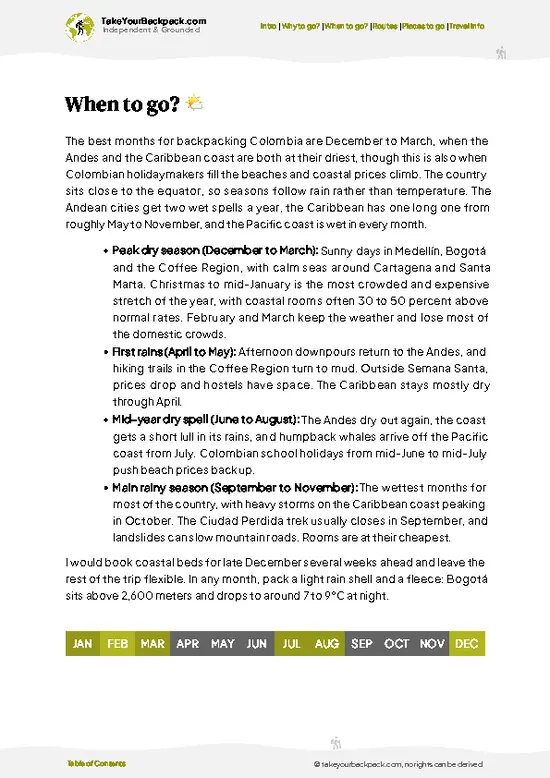
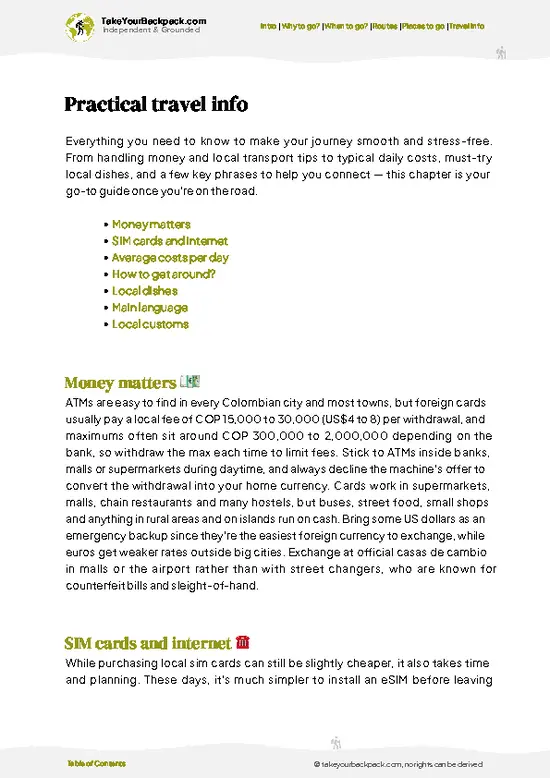
example page 3 from our offline Travel Guide for Colombia
example page 4 from our offline Travel Guide for Colombia
example page 5 from our offline Travel Guide for Colombia
example page 6 from our offline Travel Guide for Colombia
example page 7 from our offline Travel Guide for Colombia
The digital guide (349 pages) contains:
✅ 115 highlights, ranked by travel appeal
✅ Optimized 7, 14 & 21-day travel routes
✅ Cities, national parks, landmarks, beaches
✅ How to get around
✅ Offline-friendly for travel without Wi-Fi
👉 Click to see all 30+ guide features

📅 Plan smarter in minutes, not weeks
✅ Month by month travel advice
✅ Festivals & national holidays
✅ Budget expectations

🗺️ Go to the right places, skip the overrated ones
✅ Honest pros & cons of destinations
✅ Top hikes, parks & viewpoints
✅ Lesser-known places most travelers miss
✅ Clear “worth it vs skip it” guidance

🛏️ Travel smoothly without rookie mistakes
✅ Best areas to stay
✅ Transport systems explained simply
✅ Common scams & safety advice
✅ SIM cards, money & practical tips

🌍 Understand the country, not just visit it
✅ Culture & traditions
✅ 52 Essential phrases & customs
✅ Festivals worth planning around
✅ Traveler-friendly historical context
✅ Insights that make places more meaningful

📱 Built for real travel conditions
✅ Fully downloadable PDF
✅ Works completely offline
✅ Optimized for phone use
✅ Useful in remote areas & buses
✅ Everything in one place
Stop searching, start planning
Get instant access to your full guide. 30‑day money-back guarantee.
+ Add another guide for just

By proceeding you agree to our terms.
Sent to your inbox immediately after payment • 100% Secure Checkout
Best Backpacking Travel Advisor 2025 tourism awardBest Backpacking
Travel Advisor
2025
What others say about Take Your Backpack Guides:
⭐⭐⭐⭐⭐
Fantastic, amazing amount of information!
⭐⭐⭐⭐⭐
My goodness this is amazing, it's what I've been looking for hats off too you!
⭐⭐⭐⭐⭐
I think this is absolutely BRILLIANT
⭐⭐⭐⭐
Very complete and informative. It's still missing places, but I gotta to commend you
⭐⭐⭐⭐⭐
This is truly amazing, thank you, can't wait to explore it with my kids!
⭐⭐⭐⭐⭐
Awesome resource, thank you!
⭐⭐⭐⭐⭐
This is amazing! Can't wait to explore the ones I haven't seen
⭐⭐⭐⭐
I love this! Well done, great idea.
⭐⭐⭐⭐⭐
Thanks for taking the time to make this gem!
⭐⭐⭐⭐⭐
This might be the best website I've ever seen.
⭐⭐⭐⭐⭐
Congratulations, and thank you so much for your work; it's incredibly valuable.
⭐⭐⭐⭐
In all seriousness I think you did a great job pointing out the important spots
⭐⭐⭐⭐⭐
10/10 very good
⭐⭐⭐⭐⭐
As someone who's only just starting to visit regularly this is awesome, thank you.
⭐⭐⭐⭐
Thank you very much! I'm going to visit my dad, it's going to be very useful!
⭐⭐⭐⭐⭐
This is really cool! We'll be travelling for the first time and this definitely come in handy.
⭐⭐⭐⭐⭐
You are now our minister of culture, congratulations 👨‍💼
⭐⭐⭐⭐⭐
Just wanted to tell you that this is a pearl! Going to follow your recommendations.
⭐⭐⭐⭐⭐
This is so cool. I'll definitely be using the resource for my travels soon.
⭐⭐⭐⭐⭐
This is very impressive! Good work.
⭐⭐⭐⭐⭐
This is an amazing and informative site. Very well done!

🛏️ Where to stay?Where to Base Yourself

Hostels and budget guesthouses are easy to find across Colombia, with dorm beds typically running COP 40,000 to 80,000 (US$12 to 25) and private rooms from about COP 100,000 (US$31). In Bogotá, La Candelaria puts you within walking distance of the museums and old-town streets but empties out after dark, while Chapinero has better restaurants, bars and a safer evening feel; in Medellín, El Poblado is the party hub with the highest prices and noise, and Laureles is calmer, greener and more local. In Cartagena, Getsemaní has the densest cluster of hostels, street art and plaza nightlife a few minutes from the walled Centro Histórico, which is prettier and quieter but costs noticeably more.

If you … read more 👉
Hostels and budget guesthouses are easy to find across Colombia, with dorm beds typically running COP 40,000 to 80,000 (US$12 to 25) and private rooms from about COP 100,000 (US$31). In Bogotá, La Candelaria puts you within walking distance of the museums and old-town streets but empties out after dark, while Chapinero has better restaurants, bars and a safer evening feel; in Medellín, El Poblado is the party hub with the highest prices and noise, and Laureles is calmer, greener and more local. In Cartagena, Getsemaní has the densest cluster of hostels, street art and plaza nightlife a few minutes from the walled Centro Histórico, which is prettier and quieter but costs noticeably more.

If you enjoy meeting fellow travelers, consider choosing hostels with high ratings for atmosphere. On the other hand, if you prefer having your own space, a hotel might be a better option.

ColombiaExpand Your Journey

👋 Meet the founderWho’s Behind Take Your Backpack?

Johan, backpacker and founder of TakeYourBackpackHi, I’m Johan (Netherlands 🇳🇱), the creator of TakeYourBackpack. Over the past 3 decades, I’ve backpacked through 90+ countries across six continents, gaining extensive experience with independent travel, long-term trips, and overland routes.

This site is built on a combination of firsthand travel experience and carefully curated insights from other backpackers. Many guides are based on places I’ve personally visited, while others bring together tips, observations, and practical advice shared by trusted travelers I’ve met along the way.

The goal is to provide realistic, experience-driven guidance — not generic itineraries — so you can explore destinations with better context, clearer expectations, and more confidence.