×

Denmark🇩🇰 | best villagesDiscover the 3 Best villages Across Denmark

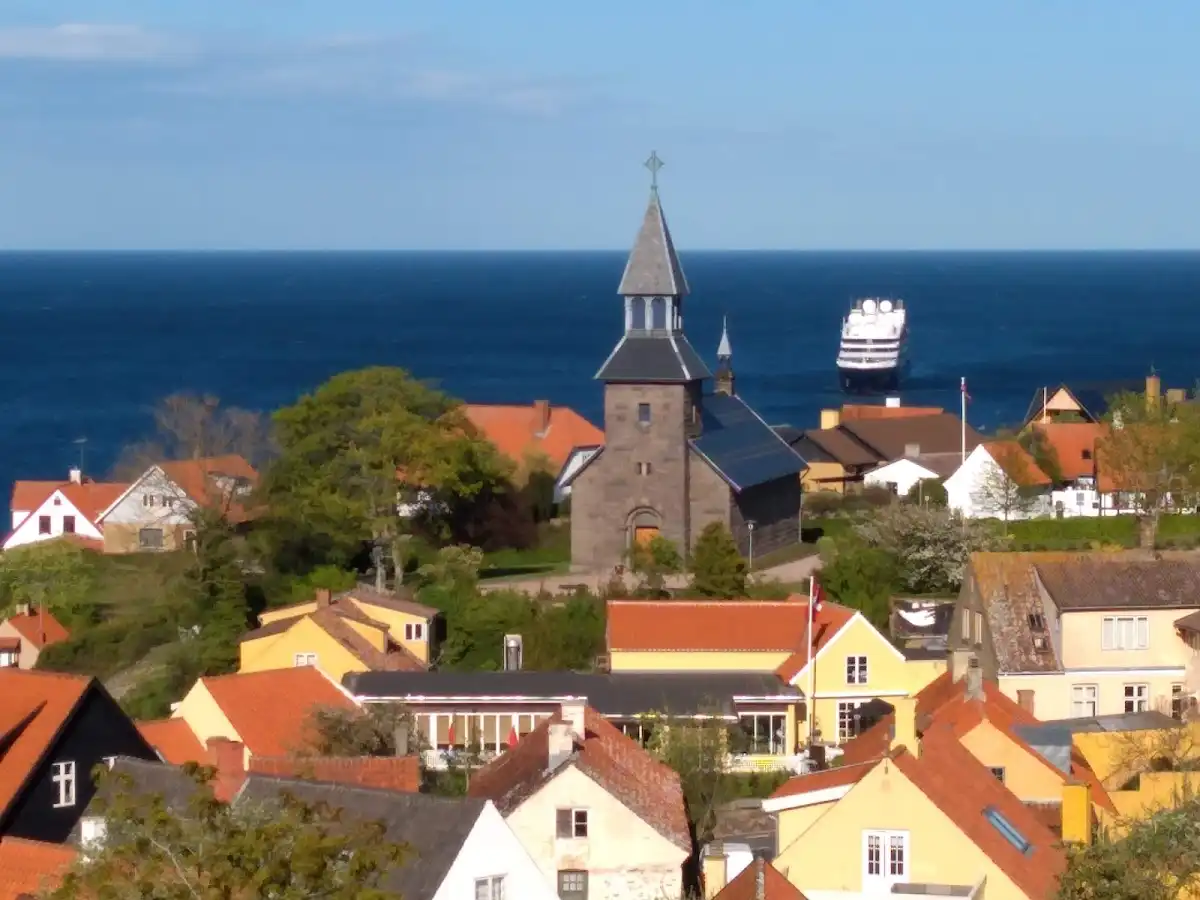
Villages in Denmark are small, tidy and low-lying, built around a church, a harbor or a farm cluster rather than a mountain pass. Most sit within a few hours of the sea. The islands of Funen, Ærø and Bornholm offer half-timbered lanes and quiet cycling, while Jutland adds dunes, fishing harbors and wide western beaches. Zealand villages are easiest to reach from Copenhagen, and busiest in July. Prices are high everywhere, yet trains, buses and ferries make independent travel straightforward without a car. Expect calm, not spectacle: thatched roofs, hollyhocks, bakeries that close early and almost no touts.

By Johan Kruseman 🇳🇱 | Updated October 18, 2026
Explore the best landmarks in Denmark

Why go?Why These village Stand Out

Denmark has no mountains to isolate settlements, so villages here grew from agriculture, fishing and ferry crossings across a country of more than 400 named islands. The land is flat and the distances are short, which means a village is seldom more than a few kilometers from the next one. Centuries of strong land reform and cooperative farming left behind compact village greens, thatched farmhouses and timber-framed rows, and a heritage tradition that keeps them maintained. Many market towns kept their medieval street plans because they were never heavily industrialized.

Travelers should know that Denmark is expensive and orderly. Rural shops close early on Saturdays and often stay shut on Sundays, and small-island ferries run on fixed schedules. Quiet is the point: there is little nightlife … read more 👉
Denmark has no mountains to isolate settlements, so villages here grew from agriculture, fishing and ferry crossings across a country of more than 400 named islands. The land is flat and the distances are short, which means a village is seldom more than a few kilometers from the next one. Centuries of strong land reform and cooperative farming left behind compact village greens, thatched farmhouses and timber-framed rows, and a heritage tradition that keeps them maintained. Many market towns kept their medieval street plans because they were never heavily industrialized.

Travelers should know that Denmark is expensive and orderly. Rural shops close early on Saturdays and often stay shut on Sundays, and small-island ferries run on fixed schedules. Quiet is the point: there is little nightlife outside the larger towns, and many settlements are best seen on a bicycle along the national cycle route network. The climate is maritime, so wind and changeable rain are part of the picture even in summer. In return, villages are clean, safe and well signposted, with public toilets, harbor-side shelters and marked shelter sites for free or low-cost camping in state forests. Anyone expecting dramatic landscapes should look elsewhere; the appeal here is modest, precise and well kept.
Behind the Scenes of Selection
The list of best villages in Denmark is created based on authenticity, scenic beauty, community spirit, traditions, and overall character. If you feel a village is missing in this list, please let us know.

When to go?Optimal Periods for Travel

Best months for Danish villages: June to August is the best period for villages in Denmark, because daylight lasts up to 17 to 18 hours, most seasonal cafés, ferries and museums are open, and daytime highs sit around 18 to 23°C. Late May and September make good shoulder seasons, with 12 to 18°C, fewer visitors and many places still operating on normal hours.
Weather and crowds: Rain falls throughout the year, with roughly 600 to 800 mm annually, and the west coast of Jutland is windier and cooler than the east. July is the busiest month, especially on Bornholm, Ærø and the Skagen and Ribe areas, and Danish school holidays push up prices for summer houses and hostels. Expect accommodation to cost 20 to 50 percent more than in spring or autumn, and book ferries in advance for island crossings. … read more 👉
Best months for Danish villages: June to August is the best period for villages in Denmark, because daylight lasts up to 17 to 18 hours, most seasonal cafés, ferries and museums are open, and daytime highs sit around 18 to 23°C. Late May and September make good shoulder seasons, with 12 to 18°C, fewer visitors and many places still operating on normal hours.
Weather and crowds: Rain falls throughout the year, with roughly 600 to 800 mm annually, and the west coast of Jutland is windier and cooler than the east. July is the busiest month, especially on Bornholm, Ærø and the Skagen and Ribe areas, and Danish school holidays push up prices for summer houses and hostels. Expect accommodation to cost 20 to 50 percent more than in spring or autumn, and book ferries in advance for island crossings.
Winter and early spring: From November to March, temperatures hover between -2 and 6°C and daylight can fall to about 7 hours in December. Many small museums, ice cream kiosks and campsites close or cut hours from October to April, and some island ferries run fewer departures. December brings Christmas markets in several towns, which suit travelers who prefer candlelit streets over cycling. April and early May bring bloom and lower prices, but evenings stay cold.

village hoppingOptimizing Your Multi-Stop Itinerary

How many days to plan: A trip linking several Danish villages works best in 7 to 10 days, with two or three bases rather than one stop each night. Denmark is compact, so the challenge is pacing rather than distance.
Grouping regions and direction: Zealand and the islands of the Baltic cluster naturally around Copenhagen, while Funen and southern islands connect through Odense and Svendborg. Jutland can be treated as a separate chapter, entered through Aarhus, Esbjerg or Aalborg. A sensible direction runs east to west: start in Copenhagen, cross the Great Belt by train (about 1 hour 15 minutes to Odense), then continue to Jutland, which is 1 to 2 hours onward by train. Bornholm is a separate commitment, with ferry or flight from Copenhagen, and the ferry from Køge takes about 5.5 hours overnight … read more 👉
How many days to plan: A trip linking several Danish villages works best in 7 to 10 days, with two or three bases rather than one stop each night. Denmark is compact, so the challenge is pacing rather than distance.
Grouping regions and direction: Zealand and the islands of the Baltic cluster naturally around Copenhagen, while Funen and southern islands connect through Odense and Svendborg. Jutland can be treated as a separate chapter, entered through Aarhus, Esbjerg or Aalborg. A sensible direction runs east to west: start in Copenhagen, cross the Great Belt by train (about 1 hour 15 minutes to Odense), then continue to Jutland, which is 1 to 2 hours onward by train. Bornholm is a separate commitment, with ferry or flight from Copenhagen, and the ferry from Køge takes about 5.5 hours overnight or by day.
Time per stop: Allow 1 to 2 nights in each area, and a half day to a full day per village if walking or cycling. Travel between regions usually takes 1.5 to 4 hours.
Common planning mistakes: Travelers often cram too many stops into a single day, forgetting that rural buses run hourly at best and sparsely on weekends. Choose a base with a rail station, then use local buses or rented bicycles for short hops. Ferry timetables also deserve checking first, since they dictate the rest of the day.

The ListMust-Visit villages in Denmark

1 Gudhjem

cliffside harbor, smokehouses, Baltic views

Climb steep lanes to discover smoked herring, panoramic sea vistas, and a working harbor that pulses with island life.

denmark-city-gudhjem
© Google |

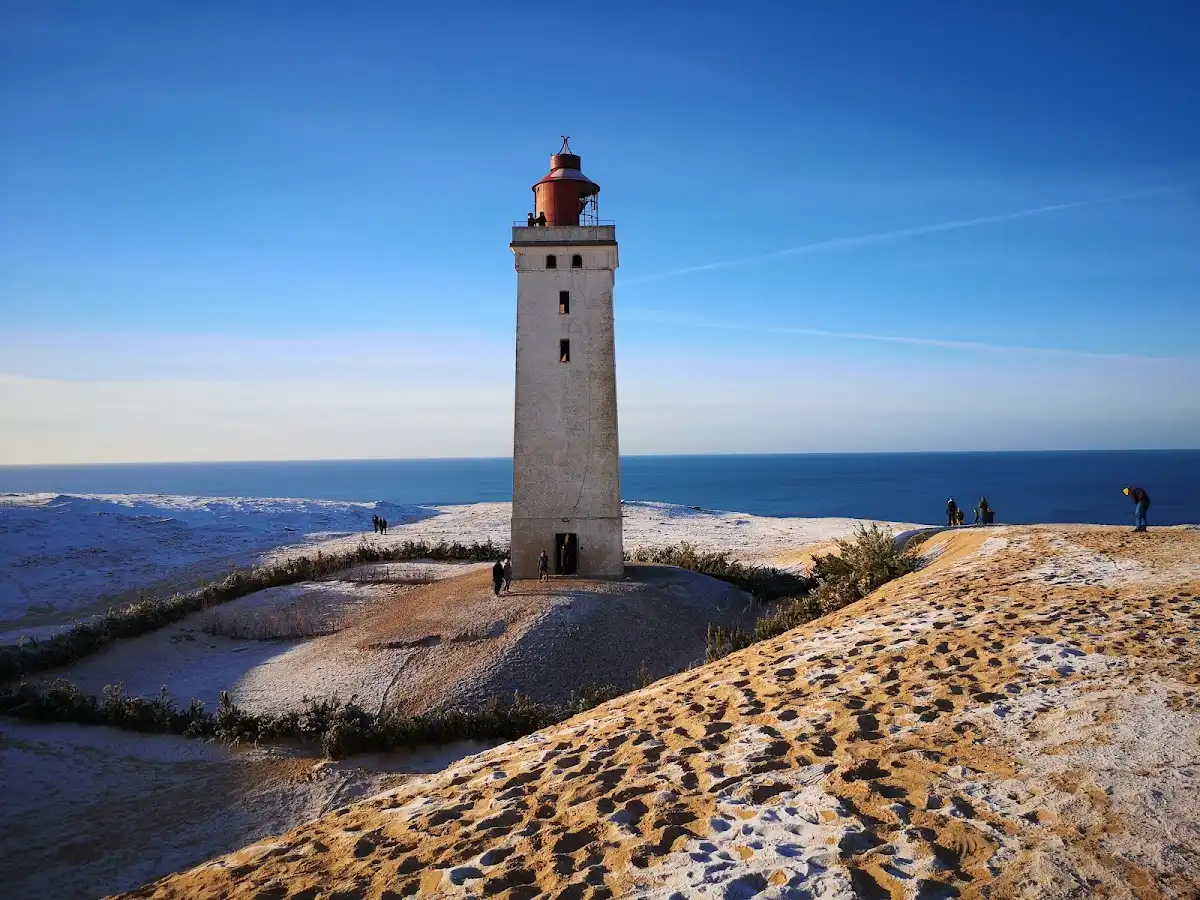
2 Lønstrup

artist studios, shifting dunes, North Sea light

Wander among galleries and windswept landscapes, where the coastline’s constant change shapes both the scenery and the local crafts.

denmark-city-lonstrup
© Google |

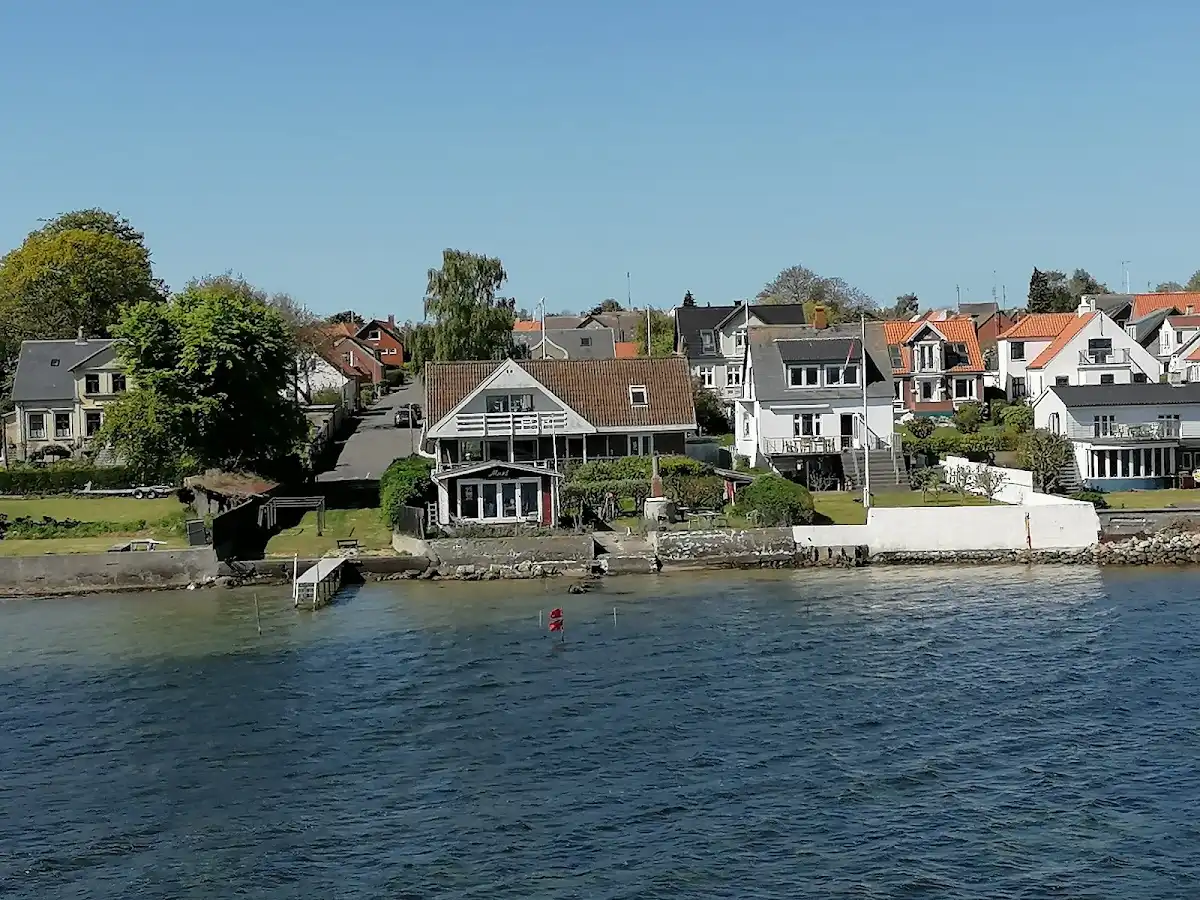
3 Marstal

maritime museum, shipyards, island ferries

Trace the rhythms of seafaring tradition, with working docks, nautical relics, and daily life centered on the water’s edge.

denmark-city-marstal
© Google |
Loading the map 🌍

Expert viewTips and Advice from Travelers

How many villages to visit: Three to five villages across a week is the number I would advise. Each village takes 2 to 4 hours to see properly, but the surrounding coast, forest or cycle routes are what justify an overnight stay. More than five usually turns into a sequence of photo stops, and Danish public transport thins out quickly outside the main rail lines.
Choosing between kinds: Island villages cost more in time, since ferries and limited timetables shape the day, and in money, with crossings from roughly 150 to 500 DKK (US$22 to 73) per person depending on route. They also give the quietest evenings and the best cycling, so they suit slow travelers with flexible schedules. Mainland villages on a rail line, particularly in Zealand and eastern Jutland, give the best return for a short … read more 👉
How many villages to visit: Three to five villages across a week is the number I would advise. Each village takes 2 to 4 hours to see properly, but the surrounding coast, forest or cycle routes are what justify an overnight stay. More than five usually turns into a sequence of photo stops, and Danish public transport thins out quickly outside the main rail lines.
Choosing between kinds: Island villages cost more in time, since ferries and limited timetables shape the day, and in money, with crossings from roughly 150 to 500 DKK (US$22 to 73) per person depending on route. They also give the quietest evenings and the best cycling, so they suit slow travelers with flexible schedules. Mainland villages on a rail line, particularly in Zealand and eastern Jutland, give the best return for a short trip: low transport cost, easy day trips and more food options. Western Jutland coast villages need a car or a long bus ride, which adds cost, but provide wide beaches and empty dunes for those who want open space. For a first visit, I would choose one island and one mainland area.
What it costs: A budget of 500 to 800 DKK (US$73 to 117) a day is realistic if sleeping in hostels or at campsites, self-catering and cycling. Dorm beds run about 250 to 400 DKK (US$36 to 58), campsites 100 to 180 DKK (US$15 to 26) per person, and a bakery lunch 50 to 90 DKK (US$7 to 13). A bicycle rental costs 100 to 200 DKK (US$15 to 29) a day. Hotels and guesthouses at 900 to 1,800 DKK (US$130 to 260) push the daily total beyond 1,200 DKK (US$175). Village churches and open harbors are free, while small museums and heritage houses charge about 50 to 120 DKK (US$7 to 17). Guided walks are rare and usually seasonal. Buying groceries at Netto, Rema 1000 or Coop saves more than any other single habit.
Safety and local manners: Crime is low and villages are safe for solo travelers, including at night. The more relevant risks are weather, with strong coastal wind and cold water, and traffic on narrow lanes where cyclists share the road. Keep to marked paths across farmland and dunes, since private land and nesting bird zones are respected. Wild camping is largely not allowed; use designated shelter sites and campsites, and book them in summer. Quiet hours matter, so keep noise low after 22:00. Most Danes speak English, but a greeting of “hej” is appreciated. Cash is rarely needed, as cards and mobile payments are accepted almost everywhere.

✈️ The backpacker research shortcutDenmark Travel Guide

An offline-friendly backpacking guide with optimized travel routes, ranked highlights, transport advice, and the best areas to stay.
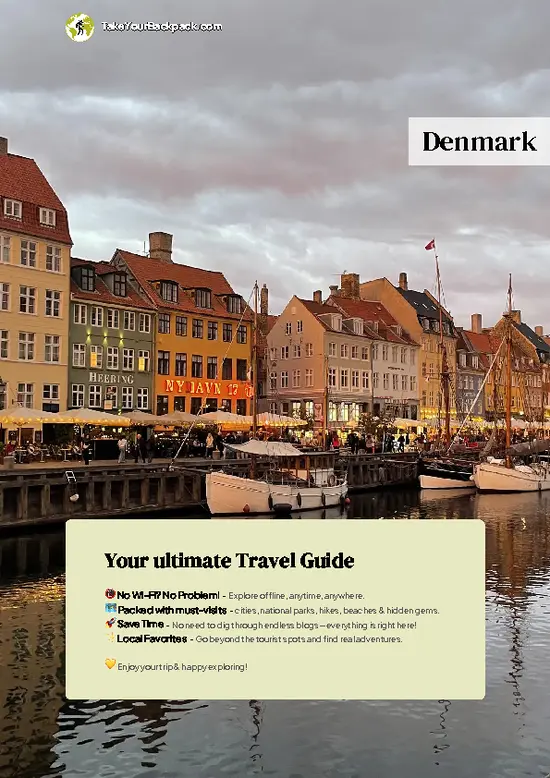
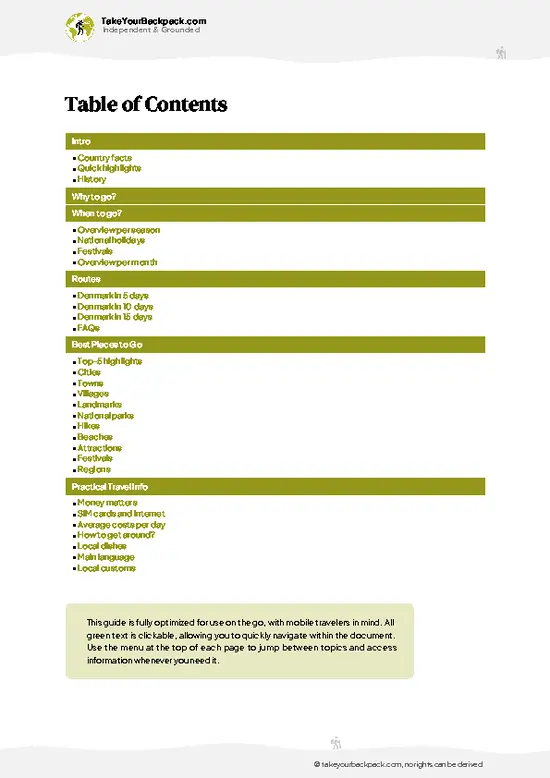
example page 0 from our offline Travel Guide for Denmark
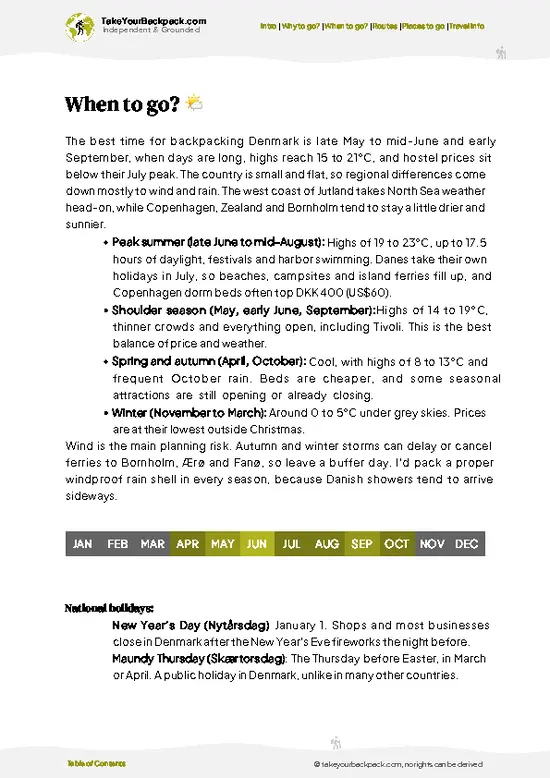
example page 1 from our offline Travel Guide for Denmark
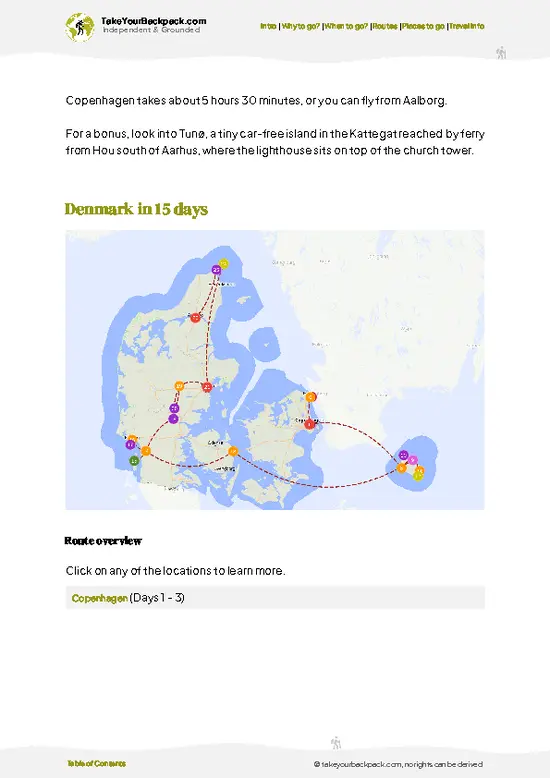
example page 2 from our offline Travel Guide for Denmark
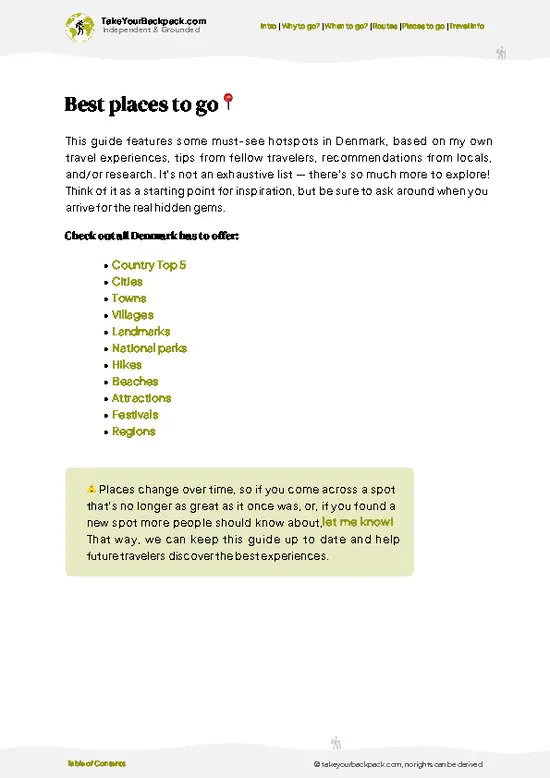
example page 3 from our offline Travel Guide for Denmark
example page 4 from our offline Travel Guide for Denmark
example page 5 from our offline Travel Guide for Denmark
example page 6 from our offline Travel Guide for Denmark
example page 7 from our offline Travel Guide for Denmark
The digital guide (359 pages) contains:
✅ 97 highlights, ranked by travel appeal
✅ Optimized 5, 10 & 15-day travel routes
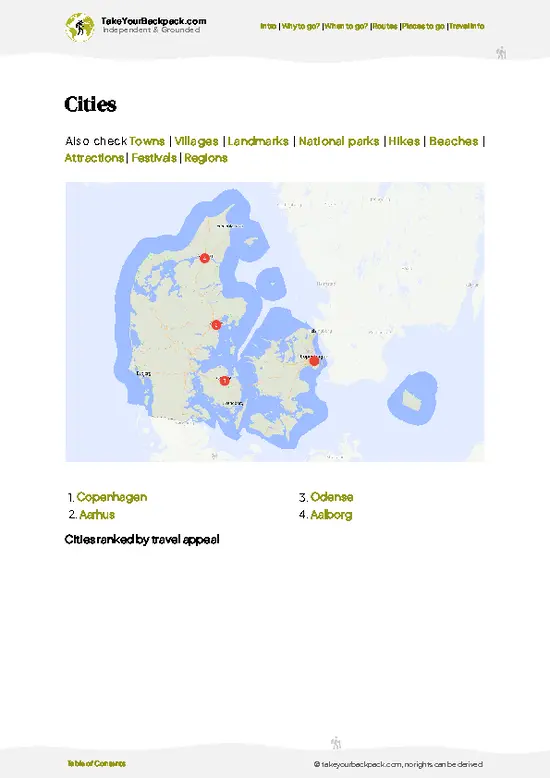
✅ Cities, national parks, landmarks, beaches
✅ How to get around
✅ Offline-friendly for travel without Wi-Fi
👉 Click to see all 30+ guide features

📅 Plan smarter in minutes, not weeks
✅ Month by month travel advice
✅ Festivals & national holidays
✅ Budget expectations

🗺️ Go to the right places, skip the overrated ones
✅ Honest pros & cons of destinations
✅ Top hikes, parks & viewpoints
✅ Lesser-known places most travelers miss
✅ Clear “worth it vs skip it” guidance

🛏️ Travel smoothly without rookie mistakes
✅ Best areas to stay
✅ Transport systems explained simply
✅ Common scams & safety advice
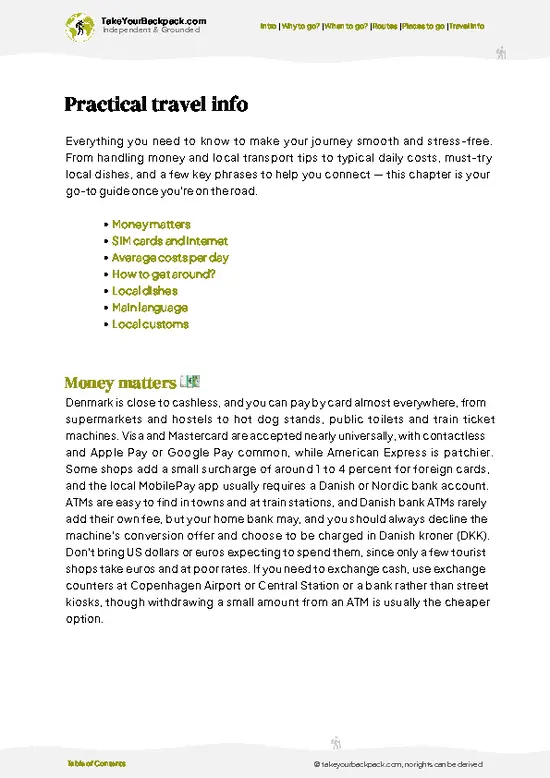
✅ SIM cards, money & practical tips

🌍 Understand the country, not just visit it
✅ Culture & traditions
✅ 52 Essential phrases & customs
✅ Festivals worth planning around
✅ Traveler-friendly historical context
✅ Insights that make places more meaningful

📱 Built for real travel conditions
✅ Fully downloadable PDF
✅ Works completely offline
✅ Optimized for phone use
✅ Useful in remote areas & buses
✅ Everything in one place
Stop searching, start planning
Get instant access to your full guide. 30‑day money-back guarantee.
+ Add another guide for just

By proceeding you agree to our terms.
Sent to your inbox immediately after payment • 100% Secure Checkout
Best Backpacking Travel Advisor 2025 tourism awardBest Backpacking
Travel Advisor
2025
What others say about Take Your Backpack Guides:
⭐⭐⭐⭐⭐
Fantastic, amazing amount of information!
⭐⭐⭐⭐⭐
My goodness this is amazing, it's what I've been looking for hats off too you!
⭐⭐⭐⭐⭐
I think this is absolutely BRILLIANT
⭐⭐⭐⭐
Very complete and informative. It's still missing places, but I gotta to commend you
⭐⭐⭐⭐⭐
This is truly amazing, thank you, can't wait to explore it with my kids!
⭐⭐⭐⭐⭐
Awesome resource, thank you!
⭐⭐⭐⭐⭐
This is amazing! Can't wait to explore the ones I haven't seen
⭐⭐⭐⭐
I love this! Well done, great idea.
⭐⭐⭐⭐⭐
Thanks for taking the time to make this gem!
⭐⭐⭐⭐⭐
This might be the best website I've ever seen.
⭐⭐⭐⭐⭐
Congratulations, and thank you so much for your work; it's incredibly valuable.
⭐⭐⭐⭐
In all seriousness I think you did a great job pointing out the important spots
⭐⭐⭐⭐⭐
10/10 very good
⭐⭐⭐⭐⭐
As someone who's only just starting to visit regularly this is awesome, thank you.
⭐⭐⭐⭐
Thank you very much! I'm going to visit my dad, it's going to be very useful!
⭐⭐⭐⭐⭐
This is really cool! We'll be travelling for the first time and this definitely come in handy.
⭐⭐⭐⭐⭐
You are now our minister of culture, congratulations 👨‍💼
⭐⭐⭐⭐⭐
Just wanted to tell you that this is a pearl! Going to follow your recommendations.
⭐⭐⭐⭐⭐
This is so cool. I'll definitely be using the resource for my travels soon.
⭐⭐⭐⭐⭐
This is very impressive! Good work.
⭐⭐⭐⭐⭐
This is an amazing and informative site. Very well done!

🛏️ Where to stay?Where to Base Yourself

Denmark has plenty of hostels, with dorm beds usually running DKK 200 to 400 (about US$30 to 60) a night and the widest choice in Copenhagen, plus smaller clusters in Aarhus and Odense. In Copenhagen, Vesterbro next to the Central Station has the most beds and the Meatpacking District’s late bars, though stretches of Istedgade feel scruffy after dark, while Indre By puts you within walking distance of Nyhavn and Strøget at higher prices, and Nørrebro trades a 15 to 20 minute bike ride from the center for cheaper food and lively bars along Jægersborggade and Blågårdsgade. In Aarhus, the Latin Quarter keeps you close to cafés and the old town, but rooms book out fast around university terms and … read more 👉
Denmark has plenty of hostels, with dorm beds usually running DKK 200 to 400 (about US$30 to 60) a night and the widest choice in Copenhagen, plus smaller clusters in Aarhus and Odense. In Copenhagen, Vesterbro next to the Central Station has the most beds and the Meatpacking District’s late bars, though stretches of Istedgade feel scruffy after dark, while Indre By puts you within walking distance of Nyhavn and Strøget at higher prices, and Nørrebro trades a 15 to 20 minute bike ride from the center for cheaper food and lively bars along Jægersborggade and Blågårdsgade. In Aarhus, the Latin Quarter keeps you close to cafés and the old town, but rooms book out fast around university terms and festival weeks.

If you enjoy meeting fellow travelers, consider choosing hostels with high ratings for atmosphere. On the other hand, if you prefer having your own space, a hotel might be a better option.

DenmarkExpand Your Journey

👋 Meet the founderWho’s Behind Take Your Backpack?

Johan, backpacker and founder of TakeYourBackpackHi, I’m Johan (Netherlands 🇳🇱), the creator of TakeYourBackpack. Over the past 3 decades, I’ve backpacked through 90+ countries across six continents, gaining extensive experience with independent travel, long-term trips, and overland routes.

This site is built on a combination of firsthand travel experience and carefully curated insights from other backpackers. Many guides are based on places I’ve personally visited, while others bring together tips, observations, and practical advice shared by trusted travelers I’ve met along the way.

The goal is to provide realistic, experience-driven guidance — not generic itineraries — so you can explore destinations with better context, clearer expectations, and more confidence.