×
Equatorial Guinea🇬🇶 | 2 days itinerary

Backpacking Equatorial Guinea: A 2-Day Guide

By Johan Kruseman 🇳🇱 | Updated April 29, 2026
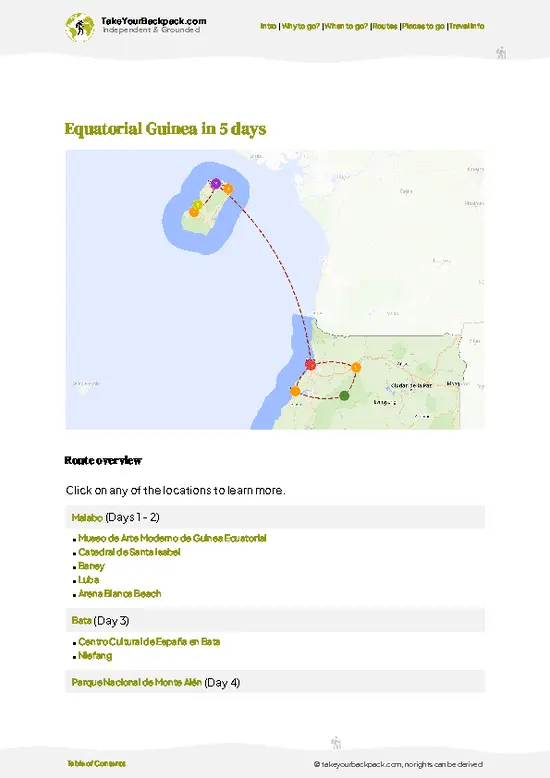
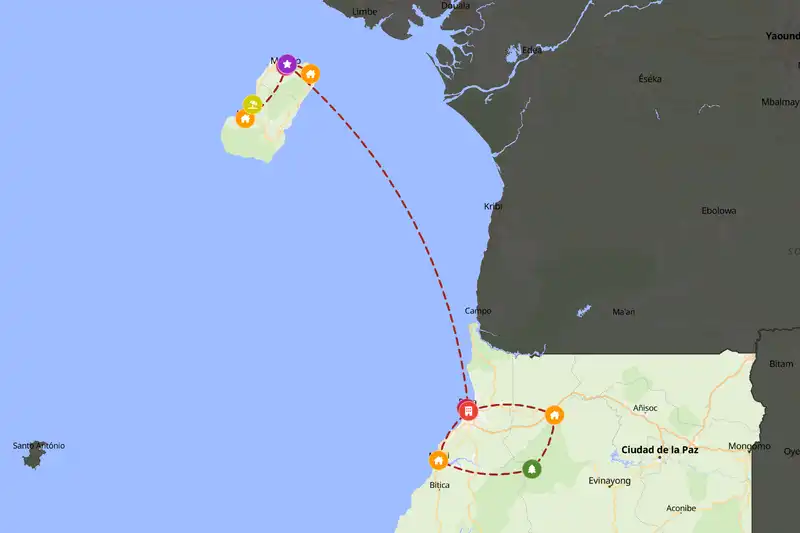
This 2-day Bioko Island sprint is for travelers who want a concentrated hit of Equatorial Guinea’s nature and culture without burning all their vacation days, moving at a relaxed but full days’ pace using taxis and short private transfers from Malabo. You’ll base yourself around Malabo and the highlands, trading long bus rides for time on trails, waterfalls, and coastal viewpoints.

Day 1: Malabo’s history and coastal feel

Land in Malabo and keep the radius tight so you actually feel the city instead of just driving through it. Start with the Catedral de Santa Isabel, where the neo-Gothic façade and ocean air give you a quick sense of how Spanish colonial history and island life collide in one frame. From there, walk or taxi to the Museo Nacional de Arte y Tradiciones de Guinea Ecuatorial, which is small enough to do in a couple of hours but dense with context on Fang, Bubi, and other ethnic traditions, so the masks and carvings you’ll see later in the countryside actually mean something. … read more 👉
This 2-day Bioko Island sprint is for travelers who want a concentrated hit of Equatorial Guinea’s nature and culture without burning all their vacation days, moving at a relaxed but full days’ pace using taxis and short private transfers from Malabo. You’ll base yourself around Malabo and the highlands, trading long bus rides for time on trails, waterfalls, and coastal viewpoints.

Day 1: Malabo’s history and coastal feel

Land in Malabo and keep the radius tight so you actually feel the city instead of just driving through it. Start with the Catedral de Santa Isabel, where the neo-Gothic façade and ocean air give you a quick sense of how Spanish colonial history and island life collide in one frame. From there, walk or taxi to the Museo Nacional de Arte y Tradiciones de Guinea Ecuatorial, which is small enough to do in a couple of hours but dense with context on Fang, Bubi, and other ethnic traditions, so the masks and carvings you’ll see later in the countryside actually mean something. In the afternoon, swing by the Centro Cultural de España en Malabo for a coffee, a gallery visit, or a performance if the timing lines up; it’s one of the easiest places to feel the contemporary cultural pulse rather than just the official version of the country. If you have daylight left, use a short taxi ride to the Palacio Presidencial de Malabo area for an exterior look at the building and its manicured surroundings, treating it as a quick architectural stop rather than a full visit so you don’t overload the day.

Day 2: Highlands, waterfalls, and island views

On your second day, leave the city early and head into the interior of Isla de Bioko for a complete change of scenery. Aim for Moca in the highlands, where cooler air and forested slopes make the island feel like a different country from coastal Malabo; from here you can access the Cascadas de Moka, a compact but rewarding outing where short hikes lead to layered waterfalls and viewpoints over the surrounding valleys. If you want a bigger sense of Bioko’s volcanic backbone without committing to a full summit push, work in a scenic drive or short walk on the flanks of Pico Basile National Park, using roadside viewpoints and short trails rather than a full-day ascent so you still have time to get back to Malabo before dark. This mix of city, culture, and highland nature keeps the pace realistic for two days while still giving you a clear mental map of how the island fits together.

As a final bonus idea, consider a future side trip to the tiny fishing community of Utonde, where evenings are just waves, wooden boats, and grilled fish on the sand.

Loading the map 🌍
film
0
0
0a
Catedral de Santa Isabel
film
1
1
1a
Moca
film
2
2
2a
Cascadas de Moka

🛏️ Where to stay?Itinerary Summary

✈️ The backpacker research shortcutEquatorial Guinea Travel Guide

An offline-friendly backpacking guide with optimized travel routes, ranked highlights, transport advice, and the best areas to stay.
example page 0 from our offline Travel Guide for Equatorial Guineaexample page 1 from our offline Travel Guide for Equatorial Guineaexample page 2 from our offline Travel Guide for Equatorial Guineaexample page 3 from our offline Travel Guide for Equatorial Guineaexample page 4 from our offline Travel Guide for Equatorial Guineaexample page 5 from our offline Travel Guide for Equatorial Guinea
The digital guide (188 pages) contains:
52 highlights, ranked by travel appeal
Optimized 2, 3 & 5-day travel routes
Best neighborhoods to stay
How to get around
Offline-friendly for travel without Wi-Fi
👉 See all 30+ guide features

📅 Plan smarter in minutes, not weeks
Month by month travel advice
Festivals & national holidays
Budget expectations

🗺️ Go to the right places, skip the overrated ones
Honest pros & cons of destinations
Top hikes, parks & viewpoints
Lesser-known places most travelers miss
Clear “worth it vs skip it” guidance

🛏️ Travel smoothly without rookie mistakes
Best areas to stay
Transport systems explained simply
Common scams & safety advice
SIM cards, money & practical tips

🌍 Understand the country, not just visit it
Culture & traditions
52 Essential phrases & customs
Festivals worth planning around
Traveler-friendly historical context
Insights that make places more meaningful

📱 Built for real travel conditions
Fully downloadable PDF
Works completely offline
Optimized for phone use
Useful in remote areas & buses
Everything in one place
Save weeks of stressful planning
Get instant access to the full guide directly. 30-day money-back guarantee.


Sent to your inbox immediately after payment • 100% Secure Checkout
Best Backpacking Travel Advisor 2025 tourism awardBest Backpacking
Travel Advisor
2025
What others say about Take Your Backpack Guides:
⭐⭐⭐⭐⭐
Fantastic, amazing amount of information!
⭐⭐⭐⭐⭐
My goodness this is amazing, it's what I've been looking for hats off too you!
⭐⭐⭐⭐⭐
I think this is absolutely BRILLIANT
⭐⭐⭐⭐
Very complete and informative. It's still missing places, but I gotta to commend you
⭐⭐⭐⭐⭐
This is truly amazing, thank you, can't wait to explore it with my kids!
⭐⭐⭐⭐⭐
Awesome resource, thank you!
⭐⭐⭐⭐⭐
This is amazing! Can't wait to explore the ones I haven't seen
⭐⭐⭐⭐
I love this! Well done, great idea.
⭐⭐⭐⭐⭐
Thanks for taking the time to make this gem!
⭐⭐⭐⭐⭐
This might be the best website I've ever seen.
⭐⭐⭐⭐⭐
Congratulations, and thank you so much for your work; it's incredibly valuable.
⭐⭐⭐⭐
In all seriousness I think you did a great job pointing out the important spots
⭐⭐⭐⭐⭐
10/10 very good
⭐⭐⭐⭐⭐
As someone who's only just starting to visit regularly this is awesome, thank you.
⭐⭐⭐⭐
Thank you very much! I'm going to visit my dad, it's going to be very useful!
⭐⭐⭐⭐⭐
This is really cool! We'll be travelling for the first time and this definitely come in handy.
⭐⭐⭐⭐⭐
You are now our minister of culture, congratulations 👨‍💼
⭐⭐⭐⭐⭐
Just wanted to tell you that this is a pearl! Going to follow your recommendations.
⭐⭐⭐⭐⭐
This is so cool. I'll definitely be using the resource for my travels soon.
⭐⭐⭐⭐⭐
This is very impressive! Good work.
⭐⭐⭐⭐⭐
This is an amazing and informative site. Very well done!

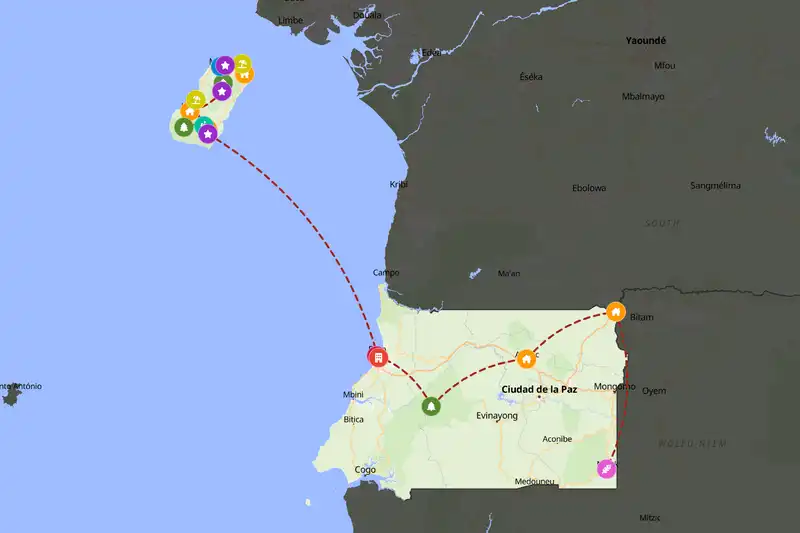
🧭 RouteChoose Your Itinerary

Travel Equatorial Guinea your way — from a quick highlights trip to a slow-paced adventure.

🙋 FAQFrequently Asked Questions

Short version: Equatorial Guinea is one of Central Africa’s harder countries to backpack independently, but not impossible if you’re patient, organized, and comfortable with uncertainty.

The main challenges for backpackers are bureaucracy, language, and low tourism infrastructure. Visas can be tricky depending on your passport, registration rules change, and officials may not always know what to do with an obvious backpacker. You want printed copies of your hotel bookings, passport, onward ticket, and a calm, polite attitude at every checkpoint.

Spanish is the working language. Outside Malabo and Bata, English is rare. If you can handle basic Spanish (booking rooms, asking prices, explaining your route), your life gets much easier. Without it, you’ll rely heavily on gestures and patience.

Tourism infrastructure is thin. There are very few hostels, almost no classic backpacker hangouts, and budget accommodation is usually basic guesthouses used by local workers. You’ll often pay mid-range prices for lower comfort than in Southeast Asia or Latin America. Booking ahead for the first nights in each city is smart, especially in Malabo and Bata.

Security-wise, it’s not a high-crime free‑for‑all, but it’s also not a place to wander around snapping photos of government buildings, ports, or checkpoints. The country is sensitive about photography; when in doubt, don’t shoot, or ask clearly first. Keep your phone and camera low‑key.

Independent backpacking here is best for travelers who already have some Africa experience, are okay with plans changing, and care more about raw, real‑life travel than easy social scenes. If this is your first trip outside Europe or North America, it’s a steep learning curve, but still doable if you prepare hard and move slowly.
For most backpackers, 7–14 days is the sweet spot, depending on how deep you want to go and how much bureaucracy you’re willing to wrestle with.

If you only have 4–5 days, focus on Malabo and nearby nature:
- Day 1–2: Malabo city, markets, waterfront, feel out the rhythm.
- Day 3–4: Day trips or an overnight into Bioko’s interior (Moka area, waterfalls, crater lakes) if logistics and weather cooperate.
This is enough to say you’ve been, but you’ll only scratch the surface.

With 7–10 days, you can do a more balanced loop:
- 3–4 days on Bioko Island (Malabo + highlands).
- 3–4 days on the mainland around Bata and one inland town or park, if transport lines up.
This timeframe lets you adapt to delays, deal with checkpoints, and still enjoy the place instead of sprinting.

With 2 weeks, you can travel at a relaxed pace:
- 4–5 days Bioko Island (Malabo, Moka, maybe a coastal village).
- 6–7 days mainland: Bata plus one or two smaller towns, maybe a national park area if you can arrange guides and permits.

More than 2 weeks only makes sense if you’re really into slow travel, birding, or research, or if you’re combining Equatorial Guinea with neighboring countries and using it as a base. Because costs are relatively high for what you get, most budget travelers are better off keeping it to 1–2 weeks and putting extra time into cheaper, easier countries nearby.
You can technically get around without your own car, but it’s not as smooth as in classic backpacker regions, and you’ll need to be flexible.

Inside cities like Malabo and Bata, you’ll rely on:
- Shared taxis: Cheap and common, but you need basic Spanish and a rough idea of prices. Always agree on the fare before getting in.
- Moto-taxis (in some areas): Fast and cheap, but bring a buff or scarf for dust and be picky about drivers; helmets are not guaranteed.

Between cities and towns, options exist but are inconsistent:
- Minibuses and shared cars: These run between major points (e.g., Malabo–Moka on Bioko, Bata–interior towns on the mainland). They usually leave when full, not on a fixed schedule, so start early in the day.
- Domestic flights: Sometimes used between Malabo and Bata or other points, but they’re not budget-friendly and schedules can change.
- Ferries/boats: There have been services between Bioko and the mainland, but they’re not always frequent, and safety standards vary.

Travel without a car means:
- You must build in buffer days for delays and cancellations.
- You’ll often arrive late or tired, so pre-booking at least the first night’s accommodation in each town is smart.
- Reaching remote beaches, villages, or trailheads can be difficult or impossible without arranging a private car or moto.

For a pure backpacker trip, it’s realistic to rely on public and shared transport for a Bioko-focused itinerary and one or two mainland hops. If you want to chase remote national parks or tiny coastal villages, you either pay for private transport, hitch rides with locals (only when it feels safe and appropriate), or accept that some spots are out of reach.
For a budget traveler, the must‑visits are the places where you can actually feel the country without needing a private driver or a luxury budget.

1. Malabo (Bioko Island)
This is your entry point and cultural anchor. The city mixes colonial architecture, modern government buildings, and everyday street life. Walk the central streets, hit the markets, and spend time on the waterfront in the late afternoon when the heat eases and people are out. It’s also where you’ll find the most accommodation options and basic services.

2. Bioko Island interior (around Moka and the highlands)
If you only leave the city once, do it here. The interior of Bioko is cooler, greener, and feels like a different country from Malabo. Think cloud forest, waterfalls, crater lakes, and small villages. You’ll likely need to arrange transport from Malabo (shared taxis or a hired car), but once there, you can do day hikes, short walks, and village wandering. This is where the country really shows its natural side.

3. Bata (mainland)
Bata is the mainland’s main city and a good base if you’re crossing to or from neighboring countries. It has a more rough‑and‑ready feel than Malabo, with busy streets, local eateries, and a working‑city vibe. For backpackers, it’s useful for logistics, people‑watching, and getting a sense of mainland life.

4. A mainland interior town or forest area (if logistics allow)
If you have time and can line up transport, spending a couple of days in a smaller inland town or near a forested area gives you a look at rural life: slower pace, roadside bars, and red‑earth roads. True national park visits (like Monte Alén) are logistically and financially heavier, but even just skirting the edges of forest zones can be rewarding for birdlife and atmosphere.

If you’re short on cash and time, a strong itinerary is: Malabo (city) + Bioko interior + a quick hop to Bata and back. That gives you both island and mainland flavor without drowning in transport costs.
If you’re tight on time or money, skip anything that demands heavy logistics or high fees for a relatively small payoff.

1. Deep, remote national park expeditions
Places like Monte Alén and other interior parks are legendary on paper, but for a backpacker they often mean expensive guides, tricky permits, unreliable transport, and no guarantee of seeing much wildlife. If you’re not a hardcore birder or researcher, your time is usually better spent in easier‑to‑reach forest and highland areas on Bioko or near more accessible mainland towns.

2. Over‑ambitious multi‑town mainland circuits
Trying to hit a long list of mainland towns in a week (Bata plus several interior stops) is a recipe for spending your whole trip in shared taxis and at checkpoints. Pick one inland area at most, or even just stick to Bata if your schedule is tight.

3. Chasing every beach
Equatorial Guinea has plenty of coastline, but not every beach is easy to reach or worth the transport cost for a quick dip. If you’ve already got good beach time in other West or Central African countries, prioritize Bioko’s highlands or cultural time in Malabo and Bata instead of burning days on hard‑to‑reach stretches of sand.

4. High‑end resorts and expat bars
They can be fun if you’re craving a break, but they eat your budget fast and don’t tell you much about the country. One drink or one sunset visit is enough; you don’t need to base your whole stay there.

5. Over‑photographing official or sensitive areas
It’s not exactly a place, but it’s something to skip: don’t waste time and stress trying to sneak photos of government buildings, checkpoints, ports, or military sites. It can cause trouble and adds zero value to your trip. Focus your lens on markets, landscapes, and everyday street life where it’s clearly okay or where you’ve asked first.

If you’re on a tight schedule, a lean, smart plan is: Malabo + Bioko interior + (optionally) Bata. Skip deep‑interior expeditions, complex park logistics, and long mainland detours unless you have both time and money to burn.

🇬🇶 Equatorial GuineaExplore Equatorial Guinea

Ready to build a truly unique trip? Predefined routes are perfect for first-time visitors, but there is so much more to discover. Whether you are chasing a city trip, pristine national parks, local food scenes, or quiet beaches, pick a category to design your own path.