Backpacking Equatorial Guinea independently is possible, but it is one of the harder countries in Africa to do on your own: tourism infrastructure is thin, prices are high and police checkpoints are frequent.
Most nationalities need a visa arranged before arrival, and you should carry your passport plus photocopies at all times. Spanish is the working language, and French helps on the mainland near the borders. Budget rooms in
Malabo and
Bata start around 30,000 to 45,000 XAF (US$50 to 75), so plan on roughly €50 to 90 (US$60 to 105) a day. Cities and the Malabo to
Luba road are easy solo;
Moka,
Ureka and
Monte Alén realistically need a hired driver and a local guide.
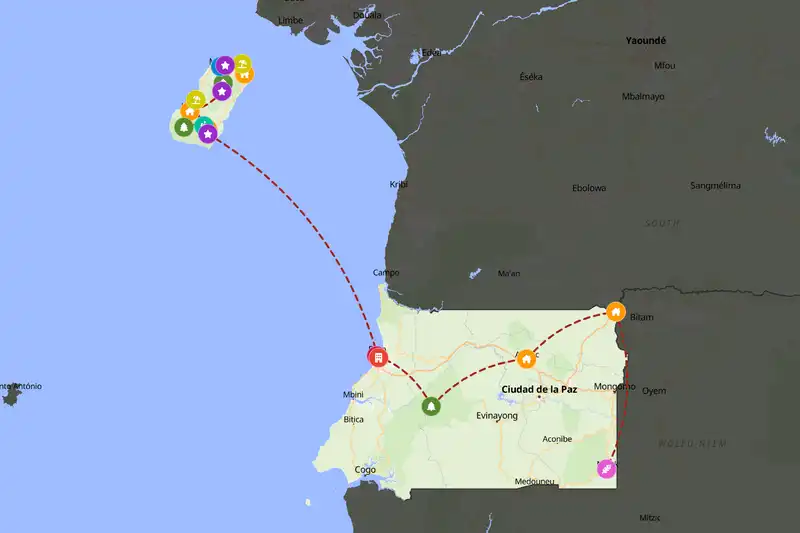
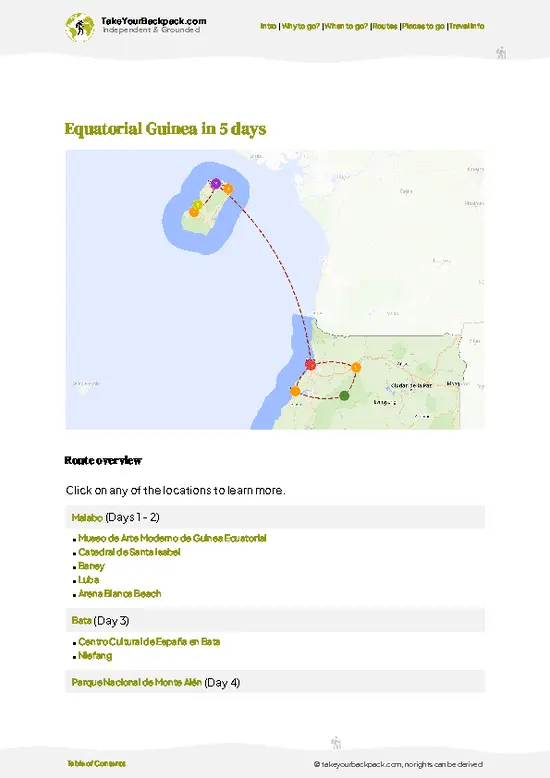
Five to seven days is the right amount of time for Equatorial Guinea if you want to see both Bioko island and the mainland; two to three days covers Bioko alone.
On Bioko, give
Malabo one full day, the
Luba and
Arena Blanca coast one day, and the
Moka highlands plus
Ureka two days with a night in the mountains. The Malabo to Bata flight takes about 45 minutes, and the mainland needs at least two to three days: one for
Bata and two for a round trip to
Monte Alén. Add two more days if you want to reach
Mongomo or
Ebebiyin in the east, each 3 to 4 hours by road from Bata.
You can get around Equatorial Guinea without a car for the cities and main roads, but the best nature sites on Bioko and the mainland are realistically reached with a hired car and driver.
Shared taxis inside
Malabo and
Bata cost around 500 to 1,000 XAF (US$1 to 2) per ride. Minibuses and shared taxis run from Malabo to
Luba in about an hour, and from Bata to
Niefang,
Evinayong and
Mongomo. The islands are linked by flights, with Malabo to Bata taking about 45 minutes. For
Moka,
Ureka,
Pico Basilé and
Monte Alén, expect to pay roughly 50,000 to 80,000 XAF (US$80 to 130) a day for a car with driver.
The must-visits in Equatorial Guinea are Malabo’s old town, the Moka highlands and Ureka on Bioko, and Parque Nacional de Monte Alén on the mainland.
In
Malabo, spend a morning at the
Museo Nacional de Arte y Tradiciones and around the
Catedral de Santa Isabel.
Arena Blanca Beach near Luba, about an hour from Malabo, is the island’s best beach, with butterflies from roughly December to February.
Moka, 1.5 to 2 hours south at around 1,400 meters, has crater lakes and waterfalls, and
Ureka below it has rainforest trails and turtle nesting from November to February. On the mainland,
Monte Alén is 3 to 4 hours from Bata and deserves at least one night.
If you are short on time in Equatorial Guinea, skip Sipopo, the far eastern towns of the mainland and Annobón, and spend those days on Bioko’s highlands or in Monte Alén instead.
Sipopo, 15 kilometers east of Malabo, is a resort strip that feels much like any beach hotel zone.
Mongomo and
Ebebiyin are 3 to 4 hours each way from Bata, a long trip mainly for showcase architecture and border-town markets.
Annobón is fascinating, but flights are infrequent and irregular, so it can swallow several days. The
Estadio de Malabo and the
Malabo National Theatre are only worth it if an event is on during your stay.
Yes, our itinerary-planner does exactly that. Set your trip length in days, give your interests and travel style, optionally give start- and end location and/or some mandatory stops you would like to include and the itinerary planner creates your personalized routes for Equatorial Guinea in seconds. Try it out!
Try the itinerary plannerv2.webp)

 Best Backpacking