×

France🇫🇷 | best festivalsThe 10 Top festivals in France

France runs on festivals the way other countries run on public holidays. Nearly every town stages something between May and September, and the gap between a free village fête and a ticketed mega-event is huge. The south (Provence, the Riviera, Occitanie) packs in hot, late-night open-air events, but accommodation prices jump and rooms vanish months ahead. Paris and the Île-de-France offer the easiest access by train and the widest choice, though beds cost the most. Brittany and Normandy deliver Celtic music, sea air and lower prices, yet buses thin out once you leave the main towns. The Alps and Pyrenees favor mountain and folk events with limited transport. Independent travelers can do all of it, but only with a rail pass or a rental car in hand. Skip the biggest ticketed names if you travel on a tight budget, since they cost far more than the free street events, which are often better. Pick a region first, then the festival.

By Johan Kruseman 🇳🇱 | Updated October 18, 2026
Explore the best regions in France

Why go?What Makes Them Special

France suits festivals because the state pays for them. Public funding for culture is unusually high, and regional and municipal councils back thousands of events, which keeps many of them free or cheap. Centuries of Catholic calendar traditions, wine harvests and market days gave every region a reason to gather, and those habits survive in the patron saint days and harvest celebrations still held in small towns. Roman theaters, medieval squares, castles and abbeys serve as ready-made venues, so the setting is rarely a muddy field.

Geography helps too. The country is compact enough, and its rail network (TGV and regional TER trains) links most major festival cities. The long, warm summer, with daylight until 9 or 10 pm in July, lets events run outdoors late into the night. Camping is cheap … read more 👉
France suits festivals because the state pays for them. Public funding for culture is unusually high, and regional and municipal councils back thousands of events, which keeps many of them free or cheap. Centuries of Catholic calendar traditions, wine harvests and market days gave every region a reason to gather, and those habits survive in the patron saint days and harvest celebrations still held in small towns. Roman theaters, medieval squares, castles and abbeys serve as ready-made venues, so the setting is rarely a muddy field.

Geography helps too. The country is compact enough, and its rail network (TGV and regional TER trains) links most major festival cities. The long, warm summer, with daylight until 9 or 10 pm in July, lets events run outdoors late into the night. Camping is cheap and widespread, which matters for independent travelers.

Know the limits before you commit. Prices rise sharply in peak season, and accommodation near the best-known events sells out months ahead, so last-minute plans rarely work. Rural venues are poorly served by public transport, and evening trains and buses often stop before the music does. August is the worst month for anything involving city life, because many Parisians leave and local businesses close for their own holidays. Strikes can disrupt rail travel, so keep a buffer day. Language is another point: a few French phrases get you much further, particularly outside Paris, where English is less common. Finally, the big-name events are not automatically better. Smaller regional festivals usually give you more room, lower prices and a more local crowd.
Why These Made the Cut
The list of best festivals in France is created based on energy, traditions, crowd experience, activities, and overall excitement. If you feel a festival is missing in this list, please let us know.

When to go?Optimal Periods for Travel

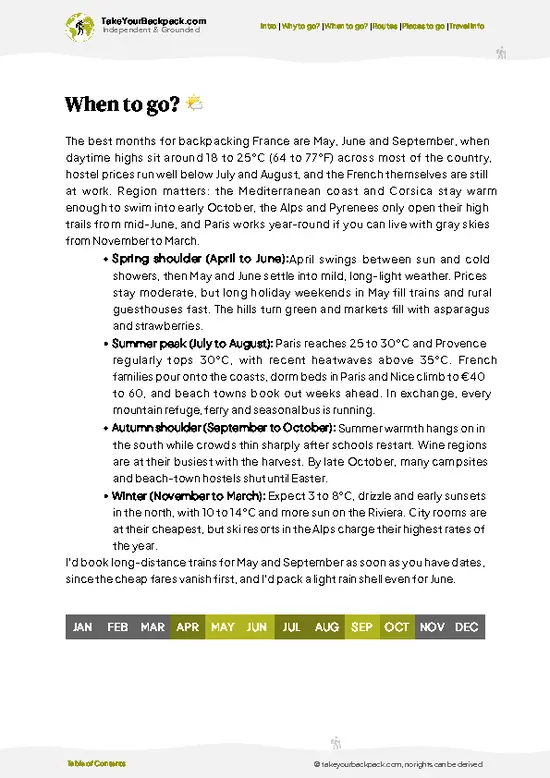
Best months: The best months for festivals in France are June to September, when the weather is warm and dry enough for outdoor stages, and long daylight stretches evenings well past 9 pm. July is the busiest month for events. Early summer, especially June, gives you much of the same program with fewer crowds.
Weather by region: Expect highs of 22 to 28°C in the north and center during summer, with occasional thunderstorms. The Mediterranean south reaches 28 to 35°C in July and August, with little rain. Brittany and Normandy stay cooler, around 18 to 23°C, and showers can come any day, so pack a rain shell. The Alps and Pyrenees are pleasant in summer but cold at night, with nighttime lows near 5 to 12°C at altitude.
Peak and shoulder seasons: Peak pricing applies in July and August, particularly … read more 👉
Best months: The best months for festivals in France are June to September, when the weather is warm and dry enough for outdoor stages, and long daylight stretches evenings well past 9 pm. July is the busiest month for events. Early summer, especially June, gives you much of the same program with fewer crowds.
Weather by region: Expect highs of 22 to 28°C in the north and center during summer, with occasional thunderstorms. The Mediterranean south reaches 28 to 35°C in July and August, with little rain. Brittany and Normandy stay cooler, around 18 to 23°C, and showers can come any day, so pack a rain shell. The Alps and Pyrenees are pleasant in summer but cold at night, with nighttime lows near 5 to 12°C at altitude.
Peak and shoulder seasons: Peak pricing applies in July and August, particularly on the Riviera, in Provence and on the Atlantic coast. Hotel rates in those areas can run 30 to 80 percent above shoulder levels, and dorm beds go from roughly €25 to 40 up to €45 to 70 near major events. May, June and September are the sensible shoulder months. Prices drop and trains are less packed, though some seasonal hostels and campsites open only from late May or close by mid-September.
Off-season and closures: October to April holds few outdoor events and is not worth planning around if open-air festivals are the goal. Winter brings indoor music and film programs in cities, plus Alpine events, but coastal towns shut many hotels and restaurants. Mid-August is the one stretch to treat carefully: many independent shops and restaurants close for annual holidays, especially in smaller towns, even as the festival calendar peaks.

festival hoppingOptimizing Your Multi-Stop Itinerary

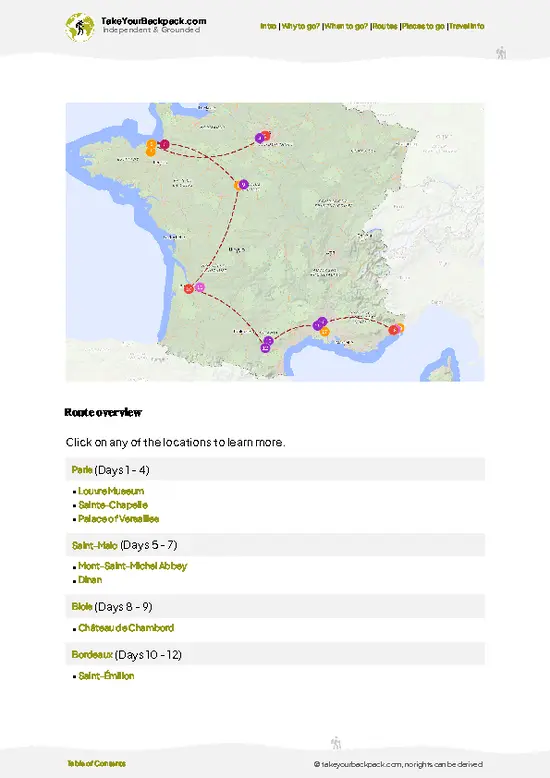
How long you need: A trip combining several festivals in France needs 10 to 21 days. Less than 10 forces constant transfers, and more than 21 usually means you could drop a region and enjoy the rest more.
Which regions go together: Group by rail corridor rather than by proximity on a map. Paris and the north link easily with Normandy and Brittany by train, with Paris to Rennes taking about 1.5 hours and Paris to Rouen about 1 hour 15 minutes. Lyon is the natural pivot between the north and the south, roughly 2 hours from Paris by TGV, and from there Provence and the Riviera are another 1.5 to 4 hours. The southwest and Pyrenees fit better as a separate loop via Bordeaux or Toulouse, each about 2 to 3 hours from Paris by fast train. A sensible direction is north to south, since the hottest and … read more 👉
How long you need: A trip combining several festivals in France needs 10 to 21 days. Less than 10 forces constant transfers, and more than 21 usually means you could drop a region and enjoy the rest more.
Which regions go together: Group by rail corridor rather than by proximity on a map. Paris and the north link easily with Normandy and Brittany by train, with Paris to Rennes taking about 1.5 hours and Paris to Rouen about 1 hour 15 minutes. Lyon is the natural pivot between the north and the south, roughly 2 hours from Paris by TGV, and from there Provence and the Riviera are another 1.5 to 4 hours. The southwest and Pyrenees fit better as a separate loop via Bordeaux or Toulouse, each about 2 to 3 hours from Paris by fast train. A sensible direction is north to south, since the hottest and most expensive stretch then comes at the end, when you can adjust to local prices and plans.
Time per stop: Give each stop 2 to 4 nights. One night means you spend the day on trains, while more than 4 rarely adds much unless you use the base for day trips. Between regions, expect 3 to 6 hours of travel; anything longer than that should be an overnight break rather than a rushed day.
Planning mistakes: Booking festivals in two distant regions on consecutive days is the commonest error. Allow a full buffer day for travel. Another is relying on local buses to reach rural venues, which often run only a few times a day and rarely late. Use a rental car for those stretches, or book accommodation within walking distance. Travelers also underestimate how fast beds sell out in July, so book trains and rooms early. Finally, skip the cross-country dash to fit in every famous event. Three well-chosen regions beat six rushed ones.

The ListMust-Visit festivals in France

1 Cannes Film Festival

red carpet, film premieres, celebrity sightings

Observe the film industry converge on the Riviera, where exclusive screenings and high-profile events draw global attention and limited public access.

2 Nice Carnival

flower battles, giant floats, seaside processions

Watch elaborate parades along the Promenade, where costumed performers and floral confetti create a lively winter spectacle by the sea.

3 Lyon Festival of Lights

light installations, illuminated facades, urban art

See the city glow with creative projections and interactive displays, drawing crowds to plazas and riversides after dark.

4 Avignon Festival

theater, medieval venues, street performances

Experience a city transformed by experimental plays, open-air shows, and a creative energy that spills from historic stages into public squares.

5 Fête de la Musique

free concerts, citywide stages, amateur bands

Roam city streets filled with spontaneous performances, as musicians of all genres turn public spaces into open-air venues for one night.

6 Hellfest

heavy metal, outdoor stages, alternative crowd

Immerse yourself in a gathering of metal fans, with intense live sets and a dedicated community camping on site for days of music.

7 Les Vieilles Charrues

open fields, diverse acts, Brittany gathering

Camp with thousands for a multi-genre music experience, where international and French artists share sprawling rural stages.

8 Festival Interceltique de Lorient

Celtic music, bagpipes, international delegations

Celebrate Celtic cultures with concerts, parades, and traditional gatherings, drawing musicians and visitors from across Europe.

9 Printemps de Bourges

new music, springtime, citywide venues

Catch emerging and established acts in intimate and large settings, as the city hosts a week of concerts marking the start of festival season.

10 Jazz à Juan

seaside stage, jazz legends, pine grove

Relax under the trees as world-class jazz musicians perform by the Mediterranean, with evening breezes and a laid-back crowd.

11 Bastille Day

military parade, fireworks, national pride

Join crowds gathering for parades and nighttime displays, as public spaces fill with music, celebration, and a sense of shared French identity.

12 Fêtes de Bayonne

white and red dress, Basque traditions, street parties

Take part in communal festivities marked by local customs, open-air concerts, and a sea of revelers filling the old town.

13 Menton Lemon Festival

citrus sculptures, themed parades, Riviera gardens

Wander among giant lemon and orange displays, with creative floats and garden installations celebrating the region’s unique microclimate.

14 Festival de Nîmes

Roman arena, rock concerts, summer nights

Attend major live shows in an ancient amphitheater, where modern sound and historic architecture create a striking contrast.

15 Festival d’Automne à Paris

contemporary arts, multidisciplinary, Paris venues

Engage with avant-garde performances and exhibitions across the city, blending theater, dance, and visual arts in urban spaces.

16 Trans Musicales

emerging artists, eclectic line-up, Rennes venues

Discover new sounds in packed halls and clubs, where festival-goers seek out fresh talent and unexpected collaborations.

17 Festival de Cornouaille

Breton costumes, folk dances, regional food

Experience living traditions through parades, music, and local specialties, as the town showcases its Celtic heritage.

Think you know France?

Prove you’re a true local — uncover 7 lesser-known festivals in France that locals tend to keep to themselves.
Loading the map 🌍

Expert viewTips and Advice from Travelers

How many to attend: Plan on three festivals in a single trip, four at the absolute most. Each one takes two to four days once you add arrival, recovery and the inevitable queues, and France’s distances and rail strikes mean transit eats time. Beyond four, you spend more time on trains than at events, and the fatigue dulls everything.
Which kind to prioritize: Music lovers should choose the mid-sized regional events over the headline names. They cost less, feel less commercialized and let you actually move around. Culture and history seekers get the most value from the theater, classical and street-arts events held in Roman or medieval settings, which often include free stages. Travelers on a tight budget should favor free town festivals and harvest or patron-saint celebrations, where entry … read more 👉
How many to attend: Plan on three festivals in a single trip, four at the absolute most. Each one takes two to four days once you add arrival, recovery and the inevitable queues, and France’s distances and rail strikes mean transit eats time. Beyond four, you spend more time on trains than at events, and the fatigue dulls everything.
Which kind to prioritize: Music lovers should choose the mid-sized regional events over the headline names. They cost less, feel less commercialized and let you actually move around. Culture and history seekers get the most value from the theater, classical and street-arts events held in Roman or medieval settings, which often include free stages. Travelers on a tight budget should favor free town festivals and harvest or patron-saint celebrations, where entry costs nothing and food stalls cost €5 to 12. Skip the largest ticketed names if your budget is below about US$60 a day: tickets can run €60 to 150 or more per day, and accommodation nearby multiplies the bill. Families and light sleepers do better with daytime or seated events than with camping-style festivals.
What it costs: A realistic daily budget is US$55 to 85 (about €50 to 80) for dorms or camping, self-catering and local transport. Mid-range travelers should expect US$110 to 170 (€100 to 155) with a private room. Peak summer and festival weekends push dorm beds to €35 to 70 a night. Entry for free events is nothing, small regional events usually cost €10 to 40 a day, and large ticketed ones cost €60 to 150 or more. Plan for €5 to 15 for guides or programs at heritage events, and €10 to 40 for regional train segments, with long TGV trips running €25 to 90 if booked early. Beer at a festival typically costs €5 to 8, so a daily drinks budget of €20 to 30 adds up fast. Campsites on site or nearby usually cost €10 to 25 a night.
Safety and local conduct: France is generally safe at festivals, but crowds attract pickpockets, especially around Paris and in the south. Keep phones and wallets in front pockets and avoid leaving bags unattended at campsites. Some large events run bag checks and prohibit glass or large backpacks, so bring a small daypack. Heat is a bigger daily risk than crime in July and August: carry water and sunscreen, and use free water points where available. Police and security presence has increased at major events, so expect queues at entrances and allow extra time.
Cultural points: Greet shopkeepers and staff with a “bonjour” before asking anything, since skipping it comes across as rude. Learn a few basic French phrases. Tipping is not expected beyond rounding up, since service is included. Noise rules apply in residential areas after about 10 pm, even during festivals, so keep camping and late-night gatherings quiet. Sunday and mid-August closures catch people out, so buy food and cash in advance. Most important, book beds and trains early, because that single step prevents the most common festival trip failures.

✈️ The backpacker research shortcutFrance Travel Guide

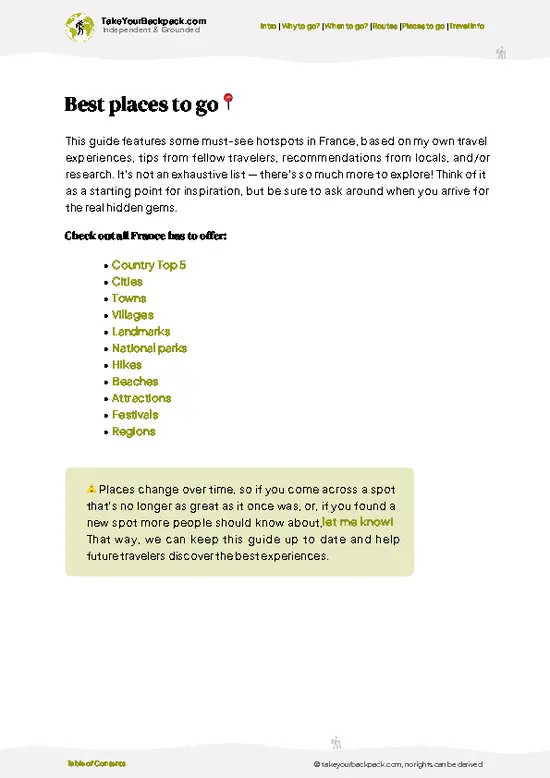
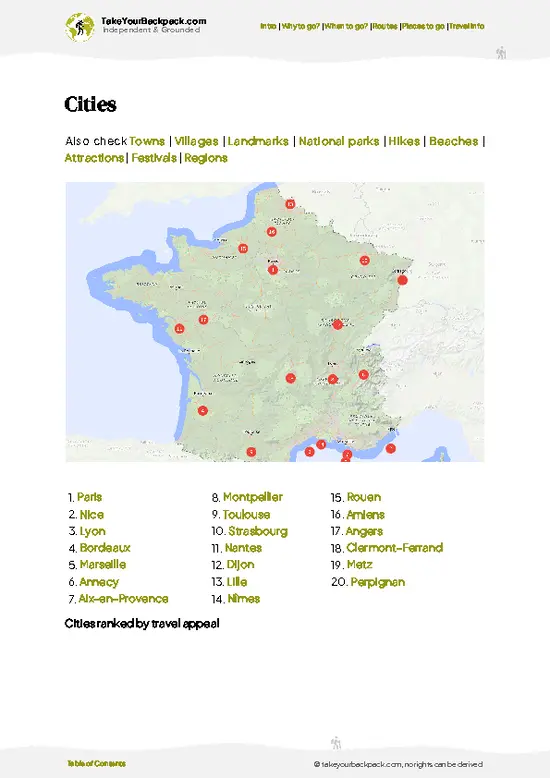
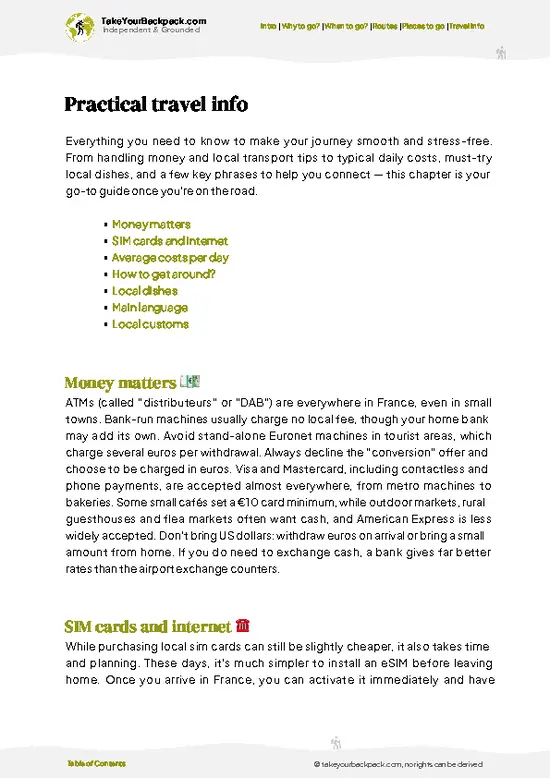
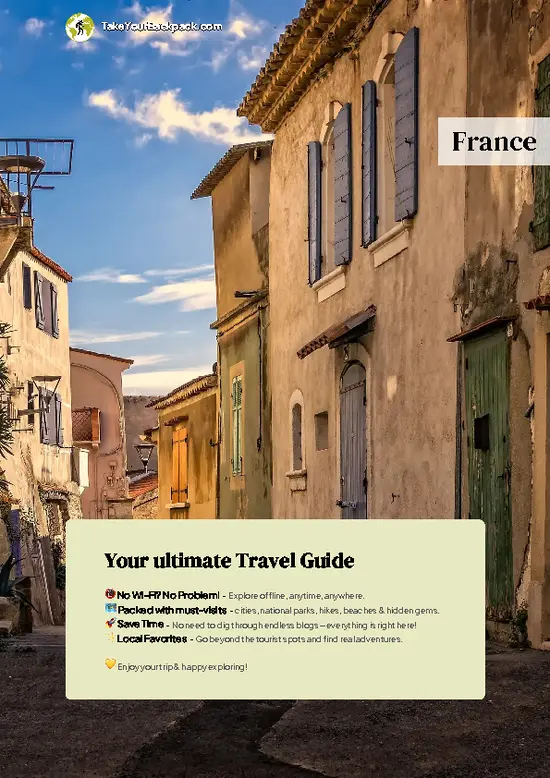
An offline-friendly backpacking guide with optimized travel routes, ranked highlights, transport advice, and the best areas to stay.
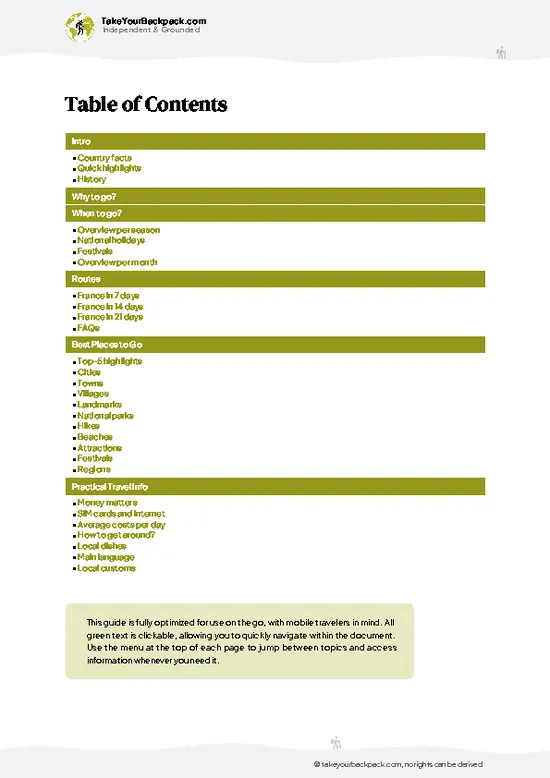
example page 0 from our offline Travel Guide for France
example page 1 from our offline Travel Guide for France
example page 2 from our offline Travel Guide for France
example page 3 from our offline Travel Guide for France
example page 4 from our offline Travel Guide for France
example page 5 from our offline Travel Guide for France
example page 6 from our offline Travel Guide for France
example page 7 from our offline Travel Guide for France
The digital guide (501 pages) contains:
✅ 135 highlights, ranked by travel appeal
✅ Optimized 7, 14 & 21-day travel routes
✅ Cities, national parks, landmarks, beaches
✅ How to get around
✅ Offline-friendly for travel without Wi-Fi
👉 Click to see all 30+ guide features

📅 Plan smarter in minutes, not weeks
✅ Month by month travel advice
✅ Festivals & national holidays
✅ Budget expectations

🗺️ Go to the right places, skip the overrated ones
✅ Honest pros & cons of destinations
✅ Top hikes, parks & viewpoints
✅ Lesser-known places most travelers miss
✅ Clear “worth it vs skip it” guidance

🛏️ Travel smoothly without rookie mistakes
✅ Best areas to stay
✅ Transport systems explained simply
✅ Common scams & safety advice
✅ SIM cards, money & practical tips

🌍 Understand the country, not just visit it
✅ Culture & traditions
✅ 52 Essential phrases & customs
✅ Festivals worth planning around
✅ Traveler-friendly historical context
✅ Insights that make places more meaningful

📱 Built for real travel conditions
✅ Fully downloadable PDF
✅ Works completely offline
✅ Optimized for phone use
✅ Useful in remote areas & buses
✅ Everything in one place
Stop searching, start planning
Get instant access to your full guide. 30‑day money-back guarantee.
+ Add another guide for just

By proceeding you agree to our terms.
Sent to your inbox immediately after payment • 100% Secure Checkout
Best Backpacking Travel Advisor 2025 tourism awardBest Backpacking
Travel Advisor
2025
What others say about Take Your Backpack Guides:
⭐⭐⭐⭐⭐
Fantastic, amazing amount of information!
⭐⭐⭐⭐⭐
My goodness this is amazing, it's what I've been looking for hats off too you!
⭐⭐⭐⭐⭐
I think this is absolutely BRILLIANT
⭐⭐⭐⭐
Very complete and informative. It's still missing places, but I gotta to commend you
⭐⭐⭐⭐⭐
This is truly amazing, thank you, can't wait to explore it with my kids!
⭐⭐⭐⭐⭐
Awesome resource, thank you!
⭐⭐⭐⭐⭐
This is amazing! Can't wait to explore the ones I haven't seen
⭐⭐⭐⭐
I love this! Well done, great idea.
⭐⭐⭐⭐⭐
Thanks for taking the time to make this gem!
⭐⭐⭐⭐⭐
This might be the best website I've ever seen.
⭐⭐⭐⭐⭐
Congratulations, and thank you so much for your work; it's incredibly valuable.
⭐⭐⭐⭐
In all seriousness I think you did a great job pointing out the important spots
⭐⭐⭐⭐⭐
10/10 very good
⭐⭐⭐⭐⭐
As someone who's only just starting to visit regularly this is awesome, thank you.
⭐⭐⭐⭐
Thank you very much! I'm going to visit my dad, it's going to be very useful!
⭐⭐⭐⭐⭐
This is really cool! We'll be travelling for the first time and this definitely come in handy.
⭐⭐⭐⭐⭐
You are now our minister of culture, congratulations 👨‍💼
⭐⭐⭐⭐⭐
Just wanted to tell you that this is a pearl! Going to follow your recommendations.
⭐⭐⭐⭐⭐
This is so cool. I'll definitely be using the resource for my travels soon.
⭐⭐⭐⭐⭐
This is very impressive! Good work.
⭐⭐⭐⭐⭐
This is an amazing and informative site. Very well done!

🛏️ Where to stay?Top Places to Consider Staying

France has plenty of hostels and budget rooms, with dorm beds running roughly €30 to 55 in Paris and €20 to 40 in most other cities. In Paris, the Canal Saint-Martin area and Belleville in the northeast hold the densest cluster of large hostels, with cheap bars and good metro links but a scruffy edge after dark, while Montmartre puts you near Sacré-Cœur and the Pigalle nightlife at the cost of steep hills and pickpockets around the main stations. Elsewhere, look at Vieux Lyon in Lyon for cobbled-lane atmosphere and walkable sights, the Vieux-Port and Cours Julien in Marseille for late nights (stay alert around the station), and the Old Town of Nice for beach access, though its narrow streets … read more 👉
France has plenty of hostels and budget rooms, with dorm beds running roughly €30 to 55 in Paris and €20 to 40 in most other cities. In Paris, the Canal Saint-Martin area and Belleville in the northeast hold the densest cluster of large hostels, with cheap bars and good metro links but a scruffy edge after dark, while Montmartre puts you near Sacré-Cœur and the Pigalle nightlife at the cost of steep hills and pickpockets around the main stations. Elsewhere, look at Vieux Lyon in Lyon for cobbled-lane atmosphere and walkable sights, the Vieux-Port and Cours Julien in Marseille for late nights (stay alert around the station), and the Old Town of Nice for beach access, though its narrow streets stay noisy until late in summer.

If you enjoy meeting fellow travelers, consider choosing hostels with high ratings for atmosphere. On the other hand, if you prefer having your own space, a hotel might be a better option.

FranceMore Places Across France

👋 Meet the founderWho’s Behind Take Your Backpack?

Johan, backpacker and founder of TakeYourBackpackHi, I’m Johan (Netherlands 🇳🇱), the creator of TakeYourBackpack. Over the past 3 decades, I’ve backpacked through 90+ countries across six continents, gaining extensive experience with independent travel, long-term trips, and overland routes.

This site is built on a combination of firsthand travel experience and carefully curated insights from other backpackers. Many guides are based on places I’ve personally visited, while others bring together tips, observations, and practical advice shared by trusted travelers I’ve met along the way.

The goal is to provide realistic, experience-driven guidance — not generic itineraries — so you can explore destinations with better context, clearer expectations, and more confidence.