×

Greece🇬🇷 | best citiesThe 6 Top cities in Greece

Greek cities are compact, loud and sun-bleached: marble worn smooth underfoot, grilled octopus and diesel in the same breath, cats asleep on car roofs. Across Greece the differences matter. The capital is sprawling and gritty, with ancient stone rising out of concrete. The northern cities feel more Balkan and student-driven, with cheaper beds and fewer tourists. Island towns are whitewashed and photogenic, but summer prices climb and crowds pack the lanes by mid-morning. The Peloponnese and western ports sit between those poles. For backpacking or independent travel, the choice comes down to whether you want history, nightlife, sea access or quiet.

By Johan Kruseman 🇳🇱 | Updated October 19, 2026
Explore the best towns in Greece

Why go?Why These city Stand Out

Greece built its cities around harbors, hills and defensible rock, so almost every place has a high point for a fortress or temple and a waterfront for trade. That geography gives you walkable centers where a 2,500-year-old wall can stand beside a kiosk selling coffee and cigarettes. Mountains split the mainland, and thousands of islands scatter the coast, so cities have developed distinct local identities rather than one national template. Dialect, food and rhythm change noticeably between north and south.

The Mediterranean climate pushes life outdoors. Evenings fill with plastic chairs on pavements, the clink of frappé glasses, and the smell of charcoal and jasmine. Yet the same sun makes midsummer sightseeing punishing, with stone and asphalt radiating heat into the night.

Before choosing … read more 👉
Greece built its cities around harbors, hills and defensible rock, so almost every place has a high point for a fortress or temple and a waterfront for trade. That geography gives you walkable centers where a 2,500-year-old wall can stand beside a kiosk selling coffee and cigarettes. Mountains split the mainland, and thousands of islands scatter the coast, so cities have developed distinct local identities rather than one national template. Dialect, food and rhythm change noticeably between north and south.

The Mediterranean climate pushes life outdoors. Evenings fill with plastic chairs on pavements, the clink of frappé glasses, and the smell of charcoal and jasmine. Yet the same sun makes midsummer sightseeing punishing, with stone and asphalt radiating heat into the night.

Before choosing Greece for its cities, know that public transport is uneven. Intercity buses (KTEL) cover most of the mainland, trains are limited, and island links depend on ferry schedules that shift with weather. Cities are often less polished than the postcards: graffiti, uneven pavements and traffic noise come with the atmosphere. Many archaeological sites close mid-afternoon, and shops often shut for a siesta-style break. Adjust your expectations and the places reward you.
Why These Made the Cut
The list of best cities in Greece is created based on culture, vibe, attractions, transport ease, and local charm. If you feel a city is missing in this list, please let us know.

When to go?When to Plan Your Trip

Best months for city travel: The best months for Greek cities are April to early June and mid-September to October, when daytime highs run about 20 to 28°C, the light is clear and gold, and sites are open without the summer crush. Spring brings wildflowers and the smell of orange blossom in the south. Autumn keeps the sea warm, often 22 to 25°C into October.
Summer heat and crowds: July and August are the hard months. Athens and the southern mainland regularly pass 35°C, and heatwaves of 38 to 42°C happen. Stone streets hold heat after dark, and many people sleep with fans running. Accommodation prices in popular places can run 30 to 60 percent higher than in shoulder season, and island ferries sell out. Major sites such as the Acropolis are best visited at opening time, around 8:00, before … read more 👉
Best months for city travel: The best months for Greek cities are April to early June and mid-September to October, when daytime highs run about 20 to 28°C, the light is clear and gold, and sites are open without the summer crush. Spring brings wildflowers and the smell of orange blossom in the south. Autumn keeps the sea warm, often 22 to 25°C into October.
Summer heat and crowds: July and August are the hard months. Athens and the southern mainland regularly pass 35°C, and heatwaves of 38 to 42°C happen. Stone streets hold heat after dark, and many people sleep with fans running. Accommodation prices in popular places can run 30 to 60 percent higher than in shoulder season, and island ferries sell out. Major sites such as the Acropolis are best visited at opening time, around 8:00, before the heat builds.
Winter and regional differences: From November to March, the climate splits by region. Athens and the south stay mild, around 10 to 15°C, with most of the rain falling from November to February, while the north, including Thessaloniki and the mountains, is colder, with frost and occasional snow. Winter is cheap and quiet, and cafes and tavernas fill with locals. The trade-off is that island services thin out, ferries run less often, and some seasonal businesses close completely between November and March.

city hoppingHow to Combine cities Into One Trip

How many days to plan: A trip combining several Greek cities needs 10 to 14 days, and a week can work if you stay on the mainland. Allow 2 to 3 nights per stop, so you see the main sites and still have an evening for a taverna and a slow walk.
Direction and regional clusters: The clusters are the mainland north (Macedonia and Thrace), the central and Peloponnese area, the Athens region, and the islands. A sensible approach is a loop or a one-way line from Athens outward, ending at a ferry port or the northern rail and bus hub, rather than doubling back. Athens to the Peloponnese by KTEL bus takes roughly 2 to 3 hours. Athens to Thessaloniki is about 4 to 5 hours by train or 5 to 6 by bus. Ferries from Piraeus to the main Cycladic islands run about 3 to 6 hours on conventional boats, shorter … read more 👉
How many days to plan: A trip combining several Greek cities needs 10 to 14 days, and a week can work if you stay on the mainland. Allow 2 to 3 nights per stop, so you see the main sites and still have an evening for a taverna and a slow walk.
Direction and regional clusters: The clusters are the mainland north (Macedonia and Thrace), the central and Peloponnese area, the Athens region, and the islands. A sensible approach is a loop or a one-way line from Athens outward, ending at a ferry port or the northern rail and bus hub, rather than doubling back. Athens to the Peloponnese by KTEL bus takes roughly 2 to 3 hours. Athens to Thessaloniki is about 4 to 5 hours by train or 5 to 6 by bus. Ferries from Piraeus to the main Cycladic islands run about 3 to 6 hours on conventional boats, shorter on high-speed ones, and flights between major hubs take about an hour.
Common planning mistakes: The first is trying to cover everything. Greek distances look short on a map, but mountain roads and infrequent trains stretch the clock. Pick two or three regions, not four. The second is trusting ferry timetables in the wind season, when the meltemi in July and August can cancel sailings, so keep a spare day before any flight home. The third is booking one-night stops that eat your afternoons in bus stations. Book transit for mornings, and leave afternoons free for the sites that close early.

The ListThe Best cities of Greece

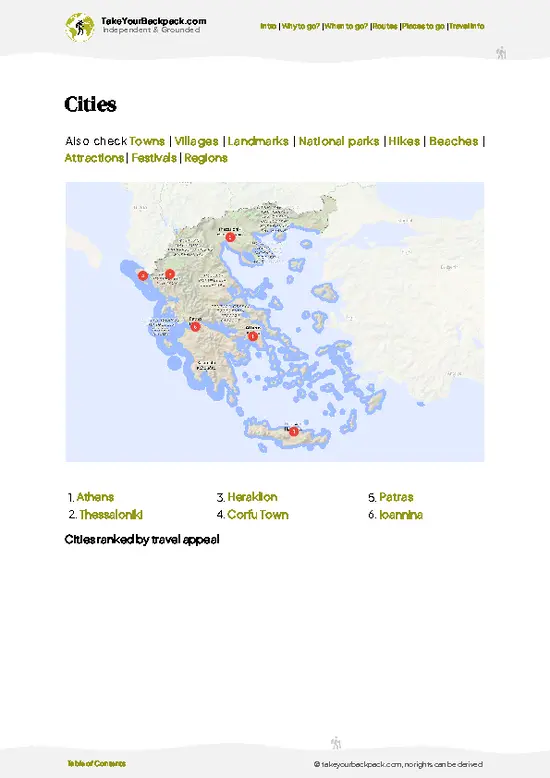
1 Athens

Acropolis views, urban sprawl, street art, ancient ruins

Navigate dense neighborhoods where ancient relics meet modern grit, discovering archaeological sites, lively markets, and a layered cityscape shaped by history and daily life.

Greece - Athens

2 Thessaloniki

Byzantine churches, waterfront promenade, student energy, multicultural quarters

Absorb a blend of Ottoman, Jewish, and Greek influences while sampling street food and exploring neighborhoods shaped by a youthful, diverse population.

greece-city-thessaloniki
© Google | Bojan Marelja

3 Heraklion

Minoan palace, port city bustle, local markets, Cretan cuisine

Experience a working city where archaeological wonders, busy docks, and a strong food culture reveal Crete’s complex past and present.

4 Corfu Town

Venetian alleys, olive groves, pastel mansions, Ionian coastline

Wander through narrow lanes lined with faded mansions, then escape to quiet beaches and green hills dotted with olive trees and cypress.

5 Patras

Carnival traditions, Roman ruins, ferry port, university life

Join a city shaped by student rhythms and maritime links, with Roman monuments and lively festivals marking the calendar and the streets.

6 Ioannina

Lake island, Ottoman relics, lakeside cafés, mountain gateway

Cross into a lakeside city where castle walls, mosques, and a small island set the tone for exploring Epirus and its rugged landscapes.

greece-city-ioannina
© Google |
Loading the map 🌍

Expert viewTips and Advice from Travelers

How many cities to visit: I advise three to four cities on a trip of two weeks. Fewer than three and you miss how sharply Greece changes between regions. More than four and you spend your days in bus stations and on hot platforms, which costs time and gives little back. Each stop deserves two to three nights because sites often close by 15:00 and evenings are when the streets come alive.
Choosing between kinds of cities: Greek cities fall into rough types: the large capital, northern university cities, historic regional towns and island ports. If your budget is tight, the northern and regional cities give you the most. Rooms and meals cost less, crowds are thinner, and you meet more locals. If history is your driver, the capital is worth the extra cost and noise, because its main sites cluster … read more 👉
How many cities to visit: I advise three to four cities on a trip of two weeks. Fewer than three and you miss how sharply Greece changes between regions. More than four and you spend your days in bus stations and on hot platforms, which costs time and gives little back. Each stop deserves two to three nights because sites often close by 15:00 and evenings are when the streets come alive.
Choosing between kinds of cities: Greek cities fall into rough types: the large capital, northern university cities, historic regional towns and island ports. If your budget is tight, the northern and regional cities give you the most. Rooms and meals cost less, crowds are thinner, and you meet more locals. If history is your driver, the capital is worth the extra cost and noise, because its main sites cluster in one walkable zone. If you want sea and swimming within a city stay, island ports cost more in time and money, and the ferry is the main expense, so only go if beaches matter to you. For a mix, one big city plus one regional town is the best value.
What it costs: A realistic backpacker budget is €50 to 80 a day in shoulder season, with dorm beds at €15 to 35 and basic doubles at €40 to 70. Souvlaki or a gyros pita costs €3 to 5, and a sit-down taverna meal with wine is €12 to 20. Expect €25 to 50 more a day in July and August in island ports. Entry fees add up: the Acropolis ticket is around €30 in season (lower in winter), and many major sites charge €6 to 20. A combined ticket helps if you visit several. Guides cost €15 to 40 a head in groups. City buses and metros run roughly €1.20 to 1.50 a ride, and intercity buses cost €10 to 30 per leg. Ferries run about €25 to 70 a leg depending on speed and distance.
Safety and cultural notes: Greek cities are generally safe, with crime mostly limited to pickpocketing on crowded metros and around major sites. Keep your bag zipped and in front of you. Some central districts can feel rough after dark, so stay on lit streets. Strikes by transport workers happen often and can halt ferries, metros and trains for a day, so keep a buffer. Dress modestly in churches and monasteries, covering shoulders and knees. Dinner starts late, often after 21:00, and pushing for a quick bill is considered rude. Tap water is drinkable in most cities, but carry a bottle and refill it in summer, when you need several liters a day.

✈️ The backpacker research shortcutGreece Travel Guide

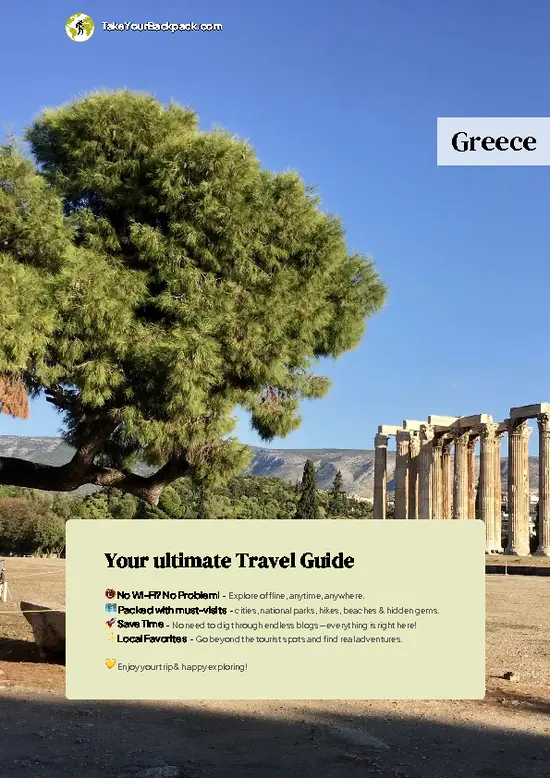
An offline-friendly backpacking guide with optimized travel routes, ranked highlights, transport advice, and the best areas to stay.
example page 0 from our offline Travel Guide for Greece
example page 1 from our offline Travel Guide for Greece
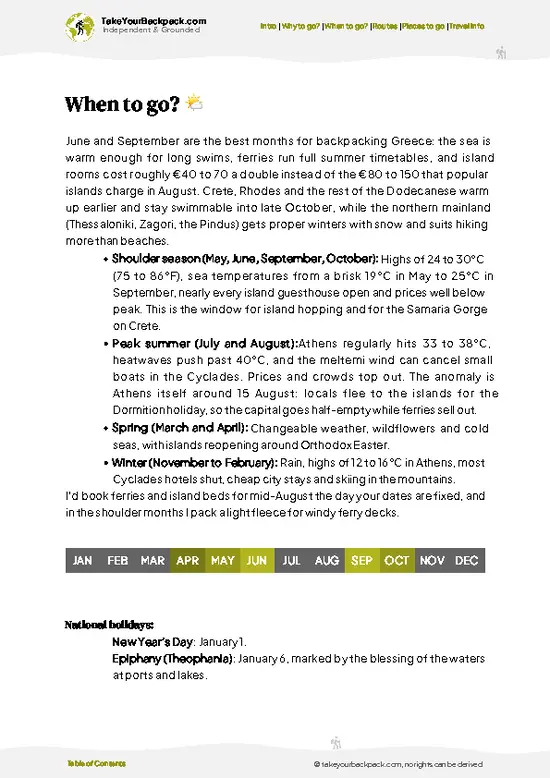
example page 2 from our offline Travel Guide for Greece
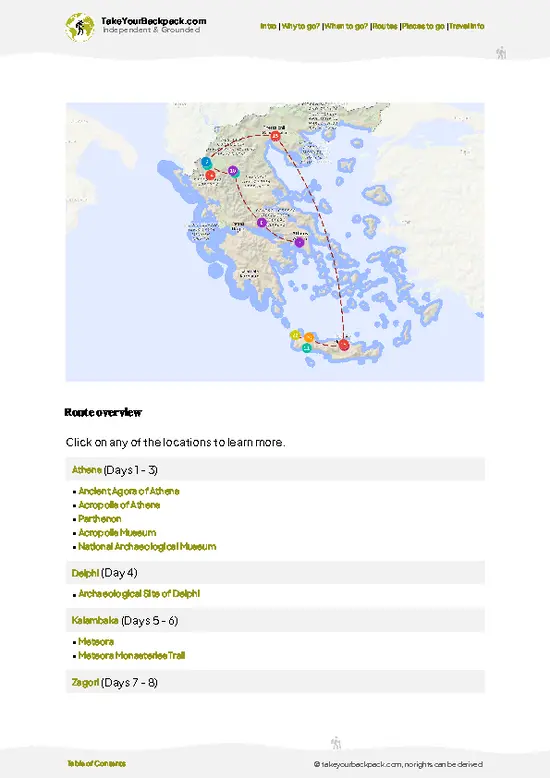
example page 3 from our offline Travel Guide for Greece
example page 4 from our offline Travel Guide for Greece
example page 5 from our offline Travel Guide for Greece
example page 6 from our offline Travel Guide for Greece
example page 7 from our offline Travel Guide for Greece
The digital guide (417 pages) contains:
✅ 114 highlights, ranked by travel appeal
✅ Optimized 5, 10 & 15-day travel routes
✅ Cities, national parks, landmarks, beaches
✅ How to get around
✅ Offline-friendly for travel without Wi-Fi
👉 Click to see all 30+ guide features

📅 Plan smarter in minutes, not weeks
✅ Month by month travel advice
✅ Festivals & national holidays
✅ Budget expectations

🗺️ Go to the right places, skip the overrated ones
✅ Honest pros & cons of destinations
✅ Top hikes, parks & viewpoints
✅ Lesser-known places most travelers miss
✅ Clear “worth it vs skip it” guidance

🛏️ Travel smoothly without rookie mistakes
✅ Best areas to stay
✅ Transport systems explained simply
✅ Common scams & safety advice
✅ SIM cards, money & practical tips

🌍 Understand the country, not just visit it
✅ Culture & traditions
✅ 52 Essential phrases & customs
✅ Festivals worth planning around
✅ Traveler-friendly historical context
✅ Insights that make places more meaningful

📱 Built for real travel conditions
✅ Fully downloadable PDF
✅ Works completely offline
✅ Optimized for phone use
✅ Useful in remote areas & buses
✅ Everything in one place
Stop searching, start planning
Get instant access to your full guide. 30‑day money-back guarantee.
+ Add another guide for just

By proceeding you agree to our terms.
Sent to your inbox immediately after payment • 100% Secure Checkout
Best Backpacking Travel Advisor 2025 tourism awardBest Backpacking
Travel Advisor
2025
What others say about Take Your Backpack Guides:
⭐⭐⭐⭐⭐
Fantastic, amazing amount of information!
⭐⭐⭐⭐⭐
My goodness this is amazing, it's what I've been looking for hats off too you!
⭐⭐⭐⭐⭐
I think this is absolutely BRILLIANT
⭐⭐⭐⭐
Very complete and informative. It's still missing places, but I gotta to commend you
⭐⭐⭐⭐⭐
This is truly amazing, thank you, can't wait to explore it with my kids!
⭐⭐⭐⭐⭐
Awesome resource, thank you!
⭐⭐⭐⭐⭐
This is amazing! Can't wait to explore the ones I haven't seen
⭐⭐⭐⭐
I love this! Well done, great idea.
⭐⭐⭐⭐⭐
Thanks for taking the time to make this gem!
⭐⭐⭐⭐⭐
This might be the best website I've ever seen.
⭐⭐⭐⭐⭐
Congratulations, and thank you so much for your work; it's incredibly valuable.
⭐⭐⭐⭐
In all seriousness I think you did a great job pointing out the important spots
⭐⭐⭐⭐⭐
10/10 very good
⭐⭐⭐⭐⭐
As someone who's only just starting to visit regularly this is awesome, thank you.
⭐⭐⭐⭐
Thank you very much! I'm going to visit my dad, it's going to be very useful!
⭐⭐⭐⭐⭐
This is really cool! We'll be travelling for the first time and this definitely come in handy.
⭐⭐⭐⭐⭐
You are now our minister of culture, congratulations 👨‍💼
⭐⭐⭐⭐⭐
Just wanted to tell you that this is a pearl! Going to follow your recommendations.
⭐⭐⭐⭐⭐
This is so cool. I'll definitely be using the resource for my travels soon.
⭐⭐⭐⭐⭐
This is very impressive! Good work.
⭐⭐⭐⭐⭐
This is an amazing and informative site. Very well done!

🛏️ Where to stay?Best Places to Stay in Greece

Greece has a solid spread of hostels, budget guesthouses and family-run rooms, with dorm beds in Athens typically running €18 to 35 in summer and the densest choice found in the capital, Thessaloniki and party-friendly islands like Ios and Corfu. In Athens, Psyri and Monastiraki put you a short walk from the Acropolis and the city’s busiest bar streets but stay loud until 3 a.m., Koukaki is calmer, residential and right below the Acropolis’ south slope, while Exarchia is the cheapest and most lively, though its late-night street scene can feel edgy. In Thessaloniki, Ladadika sits by the port with the best nightlife, and on the islands you’ll save money and ferry stress by staying in the main … read more 👉
Greece has a solid spread of hostels, budget guesthouses and family-run rooms, with dorm beds in Athens typically running €18 to 35 in summer and the densest choice found in the capital, Thessaloniki and party-friendly islands like Ios and Corfu. In Athens, Psyri and Monastiraki put you a short walk from the Acropolis and the city’s busiest bar streets but stay loud until 3 a.m., Koukaki is calmer, residential and right below the Acropolis’ south slope, while Exarchia is the cheapest and most lively, though its late-night street scene can feel edgy. In Thessaloniki, Ladadika sits by the port with the best nightlife, and on the islands you’ll save money and ferry stress by staying in the main port town rather than out at the beaches.

If you enjoy meeting fellow travelers, consider choosing hostels with high ratings for atmosphere. On the other hand, if you prefer having your own space, a hotel might be a better option.

GreeceExplore Greece

👋 Meet the founderWho’s Behind Take Your Backpack?

Johan, backpacker and founder of TakeYourBackpackHi, I’m Johan (Netherlands 🇳🇱), the creator of TakeYourBackpack. Over the past 3 decades, I’ve backpacked through 90+ countries across six continents, gaining extensive experience with independent travel, long-term trips, and overland routes.

This site is built on a combination of firsthand travel experience and carefully curated insights from other backpackers. Many guides are based on places I’ve personally visited, while others bring together tips, observations, and practical advice shared by trusted travelers I’ve met along the way.

The goal is to provide realistic, experience-driven guidance — not generic itineraries — so you can explore destinations with better context, clearer expectations, and more confidence.