×

Guatemala🇬🇹 | best villagesExplore the 2 Best villages in Guatemala

Villages in Guatemala are Maya highland communities and lakeside towns where daily life still runs on market days, woven cloth and wood smoke. Mornings start cold and bright, with the sound of church bells, roosters and pickup trucks grinding up cobbled hills. The western highlands around Lake Atitlán and Quetzaltenango have the strongest traditions, with women in hand-woven huipiles and steep, muddy paths. Antigua-area towns are easy and polished, and cost more. The Verapaz and Petén regions are humid, rougher and quieter. For backpacking or independent travel, chicken buses connect almost everything, but dusty, crowded rides are part of the deal.

By Johan Kruseman 🇳🇱 | Updated October 23, 2026
Explore the best landmarks in Guatemala

Why go?What Makes Them Special

Guatemala holds the largest Maya population in Central America, and that is the root of its village culture. Communities in the highlands kept their languages (over twenty Maya languages are spoken), their textile traditions and their own religious calendars through centuries of Spanish rule and a long civil war that ended in 1996. You see it in the colors of a market, hear it in the K’iche’ and Kaqchikel spoken at a tortilla stand, and smell it in copal incense drifting from church steps.

Geography does the rest. A chain of volcanoes and deep valleys isolated communities from each other, so dress, patterns and customs change from one valley to the next. Volcanic soil feeds terraced cornfields and coffee slopes, and the lakes and cloud forests give villages dramatic settings.

Before choosing … read more 👉
Guatemala holds the largest Maya population in Central America, and that is the root of its village culture. Communities in the highlands kept their languages (over twenty Maya languages are spoken), their textile traditions and their own religious calendars through centuries of Spanish rule and a long civil war that ended in 1996. You see it in the colors of a market, hear it in the K’iche’ and Kaqchikel spoken at a tortilla stand, and smell it in copal incense drifting from church steps.

Geography does the rest. A chain of volcanoes and deep valleys isolated communities from each other, so dress, patterns and customs change from one valley to the next. Volcanic soil feeds terraced cornfields and coffee slopes, and the lakes and cloud forests give villages dramatic settings.

Before choosing Guatemala, know that roads are slow and winding, landslides can close them in the wet season, and public transport means crowded converted school buses. Many villages are living communities, not attractions, so photography often needs permission and a small payment, and some ceremonies are private. Tourism infrastructure is excellent around Atitlán and Antigua, and thin elsewhere, with basic rooms, cold showers and few ATMs.
How the List Was Created
The list of best villages in Guatemala is created based on authenticity, scenic beauty, community spirit, traditions, and overall character. If you feel a village is missing in this list, please let us know.

When to go?Seasonal Guide to Visiting

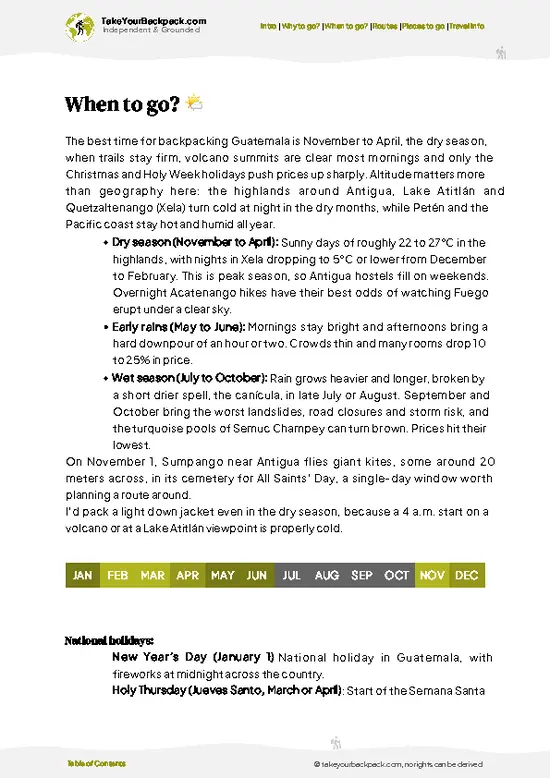
Best months: The best months for villages in Guatemala are November to April, the dry season, when highland mornings are crisp, skies are clear and volcano views stay sharp until the afternoon haze. Days in the highlands reach roughly 20 to 26°C, while nights at altitude drop to 5 to 10°C, and you will want a real jacket and a wool layer. Roads are firm, and trails around the lakes are dry and dusty.
Shoulder and wet season: May to October is the rainy season. Mornings are usually clear, then clouds build and rain arrives most afternoons, often heavy, with mud on the paths and occasional landslides on mountain roads. Green terraces and fewer travelers are the upside, and prices for rooms can run 10 to 30 percent lower. Late October and early November are shoulder weeks, when the roads are still … read more 👉
Best months: The best months for villages in Guatemala are November to April, the dry season, when highland mornings are crisp, skies are clear and volcano views stay sharp until the afternoon haze. Days in the highlands reach roughly 20 to 26°C, while nights at altitude drop to 5 to 10°C, and you will want a real jacket and a wool layer. Roads are firm, and trails around the lakes are dry and dusty.
Shoulder and wet season: May to October is the rainy season. Mornings are usually clear, then clouds build and rain arrives most afternoons, often heavy, with mud on the paths and occasional landslides on mountain roads. Green terraces and fewer travelers are the upside, and prices for rooms can run 10 to 30 percent lower. Late October and early November are shoulder weeks, when the roads are still damp but the sky starts to open.
Peak periods and regions: Crowds and prices peak at Christmas and New Year, Semana Santa (the week before Easter) and around All Saints on November 1, when kite festivals and processions fill the streets and rooms book out weeks ahead. Lowland areas such as Petén and the Verapaz stay hot and humid all year, with 28 to 35°C and heavy rain from June to November.

village hoppingHow to Combine villages Into One Trip

How Many Days a Multi-Village Trip Needs: A trip linking several villages in Guatemala works best with 8 to 14 days, which allows three to five stops without living inside a minibus.
Which Regions Pair Well and Which Way to Go: Three clusters make sense. The Western Highlands (Lake Atitlán, Quetzaltenango, Huehuetenango) is the densest, with cool pine air, woodsmoke and market mornings that start before 6 a.m. The Antigua and Central Highlands area sits close to Guatemala City’s airport. The Verapaz and Petén region is hotter, wetter and slower to reach. Travel in one direction and do not backtrack: fly into Guatemala City, move west through the highlands, then loop north only if you have a week or more to spare. Antigua, Panajachel and Quetzaltenango act as the transport hubs where you change … read more 👉
How Many Days a Multi-Village Trip Needs: A trip linking several villages in Guatemala works best with 8 to 14 days, which allows three to five stops without living inside a minibus.
Which Regions Pair Well and Which Way to Go: Three clusters make sense. The Western Highlands (Lake Atitlán, Quetzaltenango, Huehuetenango) is the densest, with cool pine air, woodsmoke and market mornings that start before 6 a.m. The Antigua and Central Highlands area sits close to Guatemala City’s airport. The Verapaz and Petén region is hotter, wetter and slower to reach. Travel in one direction and do not backtrack: fly into Guatemala City, move west through the highlands, then loop north only if you have a week or more to spare. Antigua, Panajachel and Quetzaltenango act as the transport hubs where you change vehicles.
Time per Stop and Between Regions: Give each village 2 to 3 nights. One night means arriving tired and leaving before the light turns gold on the hills. Guatemala City to Antigua takes 1 to 1.5 hours, Antigua to Lake Atitlán 2.5 to 3.5 hours, Atitlán to Quetzaltenango 3 to 4 hours, and Guatemala City to Cobán 4 to 5 hours. Shuttles are faster and pricier; chicken buses are cheap, loud, and run on diesel fumes and reggaeton.
Planning Mistakes to Avoid: The common error is reading a map and ignoring the mountain roads. A 100 km stretch can take four hours of switchbacks, landslide delays in the rainy season and fog after midday. Plan one long transfer per day at most, and leave before 9 a.m. so you arrive in daylight. Another trap is cramming in too many stops. Pick fewer places, and use the spare time for market days, which vary by village and often fall on Thursday and Sunday, so check the day before you book your bus.

The ListHighly Recommended villages of Guatemala

1 San Marcos La Laguna

Wooden dock, yoga and temazcal, vegetarian cafés, cliff swims

Walk car-free stone paths between lakeside yoga studios, cacao ceremonies and rooftop cafés, then jump from rock ledges or climb to the viewpoint at sunset.

guatemala-city-san-marcos-la-laguna
© Google |

2 Tzununá

Working fishermen’s dock, weaving stalls, quiet lanes, lookout trails

Watch fishermen haul nets at dawn, buy textiles from family weavers, and follow short steep trails to volcano views above a very small village.

guatemala-city-tzununa
© Google | Cristian Pineda
Loading the map 🌍

Expert viewInsights from Locals and Experts

How many villages: I would advise four to six villages on a trip of two weeks. That is enough to feel the difference between the volcanic lake region, the Maya highlands and the northern cloud forest, but not so many that you spend your days on buses. Each place needs at least two nights: the first evening is spent finding your feet, the second morning is when a market, a trail or a conversation at a corner comedor finally works out.
Choosing the kind: If you want comfort, cafés and easy social contact, pick lakeside and colonial-area towns, with hostels, yoga shacks and strong wifi. If you want Maya culture, go to market towns in the western highlands, where the smell of copal and the sound of K’iche’ fill the stalls on market days. For quiet, rivers and jungle, choose the Verapaz and the … read more 👉
How many villages: I would advise four to six villages on a trip of two weeks. That is enough to feel the difference between the volcanic lake region, the Maya highlands and the northern cloud forest, but not so many that you spend your days on buses. Each place needs at least two nights: the first evening is spent finding your feet, the second morning is when a market, a trail or a conversation at a corner comedor finally works out.
Choosing the kind: If you want comfort, cafés and easy social contact, pick lakeside and colonial-area towns, with hostels, yoga shacks and strong wifi. If you want Maya culture, go to market towns in the western highlands, where the smell of copal and the sound of K’iche’ fill the stalls on market days. For quiet, rivers and jungle, choose the Verapaz and the north, where rooms are plain, cold showers are normal and you see few other foreigners. Mixing one of each kind works best.
What it costs: Plan on US$25 to 45 a day as a backpacker: dorm beds US$8 to 15, private rooms US$20 to 40, local meals of beans, eggs and tortillas US$2 to 5, and a chicken bus ride US$1 to 4. Tourist shuttles cost US$10 to 25 per leg. Guides for volcano or village hikes run US$15 to 40, and small community entry fees or photo tips are often US$1 to 5. Carry quetzales in small bills, because many villages have no ATM and change is scarce.
Safety and manners: Daytime village life is generally calm, but petty theft and robberies on isolated trails happen, so hike with a registered local guide, keep valuables out of sight on buses and avoid traveling after dark. Roads in the rainy season can turn slippery, so check conditions locally. Culturally, dress modestly, greet people with a quiet “buenos días,” and ask before photographing anyone, especially children and women at the market. Churches that mix Catholic and Maya rites are active places of worship, so keep your voice low and skip photos during ceremonies. A few quetzales for a photo or a hand-woven bracelet is a fair exchange, and you get a better portrait, and a smile, for it.

✈️ The backpacker research shortcutGuatemala Travel Guide

An offline-friendly backpacking guide with optimized travel routes, ranked highlights, transport advice, and the best areas to stay.
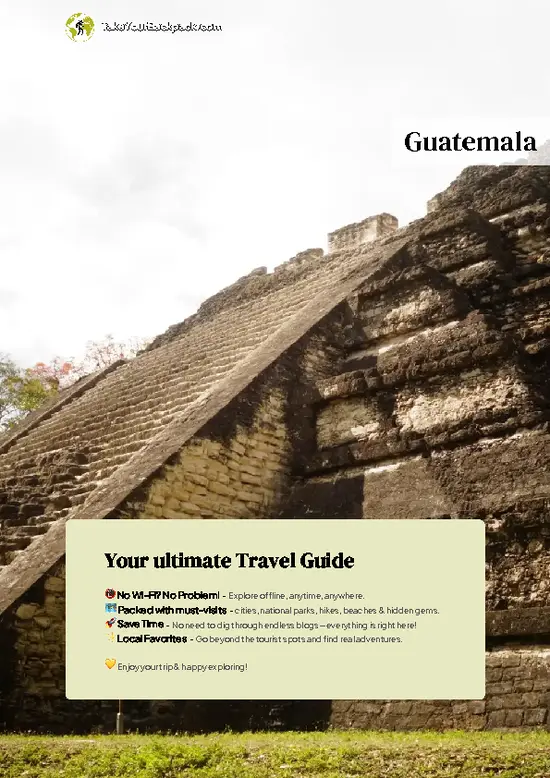
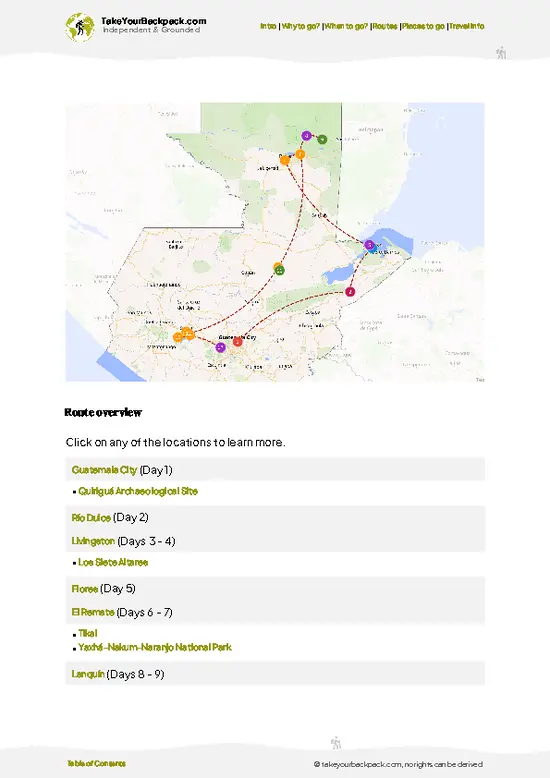
example page 0 from our offline Travel Guide for Guatemala
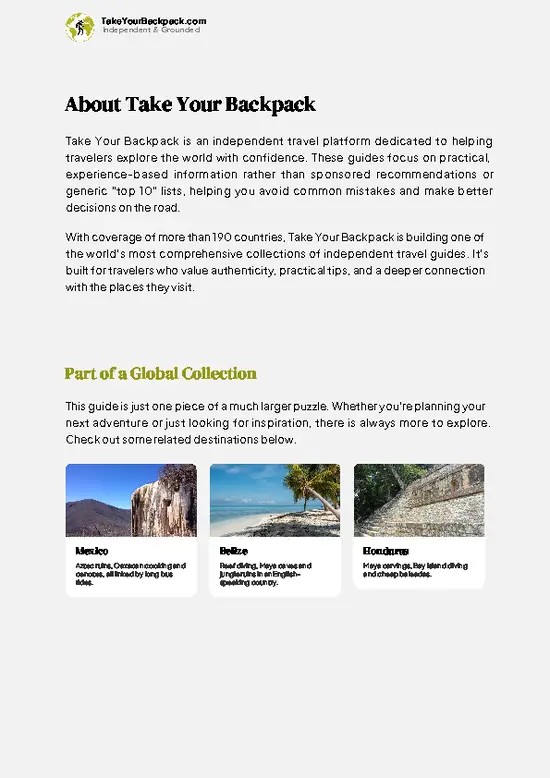
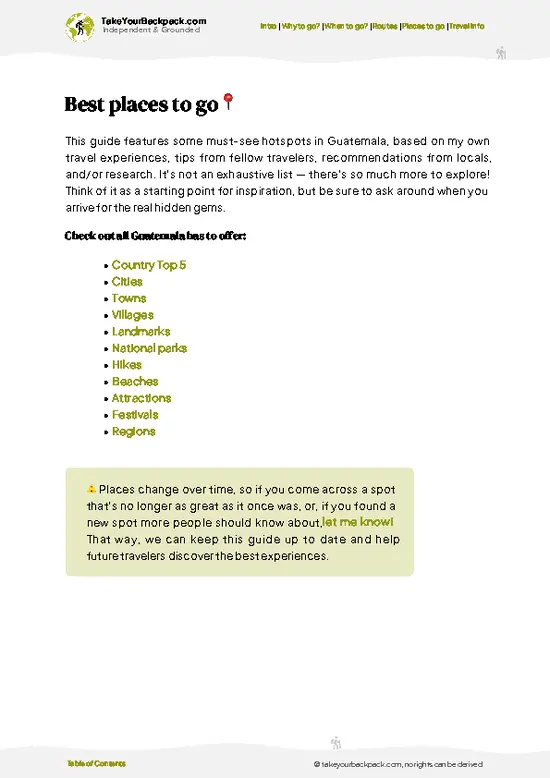
example page 1 from our offline Travel Guide for Guatemala
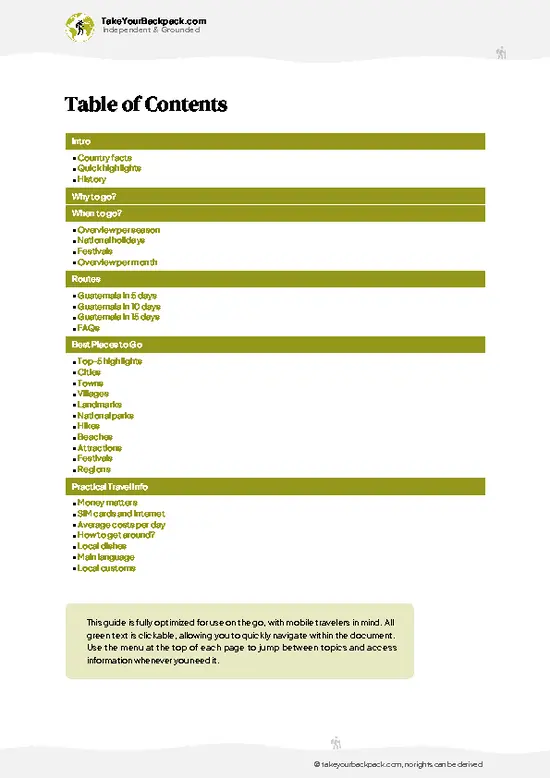
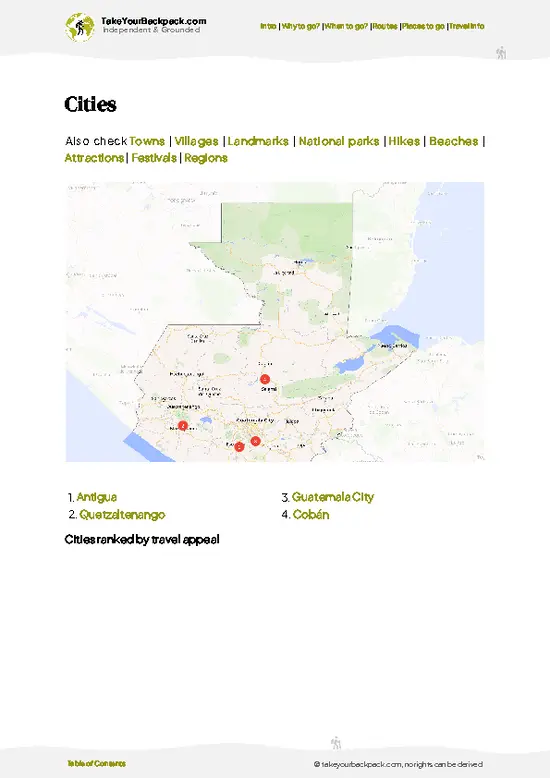
example page 2 from our offline Travel Guide for Guatemala
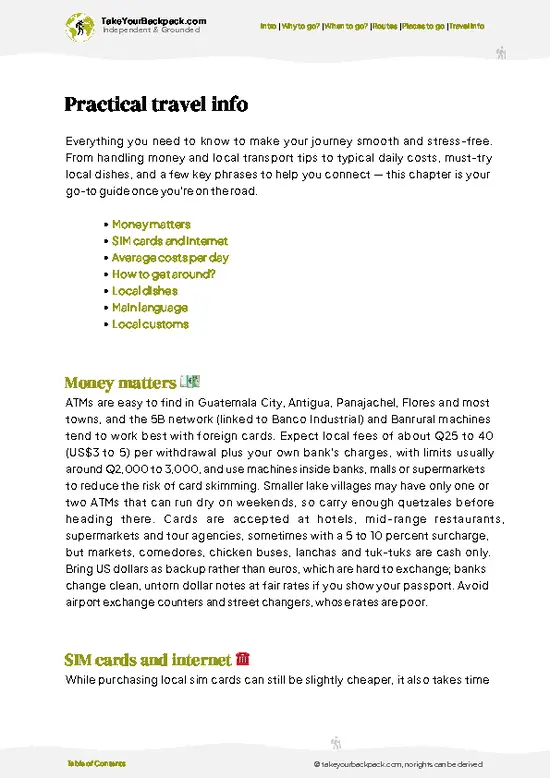
example page 3 from our offline Travel Guide for Guatemala
example page 4 from our offline Travel Guide for Guatemala
example page 5 from our offline Travel Guide for Guatemala
example page 6 from our offline Travel Guide for Guatemala
example page 7 from our offline Travel Guide for Guatemala
The digital guide (272 pages) contains:
✅ 85 highlights, ranked by travel appeal
✅ Optimized 5, 10 & 15-day travel routes
✅ Cities, national parks, landmarks, beaches
✅ How to get around
✅ Offline-friendly for travel without Wi-Fi
👉 Click to see all 30+ guide features

📅 Plan smarter in minutes, not weeks
✅ Month by month travel advice
✅ Festivals & national holidays
✅ Budget expectations

🗺️ Go to the right places, skip the overrated ones
✅ Honest pros & cons of destinations
✅ Top hikes, parks & viewpoints
✅ Lesser-known places most travelers miss
✅ Clear “worth it vs skip it” guidance

🛏️ Travel smoothly without rookie mistakes
✅ Best areas to stay
✅ Transport systems explained simply
✅ Common scams & safety advice
✅ SIM cards, money & practical tips

🌍 Understand the country, not just visit it
✅ Culture & traditions
✅ 52 Essential phrases & customs
✅ Festivals worth planning around
✅ Traveler-friendly historical context
✅ Insights that make places more meaningful

📱 Built for real travel conditions
✅ Fully downloadable PDF
✅ Works completely offline
✅ Optimized for phone use
✅ Useful in remote areas & buses
✅ Everything in one place
Stop searching, start planning
Get instant access to your full guide. 30‑day money-back guarantee.
+ Add another guide for just

By proceeding you agree to our terms.
Sent to your inbox immediately after payment • 100% Secure Checkout
Best Backpacking Travel Advisor 2025 tourism awardBest Backpacking
Travel Advisor
2025
What others say about Take Your Backpack Guides:
⭐⭐⭐⭐⭐
Fantastic, amazing amount of information!
⭐⭐⭐⭐⭐
My goodness this is amazing, it's what I've been looking for hats off too you!
⭐⭐⭐⭐⭐
I think this is absolutely BRILLIANT
⭐⭐⭐⭐
Very complete and informative. It's still missing places, but I gotta to commend you
⭐⭐⭐⭐⭐
This is truly amazing, thank you, can't wait to explore it with my kids!
⭐⭐⭐⭐⭐
Awesome resource, thank you!
⭐⭐⭐⭐⭐
This is amazing! Can't wait to explore the ones I haven't seen
⭐⭐⭐⭐
I love this! Well done, great idea.
⭐⭐⭐⭐⭐
Thanks for taking the time to make this gem!
⭐⭐⭐⭐⭐
This might be the best website I've ever seen.
⭐⭐⭐⭐⭐
Congratulations, and thank you so much for your work; it's incredibly valuable.
⭐⭐⭐⭐
In all seriousness I think you did a great job pointing out the important spots
⭐⭐⭐⭐⭐
10/10 very good
⭐⭐⭐⭐⭐
As someone who's only just starting to visit regularly this is awesome, thank you.
⭐⭐⭐⭐
Thank you very much! I'm going to visit my dad, it's going to be very useful!
⭐⭐⭐⭐⭐
This is really cool! We'll be travelling for the first time and this definitely come in handy.
⭐⭐⭐⭐⭐
You are now our minister of culture, congratulations 👨‍💼
⭐⭐⭐⭐⭐
Just wanted to tell you that this is a pearl! Going to follow your recommendations.
⭐⭐⭐⭐⭐
This is so cool. I'll definitely be using the resource for my travels soon.
⭐⭐⭐⭐⭐
This is very impressive! Good work.
⭐⭐⭐⭐⭐
This is an amazing and informative site. Very well done!

🛏️ Where to stay?Best Places to Stay in Guatemala

Hostels and budget beds are easy to find in Guatemala, with dorms typically running Q80 to 150 (US$10 to 20) and simple private rooms from about Q200 (US$26), clustered in a handful of traveler hubs. Antigua has the widest choice within walking distance of its cobbled center, bars and volcano-tour operators, though prices run highest here and some hostels near the central streets stay loud late into the night. At Lake Atitlán, San Pedro La Laguna is the cheap, social base with plenty of nightlife, San Marcos La Laguna is quieter and leans toward yoga retreats, while Flores works as the compact island gateway to Tikal and Guatemala City’s Zona 10 and Zona 13 are the safer picks for an airport … read more 👉
Hostels and budget beds are easy to find in Guatemala, with dorms typically running Q80 to 150 (US$10 to 20) and simple private rooms from about Q200 (US$26), clustered in a handful of traveler hubs. Antigua has the widest choice within walking distance of its cobbled center, bars and volcano-tour operators, though prices run highest here and some hostels near the central streets stay loud late into the night. At Lake Atitlán, San Pedro La Laguna is the cheap, social base with plenty of nightlife, San Marcos La Laguna is quieter and leans toward yoga retreats, while Flores works as the compact island gateway to Tikal and Guatemala City’s Zona 10 and Zona 13 are the safer picks for an airport night compared with the grittier Zona 1.

If you enjoy meeting fellow travelers, consider choosing hostels with high ratings for atmosphere. On the other hand, if you prefer having your own space, a hotel might be a better option.

GuatemalaExplore Guatemala

👋 Meet the founderWho’s Behind Take Your Backpack?

Johan, backpacker and founder of TakeYourBackpackHi, I’m Johan (Netherlands 🇳🇱), the creator of TakeYourBackpack. Over the past 3 decades, I’ve backpacked through 90+ countries across six continents, gaining extensive experience with independent travel, long-term trips, and overland routes.

This site is built on a combination of firsthand travel experience and carefully curated insights from other backpackers. Many guides are based on places I’ve personally visited, while others bring together tips, observations, and practical advice shared by trusted travelers I’ve met along the way.

The goal is to provide realistic, experience-driven guidance — not generic itineraries — so you can explore destinations with better context, clearer expectations, and more confidence.