×

Guatemala🇬🇹 | best citiesExplore the 4 Best cities in Guatemala

Cities in Guatemala are smaller, louder and more textured than most visitors expect. Cobbled colonial streets in the highlands smell of woodsmoke, roasting corn and diesel from chicken buses, while the lowlands and the Caribbean coast bring heat, humidity and the drone of cicadas. The western highlands sit cool at 1,500 to 2,300 meters and draw most backpackers, so they are easiest to reach and busiest. The capital region is a sprawl of traffic and concrete, and the northern lowlands need long rides on rough roads but have far fewer crowds. Costs stay low everywhere, and independent travel works well, as shuttles link the main hubs daily.

By Johan Kruseman 🇳🇱 | Updated October 23, 2026
Explore the best towns in Guatemala

Why go?What Makes Them Special

Guatemala packs a surprising range of urban life into a country about the size of Tennessee. The reason is geography: a chain of volcanoes and high valleys runs through the middle, so settlements grew in cool, fertile basins rather than on one coast. Spanish colonial grids, built over and beside Maya communities, still hold the ground today. Streets are paved with uneven stone, markets sell hand-woven textiles in the colors of each village, and Kaqchikel, K’iche’ and other Mayan languages are heard as often as Spanish in the highlands.
The same geography has a price. Earthquakes and volcanic activity have shaped and shattered towns for centuries, and many ruined churches stand roofless as proof. Roads twist through mountains, so distances that look short on a map can take hours. Public transport … read more 👉
Guatemala packs a surprising range of urban life into a country about the size of Tennessee. The reason is geography: a chain of volcanoes and high valleys runs through the middle, so settlements grew in cool, fertile basins rather than on one coast. Spanish colonial grids, built over and beside Maya communities, still hold the ground today. Streets are paved with uneven stone, markets sell hand-woven textiles in the colors of each village, and Kaqchikel, K’iche’ and other Mayan languages are heard as often as Spanish in the highlands.
The same geography has a price. Earthquakes and volcanic activity have shaped and shattered towns for centuries, and many ruined churches stand roofless as proof. Roads twist through mountains, so distances that look short on a map can take hours. Public transport means crowded, painted chicken buses and minibus shuttles, which are cheap, loud and sometimes slow.
Before choosing Guatemala for its cities, know that the sights are more about atmosphere and history than polish. Expect pickpockets in busy markets, uneven pavements, power cuts in rural areas and cash-based transactions. Carry small bills, as many places do not take cards. In return you get one of Latin America’s most affordable and culturally intact urban circuits.
How the List Was Created
The list of best cities in Guatemala is created based on culture, vibe, attractions, transport ease, and local charm. If you feel a city is missing in this list, please let us know.

When to go?Seasonal Guide to Visiting

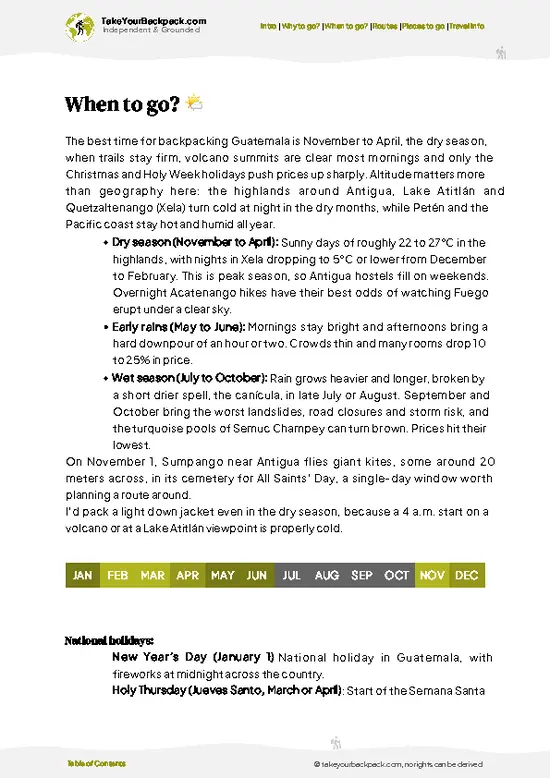
Best months and weather: The best months for cities in Guatemala are November to April, the dry season, when highland days are sunny and clear at roughly 20 to 25°C, and skies show volcano outlines at dawn. Nights in the highlands at 1,500 to 2,300 meters drop to 5 to 12°C, so cobbled streets feel cold in the morning and you will want a fleece. In the lowlands and on the Caribbean side, daytime heat of 30 to 35°C is common year-round, with thick humidity.
Shoulder and rainy seasons: May to October is the rainy season. Mornings are often bright, then clouds build and heavy downpours arrive in the afternoon, rattling tin roofs and turning stone lanes slick. Rainfall in the highlands can reach 1,000 to 2,000 mm across the season, and more on the Caribbean side, where it rains in every month. May … read more 👉
Best months and weather: The best months for cities in Guatemala are November to April, the dry season, when highland days are sunny and clear at roughly 20 to 25°C, and skies show volcano outlines at dawn. Nights in the highlands at 1,500 to 2,300 meters drop to 5 to 12°C, so cobbled streets feel cold in the morning and you will want a fleece. In the lowlands and on the Caribbean side, daytime heat of 30 to 35°C is common year-round, with thick humidity.
Shoulder and rainy seasons: May to October is the rainy season. Mornings are often bright, then clouds build and heavy downpours arrive in the afternoon, rattling tin roofs and turning stone lanes slick. Rainfall in the highlands can reach 1,000 to 2,000 mm across the season, and more on the Caribbean side, where it rains in every month. May and October are the wettest shoulder months for travel, and landslides can slow roads. September and October tend to be the wettest, while June to August often brings a short, drier spell known as the “canícula”.
Peak periods and prices: Peaks are Holy Week (March or April), when processions carpet streets with colored sawdust and rooms book out weeks ahead, and the Christmas to New Year period. Prices for dorm beds and private rooms can rise by 30 to 100 percent in those weeks. Outside them, rainy-season rates are easy to bargain down.

city hoppingHow to Combine cities Into One Trip

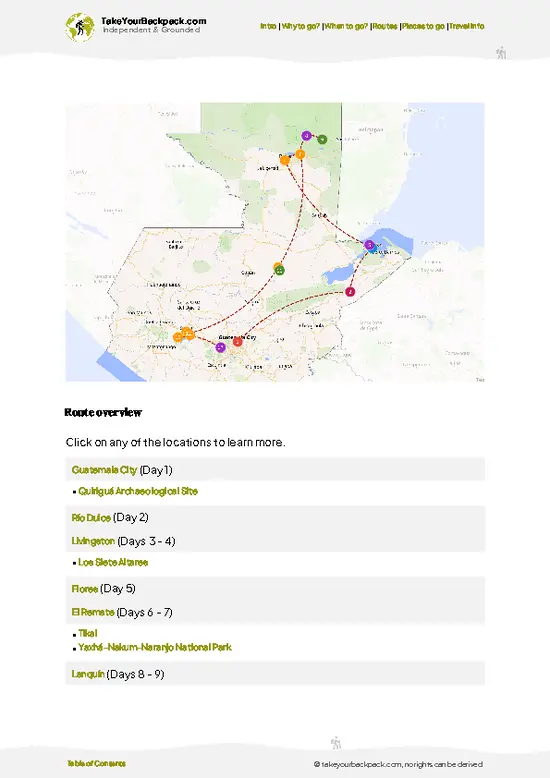
How long to allow: A trip combining several cities in Guatemala needs 10 to 14 days, which gives each stop room to breathe without constant packing. The country’s main clusters are the western highlands around Lake Atitlán and Quetzaltenango, the central colonial valley near the capital, and the northern lowlands toward Petén and the Belize border. Highland stops link easily, and the capital works as the transport hub where long routes begin and end.
Direction and timing: Travel from the central valley west through the highlands, then loop back toward the capital and head north or east. Allow 2 to 3 nights per highland stop, and more only if you plan language classes or volcano hikes. Shuttles between neighboring highland hubs take 2 to 4 hours, and links between the highlands and the capital … read more 👉
How long to allow: A trip combining several cities in Guatemala needs 10 to 14 days, which gives each stop room to breathe without constant packing. The country’s main clusters are the western highlands around Lake Atitlán and Quetzaltenango, the central colonial valley near the capital, and the northern lowlands toward Petén and the Belize border. Highland stops link easily, and the capital works as the transport hub where long routes begin and end.
Direction and timing: Travel from the central valley west through the highlands, then loop back toward the capital and head north or east. Allow 2 to 3 nights per highland stop, and more only if you plan language classes or volcano hikes. Shuttles between neighboring highland hubs take 2 to 4 hours, and links between the highlands and the capital take 3 to 5 hours. Reaching the northern lowlands is a longer commitment, usually 8 to 10 hours by road or a short flight of about an hour from the capital.
Common planning mistakes: The most frequent error is cramming: trying to cover highlands, north and coast in a week, then spending half of it on bumpy minibus seats. Pick two regions instead. Another is traveling after dark, when roads are slower and riskier, so aim to arrive by mid-afternoon. Many travelers also forget that mountain roads can close in heavy rain, so leave a buffer day before any flight or border crossing.

The ListHighly Recommended cities of Guatemala

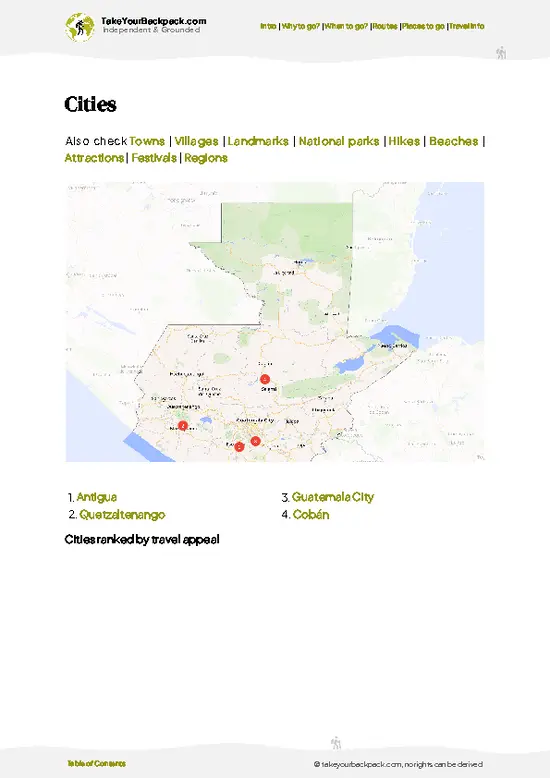
1 Antigua

Yellow arch, volcano views, convent ruins, cobbled streets

Wander cobbled blocks past baroque church cloisters and convent ruins, then climb a hill at sunrise for the grid below and the volcano behind.

guatemala-city-antigua
© Google | Nelson Gonzalez

2 Quetzaltenango

Xela, Spanish schools, steam baths, cemetery colors

Settle in for language classes, then sit in a volcanic steam cell, browse the daily market and watch the plaza turn gold by late afternoon.

guatemala-city-quetzaltenango
© Google | Luis Rodríguez

3 Guatemala City

Maya jade, Zona 4 cafés, relief map, Zona 1 markets

Spend days in serious museums of Maya artifacts and highland weaving, then head to Zona 4 for murals, coffee and evening drinks.

4 Cobán

Cardamom farms, orchids, Verapaz market, drizzle

Tour a working coffee and cardamom farm, browse a fragrant market run by Q’eqchi’ and Poqomchi’ vendors, and walk pine forest trails on the edge of town.

guatemala-city-coban
© Google | Tujaal Radio
Loading the map 🌍

Expert viewInsights from Locals and Experts

How many cities to visit: Three to five cities is the right number for a backpacker in Guatemala. The roads climb and twist through volcanic country, so every transfer eats a half day, and the places repay slower stays of two or three nights, where you can wander markets and eat from street stalls at dusk. More than five turns the trip into a blur of shuttle windows and dusty backpacks.
Choosing the kind of city: Colonial towns suit first-timers and anyone who wants cobbled streets, cafés, Spanish classes and easy shuttle links. Highland market cities suit travelers seeking indigenous culture, with woven textiles, incense smoke and a Mayan language spoken beside Spanish, though comforts are fewer and nights are cold. Lowland and northern hubs are best for ruin-hunters willing to trade comfort … read more 👉
How many cities to visit: Three to five cities is the right number for a backpacker in Guatemala. The roads climb and twist through volcanic country, so every transfer eats a half day, and the places repay slower stays of two or three nights, where you can wander markets and eat from street stalls at dusk. More than five turns the trip into a blur of shuttle windows and dusty backpacks.
Choosing the kind of city: Colonial towns suit first-timers and anyone who wants cobbled streets, cafés, Spanish classes and easy shuttle links. Highland market cities suit travelers seeking indigenous culture, with woven textiles, incense smoke and a Mayan language spoken beside Spanish, though comforts are fewer and nights are cold. Lowland and northern hubs are best for ruin-hunters willing to trade comfort for heat, jungle noise and far fewer crowds. The capital is a transit point more than a destination for most budget travelers. Mix one of each kind and you get contrast without exhaustion.
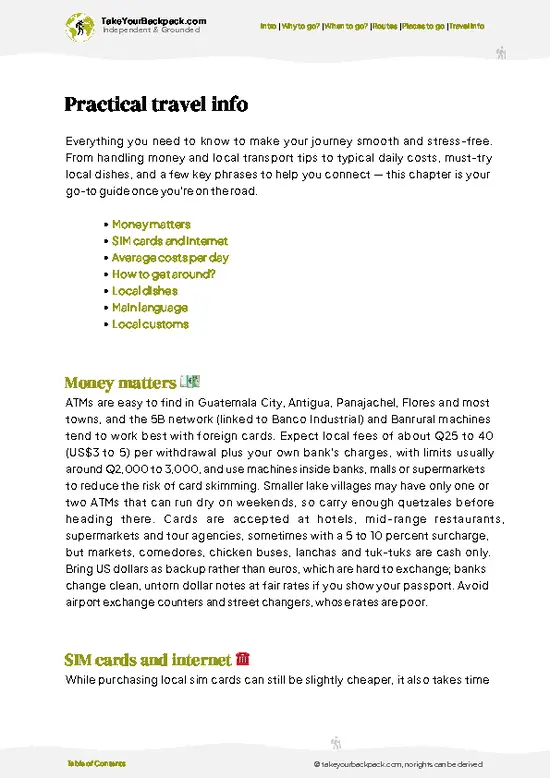
What it costs: Budget US$25 to 40 a day for dorms or simple private rooms (US$8 to 20), set meals at local comedores (US$3 to 6), and shuttles or chicken buses between cities (US$3 to 20 depending on distance). Museum and site entry fees are usually US$2 to 10, though major archaeological parks cost more, often US$20 to 25 for foreigners. Guided walking tours run US$10 to 25, and volcano hikes with a guide US$10 to 30. Per city visit, plan US$40 to 100 including a night or two, food, one guide and local transport. ATMs are common in larger towns, but cash in quetzales (roughly 7.7 to the US dollar) is king in markets.
Safety and culture: Petty theft is the main risk, so keep phones out of sight on crowded buses and in markets. Use tourist shuttles or registered taxis at night and avoid walking empty streets after dark, especially in the capital. Ask before photographing people, especially in indigenous communities, where some prefer not to be photographed, and expect to pay a small fee or buy something in return. Dress modestly in churches and during processions, stay quiet in ceremonies, and learn a few Spanish greetings, as a simple “buenos días” opens doors. Carry a copy of your passport, not the original, and a small flashlight for power cuts and cobbled alleys.

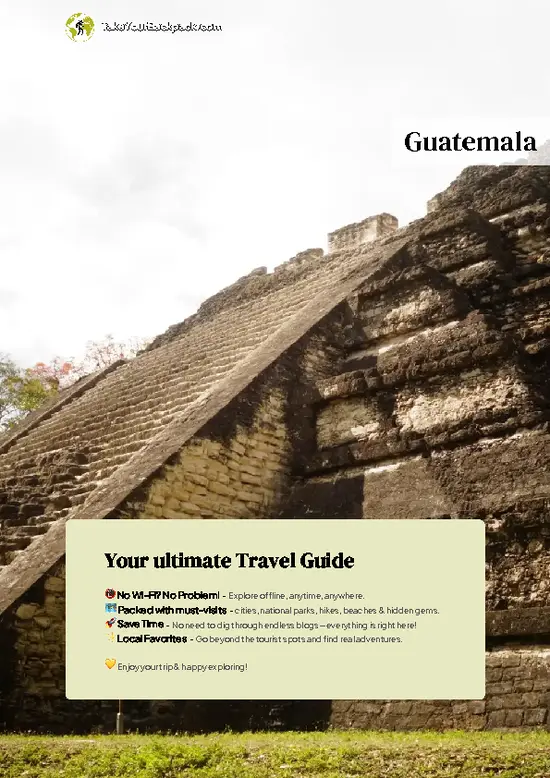
✈️ The backpacker research shortcutGuatemala Travel Guide

An offline-friendly backpacking guide with optimized travel routes, ranked highlights, transport advice, and the best areas to stay.
example page 0 from our offline Travel Guide for Guatemala
example page 1 from our offline Travel Guide for Guatemala
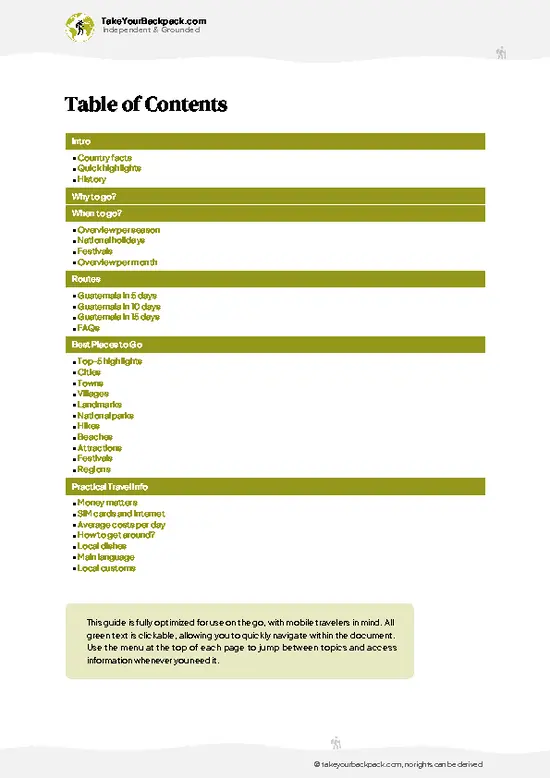
example page 2 from our offline Travel Guide for Guatemala
example page 3 from our offline Travel Guide for Guatemala
example page 4 from our offline Travel Guide for Guatemala
example page 5 from our offline Travel Guide for Guatemala
example page 6 from our offline Travel Guide for Guatemala
example page 7 from our offline Travel Guide for Guatemala
The digital guide (272 pages) contains:
✅ 85 highlights, ranked by travel appeal
✅ Optimized 5, 10 & 15-day travel routes
✅ Cities, national parks, landmarks, beaches
✅ How to get around
✅ Offline-friendly for travel without Wi-Fi
👉 Click to see all 30+ guide features

📅 Plan smarter in minutes, not weeks
✅ Month by month travel advice
✅ Festivals & national holidays
✅ Budget expectations

🗺️ Go to the right places, skip the overrated ones
✅ Honest pros & cons of destinations
✅ Top hikes, parks & viewpoints
✅ Lesser-known places most travelers miss
✅ Clear “worth it vs skip it” guidance

🛏️ Travel smoothly without rookie mistakes
✅ Best areas to stay
✅ Transport systems explained simply
✅ Common scams & safety advice
✅ SIM cards, money & practical tips

🌍 Understand the country, not just visit it
✅ Culture & traditions
✅ 52 Essential phrases & customs
✅ Festivals worth planning around
✅ Traveler-friendly historical context
✅ Insights that make places more meaningful

📱 Built for real travel conditions
✅ Fully downloadable PDF
✅ Works completely offline
✅ Optimized for phone use
✅ Useful in remote areas & buses
✅ Everything in one place
Stop searching, start planning
Get instant access to your full guide. 30‑day money-back guarantee.
+ Add another guide for just

By proceeding you agree to our terms.
Sent to your inbox immediately after payment • 100% Secure Checkout
Best Backpacking Travel Advisor 2025 tourism awardBest Backpacking
Travel Advisor
2025
What others say about Take Your Backpack Guides:
⭐⭐⭐⭐⭐
Fantastic, amazing amount of information!
⭐⭐⭐⭐⭐
My goodness this is amazing, it's what I've been looking for hats off too you!
⭐⭐⭐⭐⭐
I think this is absolutely BRILLIANT
⭐⭐⭐⭐
Very complete and informative. It's still missing places, but I gotta to commend you
⭐⭐⭐⭐⭐
This is truly amazing, thank you, can't wait to explore it with my kids!
⭐⭐⭐⭐⭐
Awesome resource, thank you!
⭐⭐⭐⭐⭐
This is amazing! Can't wait to explore the ones I haven't seen
⭐⭐⭐⭐
I love this! Well done, great idea.
⭐⭐⭐⭐⭐
Thanks for taking the time to make this gem!
⭐⭐⭐⭐⭐
This might be the best website I've ever seen.
⭐⭐⭐⭐⭐
Congratulations, and thank you so much for your work; it's incredibly valuable.
⭐⭐⭐⭐
In all seriousness I think you did a great job pointing out the important spots
⭐⭐⭐⭐⭐
10/10 very good
⭐⭐⭐⭐⭐
As someone who's only just starting to visit regularly this is awesome, thank you.
⭐⭐⭐⭐
Thank you very much! I'm going to visit my dad, it's going to be very useful!
⭐⭐⭐⭐⭐
This is really cool! We'll be travelling for the first time and this definitely come in handy.
⭐⭐⭐⭐⭐
You are now our minister of culture, congratulations 👨‍💼
⭐⭐⭐⭐⭐
Just wanted to tell you that this is a pearl! Going to follow your recommendations.
⭐⭐⭐⭐⭐
This is so cool. I'll definitely be using the resource for my travels soon.
⭐⭐⭐⭐⭐
This is very impressive! Good work.
⭐⭐⭐⭐⭐
This is an amazing and informative site. Very well done!

🛏️ Where to stay?Accommodation Highlights

Hostels and budget beds are easy to find in Guatemala, with dorms typically running Q80 to 150 (US$10 to 20) and simple private rooms from about Q200 (US$26), clustered in a handful of traveler hubs. Antigua has the widest choice within walking distance of its cobbled center, bars and volcano-tour operators, though prices run highest here and some hostels near the central streets stay loud late into the night. At Lake Atitlán, San Pedro La Laguna is the cheap, social base with plenty of nightlife, San Marcos La Laguna is quieter and leans toward yoga retreats, while Flores works as the compact island gateway to Tikal and Guatemala City’s Zona 10 and Zona 13 are the safer picks for an airport … read more 👉
Hostels and budget beds are easy to find in Guatemala, with dorms typically running Q80 to 150 (US$10 to 20) and simple private rooms from about Q200 (US$26), clustered in a handful of traveler hubs. Antigua has the widest choice within walking distance of its cobbled center, bars and volcano-tour operators, though prices run highest here and some hostels near the central streets stay loud late into the night. At Lake Atitlán, San Pedro La Laguna is the cheap, social base with plenty of nightlife, San Marcos La Laguna is quieter and leans toward yoga retreats, while Flores works as the compact island gateway to Tikal and Guatemala City’s Zona 10 and Zona 13 are the safer picks for an airport night compared with the grittier Zona 1.

If you enjoy meeting fellow travelers, consider choosing hostels with high ratings for atmosphere. On the other hand, if you prefer having your own space, a hotel might be a better option.

GuatemalaSee More of Guatemala

👋 Meet the founderWho’s Behind Take Your Backpack?

Johan, backpacker and founder of TakeYourBackpackHi, I’m Johan (Netherlands 🇳🇱), the creator of TakeYourBackpack. Over the past 3 decades, I’ve backpacked through 90+ countries across six continents, gaining extensive experience with independent travel, long-term trips, and overland routes.

This site is built on a combination of firsthand travel experience and carefully curated insights from other backpackers. Many guides are based on places I’ve personally visited, while others bring together tips, observations, and practical advice shared by trusted travelers I’ve met along the way.

The goal is to provide realistic, experience-driven guidance — not generic itineraries — so you can explore destinations with better context, clearer expectations, and more confidence.