×

Guatemala🇬🇹 | best attractionsExplore the 10 Best attractions in Guatemala

Attractions in Guatemala are mostly outdoor, physical and cultural: volcano ridges at dawn, jungle ruins where howler monkeys roar before sunrise, and Maya markets smelling of copal smoke and woodsmoke tortillas. The mood shifts sharply by region. The Western Highlands are cool, textured and crowded on market days, with cheap entry and chicken buses at your elbow. The Petén lowlands are hot, humid and far away, so access costs more time or money. Antigua is easy and polished, while remote areas ask for patience on rough roads. Independent travelers can reach most sites with shuttles and local buses, and many experiences cost less than US$15.

By Johan Kruseman 🇳🇱 | Updated October 23, 2026
Explore the best festivals in Guatemala

Why go?What Makes Them Special

Guatemala packs an unusual amount into a small country, roughly the size of Tennessee. The reason is geography and history. A chain of volcanoes runs along the Pacific side, the highlands hold some of the Americas’ largest living Maya communities, and the northern lowlands hide the ruins of a civilization that peaked more than a thousand years ago. Traditions here are not staged. Languages such as K’iche’ and Kaqchikel are still spoken daily, and weaving patterns, saints’ festivals and market rhythms continue because they never stopped.

That living culture comes with rules. Photographing people without asking can cause real offense, and some communities restrict cameras in churches or ceremonies. Altitude matters too: highland nights drop close to freezing, so the cold, damp mornings are … read more 👉
Guatemala packs an unusual amount into a small country, roughly the size of Tennessee. The reason is geography and history. A chain of volcanoes runs along the Pacific side, the highlands hold some of the Americas’ largest living Maya communities, and the northern lowlands hide the ruins of a civilization that peaked more than a thousand years ago. Traditions here are not staged. Languages such as K’iche’ and Kaqchikel are still spoken daily, and weaving patterns, saints’ festivals and market rhythms continue because they never stopped.

That living culture comes with rules. Photographing people without asking can cause real offense, and some communities restrict cameras in churches or ceremonies. Altitude matters too: highland nights drop close to freezing, so the cold, damp mornings are part of the deal, while the lowlands trade that for sticky heat and mud. Infrastructure is uneven. Tourist corridors have smooth shuttles and good hostels, but mountain roads are winding, landslides happen in the rainy season, and distances that look short on a map can eat half a day. Before choosing Guatemala, expect effort and unpredictability alongside very low prices and deep cultural contact. Early starts, small cash and flexible plans make everything easier.
Why These Made the Cut
The list of best attractions in Guatemala is created based on cultural significance or entertainment value. If you feel a attraction is missing in this list, please let us know.

When to go?Seasonal Guide to Visiting

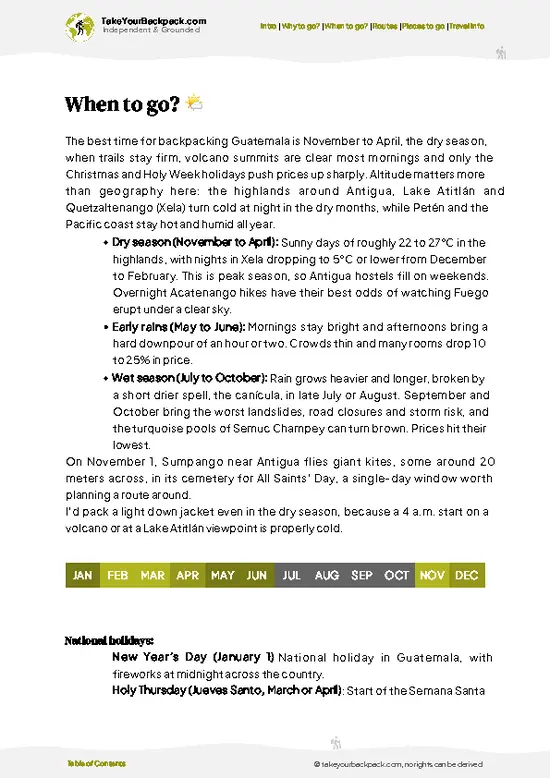
Best months and weather: The best months for attractions in Guatemala are November to April, the dry season, when skies are clear for volcano views and trails and jungle tracks are firmer underfoot. Highland days reach roughly 20 to 25°C, but nights in places like Quetzaltenango or around Lake Atitlán can fall to 3 to 8°C, so you will want a real fleece. The Petén lowlands and the Caribbean side are far hotter, often 30 to 38°C by March and April, with heavy humidity that makes midday climbing slow.
Shoulder and rainy season: The rainy season runs about May to October. Mornings are often clear, then afternoon storms roll in, turning dirt roads to brown slurry and hiding summits in cloud. Rainfall in the highlands is often 1,000 to 2,000 mm a year, and much more on the Caribbean slope and in … read more 👉
Best months and weather: The best months for attractions in Guatemala are November to April, the dry season, when skies are clear for volcano views and trails and jungle tracks are firmer underfoot. Highland days reach roughly 20 to 25°C, but nights in places like Quetzaltenango or around Lake Atitlán can fall to 3 to 8°C, so you will want a real fleece. The Petén lowlands and the Caribbean side are far hotter, often 30 to 38°C by March and April, with heavy humidity that makes midday climbing slow.
Shoulder and rainy season: The rainy season runs about May to October. Mornings are often clear, then afternoon storms roll in, turning dirt roads to brown slurry and hiding summits in cloud. Rainfall in the highlands is often 1,000 to 2,000 mm a year, and much more on the Caribbean slope and in the north. May and October are workable shoulder months with fewer people and lower hostel prices.
Peaks and prices: Crowds and costs rise around Semana Santa (March or April), when Antigua fills and rooms can double in price or sell out weeks ahead. Christmas and New Year are also busy. Late December and early January bring the clearest air. For quiet visits with good light, aim for November or early December.

attraction hoppingHow to Combine attractions Into One Trip

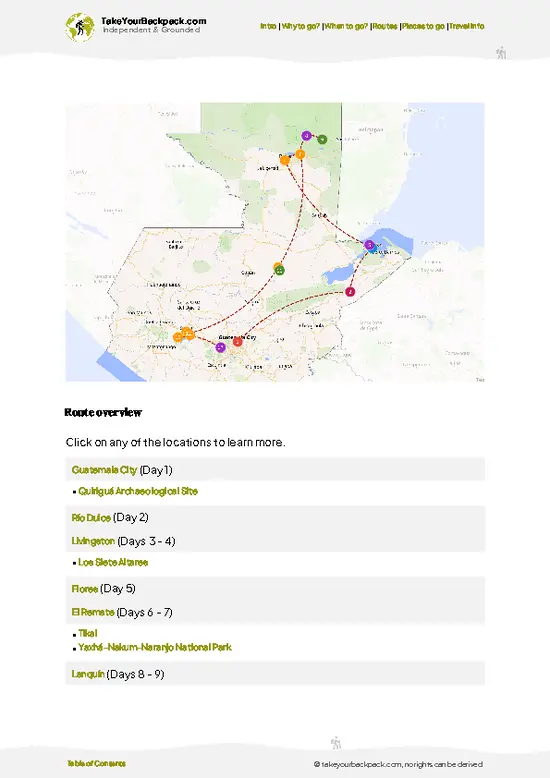
How long you need: A trip linking several attractions in Guatemala needs 10 to 16 days, and 14 gives you room to breathe. The country is compact but roads are slow, so plan around regions rather than distance.
Regions and direction: The Western Highlands cluster naturally around Guatemala City, Antigua, Lake Atitlán and Quetzaltenango. Start in Antigua, which is 1 to 1.5 hours from the airport by shuttle, then move west to the lake (about 2.5 to 3 hours) and on to Quetzaltenango (about 3 to 4 hours). From there, loop back through the central highlands toward the northeast. Then head to the Petén lowlands, ending near Flores. The overnight bus from Guatemala City takes about 8 to 10 hours, while a short domestic flight takes about 1 hour and saves a day. The Caribbean coast and Río Dulce sit … read more 👉
How long you need: A trip linking several attractions in Guatemala needs 10 to 16 days, and 14 gives you room to breathe. The country is compact but roads are slow, so plan around regions rather than distance.
Regions and direction: The Western Highlands cluster naturally around Guatemala City, Antigua, Lake Atitlán and Quetzaltenango. Start in Antigua, which is 1 to 1.5 hours from the airport by shuttle, then move west to the lake (about 2.5 to 3 hours) and on to Quetzaltenango (about 3 to 4 hours). From there, loop back through the central highlands toward the northeast. Then head to the Petén lowlands, ending near Flores. The overnight bus from Guatemala City takes about 8 to 10 hours, while a short domestic flight takes about 1 hour and saves a day. The Caribbean coast and Río Dulce sit between the highlands and Petén, adding 1 to 2 days.
Time per stop and common mistakes: Allow 2 to 4 days in each highland base and 2 to 3 days in Petén. A frequent mistake is cramming a new town every night. Shuttles leave early, mountain roads wind slowly, and the diesel fumes and swaying will wear you down. Pick fewer bases and use day trips. Another error is crossing the country in the rainy season without buffer time, since landslides can add hours. Keep a spare day. Travel in daylight, as night road conditions and security are poorer.

The ListHighly Recommended attractions of Guatemala

1 Quiriguá Archaeological Site

Stela E, carved zoomorphs, ceiba shade, Motagua valley

Walk a forest path to towering carved monoliths and boulder sculptures, with howler monkeys and birdsong sounding above the grassy plaza.

guatemala-attraction-quirigua-archaeological-site
© Google |

2 Casa Santo Domingo

Convent ruins, candlelit chapel, peacock lawns, crypt walkways

Wander through the broken vaults of a 17th-century convent, then go below ground to the crypts before the garden courtyards fill with weekend crowds.

3 Museo Nacional de Arqueología y Etnología

Stelae hall, jade masks, Tikal model, La Aurora grounds

Read glyph panels up close, see a scale model of Tikal, and trace village identity through textiles and dance masks in one morning.

guatemala-attraction-museo-nacional-de-arqueologia-y-etnologia
© Google |

4 Museo Popol Vuh

Funerary urns, incense burners, cacao vases, university campus

Look into the fanged faces of ceramic braziers and jaguar-god urns, then trace colonial silver and highland weavings across a compact collection.

guatemala-attraction-museo-popol-vuh
© Google |

5 Museo Ixchel del Traje Indígena

Huipil comparisons, backstrap looms, natural dyes, village dialects

Compare blouse patterns from dozens of highland communities and learn how cochineal and indigo colored the thread before you go shopping.

6 Museo Miraflores

Kaminaljuyú pottery, obsidian blades, mall-side mound, Zone 11

Examine painted vessels, jade ornaments and razor-sharp obsidian from the buried highland city, then spot a grassy platform beside the shopping center.

guatemala-attraction-museo-miraflores
© Google |

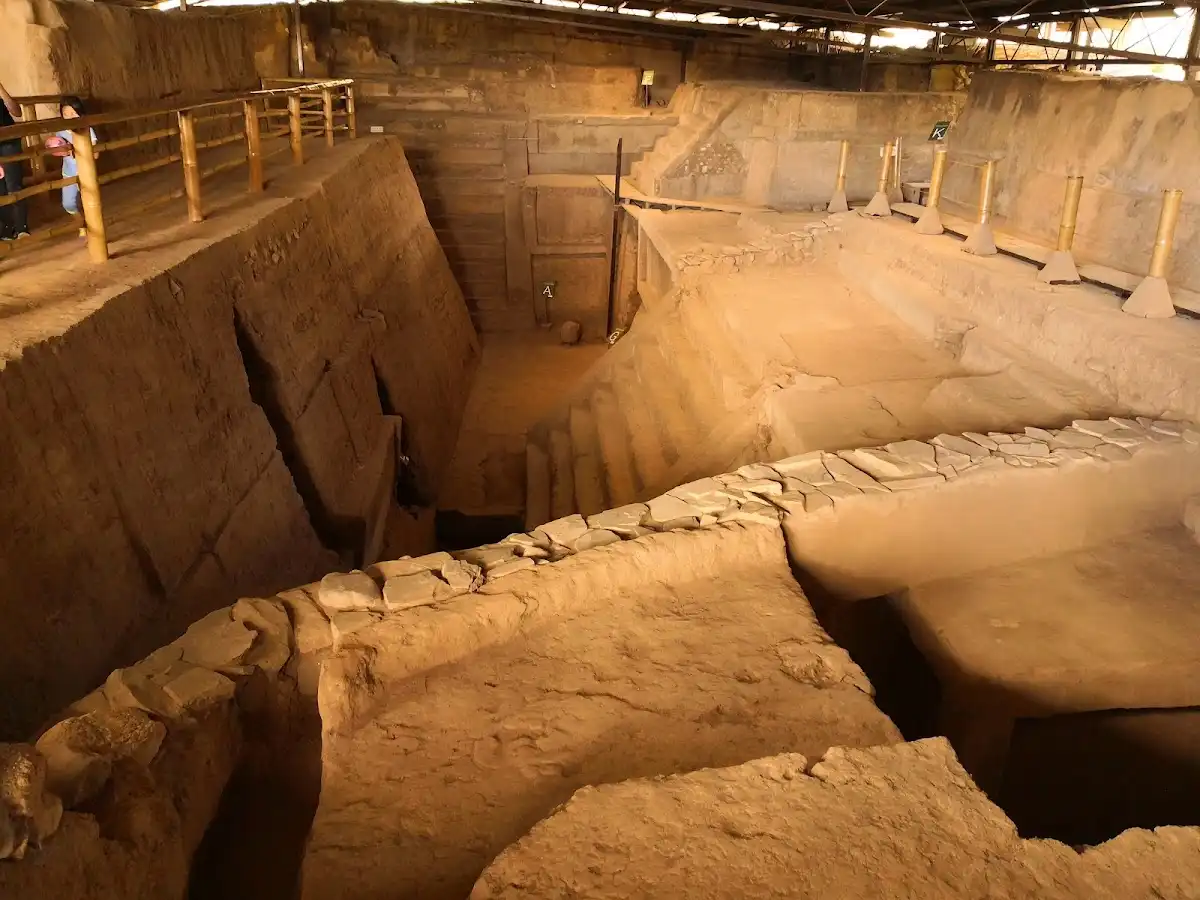
7 Kaminaljuyú

Earthen mounds, carved stelae, Zone 7 ruins, tomb finds

Begin at the museum to decode the grassy mounds, then walk among ancient platforms surrounded by modern city neighborhoods and early highland carvings.

guatemala-attraction-kaminaljuyu
© Google |

8 Palacio Nacional de la Cultura

Green facade, reception hall, stained glass, Mudéjar fountains

Join a guided tour through grand halls, courtyards and presidential salons, then look across Plaza de la Constitución from the upper level.

guatemala-attraction-palacio-nacional-de-la-cultura
© Google |

9 Museo del Libro Antiguo

Colonial printing press, antique manuscripts, Ayuntamiento courtyard, Parque Central arcades

Study handwritten pages and the wooden press that produced colonial decrees, then step out under the arcades facing the central square.

10 Catedral Metropolitana de Santiago

Neoclassical facade, names on columns, Plaza Mayor, Sunday Mass

Step inside the cathedral to find a cool, quiet nave, and read the names of civil war victims written across the outer columns.

11 Museo de Arte Moderno Carlos Mérida

Mérida color blocks, modernist canvases, sculpture rooms, rotating shows

Compare bold Maya-inspired abstraction with 20th-century Guatemalan painting in bright, quiet galleries, and check the Monday closure before you walk over.

12 Museo del Ferrocarril FEGUA

Steam locomotives, rail yards, restored coaches, Zone 1 station

Stand beside hulking black engines, climb into old passenger cars, and follow a guide through the railway's story toward the Atlantic coast.

13 Centro Cultural Miguel Ángel Asturias

Hilltop theaters, Centro Cívico, San José fort, open-air amphitheater

Catch a symphony, ballet or chamber concert on a hilltop, then walk the terraces for rooftop views over Zone 1 and distant volcanoes.

14 Museo Regional del Sureste de Petén

Carved stelae, Ixkun and Ixtutz monuments, Maya ceramics, Dolores stop on CA-13

Study weathered limestone stelae from southeast Petén sites, then compare painted bowls and stone tools before visiting the nearby Ixtonton ruin.

Think you know Guatemala?

Prove you’re a true local — uncover 4 lesser-known attractions in Guatemala that locals tend to keep to themselves.
Loading the map 🌍

Expert viewInsights from Locals and Experts

How many to choose: Plan on one major attraction every two or three days, so about 5 to 7 on a two-week trip. Highland roads are slow, many sights start before dawn, and your body needs time for altitude and heat. Fewer, longer visits mean more time for a market lunch of fresh tortillas and black beans, and for the quiet hours when tour groups leave and the light turns gold.
Choosing by travel style: If you love hiking, put volcano and highland trails first. They are physical, cold at the start and sweaty by the end, and you earn a view over cloud and crater. If history is your pull, prioritize Maya ruins, where the shade, bird calls and stone steps make heat bearable. If you want culture, spend time in highland villages and markets, where color, haggling and the smell of grilled corn make … read more 👉
How many to choose: Plan on one major attraction every two or three days, so about 5 to 7 on a two-week trip. Highland roads are slow, many sights start before dawn, and your body needs time for altitude and heat. Fewer, longer visits mean more time for a market lunch of fresh tortillas and black beans, and for the quiet hours when tour groups leave and the light turns gold.
Choosing by travel style: If you love hiking, put volcano and highland trails first. They are physical, cold at the start and sweaty by the end, and you earn a view over cloud and crater. If history is your pull, prioritize Maya ruins, where the shade, bird calls and stone steps make heat bearable. If you want culture, spend time in highland villages and markets, where color, haggling and the smell of grilled corn make it feel alive. For relaxed travelers, lake towns and colonial streets give an easier pace, with uneven cobbles and good coffee.
What it costs: Budget about US$30 to 50 a day including dorm beds, local food and entry fees, rising to US$60 to 90 with private rooms and guided trips. Entry fees range from a few quetzales for small sites to roughly Q150 to 250 (about US$20 to 33) for major archaeological parks for foreigners. A guide for a volcano hike usually costs US$10 to 20, often required for safety, and sunrise hikes can add US$10 to 15 for transport. Shuttles between tourist hubs run about US$10 to 25, while chicken buses cost under US$2 to 5 but are crowded and slower. Carry small bills in quetzales, as many small sites and market stalls do not take cards.
Safety and respect: Use registered guides on volcano trails, where armed robberies have occurred on unaccompanied hikes. Go with groups, start early, and keep valuables minimal. Avoid travel after dark, and book shuttles rather than flagging random vehicles. Ask before photographing people, particularly children, and dress modestly in churches and ceremonies. In sacred spaces, ritual fires and incense are active worship rather than performances, so stand back and stay quiet. Buying directly from weavers is a fair way to leave money in the community, and it earns you a textile with real stories in its threads.

✈️ The backpacker research shortcutGuatemala Travel Guide

An offline-friendly backpacking guide with optimized travel routes, ranked highlights, transport advice, and the best areas to stay.
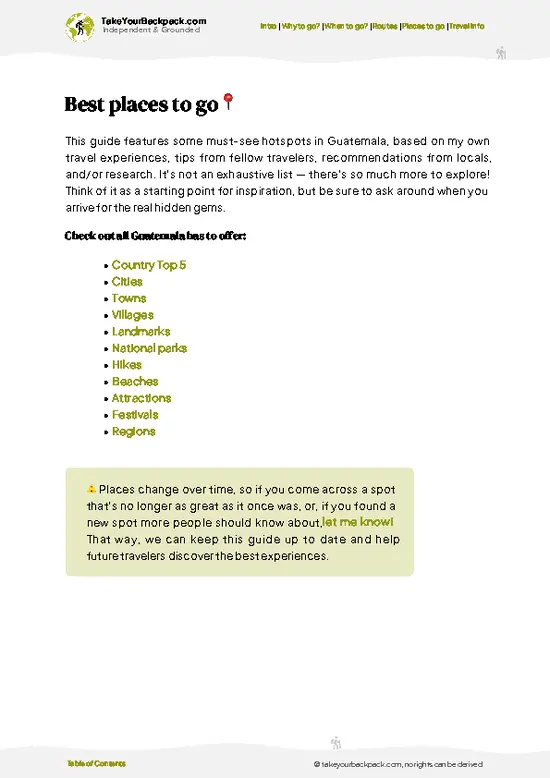
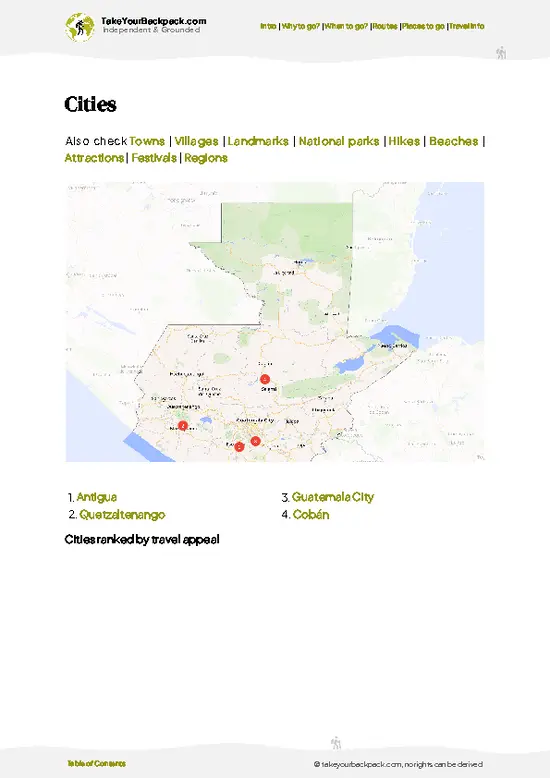
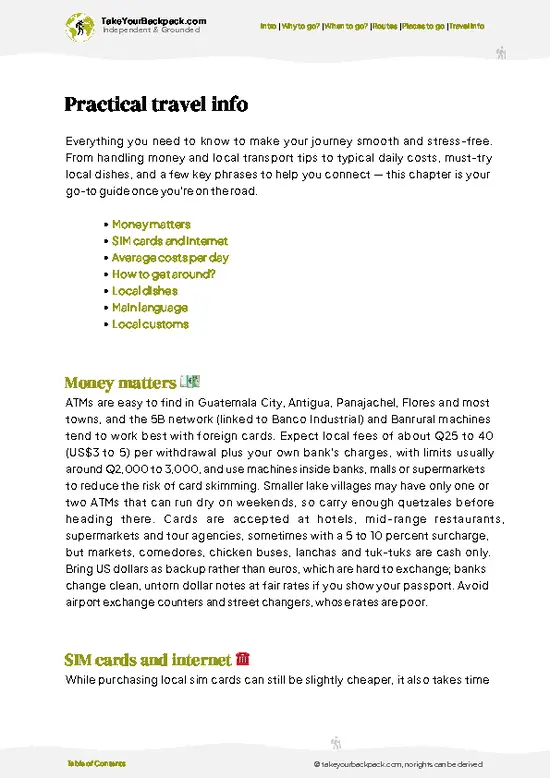
example page 0 from our offline Travel Guide for Guatemala
example page 1 from our offline Travel Guide for Guatemala
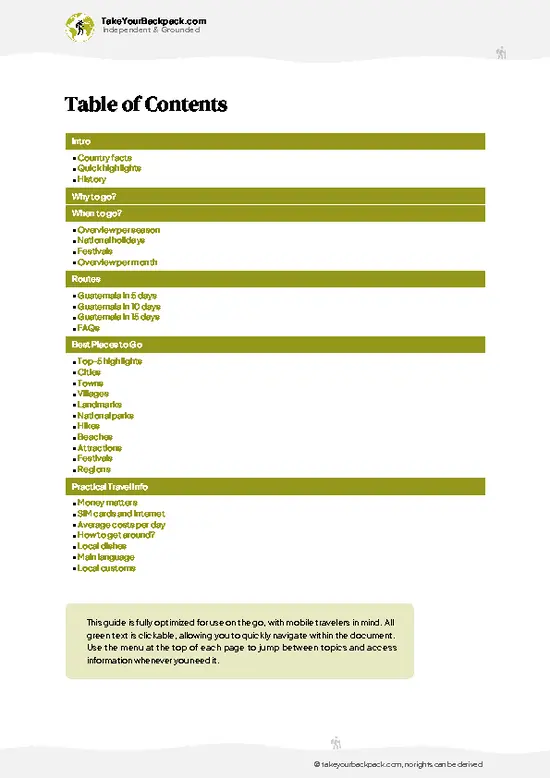
example page 2 from our offline Travel Guide for Guatemala
example page 3 from our offline Travel Guide for Guatemala
example page 4 from our offline Travel Guide for Guatemala
example page 5 from our offline Travel Guide for Guatemala
example page 6 from our offline Travel Guide for Guatemala
example page 7 from our offline Travel Guide for Guatemala
The digital guide (272 pages) contains:
✅ 85 highlights, ranked by travel appeal
✅ Optimized 5, 10 & 15-day travel routes
✅ Cities, national parks, landmarks, beaches
✅ How to get around
✅ Offline-friendly for travel without Wi-Fi
👉 Click to see all 30+ guide features

📅 Plan smarter in minutes, not weeks
✅ Month by month travel advice
✅ Festivals & national holidays
✅ Budget expectations

🗺️ Go to the right places, skip the overrated ones
✅ Honest pros & cons of destinations
✅ Top hikes, parks & viewpoints
✅ Lesser-known places most travelers miss
✅ Clear “worth it vs skip it” guidance

🛏️ Travel smoothly without rookie mistakes
✅ Best areas to stay
✅ Transport systems explained simply
✅ Common scams & safety advice
✅ SIM cards, money & practical tips

🌍 Understand the country, not just visit it
✅ Culture & traditions
✅ 52 Essential phrases & customs
✅ Festivals worth planning around
✅ Traveler-friendly historical context
✅ Insights that make places more meaningful

📱 Built for real travel conditions
✅ Fully downloadable PDF
✅ Works completely offline
✅ Optimized for phone use
✅ Useful in remote areas & buses
✅ Everything in one place
Stop searching, start planning
Get instant access to your full guide. 30‑day money-back guarantee.
+ Add another guide for just

By proceeding you agree to our terms.
Sent to your inbox immediately after payment • 100% Secure Checkout
Best Backpacking Travel Advisor 2025 tourism awardBest Backpacking
Travel Advisor
2025
What others say about Take Your Backpack Guides:
⭐⭐⭐⭐⭐
Fantastic, amazing amount of information!
⭐⭐⭐⭐⭐
My goodness this is amazing, it's what I've been looking for hats off too you!
⭐⭐⭐⭐⭐
I think this is absolutely BRILLIANT
⭐⭐⭐⭐
Very complete and informative. It's still missing places, but I gotta to commend you
⭐⭐⭐⭐⭐
This is truly amazing, thank you, can't wait to explore it with my kids!
⭐⭐⭐⭐⭐
Awesome resource, thank you!
⭐⭐⭐⭐⭐
This is amazing! Can't wait to explore the ones I haven't seen
⭐⭐⭐⭐
I love this! Well done, great idea.
⭐⭐⭐⭐⭐
Thanks for taking the time to make this gem!
⭐⭐⭐⭐⭐
This might be the best website I've ever seen.
⭐⭐⭐⭐⭐
Congratulations, and thank you so much for your work; it's incredibly valuable.
⭐⭐⭐⭐
In all seriousness I think you did a great job pointing out the important spots
⭐⭐⭐⭐⭐
10/10 very good
⭐⭐⭐⭐⭐
As someone who's only just starting to visit regularly this is awesome, thank you.
⭐⭐⭐⭐
Thank you very much! I'm going to visit my dad, it's going to be very useful!
⭐⭐⭐⭐⭐
This is really cool! We'll be travelling for the first time and this definitely come in handy.
⭐⭐⭐⭐⭐
You are now our minister of culture, congratulations 👨‍💼
⭐⭐⭐⭐⭐
Just wanted to tell you that this is a pearl! Going to follow your recommendations.
⭐⭐⭐⭐⭐
This is so cool. I'll definitely be using the resource for my travels soon.
⭐⭐⭐⭐⭐
This is very impressive! Good work.
⭐⭐⭐⭐⭐
This is an amazing and informative site. Very well done!

🛏️ Where to stay?Top Places to Consider Staying

Hostels and budget beds are easy to find in Guatemala, with dorms typically running Q80 to 150 (US$10 to 20) and simple private rooms from about Q200 (US$26), clustered in a handful of traveler hubs. Antigua has the widest choice within walking distance of its cobbled center, bars and volcano-tour operators, though prices run highest here and some hostels near the central streets stay loud late into the night. At Lake Atitlán, San Pedro La Laguna is the cheap, social base with plenty of nightlife, San Marcos La Laguna is quieter and leans toward yoga retreats, while Flores works as the compact island gateway to Tikal and Guatemala City’s Zona 10 and Zona 13 are the safer picks for an airport … read more 👉
Hostels and budget beds are easy to find in Guatemala, with dorms typically running Q80 to 150 (US$10 to 20) and simple private rooms from about Q200 (US$26), clustered in a handful of traveler hubs. Antigua has the widest choice within walking distance of its cobbled center, bars and volcano-tour operators, though prices run highest here and some hostels near the central streets stay loud late into the night. At Lake Atitlán, San Pedro La Laguna is the cheap, social base with plenty of nightlife, San Marcos La Laguna is quieter and leans toward yoga retreats, while Flores works as the compact island gateway to Tikal and Guatemala City’s Zona 10 and Zona 13 are the safer picks for an airport night compared with the grittier Zona 1.

If you enjoy meeting fellow travelers, consider choosing hostels with high ratings for atmosphere. On the other hand, if you prefer having your own space, a hotel might be a better option.

GuatemalaMore Places Across Guatemala

👋 Meet the founderWho’s Behind Take Your Backpack?

Johan, backpacker and founder of TakeYourBackpackHi, I’m Johan (Netherlands 🇳🇱), the creator of TakeYourBackpack. Over the past 3 decades, I’ve backpacked through 90+ countries across six continents, gaining extensive experience with independent travel, long-term trips, and overland routes.

This site is built on a combination of firsthand travel experience and carefully curated insights from other backpackers. Many guides are based on places I’ve personally visited, while others bring together tips, observations, and practical advice shared by trusted travelers I’ve met along the way.

The goal is to provide realistic, experience-driven guidance — not generic itineraries — so you can explore destinations with better context, clearer expectations, and more confidence.