×

Guatemala🇬🇹 | best regionsExplore the 2 Best regions in Guatemala

Guatemala packs wildly different worlds into a country the size of Tennessee. The highlands smell of woodsmoke and fresh tortillas, with chilly mornings and market days loud with K’iche’ and Kaqchikel. The Petén lowlands are thick, wet and screeching with howler monkeys at dawn. The Caribbean coast and the Pacific slope run hot, humid and far less visited. Costs, crowds and ease of access shift sharply between them: gringo-trail towns have shuttles every hour, while remote corners mean chicken buses and long, bumpy dirt roads. For backpacking and independent travel, that contrast is the whole point of choosing a region.

By Johan Kruseman 🇳🇱 | Updated October 23, 2026
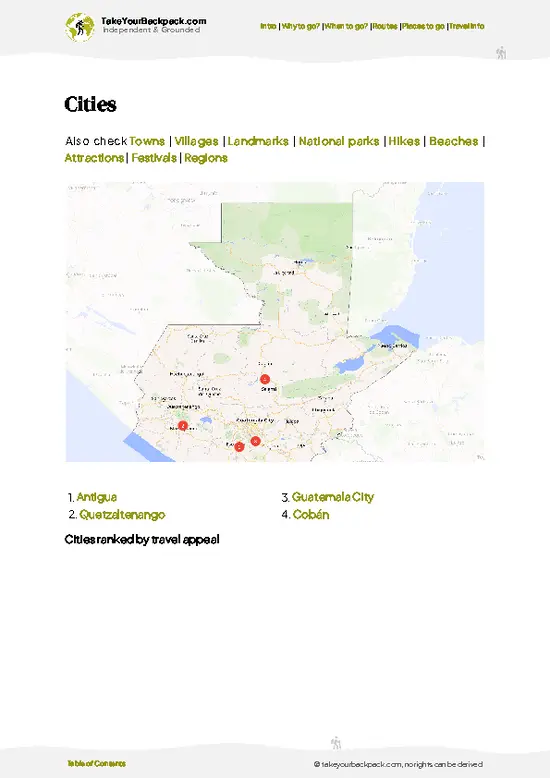
Explore the best cities in Guatemala

Why go?What Makes Them Special

Guatemala stacks geography, history and living culture into a small space. A spine of volcanoes climbs past 4,000 meters, and within a day you can drop from cool pine forest to sticky jungle or black-sand coast. That altitude range sets everything: temperature, what grows, what people wear and how long a bus ride feels.

Half the population is Maya, and about two dozen languages are spoken. Weaving patterns, market rhythms and religious ceremonies still differ village to village, so regional identity is real and visible, not staged. Ancient cities rise out of the rainforest canopy, and Spanish colonial streets of cobblestone and faded pastel walls sit beside active volcanoes that rumble and glow.

Before choosing Guatemala, know that infrastructure is uneven. Tourist shuttles connect the main … read more 👉
Guatemala stacks geography, history and living culture into a small space. A spine of volcanoes climbs past 4,000 meters, and within a day you can drop from cool pine forest to sticky jungle or black-sand coast. That altitude range sets everything: temperature, what grows, what people wear and how long a bus ride feels.

Half the population is Maya, and about two dozen languages are spoken. Weaving patterns, market rhythms and religious ceremonies still differ village to village, so regional identity is real and visible, not staged. Ancient cities rise out of the rainforest canopy, and Spanish colonial streets of cobblestone and faded pastel walls sit beside active volcanoes that rumble and glow.

Before choosing Guatemala, know that infrastructure is uneven. Tourist shuttles connect the main hubs comfortably, but anywhere off that circuit relies on crowded converted school buses, mountain switchbacks and slow journeys, and landslides can close roads in rainy months. Distances look short on the map but take hours. In return, prices stay low, and the tourist trail is compact enough that you can reach very different environments without flying. Bring patience, small bills and layers, because the same day can swing from shivering to sweating.
How the List Was Created
The list of best regions in Guatemala is created based on landscapes, local culture, attractions, vibes, and overall appeal. If you feel a region is missing in this list, please let us know.

When to go?Seasonal Guide to Visiting

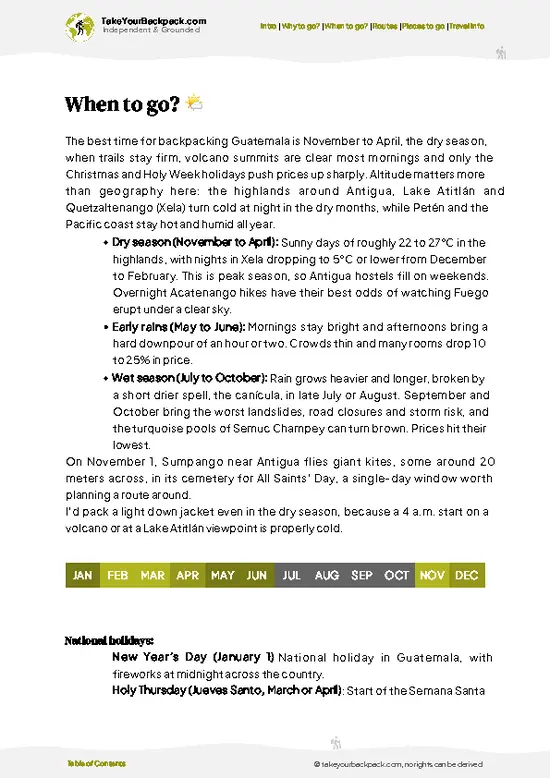
Best months: The best months are November to April, the dry season, when skies are clear, roads are dependable and volcano views are sharp at sunrise. Highland days reach roughly 20 to 25°C, but nights at altitude can drop to near freezing in December and January, so pack a real jacket.
Rainy season and shoulders: From May to October, afternoon downpours arrive almost daily, usually after a bright morning. Mornings are the time for hikes and climbs, and by late afternoon clouds sit on the ridges. Rainfall in the highlands runs in the range of 1,000 to 2,000 mm for the year, while the northern lowlands and Caribbean side are far wetter and stay hot and humid at 28 to 35°C. May and October are the shoulder months, with fewer people, green hillsides and some muddy trails. Road delays and landslides … read more 👉
Best months: The best months are November to April, the dry season, when skies are clear, roads are dependable and volcano views are sharp at sunrise. Highland days reach roughly 20 to 25°C, but nights at altitude can drop to near freezing in December and January, so pack a real jacket.
Rainy season and shoulders: From May to October, afternoon downpours arrive almost daily, usually after a bright morning. Mornings are the time for hikes and climbs, and by late afternoon clouds sit on the ridges. Rainfall in the highlands runs in the range of 1,000 to 2,000 mm for the year, while the northern lowlands and Caribbean side are far wetter and stay hot and humid at 28 to 35°C. May and October are the shoulder months, with fewer people, green hillsides and some muddy trails. Road delays and landslides become more likely in September and October.
Peaks and prices: Crowds and prices rise around Semana Santa (the week before Easter) and over Christmas and New Year, when popular towns fill up and dorm beds and rooms can cost noticeably more, often 20 to 50 percent. Book ahead for those weeks. Outside them, you can usually find a bed on arrival. The Pacific coast is hottest from March to May, so beach time suits the cooler dry months better.

region hoppingHow to Combine regions Into One Trip

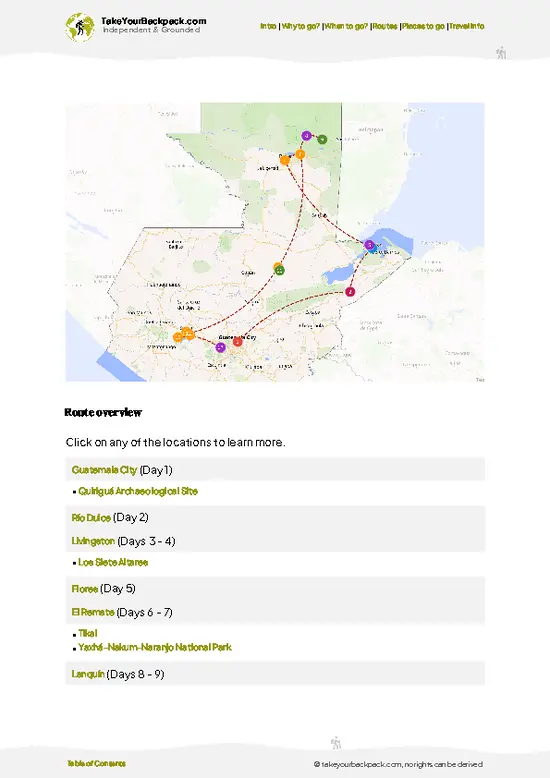
How long to allow: A trip linking several regions in Guatemala needs 10 to 21 days; under 10 days, stick to two areas. Most people do best starting in Guatemala City or Antigua, working through the highlands and finishing in the north or on the Caribbean side, or the reverse if you fly into Flores.
Time per stop and transfers: Give each stop 2 to 4 days. Highland hops by shuttle usually take 2 to 4 hours, with hubs such as Antigua, Panajachel and Quetzaltenango linked by daily minibuses. Chicken buses are cheaper but slow, and the cabin smells of diesel, fruit and sweat. The long haul to the northern lowlands is 8 to 12 hours by road from the capital, so many travelers take a 1-hour domestic flight to Flores or an overnight first-class bus. The Caribbean side adds a long day too, often 5 to … read more 👉
How long to allow: A trip linking several regions in Guatemala needs 10 to 21 days; under 10 days, stick to two areas. Most people do best starting in Guatemala City or Antigua, working through the highlands and finishing in the north or on the Caribbean side, or the reverse if you fly into Flores.
Time per stop and transfers: Give each stop 2 to 4 days. Highland hops by shuttle usually take 2 to 4 hours, with hubs such as Antigua, Panajachel and Quetzaltenango linked by daily minibuses. Chicken buses are cheaper but slow, and the cabin smells of diesel, fruit and sweat. The long haul to the northern lowlands is 8 to 12 hours by road from the capital, so many travelers take a 1-hour domestic flight to Flores or an overnight first-class bus. The Caribbean side adds a long day too, often 5 to 6 hours from the capital, plus boat time.
Planning mistakes: The classic error is trusting map distance. A 150 km stretch can eat half a day on winding roads, so treat one long transfer per two days as a ceiling. Another is cramming every region into a week and spending it on buses. Pick fewer places and stay longer. Travel in the morning, because afternoon rain and fog slow the mountain roads, and leave a buffer day before any international flight home.

The ListHighly Recommended regions of Guatemala

1 Río Dulce

Jungle gorge, sailboat moorings, Garifuna coast, hot springs

Ride a lancha between sheer green cliffs, then sleep aboard a moored sailboat or continue by water to Livingston’s Garifuna kitchens.

guatemala-region-rio-dulce
© Google | Simone

2 Lake Izabal

Stilt villages, Q’eqchi’ farms, manatee mangroves, public launches

Cross a humid freshwater basin by public launch, swimming off wooden docks and soaking in hot springs near fishing towns and quiet shore villages.

guatemala-region-lake-izabal
© Google | Nixon Galvez
Loading the map 🌍

Expert viewInsights from Locals and Experts

How many regions to visit: I advise three regions for a trip of two to three weeks, and two for anything shorter. Guatemala’s roads are slow and winding, so each added region costs a day of bus time rather than a day of exploring. Three gives you contrast, say cool mountain air, then humid jungle, without spending the trip staring through a dusty window.
Prioritizing by travel style: If you love culture and textiles, favor the highlands: Mayan markets with the clatter of bargaining, the smell of copal incense and women in hand-woven huipiles. If you want ruins and wildlife, prioritize the northern lowlands, where sunrise over the jungle canopy comes with howler monkey roars. For volcano hikes and adventure, choose the volcanic belt, where you scramble over loose ash and finish with sulfur-scented … read more 👉
How many regions to visit: I advise three regions for a trip of two to three weeks, and two for anything shorter. Guatemala’s roads are slow and winding, so each added region costs a day of bus time rather than a day of exploring. Three gives you contrast, say cool mountain air, then humid jungle, without spending the trip staring through a dusty window.
Prioritizing by travel style: If you love culture and textiles, favor the highlands: Mayan markets with the clatter of bargaining, the smell of copal incense and women in hand-woven huipiles. If you want ruins and wildlife, prioritize the northern lowlands, where sunrise over the jungle canopy comes with howler monkey roars. For volcano hikes and adventure, choose the volcanic belt, where you scramble over loose ash and finish with sulfur-scented steam and a view across cloud banks. Beach seekers should treat the coasts as a slower, hotter, less polished add-on rather than the main event.
What it costs: A frugal backpacker spends US$25 to 40 a day: dorm beds at US$6 to 12, street meals at US$2 to 4, shuttles at US$10 to 20 per leg. Mid-range comfort runs US$50 to 80. Budget for entry fees too, since the major ruin site costs about 150 quetzales (roughly US$20), volcano hikes run US$10 to 25 with a required local guide, and a domestic flight to the north costs roughly US$100 to 200 return. Carry quetzales in small notes, because markets and chicken buses rarely break large bills.
Safety and etiquette: Use tourist shuttles or first-class buses for long hauls, avoid night driving, and keep phones and cameras tucked away on crowded buses and in capital streets. Hike popular volcanoes with a registered guide or group, and start early to avoid afternoon storms and robbery risk on quieter trails. In Mayan communities, ask before photographing people, particularly children and market vendors; a smile and a small purchase often turn a no into a yes. Dress modestly in churches and ceremony spaces, and keep a respectful distance during processions. Tap water is not safe, so refill from large purified jugs. Take a first-hand tip from me: pack a warm layer even for a beach trip, since highland dawns bite.

✈️ The backpacker research shortcutGuatemala Travel Guide

An offline-friendly backpacking guide with optimized travel routes, ranked highlights, transport advice, and the best areas to stay.
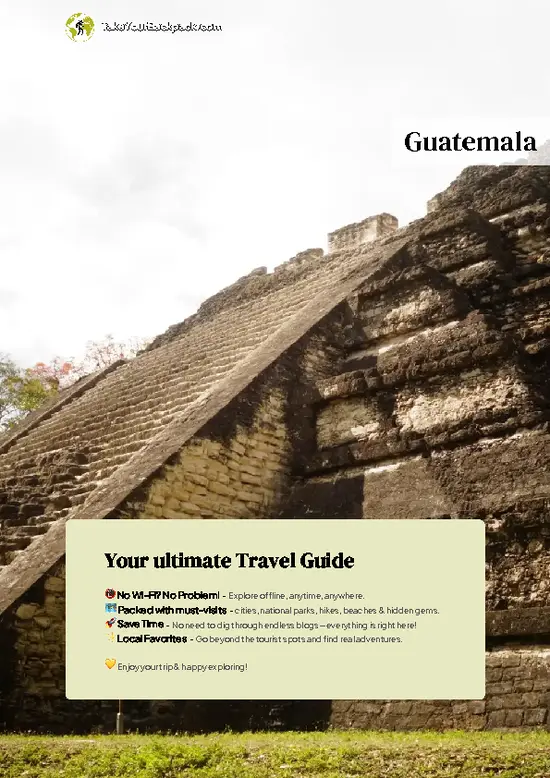
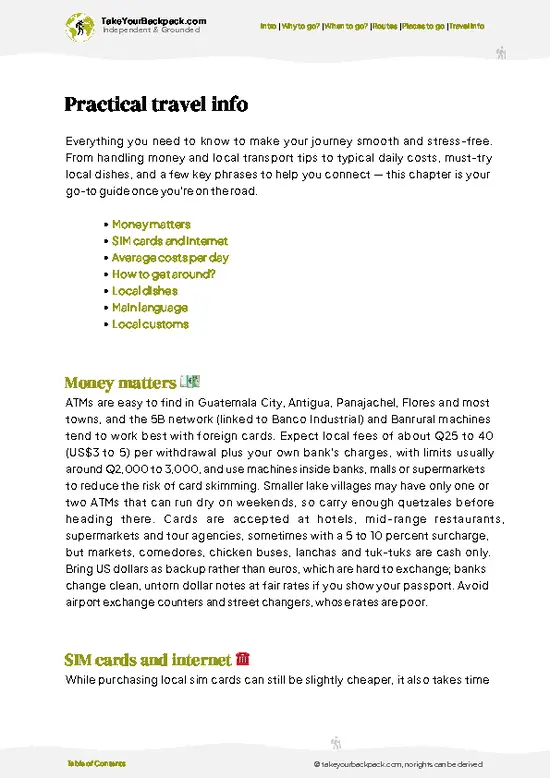
example page 0 from our offline Travel Guide for Guatemala
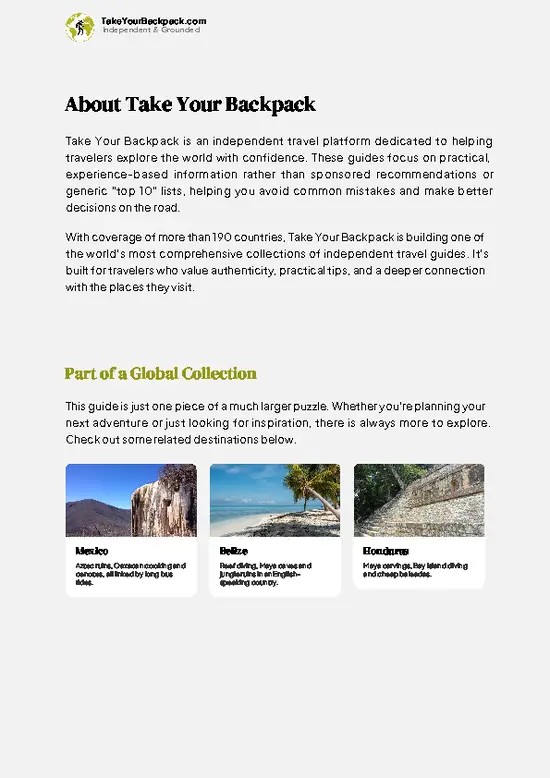
example page 1 from our offline Travel Guide for Guatemala
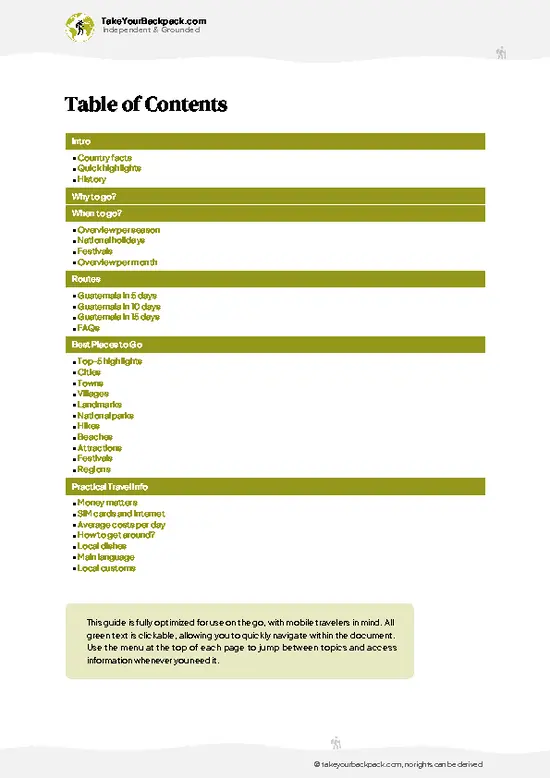
example page 2 from our offline Travel Guide for Guatemala
example page 3 from our offline Travel Guide for Guatemala
example page 4 from our offline Travel Guide for Guatemala
example page 5 from our offline Travel Guide for Guatemala
example page 6 from our offline Travel Guide for Guatemala
example page 7 from our offline Travel Guide for Guatemala
The digital guide (272 pages) contains:
✅ 85 highlights, ranked by travel appeal
✅ Optimized 5, 10 & 15-day travel routes
✅ Cities, national parks, landmarks, beaches
✅ How to get around
✅ Offline-friendly for travel without Wi-Fi
👉 Click to see all 30+ guide features

📅 Plan smarter in minutes, not weeks
✅ Month by month travel advice
✅ Festivals & national holidays
✅ Budget expectations

🗺️ Go to the right places, skip the overrated ones
✅ Honest pros & cons of destinations
✅ Top hikes, parks & viewpoints
✅ Lesser-known places most travelers miss
✅ Clear “worth it vs skip it” guidance

🛏️ Travel smoothly without rookie mistakes
✅ Best areas to stay
✅ Transport systems explained simply
✅ Common scams & safety advice
✅ SIM cards, money & practical tips

🌍 Understand the country, not just visit it
✅ Culture & traditions
✅ 52 Essential phrases & customs
✅ Festivals worth planning around
✅ Traveler-friendly historical context
✅ Insights that make places more meaningful

📱 Built for real travel conditions
✅ Fully downloadable PDF
✅ Works completely offline
✅ Optimized for phone use
✅ Useful in remote areas & buses
✅ Everything in one place
Stop searching, start planning
Get instant access to your full guide. 30‑day money-back guarantee.
+ Add another guide for just

By proceeding you agree to our terms.
Sent to your inbox immediately after payment • 100% Secure Checkout
Best Backpacking Travel Advisor 2025 tourism awardBest Backpacking
Travel Advisor
2025
What others say about Take Your Backpack Guides:
⭐⭐⭐⭐⭐
Fantastic, amazing amount of information!
⭐⭐⭐⭐⭐
My goodness this is amazing, it's what I've been looking for hats off too you!
⭐⭐⭐⭐⭐
I think this is absolutely BRILLIANT
⭐⭐⭐⭐
Very complete and informative. It's still missing places, but I gotta to commend you
⭐⭐⭐⭐⭐
This is truly amazing, thank you, can't wait to explore it with my kids!
⭐⭐⭐⭐⭐
Awesome resource, thank you!
⭐⭐⭐⭐⭐
This is amazing! Can't wait to explore the ones I haven't seen
⭐⭐⭐⭐
I love this! Well done, great idea.
⭐⭐⭐⭐⭐
Thanks for taking the time to make this gem!
⭐⭐⭐⭐⭐
This might be the best website I've ever seen.
⭐⭐⭐⭐⭐
Congratulations, and thank you so much for your work; it's incredibly valuable.
⭐⭐⭐⭐
In all seriousness I think you did a great job pointing out the important spots
⭐⭐⭐⭐⭐
10/10 very good
⭐⭐⭐⭐⭐
As someone who's only just starting to visit regularly this is awesome, thank you.
⭐⭐⭐⭐
Thank you very much! I'm going to visit my dad, it's going to be very useful!
⭐⭐⭐⭐⭐
This is really cool! We'll be travelling for the first time and this definitely come in handy.
⭐⭐⭐⭐⭐
You are now our minister of culture, congratulations 👨‍💼
⭐⭐⭐⭐⭐
Just wanted to tell you that this is a pearl! Going to follow your recommendations.
⭐⭐⭐⭐⭐
This is so cool. I'll definitely be using the resource for my travels soon.
⭐⭐⭐⭐⭐
This is very impressive! Good work.
⭐⭐⭐⭐⭐
This is an amazing and informative site. Very well done!

🛏️ Where to stay?Where to Base Yourself

Hostels and budget beds are easy to find in Guatemala, with dorms typically running Q80 to 150 (US$10 to 20) and simple private rooms from about Q200 (US$26), clustered in a handful of traveler hubs. Antigua has the widest choice within walking distance of its cobbled center, bars and volcano-tour operators, though prices run highest here and some hostels near the central streets stay loud late into the night. At Lake Atitlán, San Pedro La Laguna is the cheap, social base with plenty of nightlife, San Marcos La Laguna is quieter and leans toward yoga retreats, while Flores works as the compact island gateway to Tikal and Guatemala City’s Zona 10 and Zona 13 are the safer picks for an airport … read more 👉
Hostels and budget beds are easy to find in Guatemala, with dorms typically running Q80 to 150 (US$10 to 20) and simple private rooms from about Q200 (US$26), clustered in a handful of traveler hubs. Antigua has the widest choice within walking distance of its cobbled center, bars and volcano-tour operators, though prices run highest here and some hostels near the central streets stay loud late into the night. At Lake Atitlán, San Pedro La Laguna is the cheap, social base with plenty of nightlife, San Marcos La Laguna is quieter and leans toward yoga retreats, while Flores works as the compact island gateway to Tikal and Guatemala City’s Zona 10 and Zona 13 are the safer picks for an airport night compared with the grittier Zona 1.

If you enjoy meeting fellow travelers, consider choosing hostels with high ratings for atmosphere. On the other hand, if you prefer having your own space, a hotel might be a better option.

GuatemalaExpand Your Journey

👋 Meet the founderWho’s Behind Take Your Backpack?

Johan, backpacker and founder of TakeYourBackpackHi, I’m Johan (Netherlands 🇳🇱), the creator of TakeYourBackpack. Over the past 3 decades, I’ve backpacked through 90+ countries across six continents, gaining extensive experience with independent travel, long-term trips, and overland routes.

This site is built on a combination of firsthand travel experience and carefully curated insights from other backpackers. Many guides are based on places I’ve personally visited, while others bring together tips, observations, and practical advice shared by trusted travelers I’ve met along the way.

The goal is to provide realistic, experience-driven guidance — not generic itineraries — so you can explore destinations with better context, clearer expectations, and more confidence.