×

Hungary🇭🇺 | best hikesYour Guide to the 5 Best hikes in Hungary

Hiking in Hungary means low mountains, not alpine drama. The highest point, Kékes in the Mátra, tops out at 1,014 meters, so trails run through beech forest that smells of damp leaf mold, over volcanic ridges, and along dolomite cliffs above the Danube. The northern ranges (Bükk, Mátra, Börzsöny, Pilis) have waymarked paths, hostels and village pubs, and they are the easiest for independent travelers to reach by train from Budapest. The Great Plain and the Balaton uplands trade elevation for open sky, reed beds and vineyard lanes. Costs stay low, crowds thin out on weekdays, and the main hardship is summer heat and ticks.

By Johan Kruseman 🇳🇱 | Updated October 19, 2026
Explore the best beaches in Hungary

Why go?Key Factors That Shape the Experience

Hungary is built for walking rather than climbing, and that shapes everything. The country is mostly basin, ringed by the Carpathian arc to the north and softened by volcanic cones, karst plateaus and the Danube Bend. Elevation gains are modest, so a hike here is a long day through oak and beech forest, with dust underfoot in August and thick clay mud after rain. The big advantage is the Országos Kéktúra, the National Blue Trail, a waymarked line crossing the country with a blue stripe painted on tree trunks and rocks. Hungarian hiking culture is organized and social: clubs, stamp booklets, and trailside huts called kulcsosház where you can sleep cheaply. Signage is reliable, but English is rare off the main routes, and many village shops close early on Saturdays and all day Sunday. National … read more 👉
Hungary is built for walking rather than climbing, and that shapes everything. The country is mostly basin, ringed by the Carpathian arc to the north and softened by volcanic cones, karst plateaus and the Danube Bend. Elevation gains are modest, so a hike here is a long day through oak and beech forest, with dust underfoot in August and thick clay mud after rain. The big advantage is the Országos Kéktúra, the National Blue Trail, a waymarked line crossing the country with a blue stripe painted on tree trunks and rocks. Hungarian hiking culture is organized and social: clubs, stamp booklets, and trailside huts called kulcsosház where you can sleep cheaply. Signage is reliable, but English is rare off the main routes, and many village shops close early on Saturdays and all day Sunday. National parks charge little or nothing, though caves require guided entry. Before choosing Hungary, know that it suits people who like rolling terrain, wine cellars and thermal baths after a walk, and not those chasing high peaks, glaciers or true wilderness. Mobile coverage is good, water is scarce on ridges, and hunting areas can close sections of forest in winter.
How the List Was Created
The list of best hikes in Hungary is created based on scenery, challenge, trail quality, landmarks, and overall enjoyment. If you feel a hike is missing in this list, please let us know.

When to go?Optimal Periods for Travel

Best months for hiking in Hungary: September and October, plus May and early June, are the best months because daytime temperatures sit around 15 to 24°C, the forest is dry enough to be firm underfoot, and the light is low and gold. Spring brings wild garlic smell in the beech woods and fresh green canopy; autumn turns the Bükk and Mátra copper and rust.Summer and shoulder seasons: July and August are hot, often 28 to 35°C in the lowlands, with the Great Plain and Tokaj region baking hardest. Ridges in the northern mountains run roughly 5 to 8 degrees cooler, but shade thins on exposed volcanic slopes and afternoon thunderstorms are common. Start at dawn and carry at least 2 liters of water. Ticks peak from April to October, so long trousers help. Weekends in summer fill Balaton shores and … read more 👉
Best months for hiking in Hungary: September and October, plus May and early June, are the best months because daytime temperatures sit around 15 to 24°C, the forest is dry enough to be firm underfoot, and the light is low and gold. Spring brings wild garlic smell in the beech woods and fresh green canopy; autumn turns the Bükk and Mátra copper and rust.Summer and shoulder seasons: July and August are hot, often 28 to 35°C in the lowlands, with the Great Plain and Tokaj region baking hardest. Ridges in the northern mountains run roughly 5 to 8 degrees cooler, but shade thins on exposed volcanic slopes and afternoon thunderstorms are common. Start at dawn and carry at least 2 liters of water. Ticks peak from April to October, so long trousers help. Weekends in summer fill Balaton shores and Budapest-area trails, and guesthouse prices near the lake rise by 30 to 50 percent in July and August.Winter: December to February brings 0 to minus 8°C in the hills, with snow on Kékes and the Bükk plateau and often thick fog on the lowlands. Some huts and seasonal cafés close, bus frequencies drop, and short daylight (about 8 hours) limits distance. Rainfall averages around 500 to 650 mm a year, heaviest in late spring.

hike hoppingTips for Visiting Multiple Destinations

How many days and which regions to link: A trip combining several hikes in Hungary needs 7 to 10 days, and that includes rest and travel time. The country is small, so the northern ranges group tightly: Budapest, the Danube Bend with Börzsöny and Pilis, then Mátra and Bükk to the northeast, with the Balaton uplands as a separate western leg.Direction and pacing: Start in Budapest, which has the best rail connections, and move outward in a loop. Danube Bend trailheads sit 1 to 2 hours from the capital by suburban train and bus. From there, head east to Gyöngyös or Eger, roughly 1.5 to 2.5 hours by train or bus, and work through the Mátra and Bükk. The Balaton region is 2 to 3 hours from Budapest by train, so finish there or drop it if time runs short. Allow 1 to 2 days per stop, since most … read more 👉
How many days and which regions to link: A trip combining several hikes in Hungary needs 7 to 10 days, and that includes rest and travel time. The country is small, so the northern ranges group tightly: Budapest, the Danube Bend with Börzsöny and Pilis, then Mátra and Bükk to the northeast, with the Balaton uplands as a separate western leg.Direction and pacing: Start in Budapest, which has the best rail connections, and move outward in a loop. Danube Bend trailheads sit 1 to 2 hours from the capital by suburban train and bus. From there, head east to Gyöngyös or Eger, roughly 1.5 to 2.5 hours by train or bus, and work through the Mátra and Bükk. The Balaton region is 2 to 3 hours from Budapest by train, so finish there or drop it if time runs short. Allow 1 to 2 days per stop, since most walks fill 5 to 8 hours and need an early start to catch the last bus.Planning mistakes: Travelers often cram three regions into three days and spend half of each in transit. Pick two regions and use a town base for several nights. Another mistake is trusting weekend transport: rural services thin out sharply on Saturdays and Sundays, and many buses stop by late afternoon. Check the MÁV train and Volánbusz timetables the day before and plan trails that end at a station.

The ListHighly Recommended hikes of Hungary

1 Mátra Mountains

highest peak, volcanic slopes, pine forests

Ascend Hungary’s tallest summit through dense pine stands and volcanic hills, with panoramic lookouts and remote mountain huts along the way.

hungary-hike-matra-mountains
© Google |

2 Pilis Mountains

limestone plateaus, pilgrimage sites, forest trails

Roam through upland forests and rocky outcrops, passing ancient monasteries and caves that have drawn travelers for centuries.

hungary-hike-pilis-mountains
© Google | Péter Bogár

3 Börzsöny Mountains

wild valleys, dense beech woods, wildlife tracks

Navigate steep ravines and thick forests, where elusive wildlife and remote ridgelines offer a sense of seclusion close to Budapest.

hungary-hike-borzsony-mountains
© Google | Tibor Tóth

4 Kőszeg Mountains

border forests, castle views, gentle ridges

Follow winding trails through oak and beech woods, passing medieval fortresses and quiet border villages where Austria meets Hungary.

hungary-hike-koszeg-mountains
© Google |

5 Mecsek Mountains

karst caves, rolling hills, Roman ruins

Traverse limestone ridges and forested slopes, discovering ancient ruins, hidden caves, and the layered history of southern Hungary.

hungary-hike-mecsek-mountains
© Google |
Loading the map 🌍

Expert viewWhat You Should Know

How many hikes to plan: I advise three to five hikes on a first trip. That gives you time to see how different the ranges feel (volcanic Mátra, limestone Bükk, riverside Börzsöny, lakeside Balaton) without burning a day on every transfer. Most walks take 5 to 8 hours, and the last bus often leaves before dusk, so more than one hike a day rarely works.Prioritizing by travel style: Budget walkers and long-distance fans should favor the Blue Trail stages, which are free, well marked and linked to cheap huts. Food and wine lovers do best in Eger, Tokaj and the Balaton uplands, where vineyard paths end at a cellar. Short-trip travelers who want views over history should choose the Danube Bend, easy to reach and busier on weekends. Skip the Great Plain for hiking unless you like flat, open walking … read more 👉
How many hikes to plan: I advise three to five hikes on a first trip. That gives you time to see how different the ranges feel (volcanic Mátra, limestone Bükk, riverside Börzsöny, lakeside Balaton) without burning a day on every transfer. Most walks take 5 to 8 hours, and the last bus often leaves before dusk, so more than one hike a day rarely works.Prioritizing by travel style: Budget walkers and long-distance fans should favor the Blue Trail stages, which are free, well marked and linked to cheap huts. Food and wine lovers do best in Eger, Tokaj and the Balaton uplands, where vineyard paths end at a cellar. Short-trip travelers who want views over history should choose the Danube Bend, easy to reach and busier on weekends. Skip the Great Plain for hiking unless you like flat, open walking and birdwatching.What it costs: Plan on roughly US$35 to 60 a day (about 13,000 to 22,000 Hungarian forints) in the hills. A bed in a hostel or kulcsosház runs about 5,000 to 12,000 HUF (US$14 to 33), and a simple lunch at a village étterem costs around 3,500 to 6,000 HUF. Local transport is cheap: a Budapest to Eger train is about 4,000 to 5,500 HUF. Most trails are free; national park cave tours cost about 3,000 to 6,500 HUF, and guides are rarely needed. A typical hike visit, including transport, comes to US$8 to 25.Safety and etiquette: Ticks carry Lyme disease and tick-borne encephalitis, so check your skin each evening and consider the vaccine. Heat is the main danger from June to August, and water points on ridges are sparse. Trails are well marked, but forest tracks cross hunting grounds; heed closure signs from autumn to winter. Emergency number 112 works across the country and signal is usually decent. Greet other walkers with a quiet “Jó napot” (good day), which locals appreciate, and take your trash out. Cash is useful in villages, since small shops and huts may not take cards.What makes it worth the trip: Crowds are thin on weekdays and costs stay low. What stays with you is the details: mist hanging in beech trunks at 7 a.m., the crunch of basalt scree on a Mátra ridge, and a bowl of goulash at the end of a long day.

✈️ The backpacker research shortcutHungary Travel Guide

An offline-friendly backpacking guide with optimized travel routes, ranked highlights, transport advice, and the best areas to stay.
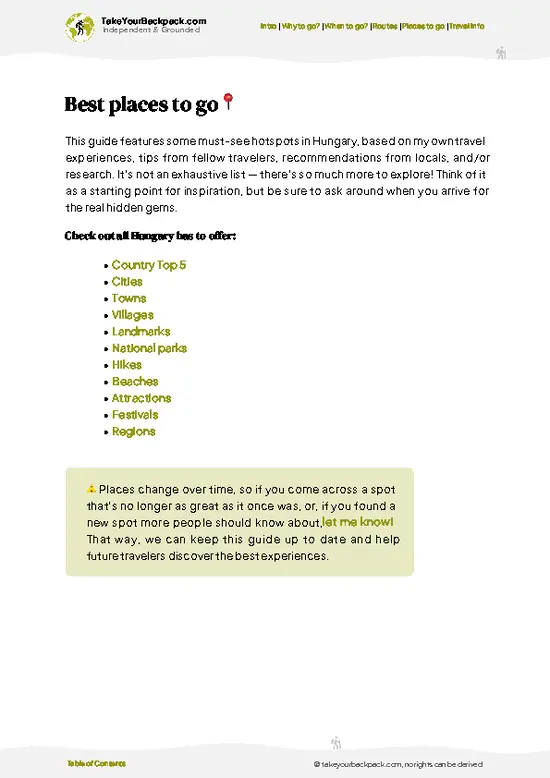
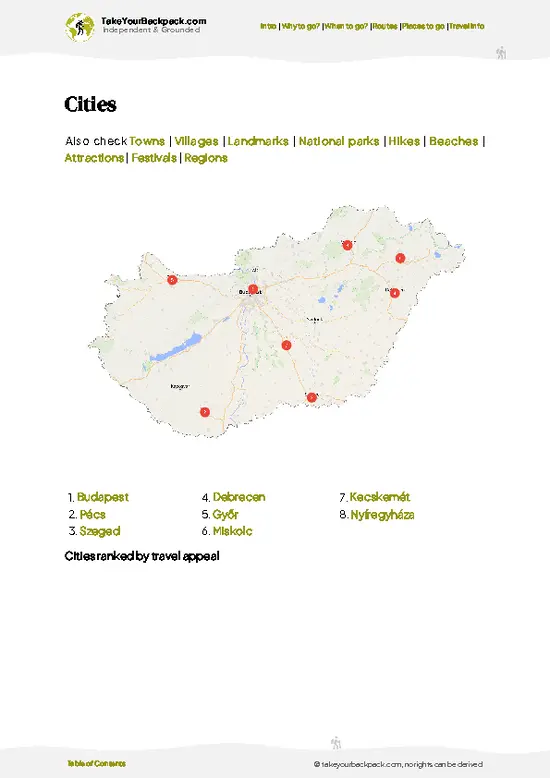
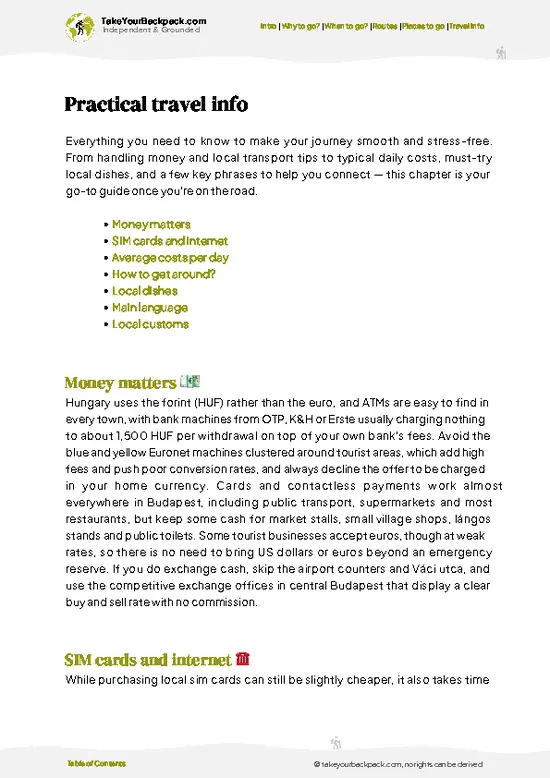
example page 0 from our offline Travel Guide for Hungary
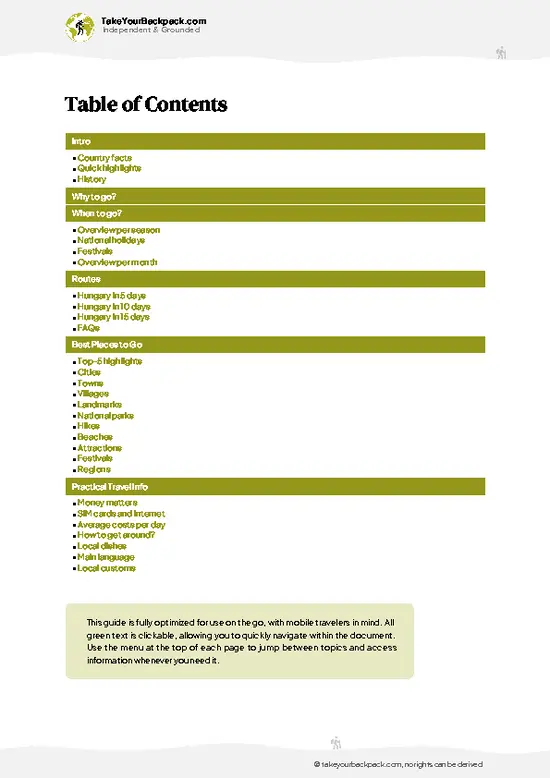
example page 1 from our offline Travel Guide for Hungary
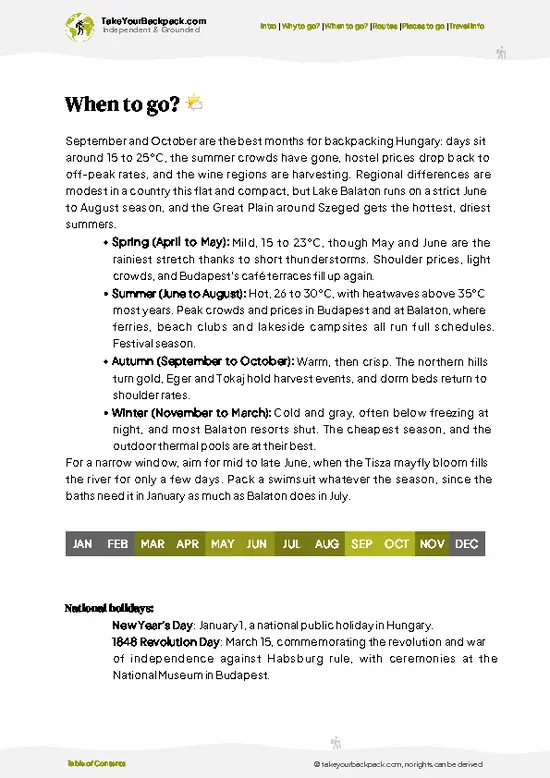
example page 2 from our offline Travel Guide for Hungary
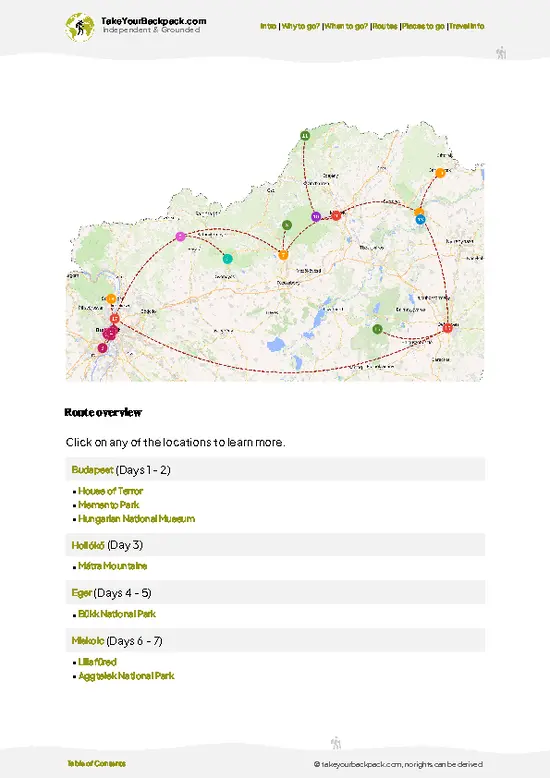
example page 3 from our offline Travel Guide for Hungary
example page 4 from our offline Travel Guide for Hungary
example page 5 from our offline Travel Guide for Hungary
example page 6 from our offline Travel Guide for Hungary
example page 7 from our offline Travel Guide for Hungary
The digital guide (334 pages) contains:
✅ 86 highlights, ranked by travel appeal
✅ Optimized 5, 10 & 15-day travel routes
✅ Cities, national parks, landmarks, beaches
✅ How to get around
✅ Offline-friendly for travel without Wi-Fi
👉 Click to see all 30+ guide features

📅 Plan smarter in minutes, not weeks
✅ Month by month travel advice
✅ Festivals & national holidays
✅ Budget expectations

🗺️ Go to the right places, skip the overrated ones
✅ Honest pros & cons of destinations
✅ Top hikes, parks & viewpoints
✅ Lesser-known places most travelers miss
✅ Clear “worth it vs skip it” guidance

🛏️ Travel smoothly without rookie mistakes
✅ Best areas to stay
✅ Transport systems explained simply
✅ Common scams & safety advice
✅ SIM cards, money & practical tips

🌍 Understand the country, not just visit it
✅ Culture & traditions
✅ 52 Essential phrases & customs
✅ Festivals worth planning around
✅ Traveler-friendly historical context
✅ Insights that make places more meaningful

📱 Built for real travel conditions
✅ Fully downloadable PDF
✅ Works completely offline
✅ Optimized for phone use
✅ Useful in remote areas & buses
✅ Everything in one place
Stop searching, start planning
Get instant access to your full guide. 30‑day money-back guarantee.
+ Add another guide for just

By proceeding you agree to our terms.
Sent to your inbox immediately after payment • 100% Secure Checkout
Best Backpacking Travel Advisor 2025 tourism awardBest Backpacking
Travel Advisor
2025
What others say about Take Your Backpack Guides:
⭐⭐⭐⭐⭐
Fantastic, amazing amount of information!
⭐⭐⭐⭐⭐
My goodness this is amazing, it's what I've been looking for hats off too you!
⭐⭐⭐⭐⭐
I think this is absolutely BRILLIANT
⭐⭐⭐⭐
Very complete and informative. It's still missing places, but I gotta to commend you
⭐⭐⭐⭐⭐
This is truly amazing, thank you, can't wait to explore it with my kids!
⭐⭐⭐⭐⭐
Awesome resource, thank you!
⭐⭐⭐⭐⭐
This is amazing! Can't wait to explore the ones I haven't seen
⭐⭐⭐⭐
I love this! Well done, great idea.
⭐⭐⭐⭐⭐
Thanks for taking the time to make this gem!
⭐⭐⭐⭐⭐
This might be the best website I've ever seen.
⭐⭐⭐⭐⭐
Congratulations, and thank you so much for your work; it's incredibly valuable.
⭐⭐⭐⭐
In all seriousness I think you did a great job pointing out the important spots
⭐⭐⭐⭐⭐
10/10 very good
⭐⭐⭐⭐⭐
As someone who's only just starting to visit regularly this is awesome, thank you.
⭐⭐⭐⭐
Thank you very much! I'm going to visit my dad, it's going to be very useful!
⭐⭐⭐⭐⭐
This is really cool! We'll be travelling for the first time and this definitely come in handy.
⭐⭐⭐⭐⭐
You are now our minister of culture, congratulations 👨‍💼
⭐⭐⭐⭐⭐
Just wanted to tell you that this is a pearl! Going to follow your recommendations.
⭐⭐⭐⭐⭐
This is so cool. I'll definitely be using the resource for my travels soon.
⭐⭐⭐⭐⭐
This is very impressive! Good work.
⭐⭐⭐⭐⭐
This is an amazing and informative site. Very well done!

🛏️ Where to stay?Accommodation Highlights

Hungary has plenty of hostels and budget guesthouses, with dorm beds in Budapest typically running about 5,000 to 10,000 HUF (US$14 to 28) a night and private rooms starting around 15,000 HUF (US$42). The densest cluster sits in Erzsébetváros (District VII, the old Jewish Quarter), which puts you steps from the ruin bars and a short walk from most sights, though weekend noise can run past 3 am; Terézváros (District VI) along Andrássy út is nearly as central and a bit calmer. Belváros (District V) gets you closest to the river and Parliament at higher prices, while the inner Palace District of Józsefváros (District VIII) is cheaper and quieter, with streets that feel rougher the farther you go … read more 👉
Hungary has plenty of hostels and budget guesthouses, with dorm beds in Budapest typically running about 5,000 to 10,000 HUF (US$14 to 28) a night and private rooms starting around 15,000 HUF (US$42). The densest cluster sits in Erzsébetváros (District VII, the old Jewish Quarter), which puts you steps from the ruin bars and a short walk from most sights, though weekend noise can run past 3 am; Terézváros (District VI) along Andrássy út is nearly as central and a bit calmer. Belváros (District V) gets you closest to the river and Parliament at higher prices, while the inner Palace District of Józsefváros (District VIII) is cheaper and quieter, with streets that feel rougher the farther you go from the Museum Boulevard ring.

If you enjoy meeting fellow travelers, consider choosing hostels with high ratings for atmosphere. On the other hand, if you prefer having your own space, a hotel might be a better option.

HungarySee More of Hungary

👋 Meet the founderWho’s Behind Take Your Backpack?

Johan, backpacker and founder of TakeYourBackpackHi, I’m Johan (Netherlands 🇳🇱), the creator of TakeYourBackpack. Over the past 3 decades, I’ve backpacked through 90+ countries across six continents, gaining extensive experience with independent travel, long-term trips, and overland routes.

This site is built on a combination of firsthand travel experience and carefully curated insights from other backpackers. Many guides are based on places I’ve personally visited, while others bring together tips, observations, and practical advice shared by trusted travelers I’ve met along the way.

The goal is to provide realistic, experience-driven guidance — not generic itineraries — so you can explore destinations with better context, clearer expectations, and more confidence.