×

India🇮🇳 | best beachesExplore the 8 Best beaches in India

Beaches in India are not one product. A 7,500 km coastline splits into three very different experiences, and picking the wrong one wastes a trip. Goa and Gokarna on the west coast give you the easiest backpacker setup: cheap huts, scooter rental, shacks serving fresh fish, and a social scene that runs from November to March. North Goa is loud and crowded; south Goa and Gokarna are quieter. Kerala is greener and calmer, with backwater-linked shores, but swimming is often rough and the sand is narrower.

The east coast and islands are a different game. Odisha and Tamil Nadu have long, empty, windswept shores with strong currents, few facilities and religious crowds rather than party crowds. The Andaman Islands have the clearest water and best snorkeling in the country, but flights and ferries push costs well above the mainland. Skip the busiest city beaches in Mumbai and Chennai; they are for evening walks, not swimming. Independent travel works best on the west coast, where buses, trains and guesthouses need no advance planning.

By Johan Kruseman 🇳🇱 | Updated October 18, 2026
Explore the best attractions in India

Why go?Why These beach Stand Out

India is a strong choice for beach culture with a backpacker budget, but a weak choice if you expect uniform resort-style coastline. The country sits on two very different seas. The Arabian Sea side has the Western Ghats dropping close to the shore, which creates the cliff-backed coves and palm-lined bays of the southwest. The Bay of Bengal side is flatter and exposed to cyclones, so its shores are broad, shallow-sloped and often rough.

History shaped the infrastructure. Portuguese rule in Goa left a tradition of seafront cafes, late licenses for alcohol and a relaxed attitude to foreigners on the sand, which is why the west coast built a backpacker scene decades before the rest of the country. Elsewhere, beaches are mostly working or sacred spaces. Fishing communities launch boats from the … read more 👉
India is a strong choice for beach culture with a backpacker budget, but a weak choice if you expect uniform resort-style coastline. The country sits on two very different seas. The Arabian Sea side has the Western Ghats dropping close to the shore, which creates the cliff-backed coves and palm-lined bays of the southwest. The Bay of Bengal side is flatter and exposed to cyclones, so its shores are broad, shallow-sloped and often rough.

History shaped the infrastructure. Portuguese rule in Goa left a tradition of seafront cafes, late licenses for alcohol and a relaxed attitude to foreigners on the sand, which is why the west coast built a backpacker scene decades before the rest of the country. Elsewhere, beaches are mostly working or sacred spaces. Fishing communities launch boats from the sand, and pilgrimage towns use the water for ritual bathing. That means a beach can be rewarding to visit but not set up for lounging.

The monsoon is the single biggest factor. From roughly June to September the southwest coast gets heavy rain, red-flag seas and closed beach shacks, and swimming is dangerous. The Andamans and the east coast follow their own patterns, so the whole country is never in season at once. A trip needs to be built around which coast is open.

Expect modest swimming conditions in many places. Strong currents, steep drop-offs and limited lifeguard coverage are common. Water quality near cities and river mouths is poor. The best swimming and snorkeling are on the islands and in a few sheltered bays, not on the famous urban stretches.

Cultural norms matter too. Most Indian beachgoers swim fully clothed, and bikinis are normal in Goa and tourist enclaves but draw stares elsewhere. Ownership and ease also vary: beaches are free to enter almost everywhere, but transport, not entry, drives the cost. Choose India for atmosphere, food, low prices and variety. Do not choose it for guaranteed empty sand and calm turquoise water, except in the Andamans, where you pay for it.
Our Approach to Ranking
The list of best beaches in India is created based on beauty, vibe, water quality, activities, and surrounding scenery. If you feel a beach is missing in this list, please let us know.

When to go?Best Time to Visit India for beaches

Best months for beaches: The best months for India’s beaches are November to February, when the southwest and west coasts are dry, seas are calm and daytime highs sit around 28 to 33°C with low humidity. This is the window for Goa, Gokarna and Kerala, and it is also when prices peak and guesthouses fill.

Shoulder seasons: March and April are hotter, reaching 33 to 36°C with heavy humidity, but beaches are quieter and rooms in Goa can cost 30 to 50 percent less than in December. Swimming is fine and shack life winds down slowly. October is a risky shoulder month: the southwest monsoon retreats unevenly, and rain can linger on the west coast into the first weeks.

Monsoon and what to skip: From June to September, the west coast gets roughly 2,000 to 3,500 mm of rain, depending on location. … read more 👉
Best months for beaches: The best months for India’s beaches are November to February, when the southwest and west coasts are dry, seas are calm and daytime highs sit around 28 to 33°C with low humidity. This is the window for Goa, Gokarna and Kerala, and it is also when prices peak and guesthouses fill.

Shoulder seasons: March and April are hotter, reaching 33 to 36°C with heavy humidity, but beaches are quieter and rooms in Goa can cost 30 to 50 percent less than in December. Swimming is fine and shack life winds down slowly. October is a risky shoulder month: the southwest monsoon retreats unevenly, and rain can linger on the west coast into the first weeks.

Monsoon and what to skip: From June to September, the west coast gets roughly 2,000 to 3,500 mm of rain, depending on location. Seas are rough, red flags go up, and many beach shacks dismantle until October. Do not plan swimming on the Arabian Sea coast in these months. Monsoon travel makes sense only if you want green hills, very low room rates (often half of peak or less) and no beach time.

East coast and islands: The Bay of Bengal side runs on a different clock. Tamil Nadu and Andhra get most rain from October to December during the northeast monsoon, with cyclone risk in that window. The better months are January to September, though April to June is very hot, often above 36°C. Odisha beaches are most comfortable from November to February.

The Andaman Islands are best from December to April, when seas are calm and visibility for snorkeling and diving is at its clearest. May to September brings rain and rougher water, and ferries can be canceled in bad weather. Book transfers with slack in your schedule.

Peak periods that change decisions: Christmas to New Year is the most expensive and crowded stretch across Goa and much of the south, with rooms often costing two to three times the November rate and minimum stays imposed. Indian school holidays in May and June fill east coast and hill-adjacent beach towns with domestic travelers. For a balance of weather, space and cost, aim for late January to mid-February on the west coast, or early December in the Andamans before the holiday surge.

beach hoppingOptimizing Your Multi-Stop Itinerary

How many days you need: A trip combining several beaches in India needs 14 to 21 days, and less than 10 only works if you stay on one coast. The country is too big to sample casually. Flights and long overland hauls consume days that never show up on a map.

Which regions cluster well: The west coast is the logical core. Goa, Gokarna and northern Kerala line up along one corridor, linked by the Konkan Railway and coastal highways. Goa to Gokarna is about 4 to 6 hours by train or bus, and Gokarna to Kochi or Varkala takes 10 to 14 hours, usually by overnight train. Travel south for the most natural flow, starting from Mumbai or Goa’s Dabolim or Mopa airports and finishing in Kochi or Trivandrum.

The Andamans pair best with a mainland trip ending in Chennai or Kolkata, with flights to Port … read more 👉
How many days you need: A trip combining several beaches in India needs 14 to 21 days, and less than 10 only works if you stay on one coast. The country is too big to sample casually. Flights and long overland hauls consume days that never show up on a map.

Which regions cluster well: The west coast is the logical core. Goa, Gokarna and northern Kerala line up along one corridor, linked by the Konkan Railway and coastal highways. Goa to Gokarna is about 4 to 6 hours by train or bus, and Gokarna to Kochi or Varkala takes 10 to 14 hours, usually by overnight train. Travel south for the most natural flow, starting from Mumbai or Goa’s Dabolim or Mopa airports and finishing in Kochi or Trivandrum.

The Andamans pair best with a mainland trip ending in Chennai or Kolkata, with flights to Port Blair taking roughly 2 to 2.5 hours. Treat them as a separate leg of 5 to 7 days, because inter-island ferries take 1.5 to 3 hours each and weather can cancel them. The east coast between Odisha and Tamil Nadu is long and thin on infrastructure, so it suits travelers with extra time, not a short loop.

Time per stop: Allow 3 to 5 nights in a main beach base and 2 to 3 in a quieter one. One night is not worth the hassle of packing, transport and check-out unless you are in transit. In the Andamans, 2 to 3 nights per island makes sense because each transfer eats half a day.

Planning mistakes: The commonest mistake is trying to cover both coasts in under two weeks. The overland link between Kerala and the Bay of Bengal side is long, often 12 to 20 hours by train, so fly or choose one side. A second error is ignoring seasons: the west coast and the Andamans do not share the same best months in every window, so match them to the month you travel.

A third is booking tight connections. Indian trains run late, long buses can be slower than listed, and island ferries can be canceled. Leave a buffer day before any international flight. Book popular sleeper and AC trains 60 to 120 days ahead in peak season, since last-minute seats on key coastal routes often sell out. Finally, skip overnight buses back to back; two in a row wrecks the following day. Alternate them with trains or a rest day.

The ListMust-Visit beaches in India

1 Radhanagar Beach

white sand, turquoise water, forest backdrop

Swim in clear shallows and rest under dense greenery, where the natural setting feels untouched and the pace remains unhurried.

2 Varkala Beach

red cliffs, mineral springs, yoga retreats

Descend from dramatic cliffs to a narrow strip of sand, where wellness seekers and travelers gather for sunsets and sea breezes.

3 Kovalam Beach

lighthouse views, crescent bays, fishing boats

Relax on curved shores lined with palm trees, where local fishermen launch their boats and a lighthouse marks the horizon.

4 Anjuna Beach

rocky headlands, flea market, trance scene

Experience a blend of dramatic coastline, eclectic shopping, and late-night music that draws a diverse crowd to Goa’s northern edge.

5 Kalapathar Beach

black rocks, quiet sands, Andaman forest

Stroll beneath overhanging trees and volcanic stones, where gentle waves and solitude define this remote Andaman shoreline.

6 Puri Beach

pilgrimage site, surf waves, sand art

Observe rituals and festivals along a lively coast, where religious traditions and rolling breakers shape the rhythm of the day.

7 Marina Beach

Chennai promenade, cricket games, wide sands

Join locals on India’s longest city beach, where open spaces host sports, evening walks, and a constant flow of daily activity.

8 Juhu Beach

Mumbai skyline, street snacks, urban crowds

Watch city life unfold along a broad sandy stretch, with food stalls, kite flyers, and families gathering at sunset.

Loading the map 🌍

Expert viewInsights from Locals and Experts

How many beaches to visit: I advise three to five beach stops in one trip, not a checklist. India’s distances and slow transport mean every extra stop costs a day or more, and the differences between beaches on the same coast are smaller than the differences between coasts. Three stops across two contrasting areas, say a social west coast base, a quiet cove and one island, give you range without exhaustion. Beyond five, you are mostly paying for transit.

Choosing by travel style: For social travelers, the Goa belt has the densest hostel scene, cheap food and easy scooter rental. For quiet and budget travelers, Gokarna’s south or Kerala’s clifftop towns give lower prices and fewer parties. For swimming and snorkeling, the Andamans are the only reliably clear water, though they cost more. For … read more 👉
How many beaches to visit: I advise three to five beach stops in one trip, not a checklist. India’s distances and slow transport mean every extra stop costs a day or more, and the differences between beaches on the same coast are smaller than the differences between coasts. Three stops across two contrasting areas, say a social west coast base, a quiet cove and one island, give you range without exhaustion. Beyond five, you are mostly paying for transit.

Choosing by travel style: For social travelers, the Goa belt has the densest hostel scene, cheap food and easy scooter rental. For quiet and budget travelers, Gokarna’s south or Kerala’s clifftop towns give lower prices and fewer parties. For swimming and snorkeling, the Andamans are the only reliably clear water, though they cost more. For culture and fewer foreigners, east coast shores in Odisha and Tamil Nadu fit, but expect basic facilities and limited swimming. Skip the urban city beaches for swimming; water quality and crowds make them poor value.

What it costs: Plan US$25 to 45 a day (about ₹2,100 to 3,800) on the mainland coast on a backpacker budget: dorm or basic room ₹500 to 1,500, meals ₹250 to 600, and scooter rental ₹300 to 500 a day plus fuel. In peak December weeks, rooms can double. Andamans budgets run US$40 to 70 a day (₹3,400 to 5,900) because ferries cost ₹700 to 1,500 per leg and snorkeling or diving trips run ₹1,500 to 3,500 (introductory dives often ₹4,000 to 6,000). Beach entry is generally free. Watch for sunbed charges at Goa shacks, usually waived if you order food and drink, and parking fees of ₹20 to 50 on some beaches. Keep cash for small transactions; ATMs near remote bays run dry.

Costs and mistakes that catch travelers out: Airport taxis and beachside touts inflate prices, so use prepaid taxi counters or app rides where available and agree fares first. Scooter rental often involves a deposit or passport hold; give a photocopy if possible and photograph existing scratches, because damage claims are common. An international or Indian license is required and police fines for riding without one start around ₹1,000 to 5,000. Sunbed vendors, massage offers and boat-tour sellers on the sand will quote tourist prices; counter at roughly half and be ready to walk away. Pre-booked island activities can be canceled by weather, so choose operators with clear refund terms.

Safety on the water: Rip currents and steep shelves kill swimmers every year, especially in the monsoon and on unguarded shores. Swim only where lifeguards operate, obey red flags, and never swim alone after drinking. Do not wade out on rocks at high tide. Jellyfish appear on some coasts in certain months, and coral cuts get infected quickly in humid conditions, so clean them promptly. Use reef-safe sunscreen in the Andamans and carry bottled water; the sun is strong even in winter.

Personal safety and etiquette: Solo women should avoid isolated stretches after dark, accept that staring is common outside Goa and the Andamans, and choose guesthouses with strong recent reviews. Do not leave bags unattended on the sand, because theft from towels is routine at crowded beaches. Keep valuables locked at your room.

Dress norms shift sharply by location. Swimwear is common in Goa and tourist islands, but at local and pilgrimage beaches, swim in shorts and a T-shirt, or a sarong over swimwear. Topless sunbathing is illegal and can bring police action. Photographing local families without asking causes friction, and drone use is restricted, with permits usually required.

Alcohol is allowed in licensed shacks, but drinking on open beaches can bring fines in some states. Drug offers are frequent in party areas, and penalties under Indian law are severe even for small amounts. Decline, and do not carry anything for others.

Where to save and where to spend: Spend on a decent room near the sand in peak season, since a bad location adds scooter costs and wasted time. Spend on a licensed dive or snorkel operator, not the cheapest one. Save on transport by taking trains and state buses, which cost a fraction of private taxis. Skip beach-front restaurants with laminated tourist menus; walk two streets inland for fresh fish thalis at about half the price.

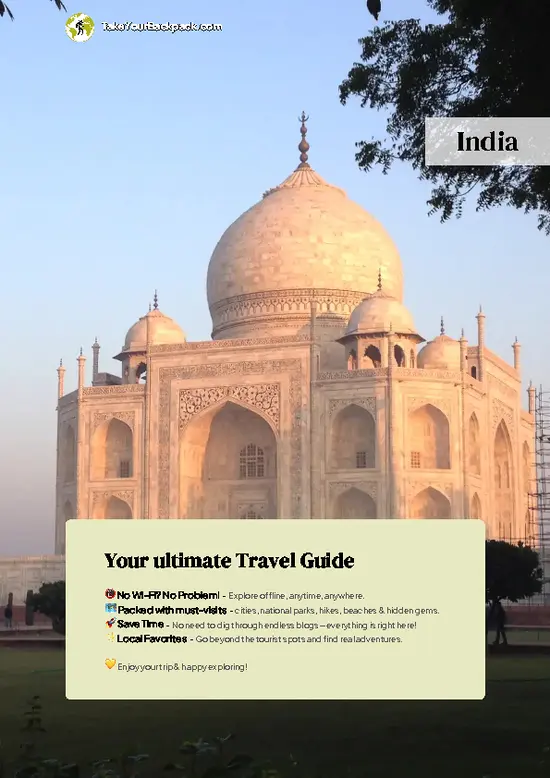
✈️ The backpacker research shortcutIndia Travel Guide

An offline-friendly backpacking guide with optimized travel routes, ranked highlights, transport advice, and the best areas to stay.
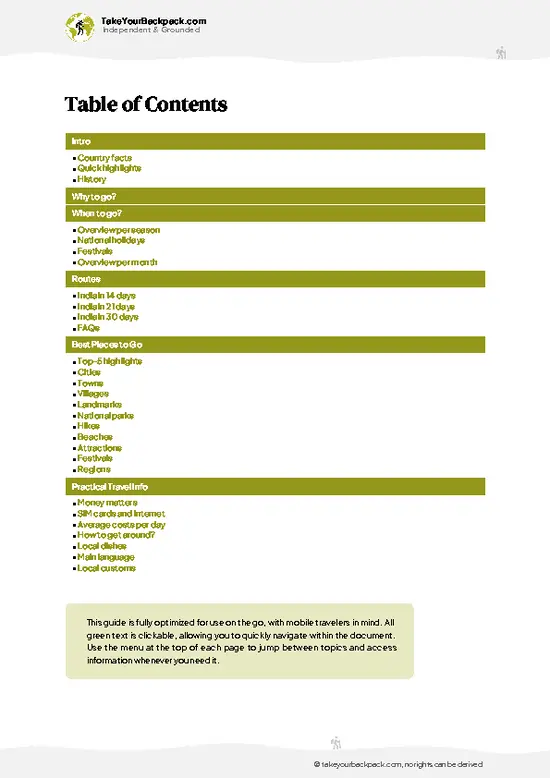
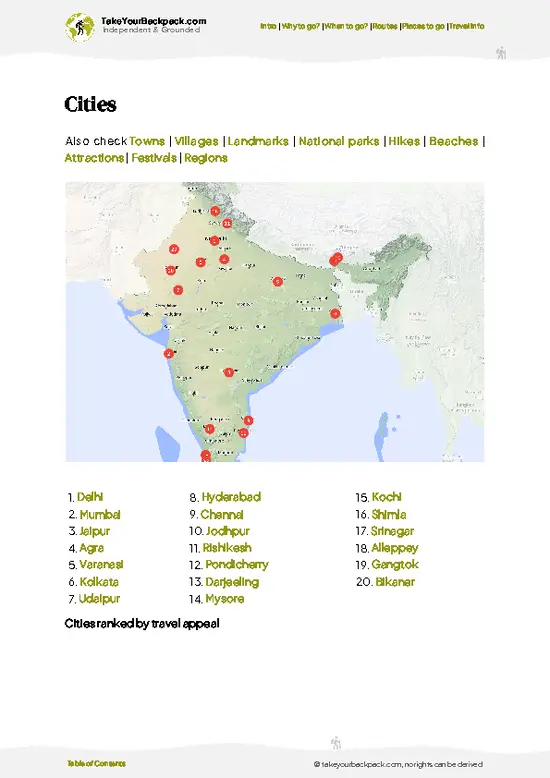
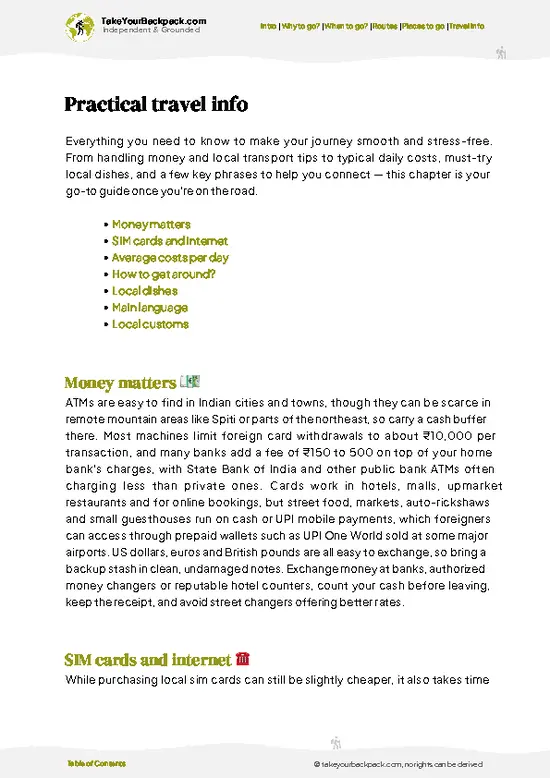
example page 0 from our offline Travel Guide for India
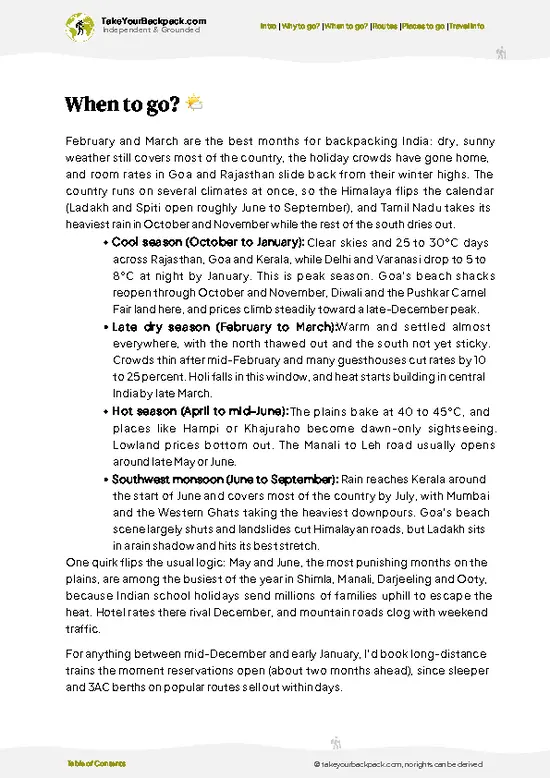
example page 1 from our offline Travel Guide for India
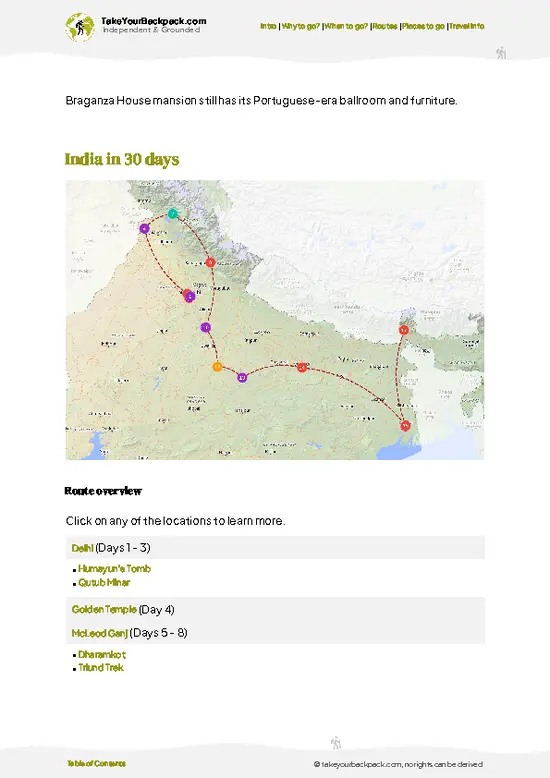
example page 2 from our offline Travel Guide for India
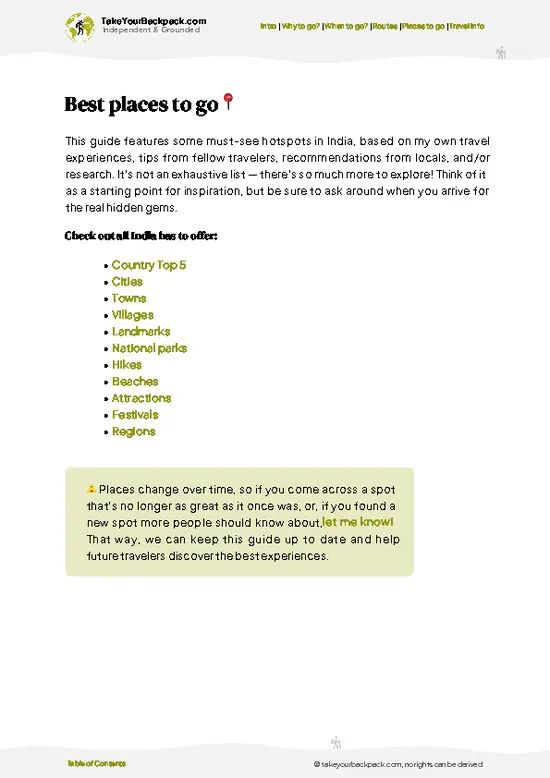
example page 3 from our offline Travel Guide for India
example page 4 from our offline Travel Guide for India
example page 5 from our offline Travel Guide for India
example page 6 from our offline Travel Guide for India
example page 7 from our offline Travel Guide for India
The digital guide (483 pages) contains:
✅ 157 highlights, ranked by travel appeal
✅ Optimized 14, 21 & 30-day travel routes
✅ Cities, national parks, landmarks, beaches
✅ How to get around
✅ Offline-friendly for travel without Wi-Fi
👉 Click to see all 30+ guide features

📅 Plan smarter in minutes, not weeks
✅ Month by month travel advice
✅ Festivals & national holidays
✅ Budget expectations

🗺️ Go to the right places, skip the overrated ones
✅ Honest pros & cons of destinations
✅ Top hikes, parks & viewpoints
✅ Lesser-known places most travelers miss
✅ Clear “worth it vs skip it” guidance

🛏️ Travel smoothly without rookie mistakes
✅ Best areas to stay
✅ Transport systems explained simply
✅ Common scams & safety advice
✅ SIM cards, money & practical tips

🌍 Understand the country, not just visit it
✅ Culture & traditions
✅ 52 Essential phrases & customs
✅ Festivals worth planning around
✅ Traveler-friendly historical context
✅ Insights that make places more meaningful

📱 Built for real travel conditions
✅ Fully downloadable PDF
✅ Works completely offline
✅ Optimized for phone use
✅ Useful in remote areas & buses
✅ Everything in one place
Stop searching, start planning
Get instant access to your full guide. 30‑day money-back guarantee.
+ Add another guide for just

By proceeding you agree to our terms.
Sent to your inbox immediately after payment • 100% Secure Checkout
Best Backpacking Travel Advisor 2025 tourism awardBest Backpacking
Travel Advisor
2025
What others say about Take Your Backpack Guides:
⭐⭐⭐⭐⭐
Fantastic, amazing amount of information!
⭐⭐⭐⭐⭐
My goodness this is amazing, it's what I've been looking for hats off too you!
⭐⭐⭐⭐⭐
I think this is absolutely BRILLIANT
⭐⭐⭐⭐
Very complete and informative. It's still missing places, but I gotta to commend you
⭐⭐⭐⭐⭐
This is truly amazing, thank you, can't wait to explore it with my kids!
⭐⭐⭐⭐⭐
Awesome resource, thank you!
⭐⭐⭐⭐⭐
This is amazing! Can't wait to explore the ones I haven't seen
⭐⭐⭐⭐
I love this! Well done, great idea.
⭐⭐⭐⭐⭐
Thanks for taking the time to make this gem!
⭐⭐⭐⭐⭐
This might be the best website I've ever seen.
⭐⭐⭐⭐⭐
Congratulations, and thank you so much for your work; it's incredibly valuable.
⭐⭐⭐⭐
In all seriousness I think you did a great job pointing out the important spots
⭐⭐⭐⭐⭐
10/10 very good
⭐⭐⭐⭐⭐
As someone who's only just starting to visit regularly this is awesome, thank you.
⭐⭐⭐⭐
Thank you very much! I'm going to visit my dad, it's going to be very useful!
⭐⭐⭐⭐⭐
This is really cool! We'll be travelling for the first time and this definitely come in handy.
⭐⭐⭐⭐⭐
You are now our minister of culture, congratulations 👨‍💼
⭐⭐⭐⭐⭐
Just wanted to tell you that this is a pearl! Going to follow your recommendations.
⭐⭐⭐⭐⭐
This is so cool. I'll definitely be using the resource for my travels soon.
⭐⭐⭐⭐⭐
This is very impressive! Good work.
⭐⭐⭐⭐⭐
This is an amazing and informative site. Very well done!

🛏️ Where to stay?Where to Stay: India Edition

India has one of Asia’s densest backpacker hostel scenes, with dorm beds typically running ₹400 to 900 (US$5 to 11) and simple private guesthouse rooms from about ₹1,000 to 2,000 (US$12 to 24). In Delhi, Paharganj has the cheapest beds and sits right by New Delhi Railway Station, but it is loud, grimy and full of touts, while Hauz Khas costs a little more and gives you cafés, bars and calmer lanes far from the Old Delhi sights. Elsewhere, Colaba in Mumbai puts you near the Gateway of India at the city’s highest prices, Anjuna and Arambol in Goa bring the parties and a laid-back beach crowd, and Tapovan in Rishikesh and Assi Ghat in Varanasi trade nightlife (alcohol is restricted in both towns) … read more 👉
India has one of Asia’s densest backpacker hostel scenes, with dorm beds typically running ₹400 to 900 (US$5 to 11) and simple private guesthouse rooms from about ₹1,000 to 2,000 (US$12 to 24). In Delhi, Paharganj has the cheapest beds and sits right by New Delhi Railway Station, but it is loud, grimy and full of touts, while Hauz Khas costs a little more and gives you cafés, bars and calmer lanes far from the Old Delhi sights. Elsewhere, Colaba in Mumbai puts you near the Gateway of India at the city’s highest prices, Anjuna and Arambol in Goa bring the parties and a laid-back beach crowd, and Tapovan in Rishikesh and Assi Ghat in Varanasi trade nightlife (alcohol is restricted in both towns) for quiet riverside stays within walking distance of the ghats and yoga schools.

If you enjoy meeting fellow travelers, consider choosing hostels with high ratings for atmosphere. On the other hand, if you prefer having your own space, a hotel might be a better option.

IndiaExplore Beyond This Category

👋 Meet the founderWho’s Behind Take Your Backpack?

Johan, backpacker and founder of TakeYourBackpackHi, I’m Johan (Netherlands 🇳🇱), the creator of TakeYourBackpack. Over the past 3 decades, I’ve backpacked through 90+ countries across six continents, gaining extensive experience with independent travel, long-term trips, and overland routes.

This site is built on a combination of firsthand travel experience and carefully curated insights from other backpackers. Many guides are based on places I’ve personally visited, while others bring together tips, observations, and practical advice shared by trusted travelers I’ve met along the way.

The goal is to provide realistic, experience-driven guidance — not generic itineraries — so you can explore destinations with better context, clearer expectations, and more confidence.