×
Ireland🇮🇪 | 5 days itinerary

Ireland in 5 Days

By Johan Kruseman 🇳🇱 | Updated May 9, 2026
This 5-day route is for first-time visitors who want a deep, low-stress hit of Ireland’s southwest: short hops, big scenery, and plenty of time in pubs instead of on buses. You’ll rely mostly on buses and local tours from Killarney and Dingle, moving at a relaxed pace that still squeezes in some of the country’s most dramatic coastline and classic small-town charm.

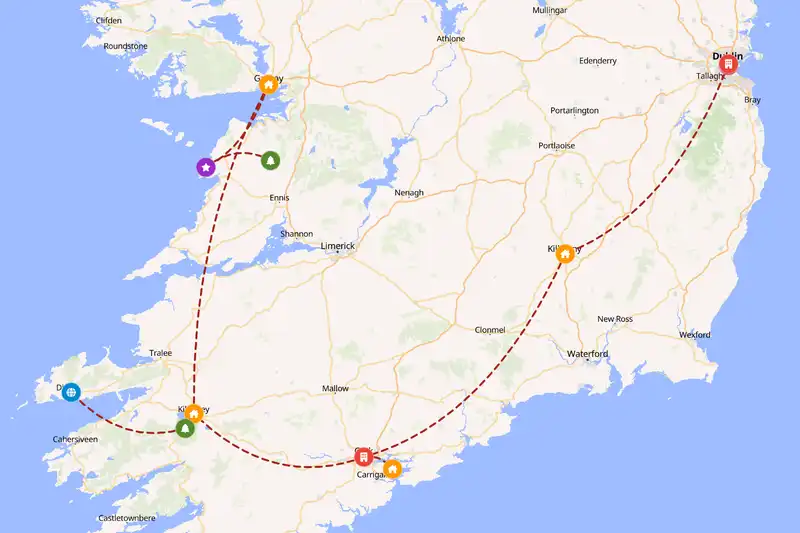
Days 1-2: Killarney & Killarney National Park

Start in Killarney, an easy launchpad with enough restaurants and live music to keep evenings lively without feeling chaotic. Base yourself here for two nights so you can spend a full day in Killarney National Park, walking or cycling between lakes, waterfalls, and old estates instead of racing between towns. This combo gives you a soft landing in Ireland: you get the comfort of a small town plus instant access to wild landscapes, all without needing a rental car.

Days 3-4: Dingle Town, Dingle Peninsula & Coumeenoole Beach

Transfer by bus to Dingle, a compact fishing village that feels … read more 👉
This 5-day route is for first-time visitors who want a deep, low-stress hit of Ireland’s southwest: short hops, big scenery, and plenty of time in pubs instead of on buses. You’ll rely mostly on buses and local tours from Killarney and Dingle, moving at a relaxed pace that still squeezes in some of the country’s most dramatic coastline and classic small-town charm.

Days 1-2: Killarney & Killarney National Park

Start in Killarney, an easy launchpad with enough restaurants and live music to keep evenings lively without feeling chaotic. Base yourself here for two nights so you can spend a full day in Killarney National Park, walking or cycling between lakes, waterfalls, and old estates instead of racing between towns. This combo gives you a soft landing in Ireland: you get the comfort of a small town plus instant access to wild landscapes, all without needing a rental car.

Days 3-4: Dingle Town, Dingle Peninsula & Coumeenoole Beach

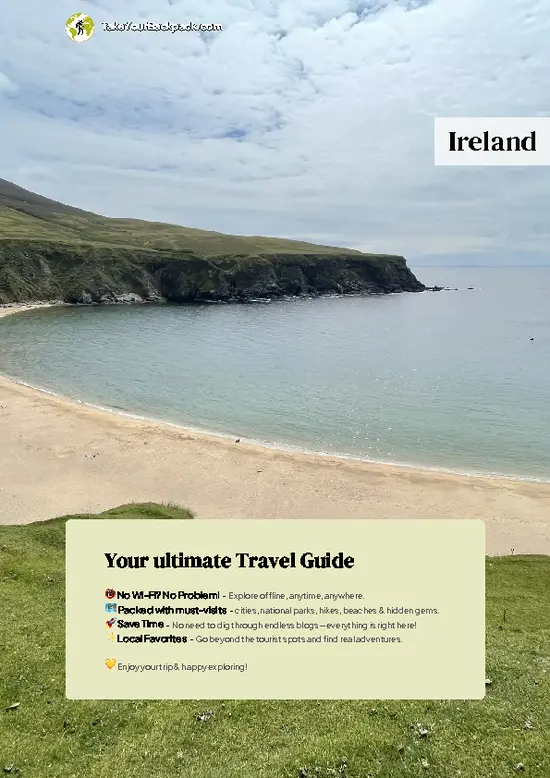
Transfer by bus to Dingle, a compact fishing village that feels built for wandering: colorful shopfronts, easy pub-hopping, and sea views at the end of half the streets. Use your full day here to explore the Dingle Peninsula on a local minibus tour or bike, looping past stone forts and Atlantic cliffs, with time to walk along Coumeenoole Beach where the waves slam into the cliffs in a way that makes you feel very small in the best possible way. Two nights in Dingle lets you enjoy slow mornings, a proper coastal day, and at least one late session of trad music without worrying about an early checkout.

Day 5: Tralee & Departure

On your final day, ride the short hop to Tralee, a practical transport hub that works well as a staging point for buses onward or back toward Dublin. You won’t need long here, but a few hours to stroll, grab a last plate of seafood, and decompress before your onward journey keeps the trip from ending in a frantic dash across the country.

My favorite memory from this route is walking back into Dingle at blue hour, salt still on my face from Coumeenoole Beach, and hearing fiddle music spill out of three different pub doors at once.
Loading the map 🌍
film
0
0
0a
Killarney
film
1
1
1a
Killarney
film
2
2
2a
Dingle
Chandan Raj
film
3
3
3a
Coumeenoole Beach

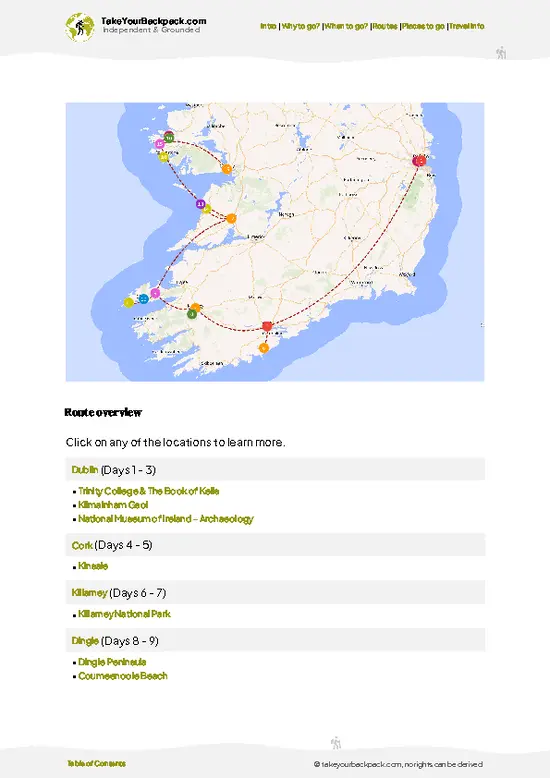
🛏️ Where to stay?The Route Breakdown

👉 Click on any of the locations to learn more.
Days 1 - 2Killarney
Days 3 - 4Dingle
Day 5Tralee

✈️ The backpacker research shortcutIreland Travel Guide

An offline-friendly backpacking guide with optimized travel routes, ranked highlights, transport advice, and the best areas to stay.
example page 0 from our offline Travel Guide for Irelandexample page 1 from our offline Travel Guide for Irelandexample page 2 from our offline Travel Guide for Irelandexample page 3 from our offline Travel Guide for Irelandexample page 4 from our offline Travel Guide for Irelandexample page 5 from our offline Travel Guide for Ireland
The digital guide (327 pages) contains:
104 highlights, ranked by travel appeal
Optimized 5, 10 & 15-day travel routes
Best neighborhoods to stay
How to get around
Offline-friendly for travel without Wi-Fi
👉 See all 30+ guide features

📅 Plan smarter in minutes, not weeks
Month by month travel advice
Festivals & national holidays
Budget expectations

🗺️ Go to the right places, skip the overrated ones
Honest pros & cons of destinations
Top hikes, parks & viewpoints
Lesser-known places most travelers miss
Clear “worth it vs skip it” guidance

🛏️ Travel smoothly without rookie mistakes
Best areas to stay
Transport systems explained simply
Common scams & safety advice
SIM cards, money & practical tips

🌍 Understand the country, not just visit it
Culture & traditions
Local customs
Festivals worth planning around
Traveler-friendly historical context
Insights that make places more meaningful

📱 Built for real travel conditions
Fully downloadable PDF
Works completely offline
Optimized for phone use
Useful in remote areas & buses
Everything in one place
Save weeks of stressful planning
Get instant access to the full guide directly. 30-day money-back guarantee.


Sent to your inbox immediately after payment • 100% Secure Checkout
Best Backpacking Travel Advisor 2025 tourism awardBest Backpacking
Travel Advisor
2025
What others say about Take Your Backpack Guides:
⭐⭐⭐⭐⭐
Fantastic, amazing amount of information!
⭐⭐⭐⭐⭐
My goodness this is amazing, it's what I've been looking for hats off too you!
⭐⭐⭐⭐⭐
I think this is absolutely BRILLIANT
⭐⭐⭐⭐
Very complete and informative. It's still missing places, but I gotta to commend you
⭐⭐⭐⭐⭐
This is truly amazing, thank you, can't wait to explore it with my kids!
⭐⭐⭐⭐⭐
Awesome resource, thank you!
⭐⭐⭐⭐⭐
This is amazing! Can't wait to explore the ones I haven't seen
⭐⭐⭐⭐
I love this! Well done, great idea.
⭐⭐⭐⭐⭐
Thanks for taking the time to make this gem!
⭐⭐⭐⭐⭐
This might be the best website I've ever seen.
⭐⭐⭐⭐⭐
Congratulations, and thank you so much for your work; it's incredibly valuable.
⭐⭐⭐⭐
In all seriousness I think you did a great job pointing out the important spots
⭐⭐⭐⭐⭐
10/10 very good
⭐⭐⭐⭐⭐
As someone who's only just starting to visit regularly this is awesome, thank you.
⭐⭐⭐⭐
Thank you very much! I'm going to visit my dad, it's going to be very useful!
⭐⭐⭐⭐⭐
This is really cool! We'll be travelling for the first time and this definitely come in handy.
⭐⭐⭐⭐⭐
You are now our minister of culture, congratulations 👨‍💼
⭐⭐⭐⭐⭐
Just wanted to tell you that this is a pearl! Going to follow your recommendations.
⭐⭐⭐⭐⭐
This is so cool. I'll definitely be using the resource for my travels soon.
⭐⭐⭐⭐⭐
This is very impressive! Good work.
⭐⭐⭐⭐⭐
This is an amazing and informative site. Very well done!

🧭 RouteGot More or Less Time?

Travel Ireland your way — from a quick highlights trip to a slow-paced adventure.

🙋 FAQCommon Questions

Yes, Ireland is very doable as an independent backpacker, especially if you’re comfortable with buses and a bit of rain. English is widely spoken, people are generally helpful, and the country feels safe for solo travelers, including at night in most towns. The main challenge is cost, not logistics, so you win by planning around that. Stick to hostel dorms, self-catering kitchens, and supermarket lunches instead of eating out every meal. Book popular hostels in Dublin, Galway, Killarney, and Dingle at least a week or two ahead in high season (June–September) because they fill fast. Wild camping is technically restricted but tolerated in some remote areas if you’re discreet, leave no trace, and avoid farmland and obvious private property; always ask if you’re near a house or farm. Hiking infrastructure is solid: waymarked trails like the Wicklow Way, Kerry Way, and Dingle Way are easy to follow with basic navigation skills. Weather changes fast, so a real rain jacket, pack cover, and quick-dry layers matter more than looking good in photos. Pubs are your social hub: you can meet locals, hear live music, and still keep it cheap by nursing one pint or even just a soft drink. Overall, if you can handle occasional wet socks and flexible plans, Ireland is one of the easier countries to backpack on your own.
For a tight budget trip, 7–10 days is the minimum that feels worthwhile, 2 weeks is the sweet spot, and 3 weeks lets you slow down and actually breathe. With 7 days, focus on one region plus Dublin: for example, 2 days in Dublin, then 3–4 days in Galway with day trips to Connemara or the Aran Islands, or 2 days in Killarney and the southwest. With 10–14 days, you can do a simple loop by bus or train: Dublin → Galway/Connemara → Doolin/Cliffs of Moher → Killarney/Dingle → back to Dublin. That gives you cities, small towns, cliffs, and mountains without sprinting. With 3 weeks, you can add the north and more hiking: Belfast and the Antrim Coast, Donegal for wilder landscapes, or extra time on long-distance trails like the Wicklow Way or Kerry Way. More days do not automatically mean more places; in Ireland, travel days eat time because roads are small and buses are not lightning fast. It’s better to pick 3–5 bases and do day trips than to change beds every night. If you only have 4–5 days, treat it as a Dublin plus one side-trip visit, not an “Ireland in full” attempt.
You can absolutely get around Ireland without a car, but you need to think in terms of hubs and spokes. Trains connect the big points (Dublin–Cork–Limerick–Galway–Belfast), and buses fill in most of the gaps. For a backpacker, this is good news: you can base yourself in a town with a decent bus network and do day trips. Galway works well for Connemara, the Aran Islands, and the Cliffs of Moher (via bus to Doolin). Killarney is your launchpad for the Ring of Kerry and Killarney National Park. Dublin covers Wicklow and Glendalough. Dingle, Donegal, and some rural peninsulas are trickier without a car, but still possible if you’re willing to use a mix of regional buses, occasional tours, and your feet. Budget-wise, buses are cheaper and more flexible than trains; look for regional companies as well as the big national ones. Hitchhiking exists but should be a backup, not a plan, especially in remote areas where traffic is light. If you want to hike point-to-point trails like the Dingle Way or Kerry Way, you can often link trailheads with buses and short taxis, but build in buffer time because rural services may only run a few times a day. For a short trip, it can be worth paying for a one-day bus tour to reach awkward spots like the Giant’s Causeway or a full Ring of Kerry loop instead of renting a car.
For a budget backpacker, the must-visits are the places that give you the most landscape and culture for the least money and hassle. Dublin is worth at least a day or two, not for the tourist checklist but for wandering neighborhoods, free museums, and pub music in areas like Temple Bar’s side streets or Camden Street. Galway is a top base: compact, walkable, full of hostels, and perfectly placed for day trips to Connemara, the Aran Islands, and the Cliffs of Moher. Killarney is another key stop, with cheap access to Killarney National Park, lakes, and mountains; you can hike, rent a bike, or just walk the trails without paying for big-ticket attractions. The Dingle Peninsula is a favorite for many backpackers: small-town feel, coastal walks, and a strong music scene, though it’s a bit more effort to reach without a car. For raw scenery, Connemara and County Donegal are standouts: bogs, mountains, wild coastline, and fewer crowds than the big-name spots. If you like long walks, the Wicklow Mountains just south of Dublin are a gift; Glendalough and sections of the Wicklow Way give you proper hiking without needing to cross the country. In Northern Ireland, the Antrim Coast and Giant’s Causeway are worth the trip if you have time, especially combined with Belfast for history and street art. Overall, prioritize: Dublin (short), Galway + Connemara, one big cliff/coast area (Cliffs of Moher or Antrim Coast), one mountain/park area (Killarney or Wicklow), and one smaller town or peninsula (Dingle or Donegal).
If you’re short on time or cash, skip anything that eats a whole day for a single crowded viewpoint or an overpriced tour. You can skip doing every famous coastal drive as a full loop; pick either the Ring of Kerry or the Dingle Peninsula, not both, and do the one that fits your route and bus options. The Cliffs of Moher are impressive, but the official visitor center is pricey and busy; if you’re already seeing other big cliffs or rugged coastlines (like Slieve League in Donegal or the Antrim Coast), you can treat Moher as optional. Inside Dublin, you can skip expensive, heavily touristed attractions like the Guinness Storehouse if your budget is tight; you get more value from free museums, walking tours, and live music in pubs. Blarney Castle and its famous stone are easy to skip on a short trip; it’s a lot of time and money for a very touristy ritual. If you’re not deeply into medieval history, you can also limit big castle admissions and enjoy the many free ruins and landscapes instead. Don’t try to cram in both the far southwest (Kerry/Dingle) and the far north (Donegal/Antrim) on a one-week trip; you’ll spend your money on buses and your days staring out a window. Choose one region and do it well. Finally, skip changing towns every night; the constant moving drains your budget and energy. Fewer bases, more day trips, and more time walking or hiking will give you a better Ireland for less money.

🇮🇪 IrelandWhere to Go Next

Ready to build a truly unique trip? Predefined routes are perfect for first-time visitors, but there is so much more to discover. Whether you are chasing a city trip, pristine national parks, local food scenes, or quiet beaches, pick a category to design your own path.