×

Ireland🇮🇪 | best citiesWhere to Find the 5 Best cities in Ireland

Ireland has a handful of cities, and none of them is big enough to lose you. Dublin is the only one with a metropolitan feel, while the rest are compact enough to cross on foot before your coffee cools. That small scale shapes everything. The east costs more and fills up fast, the south and west trade size for music-filled pubs and slower evenings, and the north adds a different currency and a heavier history. For backpackers and other independent travelers, the real choice is between convenience and atmosphere. Pick one, then accept the rain as a fixed feature.

By Johan Kruseman 🇳🇱 | Updated October 18, 2026
Explore the best towns in Ireland

Why go?Understanding Their Importance

Ireland is a country of towns that happened to become cities. The Norse and Anglo-Norman origins left walled harbors and river crossings, so most urban centers sit on water and remain walkable, with the historic core usually within 1 to 2 kilometers of the train or bus station. Population is thin outside the capital region, which means the second-tier cities feel like large villages with universities attached, and the pub fills the role that a big plaza plays elsewhere.

The Atlantic climate matters more than any guidebook admits. Rain arrives on about 150 to 220 days a year depending on the coast, so cities here are built around indoor life: live music rooms, museums, markets under cover and a general willingness to stand in a doorway and discuss the weather as though it were a rival county. … read more 👉
Ireland is a country of towns that happened to become cities. The Norse and Anglo-Norman origins left walled harbors and river crossings, so most urban centers sit on water and remain walkable, with the historic core usually within 1 to 2 kilometers of the train or bus station. Population is thin outside the capital region, which means the second-tier cities feel like large villages with universities attached, and the pub fills the role that a big plaza plays elsewhere.

The Atlantic climate matters more than any guidebook admits. Rain arrives on about 150 to 220 days a year depending on the coast, so cities here are built around indoor life: live music rooms, museums, markets under cover and a general willingness to stand in a doorway and discuss the weather as though it were a rival county.

Before choosing Ireland for its cities, know that this is not a place for skyline-chasing or nonstop nightlife until sunrise. Pubs generally close by 11:30 pm or midnight on weeknights, and public transport between cities is solid by rail and coach on main corridors but thin elsewhere. Costs are among the highest in Europe, particularly for beds. What you get in return is a country where strangers talk to you first, and a conversation with a barman can run longer than the museum you meant to visit.
Behind the Scenes of Selection
The list of best cities in Ireland is created based on culture, vibe, attractions, transport ease, and local charm. If you feel a city is missing in this list, please let us know.

When to go?Best Time to Visit Ireland for cities

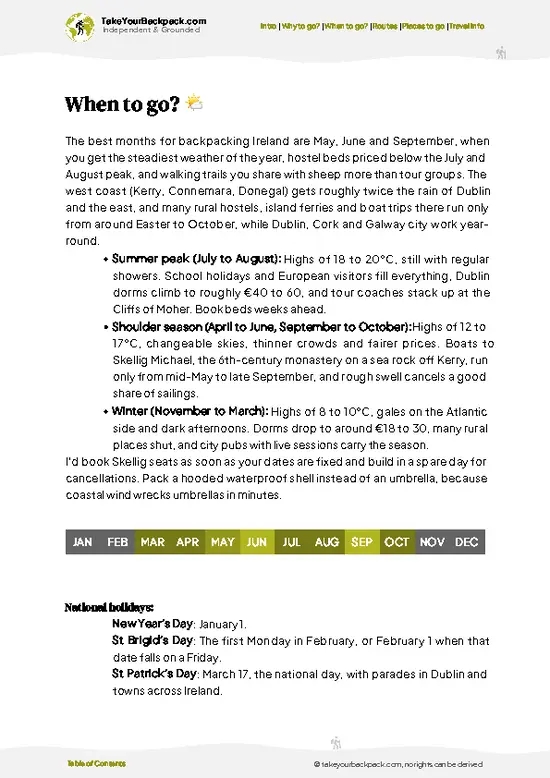
Best months for city travel: The best months for Irish cities are May, June and September, when daytime highs sit around 14 to 19°C, daylight stretches past 9 pm in early summer, and the worst crowds have not yet arrived or have already left. Nobody gets a dry guarantee here, but these months give the best odds.

Summer, shoulder and winter: July and August bring highs of 18 to 22°C and the longest evenings, along with the highest prices. Hostel dorm beds that cost €25 to 35 in spring can reach €45 to 70 in the capital, and festival weekends push them higher. Expect queues at the biggest attractions and a lot of accents from every continent.

April and October are good value shoulder months, with 9 to 15°C and rain showers that tend to be brief rather than biblical, though both can be wet. … read more 👉
Best months for city travel: The best months for Irish cities are May, June and September, when daytime highs sit around 14 to 19°C, daylight stretches past 9 pm in early summer, and the worst crowds have not yet arrived or have already left. Nobody gets a dry guarantee here, but these months give the best odds.

Summer, shoulder and winter: July and August bring highs of 18 to 22°C and the longest evenings, along with the highest prices. Hostel dorm beds that cost €25 to 35 in spring can reach €45 to 70 in the capital, and festival weekends push them higher. Expect queues at the biggest attractions and a lot of accents from every continent.

April and October are good value shoulder months, with 9 to 15°C and rain showers that tend to be brief rather than biblical, though both can be wet. Rainfall runs roughly 60 to 100 mm a month in the east and more along the west coast, so pack a waterproof jacket and treat umbrellas as a short-term loan from the wind.

November to February is cold and damp at 3 to 8°C, with sunset around 4:30 pm in December. Beds are cheapest then, often 20 to 40 percent below summer rates. Some smaller attractions cut hours or close on certain weekdays, and the west and north have the shortest winter schedules. The upside is pubs with turf fires and seats that do not require elbowing.

city hoppingTips for Visiting Multiple Destinations

How many days to plan: A trip linking several Irish cities needs 7 to 14 days, and 10 is comfortable. The country is small, which tempts people into planning too much, and a map makes 250 kilometers look like a short stroll.

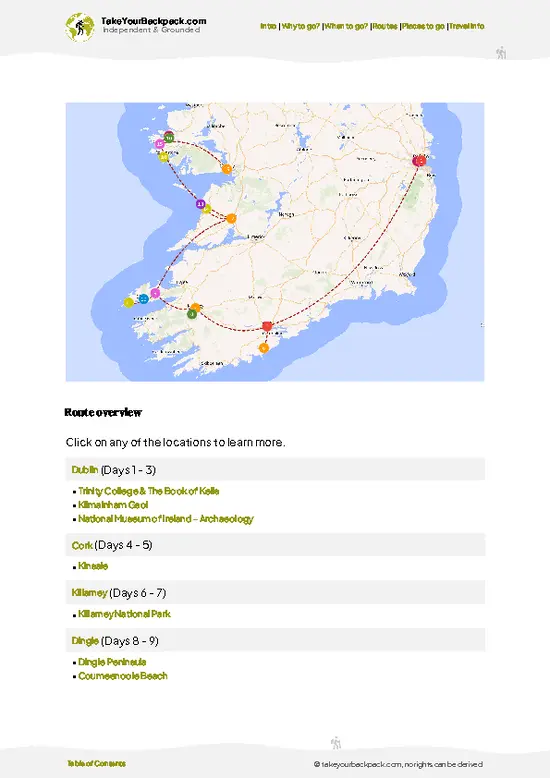
Grouping regions and direction: The cleanest approach is to cluster by region rather than zigzag. The east coast pairs with the north via the Dublin to Belfast rail line, which takes about 2 hours. The south and southwest link through Cork, with trains from Dublin taking roughly 2.5 to 3 hours. The west is reached by train or coach from Dublin in about 2.5 to 3 hours, and coaches run between the west and the south in 3.5 to 4 hours. A loop starting in Dublin, heading north, returning south and then swinging through the southwest and west keeps backtracking low. Flying … read more 👉
How many days to plan: A trip linking several Irish cities needs 7 to 14 days, and 10 is comfortable. The country is small, which tempts people into planning too much, and a map makes 250 kilometers look like a short stroll.

Grouping regions and direction: The cleanest approach is to cluster by region rather than zigzag. The east coast pairs with the north via the Dublin to Belfast rail line, which takes about 2 hours. The south and southwest link through Cork, with trains from Dublin taking roughly 2.5 to 3 hours. The west is reached by train or coach from Dublin in about 2.5 to 3 hours, and coaches run between the west and the south in 3.5 to 4 hours. A loop starting in Dublin, heading north, returning south and then swinging through the southwest and west keeps backtracking low. Flying in and out of different airports, such as Dublin and Shannon or Cork, saves a day of retracing.

Pacing and common mistakes: Allow 2 nights per city, or 3 for the capital if you want museums and a day trip. One night is a bus timetable with a bed attached. The usual mistake is trying to see five cities in five days, spending half of each one looking at a coach window. Another is assuming rural routes run as often as the main corridors. Check last departures before settling in at a pub.

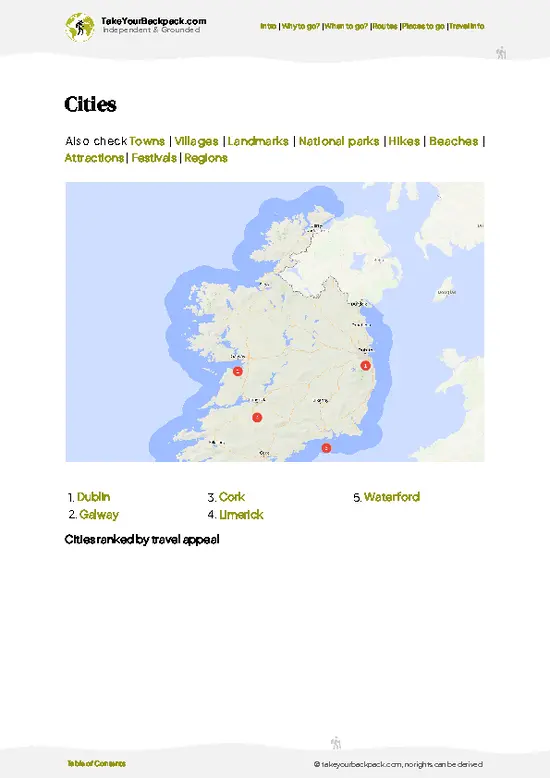
The ListMust-Visit cities in Ireland

1 Dublin

Georgian squares, literary pubs, city parks

Trace the city’s literary legacy through bookshops and pubs, then relax in green spaces surrounded by Georgian architecture and busy streets.

Ireland - Dublin

2 Galway

Latin Quarter, street performers, Corrib river

Absorb the energy of a city where music spills onto cobblestones, riverside walks lead to the sea, and festivals fill the calendar.

3 Cork

English Market, Rebel County, riverside quays

Sample local produce at the English Market, wander along the River Lee, and notice how Cork’s independent spirit shapes daily life.

ireland-city-cork
© Google | Anne P

4 Limerick

King John’s Castle, Shannon waterfront, street murals

Walk the banks of the Shannon, discover medieval fortifications, and find contemporary art woven into the city’s urban landscape.

ireland-city-limerick
© Google |

5 Waterford

Viking triangle, crystal workshops, quay-side

Trace the layers of Ireland’s oldest city, from Viking roots to glassmaking traditions, along a riverfront dotted with historic buildings.

ireland-city-waterford
© Google |
Loading the map 🌍

Expert viewTips and Advice from Travelers

How many cities to visit: I advise three or four cities on a trip of 7 to 12 days. Each place has a pace, and a city here takes a full day just to hear properly: a lunchtime market, a museum on a wet afternoon, a session in a pub that starts at 9:30 pm and refuses to end. Squeeze in six and you will remember only luggage racks.

Which kind suits you: Choose the capital if you want museums, a deep range of food and easy flights. Its streets are busy, the river quays are windy, and every second doorway seems to have a queue. Pick a mid-sized southern or western city for live traditional music, small independent cafés and people who will hand you directions plus a life story. Choose the northern cities for political history told in murals, black taxi tours and a lower bar tab, with the bonus … read more 👉
How many cities to visit: I advise three or four cities on a trip of 7 to 12 days. Each place has a pace, and a city here takes a full day just to hear properly: a lunchtime market, a museum on a wet afternoon, a session in a pub that starts at 9:30 pm and refuses to end. Squeeze in six and you will remember only luggage racks.

Which kind suits you: Choose the capital if you want museums, a deep range of food and easy flights. Its streets are busy, the river quays are windy, and every second doorway seems to have a queue. Pick a mid-sized southern or western city for live traditional music, small independent cafés and people who will hand you directions plus a life story. Choose the northern cities for political history told in murals, black taxi tours and a lower bar tab, with the bonus of Northern Ireland using pounds sterling instead of euros. Travelers who love nightlife should favor the university cities, where students keep the bars lively past what the smaller towns manage.

What it costs: Budget €70 to 110 a day on a backpacker footing: a dorm bed at €25 to 50, a self-catered or pub lunch at €10 to 16, a dinner at €15 to 25 and a pint at about €6 to 7.50 in the capital and slightly less elsewhere. Add entry fees of €8 to 20 for major museums and castles (many national museums are free), guided walking tours at €15 to 30 or on a tip basis, and city buses or trams at roughly €2 to 3 a ride. Intercity coaches commonly cost €10 to 30 if booked ahead. Visit costs vary, but a city stop with two paid sights usually lands at €40 to 70 beyond the bed. In Northern Ireland, convert your spending to pounds and keep a card handy.

Safety and manners: Irish cities are generally safe, with petty theft, mostly phone and bag snatching, the main issue on busy shopping streets and late at night near nightlife areas. Keep a bag zipped in crowded pubs. Book dorm beds early in summer, because the cheap ones vanish first. On the cultural side, buying a round is the custom when drinking with locals, and skipping your turn gets noticed. Tipping of 10 to 15 percent is standard in sit-down restaurants, not in pubs where you order at the bar. Talk about the weather, politely avoid reducing complicated history to a quip, and you will do fine.

✈️ The backpacker research shortcutIreland Travel Guide

An offline-friendly backpacking guide with optimized travel routes, ranked highlights, transport advice, and the best areas to stay.
example page 0 from our offline Travel Guide for Ireland
example page 1 from our offline Travel Guide for Ireland
example page 2 from our offline Travel Guide for Ireland
example page 3 from our offline Travel Guide for Ireland
example page 4 from our offline Travel Guide for Ireland
example page 5 from our offline Travel Guide for Ireland
example page 6 from our offline Travel Guide for Ireland
example page 7 from our offline Travel Guide for Ireland
The digital guide (366 pages) contains:
✅ 103 highlights, ranked by travel appeal
✅ Optimized 5, 10 & 15-day travel routes
✅ Cities, national parks, landmarks, beaches
✅ How to get around
✅ Offline-friendly for travel without Wi-Fi
👉 Click to see all 30+ guide features

📅 Plan smarter in minutes, not weeks
✅ Month by month travel advice
✅ Festivals & national holidays
✅ Budget expectations

🗺️ Go to the right places, skip the overrated ones
✅ Honest pros & cons of destinations
✅ Top hikes, parks & viewpoints
✅ Lesser-known places most travelers miss
✅ Clear “worth it vs skip it” guidance

🛏️ Travel smoothly without rookie mistakes
✅ Best areas to stay
✅ Transport systems explained simply
✅ Common scams & safety advice
✅ SIM cards, money & practical tips

🌍 Understand the country, not just visit it
✅ Culture & traditions
✅ Local customs
✅ Festivals worth planning around
✅ Traveler-friendly historical context
✅ Insights that make places more meaningful

📱 Built for real travel conditions
✅ Fully downloadable PDF
✅ Works completely offline
✅ Optimized for phone use
✅ Useful in remote areas & buses
✅ Everything in one place
Stop searching, start planning
Get instant access to your full guide. 30‑day money-back guarantee.
+ Add another guide for just

By proceeding you agree to our terms.
Sent to your inbox immediately after payment • 100% Secure Checkout
Best Backpacking Travel Advisor 2025 tourism awardBest Backpacking
Travel Advisor
2025
What others say about Take Your Backpack Guides:
⭐⭐⭐⭐⭐
Fantastic, amazing amount of information!
⭐⭐⭐⭐⭐
My goodness this is amazing, it's what I've been looking for hats off too you!
⭐⭐⭐⭐⭐
I think this is absolutely BRILLIANT
⭐⭐⭐⭐
Very complete and informative. It's still missing places, but I gotta to commend you
⭐⭐⭐⭐⭐
This is truly amazing, thank you, can't wait to explore it with my kids!
⭐⭐⭐⭐⭐
Awesome resource, thank you!
⭐⭐⭐⭐⭐
This is amazing! Can't wait to explore the ones I haven't seen
⭐⭐⭐⭐
I love this! Well done, great idea.
⭐⭐⭐⭐⭐
Thanks for taking the time to make this gem!
⭐⭐⭐⭐⭐
This might be the best website I've ever seen.
⭐⭐⭐⭐⭐
Congratulations, and thank you so much for your work; it's incredibly valuable.
⭐⭐⭐⭐
In all seriousness I think you did a great job pointing out the important spots
⭐⭐⭐⭐⭐
10/10 very good
⭐⭐⭐⭐⭐
As someone who's only just starting to visit regularly this is awesome, thank you.
⭐⭐⭐⭐
Thank you very much! I'm going to visit my dad, it's going to be very useful!
⭐⭐⭐⭐⭐
This is really cool! We'll be travelling for the first time and this definitely come in handy.
⭐⭐⭐⭐⭐
You are now our minister of culture, congratulations 👨‍💼
⭐⭐⭐⭐⭐
Just wanted to tell you that this is a pearl! Going to follow your recommendations.
⭐⭐⭐⭐⭐
This is so cool. I'll definitely be using the resource for my travels soon.
⭐⭐⭐⭐⭐
This is very impressive! Good work.
⭐⭐⭐⭐⭐
This is an amazing and informative site. Very well done!

🛏️ Where to stay?Top Areas to Stay

Hostels are easy to find in Ireland, with dorm beds running roughly €30 to €60 a night in Dublin and €20 to €35 in smaller cities, plus a network of independent hostels along the west coast. In Dublin, Temple Bar puts you on top of the pubs and walkable to Trinity College, though weekend noise and premium prices are part of the deal, while the area around O’Connell Street and Smithfield north of the Liffey costs less and sits near the Busáras coach station but feels rougher late at night. Galway’s Latin Quarter is compact, lively and full of live music until late, and central Cork around St Patrick’s Street keeps you close to the English Market and the pubs without Dublin prices.

If you enjoy … read more 👉
Hostels are easy to find in Ireland, with dorm beds running roughly €30 to €60 a night in Dublin and €20 to €35 in smaller cities, plus a network of independent hostels along the west coast. In Dublin, Temple Bar puts you on top of the pubs and walkable to Trinity College, though weekend noise and premium prices are part of the deal, while the area around O’Connell Street and Smithfield north of the Liffey costs less and sits near the Busáras coach station but feels rougher late at night. Galway’s Latin Quarter is compact, lively and full of live music until late, and central Cork around St Patrick’s Street keeps you close to the English Market and the pubs without Dublin prices.

If you enjoy meeting fellow travelers, consider choosing hostels with high ratings for atmosphere. On the other hand, if you prefer having your own space, a hotel might be a better option.

IrelandDiscover the Country

👋 Meet the founderWho’s Behind Take Your Backpack?

Johan, backpacker and founder of TakeYourBackpackHi, I’m Johan (Netherlands 🇳🇱), the creator of TakeYourBackpack. Over the past 3 decades, I’ve backpacked through 90+ countries across six continents, gaining extensive experience with independent travel, long-term trips, and overland routes.

This site is built on a combination of firsthand travel experience and carefully curated insights from other backpackers. Many guides are based on places I’ve personally visited, while others bring together tips, observations, and practical advice shared by trusted travelers I’ve met along the way.

The goal is to provide realistic, experience-driven guidance — not generic itineraries — so you can explore destinations with better context, clearer expectations, and more confidence.