Short answer: yes, but it’s not a Southeast-Asia-style backpacker conveyor belt. Jamaica is totally doable independently if you’re comfortable with a bit of improvising and street smarts. The island is used to tourists, but most are resort guests, not backpackers, so you won’t find a hostel on every corner or a ready-made backpacker circuit.
What makes it easy: English is the official language, routes between major towns are straightforward, and locals are generally helpful once you show basic respect. You can move between the main hubs (Kingston, Ocho Rios, Montego Bay, Negril, Port Antonio) using public buses, route taxis, and occasional shuttles. ATMs are common in towns, and you can usually pay cash for everything.
What makes it harder: distances are short but travel is slow, public transport is chaotic, and you’ll deal with persistent hustling in touristy areas. Safety is mostly about avoiding sketchy neighborhoods, not flashing valuables, and not wandering drunk at night. Crime headlines can sound intense, but backpackers who stick to sensible areas and hours usually have smooth trips.
Budget-wise, Jamaica is pricier than mainland Latin America but cheaper than resort-style Caribbean islands if you eat local (cookshops, patties, street food), use route taxis, and stay in guesthouses instead of all-inclusives. If you’re expecting $5 dorm beds and $1 beers everywhere, you’ll be disappointed; if you’re okay with mid-range prices for high-character experiences, you’ll be happy.
Bottom line: Jamaica is very backpackable for someone who’s traveled a bit before, and still manageable for a first-timer who reads up, starts slow, and doesn’t try to do everything in one go.
For a first-time backpacker on a budget, 10–14 days is the sweet spot. That gives you time to see both coasts, adjust to the pace, and not spend your whole trip in transit.
If you have 5–7 days: Pick one side of the island and keep it tight. For example:
- West-focused: Montego Bay (arrival only) → Negril (beach + cliffs) → one day trip inland (YS Falls or a coffee farm).
- East-focused: Kingston (1–2 nights) → Blue Mountains (1–2 nights) → Port Antonio (3–4 nights for beaches and waterfalls).
You’ll be moving every couple of days, but it’s still doable without feeling like a race.
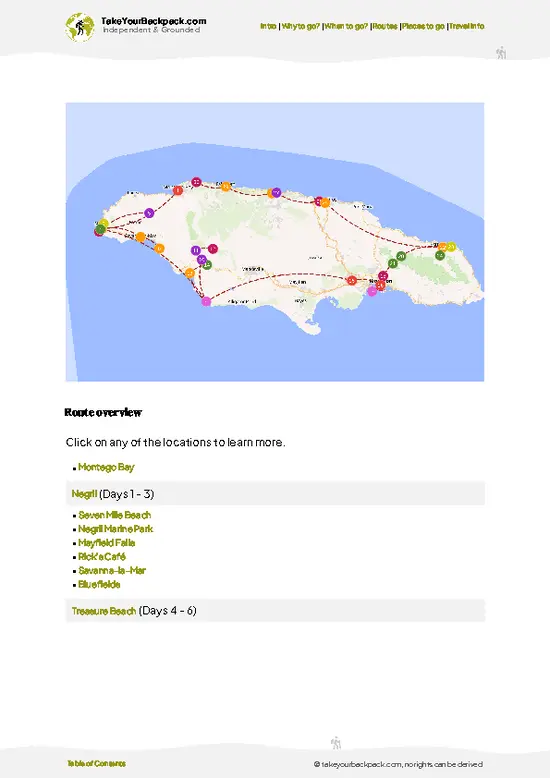
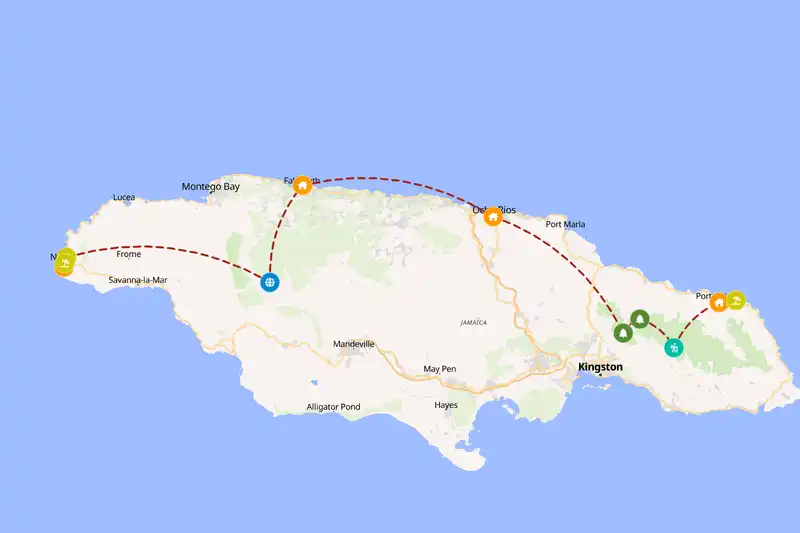
If you have 10–14 days: You can do a satisfying loop without a car:
- 2–3 nights Kingston (culture, music, food)
- 2–3 nights Blue Mountains or a rural stay
- 3–4 nights Port Antonio (beaches, waterfalls, chill time)
- 3–4 nights Negril or Montego Bay area for classic Caribbean beach time
This pace lets you have real down days instead of just transit days.
If you have 3+ weeks: You can slow down and add less-visited corners like Treasure Beach, inland towns, or more time in the mountains. Longer stays also help your budget because you can negotiate better rates for rooms and get into a routine with local food spots.
Trying to do a full island loop in under a week is where people burn out and overspend on taxis. Fewer bases, more nights in each place, and one long transit day every few days is the budget traveler’s friend.
Yes, you can absolutely get around Jamaica without a car, and most backpackers do. It just takes patience and a bit of comfort with organized chaos.
Your main tools:
- Route taxis: Shared cars running fixed routes between towns and villages. They’re cheap and frequent, but often crowded. You pay per seat, so if you want more comfort or privacy, you can pay for extra seats. Always confirm the price before you get in and make sure it’s a route taxi (red license plates), not a private charter pretending to be one.
- Public buses and minibuses: These connect bigger towns and are usually the cheapest option. They leave when full, not on a strict schedule, so build in buffer time. They can be hot and packed, but they’re a very local experience and good for your budget.
- Knutsford Express: A comfortable, air-conditioned coach service linking major cities like Kingston, Montego Bay, Ocho Rios, and Negril. It costs more than a minibus but is still reasonable and much more comfortable, especially for longer hops.
- Local taxis and charters: For awkward routes, late arrivals, or if you’re tired of juggling connections, you can negotiate a private taxi. This is the budget-buster, so use it strategically—like splitting the cost with other travelers for a long leg.
What to expect: travel is slower than the map suggests, and connections can be messy. A 3-hour drive can easily become a 5-hour journey with waiting and transfers. Plan big moves in the morning, avoid arriving in new towns late at night, and keep your daypack tight and easy to grab.
If you’re staying mostly in one region (for example, basing in Port Antonio or Negril and doing day trips), you won’t miss having a car at all. If you want to hit lots of remote spots in a short time, then not having a car means you’ll either need more days or more money for private rides.
For a budget traveler, the must-visits are less about ticking off every famous attraction and more about mixing coast, culture, and countryside without draining your wallet. These are the places that give you the best feel for Jamaica per dollar and per hour of transit.
1. Port Antonio and the East Coast
If you only pick one base, this is the strongest all-rounder. It’s more relaxed than the big resort towns, with cheaper guesthouses and a real local feel. You get beaches (Frenchman’s Cove, Winnifred Beach), waterfalls and rivers (Reach Falls, Rio Grande rafting), and easy day trips into the hills. You can eat from cookshops and street stalls instead of tourist restaurants, which keeps costs down.
2. Blue Mountains (or another mountain village stay)
Spending at least one night in the hills is worth it. Cooler air, coffee farms, hiking, and a completely different pace from the coast. You don’t have to do the full pre-dawn summit hike if that’s not your thing; even short walks and a simple homestay-style guesthouse will give you a side of Jamaica most resort visitors never see.
3. Negril (especially the cliffs)
Negril is touristy, but it earns its reputation. Seven Mile Beach is long and easygoing, and the cliffs area has cheap-ish rooms, sunset bars, and spots where you can swim or jump straight into the sea. If you’re careful where you eat and drink, you can keep it relatively budget-friendly. It’s a good place to end a trip: beach time, live music, and easy onward transport.
4. Kingston (1–2 nights for culture and music)
Kingston is not a beach town, and it’s not for everyone, but it’s the cultural engine of the island. If you’re into music, food, or history, a short stay pays off: museums, street art, sound systems, and proper local food. Stay in a safer, central neighborhood, use registered taxis or rides, and treat it like any big city: alert but curious.
5. A south coast stop (Treasure Beach or similar) if time allows
If you have more than 10 days, adding a low-key south coast village like Treasure Beach gives you a quieter, more community-based feel. Fewer big resorts, more guesthouses and small bars, and a slower rhythm. It’s not essential for a first, short trip, but it’s a strong add-on if you like laid-back places and don’t need a long list of attractions.
If you’re short on time or money, you don’t need to chase every famous name. Some places are fun but not essential for a backpacker, especially when you factor in entry fees, crowds, and transport hassle.
1. Overpriced, crowded waterfall parks
Big-name waterfalls that charge high entry plus mandatory guides or extras can eat your budget fast, especially if you’re doing several. Pick one or two that fit your route and skip the rest. You don’t need to see every single waterfall to understand Jamaica.
2. Tourist-trap day tours from cruise ports
Anything heavily marketed to cruise passengers—especially all-in-one packages from Montego Bay or Ocho Rios—tends to be overpriced and rushed. As a backpacker, you’re better off using local transport or a simple shared taxi to reach specific spots instead of buying bundled tours.
3. Multiple resort towns
You don’t need Montego Bay, Ocho Rios, and Negril in one short trip. They all offer some version of beaches, bars, and tourist infrastructure. If you’re tight on time, pick one beach base (Negril or Port Antonio are usually better value for backpackers) and skip the others.
4. High-priced, highly packaged attractions
Things like certain dolphin encounters, ATV parks, or zipline complexes are built for short-term resort guests with big budgets. They’re fun but generic; you could be almost anywhere in the world. If you’re counting your dollars, that money goes further on local food, an extra night in the mountains, or a smaller, locally run tour.
5. Trying to circle the whole island
The biggest thing to skip is the urge to do everything. A rushed loop—Kingston, Port Antonio, Ocho Rios, Montego Bay, Negril, south coast—in under 10 days means you’ll mostly see bus stations and taxi stands. For a short trip, skip entire regions rather than shaving every stop down to one night. Two or three well-chosen bases with day trips will give you a deeper, cheaper, and calmer experience than a frantic island sprint.