×

Lebanon🇱🇧 | best national parksYour Guide to the 12 Best national parks in Lebanon

Lebanon has no big-fenced park system. What it has are protected nature reserves, run mostly by local committees and NGOs, so expect modest entry fees, small visitor centers and trails of a few hours rather than multi-day wilderness. The cedar and oak forests of Mount Lebanon are the core draw, with cool air and signed paths. Coastal reserves are small and not worth a detour unless you are already on that stretch of shoreline. For backpacking or independent travel, the mountains are easier to enjoy than the south, where unmarked areas near the border deserve a hard pass. Crowds only show up on summer weekends.

By Johan Kruseman 🇳🇱 | Updated October 19, 2026
Explore the best hikes in Lebanon

Why go?Key Factors That Shape the Experience

Lebanon packs sea level to 3,000 meter peaks into a country about 200 kilometers long and 50 kilometers wide. That gives alpine forest, Mediterranean scrub, river gorges and coast within a morning's drive of each other. Few countries let you change ecosystems that fast, and that is the real strength here.

The weakness is the system itself. Most reserves are small, community-managed and patchily funded, not state parks with ranger networks and printed trail maps. Signage can be thin, opening hours shift, and some places need advance booking for a guide. Do not come expecting the polish of a North American or European park.

Culture shapes the experience in a good way. Reserves sit beside working mountain villages, so a hike often ends in a guesthouse kitchen or a village bakery rather than a car … read more 👉
Lebanon packs sea level to 3,000 meter peaks into a country about 200 kilometers long and 50 kilometers wide. That gives alpine forest, Mediterranean scrub, river gorges and coast within a morning's drive of each other. Few countries let you change ecosystems that fast, and that is the real strength here.

The weakness is the system itself. Most reserves are small, community-managed and patchily funded, not state parks with ranger networks and printed trail maps. Signage can be thin, opening hours shift, and some places need advance booking for a guide. Do not come expecting the polish of a North American or European park.

Culture shapes the experience in a good way. Reserves sit beside working mountain villages, so a hike often ends in a guesthouse kitchen or a village bakery rather than a car park. Lebanon also has deep historical layers, with monasteries and ancient cedars sharing the same valleys.

Know before choosing Lebanon: public transport is weak, electricity and card payments are unreliable, and cash in US dollars is the practical currency. Security conditions change by region, so check current government advisories before you book. For travelers who accept rough edges, the payoff is quiet trails and generous hosts.
Why These Made the Cut
The list of best national parks in Lebanon is created based on landscapes, wildlife, adventure opportunities, facilities, and overall experience. If you feel a national park is missing in this list, please let us know.

When to go?Optimal Periods for Travel

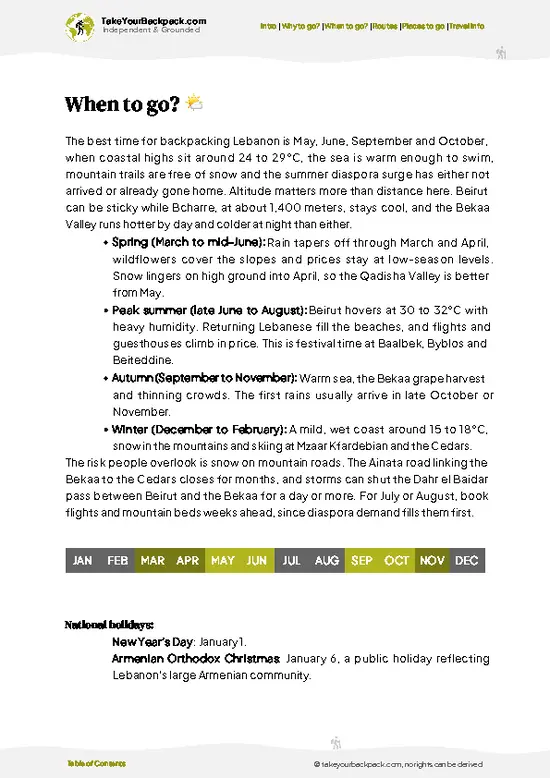
Best months and weather: April to June and September to November are the best months for Lebanon's reserves, because mountain temperatures sit around 15 to 26°C and the trails are dry and open. Spring brings wildflowers and green slopes, while autumn gives clear air and golden oak foliage.

Winter and summer: Rain falls almost entirely between November and March, roughly 800 to 1,200 mm in the Mount Lebanon range and 600 to 800 mm on the coast. Above about 1,500 meters, snow arrives from December and often lasts into March or April, which closes some roads and turns hikes into snowshoe outings. If that appeals, go in January or February. If it does not, skip winter, since lower trails are muddy and views are often lost in cloud.

July and August are peak season. Mountain highs stay near 25 to … read more 👉
Best months and weather: April to June and September to November are the best months for Lebanon's reserves, because mountain temperatures sit around 15 to 26°C and the trails are dry and open. Spring brings wildflowers and green slopes, while autumn gives clear air and golden oak foliage.

Winter and summer: Rain falls almost entirely between November and March, roughly 800 to 1,200 mm in the Mount Lebanon range and 600 to 800 mm on the coast. Above about 1,500 meters, snow arrives from December and often lasts into March or April, which closes some roads and turns hikes into snowshoe outings. If that appeals, go in January or February. If it does not, skip winter, since lower trails are muddy and views are often lost in cloud.

July and August are peak season. Mountain highs stay near 25 to 30°C, which is pleasant, but the coast hits 30 to 33°C with heavy humidity and the Bekaa Valley regularly passes 35°C. Coastal reserves are not worth visiting in midsummer. Weekends bring Lebanese families, so guesthouses in mountain villages cost more and fill up. Weekdays are far calmer.

Prices and shoulder periods: Guesthouse rates usually rise 20 to 40 percent in summer and during holiday weekends. Late April, May and October offer the best balance of space, weather and price.

national park hoppingPlanning Your Route Efficiently

How long to allow: A trip combining several of Lebanon's reserves needs 5 to 8 days, and that is enough because the country is so compact. Beirut is the logical hub, since nearly every reserve sits within 1 to 3 hours of it by road.

Grouping and direction: Two clusters work well. The central and southern Mount Lebanon group sits 1 to 1.5 hours from Beirut. The north group, around Batroun, Bsharri and Ehden, takes 1.5 to 2.5 hours. Moving from south to north, ending near Tripoli, avoids backtracking through Beirut traffic. Between clusters, allow 2 to 3 hours on a good day.

Give each reserve half a day to one full day. Anything more is padding unless you plan a longer trek. Two nights in each cluster is enough.

Planning mistakes: The most common error is trusting map times. Mountain roads are … read more 👉
How long to allow: A trip combining several of Lebanon's reserves needs 5 to 8 days, and that is enough because the country is so compact. Beirut is the logical hub, since nearly every reserve sits within 1 to 3 hours of it by road.

Grouping and direction: Two clusters work well. The central and southern Mount Lebanon group sits 1 to 1.5 hours from Beirut. The north group, around Batroun, Bsharri and Ehden, takes 1.5 to 2.5 hours. Moving from south to north, ending near Tripoli, avoids backtracking through Beirut traffic. Between clusters, allow 2 to 3 hours on a good day.

Give each reserve half a day to one full day. Anything more is padding unless you plan a longer trek. Two nights in each cluster is enough.

Planning mistakes: The most common error is trusting map times. Mountain roads are slow, Beirut traffic can double an exit trip, and a 60 kilometer drive can take 2 hours. Add a 30 to 50 percent buffer. Another mistake is cramming three reserves into a day. Pick one morning hike and let the afternoon go to a village meal.

Relying on public transport is a third problem. Minibuses reach valley towns, not trailheads, so budget for a rental car or a shared taxi. In winter, check road status before heading above 1,500 meters.

The ListThe Best national parks of Lebanon

1 Al-Shouf Cedar Nature Reserve

expansive cedar stands, wildlife corridors, rolling hills

Traverse extensive cedar forests, watch for wild boar or deer, and explore undulating terrain that links several mountain villages.

2 Cedars of God

ancient cedars, UNESCO site, sacred grove

Stand among some of the world’s oldest cedar trees, reflect on their cultural significance, and witness a landscape shaped by millennia.

lebanon-national-park-cedars-of-god
© Google |

3 Jabal Moussa Biosphere Reserve

mountain trails, ancient inscriptions, Mediterranean forest

Hike through rugged slopes where rare plants thrive, discover centuries-old carvings, and watch clouds drift over a patchwork of forest and stone.

4 Tannourine Cedars Forest Nature Reserve

dense cedar groves, karst formations, rugged terrain

Navigate rocky trails beneath thick cedar canopies, explore caves and sinkholes, and enjoy the solitude of a less-visited forest.

lebanon-national-park-tannourine-cedars-forest-nature-reserve
© Google |

5 Horsh Ehden Nature Reserve

diverse flora, steep slopes, endemic species

Descend into deep valleys rich with rare plants, listen for endemic birds, and experience dramatic elevation changes in a compact area.

lebanon-national-park-horsh-ehden-nature-reserve
© Google |

6 Palm Islands Nature Reserve

offshore islands, sandy beaches, sea turtles

Take a boat to protected islands, walk along quiet beaches, and observe nesting turtles and migratory birds in a marine sanctuary.

lebanon-national-park-palm-islands-nature-reserve
© Google |

7 Tyre Coast Nature Reserve

sandy coastline, sea grass beds, nesting birds

Walk along undeveloped beaches, watch herons and terns feeding, and see how coastal ecosystems support both wildlife and local fisheries.

8 Ammiq Wetland

bird migration, reed beds, freshwater marsh

Wander boardwalks surrounded by reeds, spot migratory birds resting in the wetlands, and experience Lebanon’s last major freshwater habitat up close.

lebanon-national-park-ammiq-wetland
© Google |

9 Bentael Nature Reserve

limestone cliffs, pine woodland, panoramic viewpoints

Climb narrow paths through pine forests, pause at rocky overlooks, and take in sweeping views of valleys and distant villages.

10 Jaj Cedars Forest

old-growth cedars, high-altitude groves, mountain air

Stroll beneath towering cedar trees, breathe crisp air at elevation, and sense the quiet endurance of Lebanon’s iconic forests.

11 Yammouneh Nature Reserve

alpine lakes, wildflowers, Roman ruins

Walk beside clear mountain lakes, pass carpets of spring wildflowers, and encounter remnants of ancient civilizations scattered across the plateau.

12 Ramlieh Valley

oak forest, river valley, rural landscape

Follow trails winding through shady oak woods, cross small streams, and observe traditional farming shaping the surrounding hills.

Loading the map 🌍

Expert viewPro Tips for Exploring the Best

How many to visit: Three to four reserves over a week is the number I advise. Each hike takes half a day to a day, the roads are slow, and a fourth stop starts eating the time you need for village meals and rest. Visiting more only turns the trip into a driving tour. The reward for restraint is trails to yourself and a table of home cooking at the end.

Which kind to prioritize: Mountain forest reserves come first for almost everyone, because they give cool air, clear paths and the strongest scenery. Choose a gorge or valley reserve second if you like longer walks and can handle rougher footing. Coastal reserves are the lowest priority, since you can see the same sea from any public beach. Backpackers on a tight budget should favor reserves with free or very cheap entry and a guesthouse in the … read more 👉
How many to visit: Three to four reserves over a week is the number I advise. Each hike takes half a day to a day, the roads are slow, and a fourth stop starts eating the time you need for village meals and rest. Visiting more only turns the trip into a driving tour. The reward for restraint is trails to yourself and a table of home cooking at the end.

Which kind to prioritize: Mountain forest reserves come first for almost everyone, because they give cool air, clear paths and the strongest scenery. Choose a gorge or valley reserve second if you like longer walks and can handle rougher footing. Coastal reserves are the lowest priority, since you can see the same sea from any public beach. Backpackers on a tight budget should favor reserves with free or very cheap entry and a guesthouse in the next village. Experienced hikers can add a guided multi-hour route for a longer day with wide views.

What it costs: Plan on US$40 to 70 a day for a comfortable independent trip. Entry fees are usually US$3 to 10 per person. A guide, required at some reserves, runs US$20 to 60 for a group. A shared taxi or van between towns costs US$3 to 10, while a private taxi for a day trip from Beirut runs US$40 to 80. A guesthouse bed is US$25 to 50, and a mountain lunch of mezze and grilled meat costs US$8 to 15. Carry cash in small US dollar bills, because card machines often fail. A day in a reserve then costs far less than the drive suggests.

Safety and etiquette: Stay on marked trails. In parts of the south, near the border, unexploded ordnance remains a real risk off established paths, and some border and northeastern areas are subject to travel warnings. Check your government advisory before booking and again before leaving. Hunting occurs in some regions in autumn, so wear a bright layer. Fires are banned in forest reserves, and rangers fine offenders.

Villages beside the reserves are conservative in dress. Cover knees and shoulders when walking through. Ask before photographing people. Accept the coffee if it is offered, since refusing can read as rude and accepting often leads to the best trail advice. Carry 2 liters of water per person, since refill points are rare, and a rain shell in spring and autumn, because mountain weather turns within an hour.

✈️ The backpacker research shortcutLebanon Travel Guide

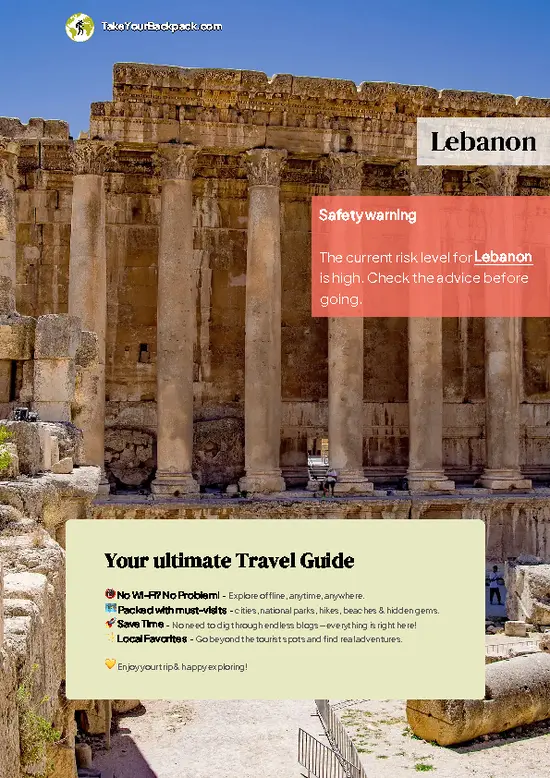
An offline-friendly backpacking guide with optimized travel routes, ranked highlights, transport advice, and the best areas to stay.
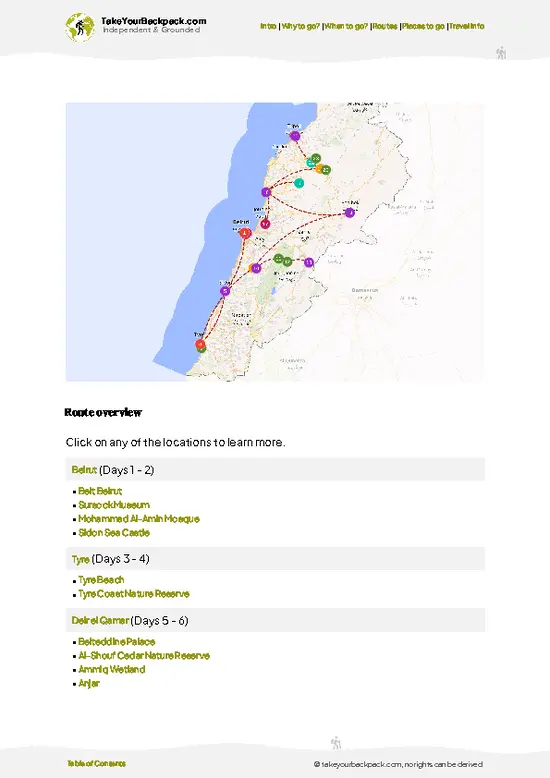
example page 0 from our offline Travel Guide for Lebanon
example page 1 from our offline Travel Guide for Lebanon
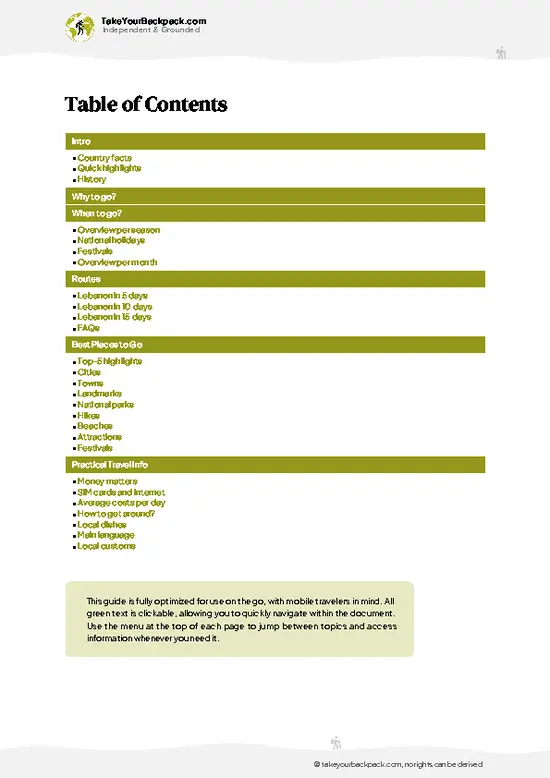
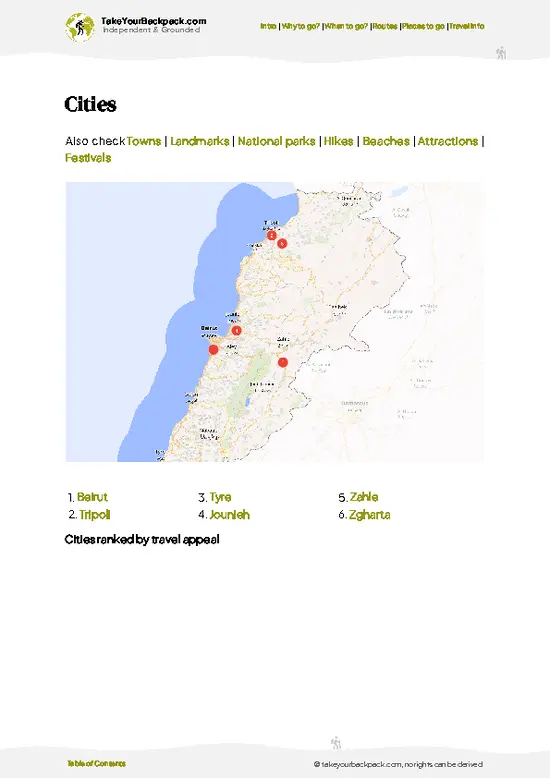
example page 2 from our offline Travel Guide for Lebanon
example page 3 from our offline Travel Guide for Lebanon
example page 4 from our offline Travel Guide for Lebanon
example page 5 from our offline Travel Guide for Lebanon
example page 6 from our offline Travel Guide for Lebanon
example page 7 from our offline Travel Guide for Lebanon
The digital guide (286 pages) contains:
✅ 77 highlights, ranked by travel appeal
✅ Optimized 5, 10 & 15-day travel routes
✅ Cities, national parks, landmarks, beaches
✅ How to get around
✅ Offline-friendly for travel without Wi-Fi
👉 Click to see all 30+ guide features

📅 Plan smarter in minutes, not weeks
✅ Month by month travel advice
✅ Festivals & national holidays
✅ Budget expectations

🗺️ Go to the right places, skip the overrated ones
✅ Honest pros & cons of destinations
✅ Top hikes, parks & viewpoints
✅ Lesser-known places most travelers miss
✅ Clear “worth it vs skip it” guidance

🛏️ Travel smoothly without rookie mistakes
✅ Best areas to stay
✅ Transport systems explained simply
✅ Common scams & safety advice
✅ SIM cards, money & practical tips

🌍 Understand the country, not just visit it
✅ Culture & traditions
✅ 52 Essential phrases & customs
✅ Festivals worth planning around
✅ Traveler-friendly historical context
✅ Insights that make places more meaningful

📱 Built for real travel conditions
✅ Fully downloadable PDF
✅ Works completely offline
✅ Optimized for phone use
✅ Useful in remote areas & buses
✅ Everything in one place
Stop searching, start planning
Get instant access to your full guide. 30‑day money-back guarantee.
+ Add another guide for just

By proceeding you agree to our terms.
Sent to your inbox immediately after payment • 100% Secure Checkout
Best Backpacking Travel Advisor 2025 tourism awardBest Backpacking
Travel Advisor
2025
What others say about Take Your Backpack Guides:
⭐⭐⭐⭐⭐
Fantastic, amazing amount of information!
⭐⭐⭐⭐⭐
My goodness this is amazing, it's what I've been looking for hats off too you!
⭐⭐⭐⭐⭐
I think this is absolutely BRILLIANT
⭐⭐⭐⭐
Very complete and informative. It's still missing places, but I gotta to commend you
⭐⭐⭐⭐⭐
This is truly amazing, thank you, can't wait to explore it with my kids!
⭐⭐⭐⭐⭐
Awesome resource, thank you!
⭐⭐⭐⭐⭐
This is amazing! Can't wait to explore the ones I haven't seen
⭐⭐⭐⭐
I love this! Well done, great idea.
⭐⭐⭐⭐⭐
Thanks for taking the time to make this gem!
⭐⭐⭐⭐⭐
This might be the best website I've ever seen.
⭐⭐⭐⭐⭐
Congratulations, and thank you so much for your work; it's incredibly valuable.
⭐⭐⭐⭐
In all seriousness I think you did a great job pointing out the important spots
⭐⭐⭐⭐⭐
10/10 very good
⭐⭐⭐⭐⭐
As someone who's only just starting to visit regularly this is awesome, thank you.
⭐⭐⭐⭐
Thank you very much! I'm going to visit my dad, it's going to be very useful!
⭐⭐⭐⭐⭐
This is really cool! We'll be travelling for the first time and this definitely come in handy.
⭐⭐⭐⭐⭐
You are now our minister of culture, congratulations 👨‍💼
⭐⭐⭐⭐⭐
Just wanted to tell you that this is a pearl! Going to follow your recommendations.
⭐⭐⭐⭐⭐
This is so cool. I'll definitely be using the resource for my travels soon.
⭐⭐⭐⭐⭐
This is very impressive! Good work.
⭐⭐⭐⭐⭐
This is an amazing and informative site. Very well done!

🛏️ Where to stay?Top Places to Consider Staying

Backpacking Lebanon is easy on a budget, with hostel dorms around US$12 to 25 a night and simple guesthouses beyond Beirut. In the capital, Hamra has the widest and cheapest choice and is walkable to the Corniche and university cafés, though traffic noise never stops, while Mar Mikhael and Gemmayzeh put you on the city’s best bar streets at the cost of loud weekend nights and pricier beds. For quieter nights, coastal Byblos and Batroun have small guesthouses near the old souks and beaches, and they work well as bases for trips north.

If you enjoy meeting fellow travelers, consider choosing hostels with high ratings for atmosphere. On the other hand, if you prefer having your own space, a hotel might be a better option.

LebanonMore Places Across Lebanon

👋 Meet the founderWho’s Behind Take Your Backpack?

Johan, backpacker and founder of TakeYourBackpackHi, I’m Johan (Netherlands 🇳🇱), the creator of TakeYourBackpack. Over the past 3 decades, I’ve backpacked through 90+ countries across six continents, gaining extensive experience with independent travel, long-term trips, and overland routes.

This site is built on a combination of firsthand travel experience and carefully curated insights from other backpackers. Many guides are based on places I’ve personally visited, while others bring together tips, observations, and practical advice shared by trusted travelers I’ve met along the way.

The goal is to provide realistic, experience-driven guidance — not generic itineraries — so you can explore destinations with better context, clearer expectations, and more confidence.