×

Madagascar🇲🇬 | best landmarksExplore the Best landmarks in Madagascar

Landmarks in Madagascar are mostly shaped by the land itself: limestone needles, sandstone canyons, baobab-lined dirt roads and granite domes, with few built monuments. Expect red dust in your teeth, the sweet-sharp smell of ylang-ylang and charcoal smoke, and long, jolting rides to reach almost anything. The central highlands around Antananarivo and Antsirabe offer royal hilltop sites, rice terraces and cooler air, with easy access by taxi-brousse and low fees. The west is hot, open and dry, with sites reached by 4x4 on sandy tracks, so costs climb. The south is sparse and windy, with few travelers. The northern coast and islands mix humid forest with beach heat. Backpacking independently is entirely possible, but distances are large and roads slow, so your choice of region decides your budget, your pace and how many other visitors you share a viewpoint with.

By Johan Kruseman 🇳🇱 | Updated October 19, 2026
Explore the best national parks in Madagascar

Why go?Key Factors That Shape the Experience

Madagascar has been separated from other landmasses for roughly 88 million years, and that isolation produced landscapes and living things found nowhere else. The result is a country whose standout sights are natural formations and living ecosystems rather than cathedrals or ruins. Wind, monsoon rain and erosion have carved razor-edged stone forests, deep gorges and rock arches, while the same isolation gave rise to the strange trees and forests that line some roads. Human history adds a second layer. Malagasy culture blends Southeast Asian, African and Arab influences, and the highlands hold fortified royal hills, sacred groves and tombs that still matter to living families. Many sites are fady, meaning taboo in some way, and local rules about what you may touch, point at or photograph are … read more 👉
Madagascar has been separated from other landmasses for roughly 88 million years, and that isolation produced landscapes and living things found nowhere else. The result is a country whose standout sights are natural formations and living ecosystems rather than cathedrals or ruins. Wind, monsoon rain and erosion have carved razor-edged stone forests, deep gorges and rock arches, while the same isolation gave rise to the strange trees and forests that line some roads. Human history adds a second layer. Malagasy culture blends Southeast Asian, African and Arab influences, and the highlands hold fortified royal hills, sacred groves and tombs that still matter to living families. Many sites are fady, meaning taboo in some way, and local rules about what you may touch, point at or photograph are real.

Before choosing Madagascar for its landmarks, understand the infrastructure. Only a handful of main roads are properly paved, and even those can be pitted. Distances that look short on a map take a full day in a crowded taxi-brousse, with chickens in the aisle and a stop for grilled zebu skewers at the roadside. Many of the best sights sit inside protected areas that charge fees and require a licensed local guide, so budgets run higher than the country’s low prices suggest. Rainy-season washouts can close tracks for days. Facilities at sites are basic: a ticket hut, a bench, perhaps a woman selling sticky bananas. Visitor numbers are low compared with other destinations, so you often have a viewpoint to yourself, with only wind and cicadas for company. That solitude is the real appeal, and it comes with patience and flexibility as the price of entry.
Our Approach to Ranking
The list of best unique sites in Madagascar is created based on history or culture, wow factor, atmosphere, quirks, and memorability. If you feel a unique site is missing in this list, please let us know.

When to go?Optimal Periods for Travel

Best months and the dry season: The best months for landmarks in Madagascar are May to October, when the dry season brings clear skies, firm roads and low humidity. Days in the highlands run about 20 to 26°C, with cold nights that can drop to 5 to 10°C around Antananarivo and Antsirabe, so a warm layer matters at sunrise viewpoints. The west and south are warmer, often 28 to 35°C by day, with dust hanging golden in the late light. Rain is rare in these months across most of the island, usually under 30 mm a month in the west.
Shoulder seasons: April and November are the useful shoulder months. Roads are mostly passable, the heat builds in the lowlands, and the first storms arrive late in the month, often as afternoon downpours. Prices for guides and 4x4 hire can be 10 to 20 percent lower than … read more 👉
Best months and the dry season: The best months for landmarks in Madagascar are May to October, when the dry season brings clear skies, firm roads and low humidity. Days in the highlands run about 20 to 26°C, with cold nights that can drop to 5 to 10°C around Antananarivo and Antsirabe, so a warm layer matters at sunrise viewpoints. The west and south are warmer, often 28 to 35°C by day, with dust hanging golden in the late light. Rain is rare in these months across most of the island, usually under 30 mm a month in the west.
Shoulder seasons: April and November are the useful shoulder months. Roads are mostly passable, the heat builds in the lowlands, and the first storms arrive late in the month, often as afternoon downpours. Prices for guides and 4x4 hire can be 10 to 20 percent lower than at peak, and fewer travelers share the trails. Late October and November also bring jacaranda blossom to the highlands towns.
Wet season and cyclones: From December to March, heavy rain and cyclone risk dominate. The east coast and north can receive 300 to 500 mm a month, rivers swell, and dirt tracks to remote sites turn to slick red mud. Some national parks and rough roads close or become impassable for days, and humid heat of 30°C or more makes hiking sticky. Cyclones peak in February and March, especially along the east.
Peak periods: July to September is the busiest period, and July and August overlap with European school holidays. Book rooms and 4x4 transport for the western and southern circuits ahead, since vehicles are limited and prices can rise 20 to 30 percent. Mid-December to early January also fills flights and boats, even though the weather is poor.

unique site hoppingPlanning Your Route Efficiently

How long a combined trip needs: A trip combining several landmarks in Madagascar needs 14 to 21 days, because road time eats far more of each day than distance suggests. Realistic speeds on most roads are 25 to 40 km per hour, and a 200 km hop can mean 7 to 10 hours in a taxi-brousse.
Regions that cluster and the direction to travel: The central highlands (Antananarivo, Antsirabe, Ambositra, Fianarantsoa) group naturally on the paved RN7 corridor, and that road continues south toward Ranohira and the dry southwest. Heading north to south along that line works well, starting in cool air and ending in heat, which is easier on the body than the reverse. The west coast around Morondava and Belo sur Tsiribihina forms a separate cluster, reached by a long road from Antsirabe or by flight from the … read more 👉
How long a combined trip needs: A trip combining several landmarks in Madagascar needs 14 to 21 days, because road time eats far more of each day than distance suggests. Realistic speeds on most roads are 25 to 40 km per hour, and a 200 km hop can mean 7 to 10 hours in a taxi-brousse.
Regions that cluster and the direction to travel: The central highlands (Antananarivo, Antsirabe, Ambositra, Fianarantsoa) group naturally on the paved RN7 corridor, and that road continues south toward Ranohira and the dry southwest. Heading north to south along that line works well, starting in cool air and ending in heat, which is easier on the body than the reverse. The west coast around Morondava and Belo sur Tsiribihina forms a separate cluster, reached by a long road from Antsirabe or by flight from the capital. The far north around Antsiranana is best treated as its own short trip with a domestic flight, not a stop on the overland route.
Time per stop: Plan 2 to 3 nights at major sites with a guided hike or drive, and 1 night where a viewpoint or short walk is all there is. Allow a full day for any park that needs a guide and a permit. Between regions, expect 6 to 12 hours of road, or a 1 to 2 hour domestic flight with Air Madagascar for the longest jumps.
Planning mistakes to avoid: The usual error is stacking too many long transfers back to back, which leaves you seeing the inside of a minibus. Add a rest day after every two long drives. Another is ignoring the weather, since a western track can close in the wet season, so keep a spare day on either side of any 4x4 leg. Many travelers also book flights too tightly after overland sections. Leave 24 hours of buffer before any international departure, because breakdowns and flooded river crossings are routine.

The ListThe Best landmarks of Madagascar

1 Avenue of the Baobabs

Giant grandidieri baobabs, working dirt road, sunset red dust, ox carts at dusk

Walk the dirt road beneath flat-crowned baobab trunks, share it with zebu carts and children, and compare the light at sunrise with the busier sunset.

madagascar-unique-site-avenue-of-the-baobabs
© Google |
Loading the map 🌍

Expert viewInsights from Locals and Experts

How many landmarks to visit: I would advise 5 to 7 landmarks on a trip of two to three weeks. Madagascar’s roads are slow enough that each major site costs a day or more in transit, and cramming in ten means you spend your trip looking at the back of a seat. Five to seven lets you stay two nights at the big ones and still have buffer for a washed-out track. The reward is time to watch the light change on a ridge instead of rushing for the next ticket.
Choosing between kinds of landmarks: Madagascar’s landmarks fall broadly into geological formations, forest and wildlife reserves and cultural or royal sites. If you are on a tight budget or short on time, favor the cultural sites and the highland rice terrace areas, since they are reachable by cheap public transport and have small fees. If you … read more 👉
How many landmarks to visit: I would advise 5 to 7 landmarks on a trip of two to three weeks. Madagascar’s roads are slow enough that each major site costs a day or more in transit, and cramming in ten means you spend your trip looking at the back of a seat. Five to seven lets you stay two nights at the big ones and still have buffer for a washed-out track. The reward is time to watch the light change on a ridge instead of rushing for the next ticket.
Choosing between kinds of landmarks: Madagascar’s landmarks fall broadly into geological formations, forest and wildlife reserves and cultural or royal sites. If you are on a tight budget or short on time, favor the cultural sites and the highland rice terrace areas, since they are reachable by cheap public transport and have small fees. If you want the dramatic rock landscapes and stone forests, accept higher costs for guides and 4x4 hire, and travel in a group to split the bill. If wildlife matters most, put forest reserves first, since night walks and early starts are where the lemurs and chameleons show up. Mix at least one of each kind, so your legs rest between demanding hikes and your days do not blur.
What it costs: A backpacker spending US$25 to 45 a day covers a dorm or basic bungalow (US$6 to 15), local meals of rice with zebu or fish (US$2 to 5) and taxi-brousse rides. Add a landmark budget on top. Park entry typically runs about 55,000 to 80,000 ariary (US$12 to 18) per day for the major reserves, and some cost more. A mandatory local guide adds roughly 50,000 to 120,000 ariary (US$11 to 26) per group, per day. A 4x4 with driver for remote western or southern sites runs about US$80 to 150 a day, split between passengers. Cultural hilltop sites usually charge small fees of 10,000 to 20,000 ariary (US$2 to 4). Carry plenty of small ariary notes, since change is scarce and cash machines are rare outside the cities. The payoff for paying the guide is real: they spot chameleons you would walk past and keep you on the right trail.
Safety and cultural considerations: Daytime hiking at established sites is generally safe with a guide, but petty theft in the capital and on night buses is common, so keep valuables out of sight. Avoid traveling after dark, as unlit roads and robbery risk make it a poor gamble. Cyclone season can strand you, so keep flexible tickets. Carry a headlamp, rain shell and water purification, because stream water in the dry south is scarce.
Respecting fady: Many sites carry fady, local taboos that vary by village. At tombs and sacred forests, ask your guide before you point, take photographs or step into a place. Remove hats and shoes if asked, dress modestly and never touch bones or offerings. A small gift of rum or a donation to the community is often expected at ceremonial sites, and the guide will explain how. Following these rules earns warm welcomes, a story told over a smoky fire and access to places many visitors never see.

✈️ The backpacker research shortcutMadagascar Travel Guide

An offline-friendly backpacking guide with optimized travel routes, ranked highlights, transport advice, and the best areas to stay.
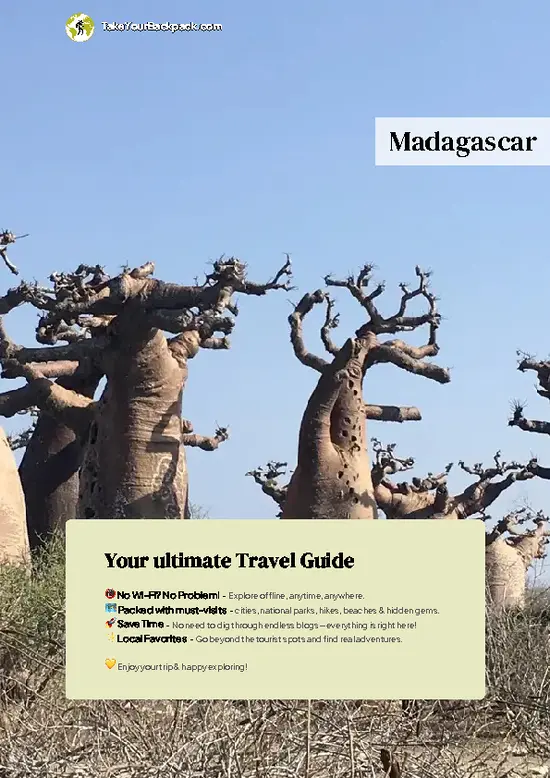
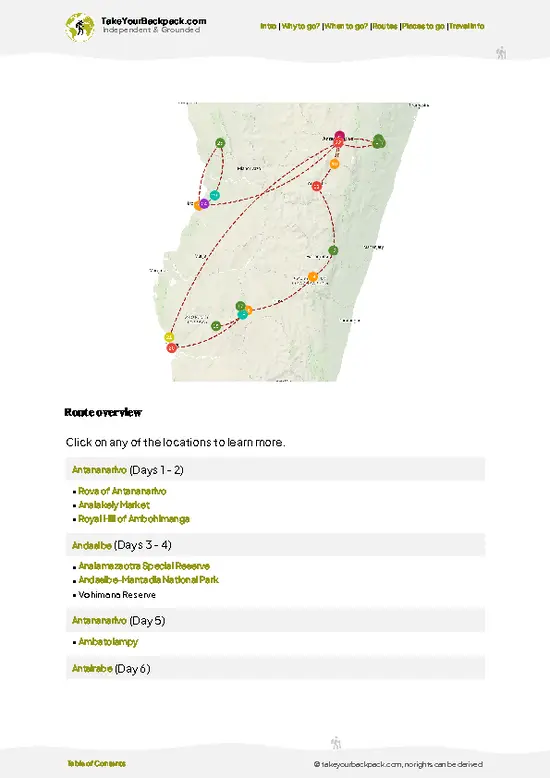
example page 0 from our offline Travel Guide for Madagascar
example page 1 from our offline Travel Guide for Madagascar
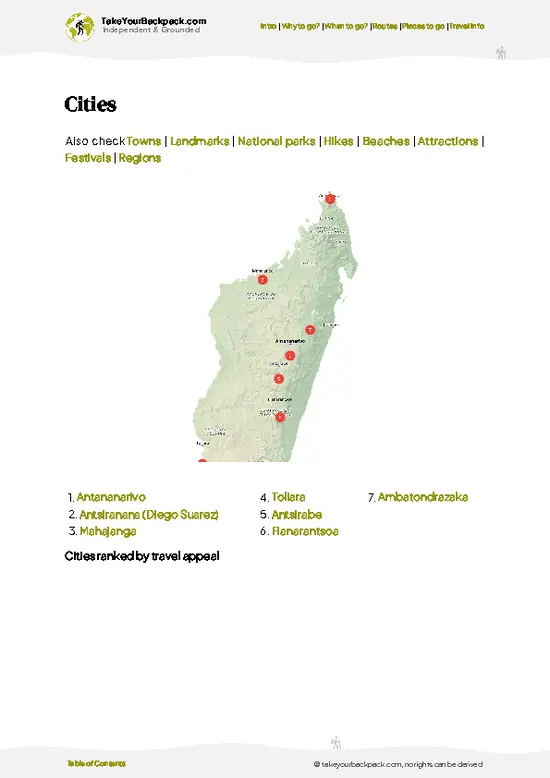
example page 2 from our offline Travel Guide for Madagascar
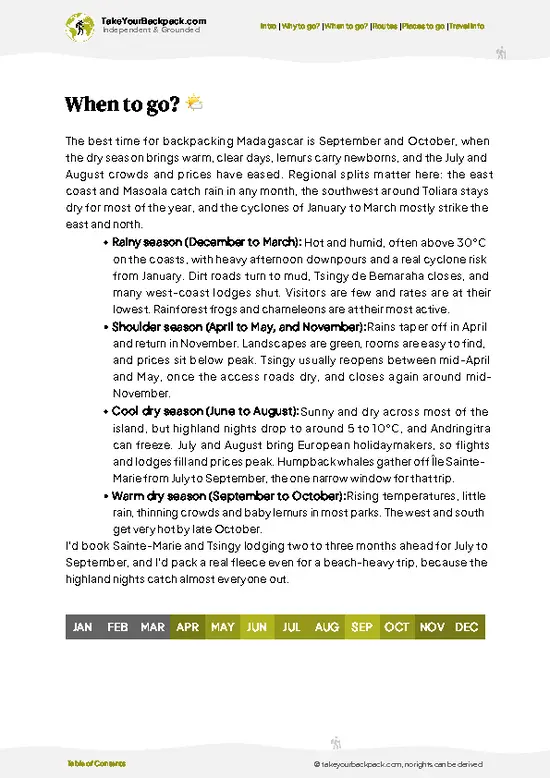
example page 3 from our offline Travel Guide for Madagascar
example page 4 from our offline Travel Guide for Madagascar
example page 5 from our offline Travel Guide for Madagascar
example page 6 from our offline Travel Guide for Madagascar
example page 7 from our offline Travel Guide for Madagascar
The digital guide (301 pages) contains:
✅ 96 highlights, ranked by travel appeal
✅ Optimized 7, 14 & 21-day travel routes
✅ Cities, national parks, landmarks, beaches
✅ How to get around
✅ Offline-friendly for travel without Wi-Fi
👉 Click to see all 30+ guide features

📅 Plan smarter in minutes, not weeks
✅ Month by month travel advice
✅ Festivals & national holidays
✅ Budget expectations

🗺️ Go to the right places, skip the overrated ones
✅ Honest pros & cons of destinations
✅ Top hikes, parks & viewpoints
✅ Lesser-known places most travelers miss
✅ Clear “worth it vs skip it” guidance

🛏️ Travel smoothly without rookie mistakes
✅ Best areas to stay
✅ Transport systems explained simply
✅ Common scams & safety advice
✅ SIM cards, money & practical tips

🌍 Understand the country, not just visit it
✅ Culture & traditions
✅ 52 Essential phrases & customs
✅ Festivals worth planning around
✅ Traveler-friendly historical context
✅ Insights that make places more meaningful

📱 Built for real travel conditions
✅ Fully downloadable PDF
✅ Works completely offline
✅ Optimized for phone use
✅ Useful in remote areas & buses
✅ Everything in one place
Stop searching, start planning
Get instant access to your full guide. 30‑day money-back guarantee.
+ Add another guide for just

By proceeding you agree to our terms.
Sent to your inbox immediately after payment • 100% Secure Checkout
Best Backpacking Travel Advisor 2025 tourism awardBest Backpacking
Travel Advisor
2025
What others say about Take Your Backpack Guides:
⭐⭐⭐⭐⭐
Fantastic, amazing amount of information!
⭐⭐⭐⭐⭐
My goodness this is amazing, it's what I've been looking for hats off too you!
⭐⭐⭐⭐⭐
I think this is absolutely BRILLIANT
⭐⭐⭐⭐
Very complete and informative. It's still missing places, but I gotta to commend you
⭐⭐⭐⭐⭐
This is truly amazing, thank you, can't wait to explore it with my kids!
⭐⭐⭐⭐⭐
Awesome resource, thank you!
⭐⭐⭐⭐⭐
This is amazing! Can't wait to explore the ones I haven't seen
⭐⭐⭐⭐
I love this! Well done, great idea.
⭐⭐⭐⭐⭐
Thanks for taking the time to make this gem!
⭐⭐⭐⭐⭐
This might be the best website I've ever seen.
⭐⭐⭐⭐⭐
Congratulations, and thank you so much for your work; it's incredibly valuable.
⭐⭐⭐⭐
In all seriousness I think you did a great job pointing out the important spots
⭐⭐⭐⭐⭐
10/10 very good
⭐⭐⭐⭐⭐
As someone who's only just starting to visit regularly this is awesome, thank you.
⭐⭐⭐⭐
Thank you very much! I'm going to visit my dad, it's going to be very useful!
⭐⭐⭐⭐⭐
This is really cool! We'll be travelling for the first time and this definitely come in handy.
⭐⭐⭐⭐⭐
You are now our minister of culture, congratulations 👨‍💼
⭐⭐⭐⭐⭐
Just wanted to tell you that this is a pearl! Going to follow your recommendations.
⭐⭐⭐⭐⭐
This is so cool. I'll definitely be using the resource for my travels soon.
⭐⭐⭐⭐⭐
This is very impressive! Good work.
⭐⭐⭐⭐⭐
This is an amazing and informative site. Very well done!

🛏️ Where to stay?Accommodation Highlights

Dorm-style hostels are rare in Madagascar, but budget guesthouses and simple hotels with private rooms from roughly 40,000 to 110,000 ariary (US$9 to 25) a night are easy to find in every town on the main tourist routes. In Antananarivo, Isoraka has the densest cluster of traveler-friendly guesthouses within walking distance of restaurants and bars, the Haute-Ville (upper town) is quieter with city views but involves steep climbs, and Analakely puts you beside the market and taxi-be hubs at the cost of noise and pickpockets, especially after dark. On the coast, Ambatoloaka on Nosy Be is the liveliest and most convenient base for nightlife, while Ivato, next to the airport, is a dull but practical … read more 👉
Dorm-style hostels are rare in Madagascar, but budget guesthouses and simple hotels with private rooms from roughly 40,000 to 110,000 ariary (US$9 to 25) a night are easy to find in every town on the main tourist routes. In Antananarivo, Isoraka has the densest cluster of traveler-friendly guesthouses within walking distance of restaurants and bars, the Haute-Ville (upper town) is quieter with city views but involves steep climbs, and Analakely puts you beside the market and taxi-be hubs at the cost of noise and pickpockets, especially after dark. On the coast, Ambatoloaka on Nosy Be is the liveliest and most convenient base for nightlife, while Ivato, next to the airport, is a dull but practical choice for one night before or after a flight.

If you enjoy meeting fellow travelers, consider choosing hostels with high ratings for atmosphere. On the other hand, if you prefer having your own space, a hotel might be a better option.

MadagascarSee More of Madagascar

👋 Meet the founderWho’s Behind Take Your Backpack?

Johan, backpacker and founder of TakeYourBackpackHi, I’m Johan (Netherlands 🇳🇱), the creator of TakeYourBackpack. Over the past 3 decades, I’ve backpacked through 90+ countries across six continents, gaining extensive experience with independent travel, long-term trips, and overland routes.

This site is built on a combination of firsthand travel experience and carefully curated insights from other backpackers. Many guides are based on places I’ve personally visited, while others bring together tips, observations, and practical advice shared by trusted travelers I’ve met along the way.

The goal is to provide realistic, experience-driven guidance — not generic itineraries — so you can explore destinations with better context, clearer expectations, and more confidence.