×

Madagascar🇲🇬 | best beachesExplore the 10 Best beaches in Madagascar

Beaches in Madagascar are mostly wide, empty and a long way from anywhere. Sand squeaks underfoot, zebu carts creak along the tideline, and the air smells of woodsmoke, salt and grilled fish. The northwest around Nosy Be is the polished end, with calm warm water, lodges and prices to match. The east coast is wilder and wetter, with palm-lined shores, rough surf and sharks that make swimming a local-knowledge decision. The southwest near Toliara has dry heat, lagoons and fishing villages where Vezo sailors launch wooden pirogues at dawn. Roads are the hard part. Expect bumpy taxi-brousse rides, flooded tracks and long waits for boats. For backpacking and independent travel, that effort filters the crowds. You pay with time, and you get empty sand, cheap bungalows and sunsets with nobody else watching.

By Johan Kruseman 🇳🇱 | Updated October 19, 2026
Explore the best attractions in Madagascar

Why go?Key Factors That Shape the Experience

Madagascar is the fourth-largest island on earth, so its coastline changes character faster than most countries manage. Roughly 5,000 kilometers of shore run from rain-soaked tropics in the east to thorn-scrub desert in the southwest, which means the variety is the point. A traveler can find mangrove-fringed bays, coral reefs, dune-backed surf beaches and offshore islands within one country, all lightly developed.

The reason for the emptiness is infrastructure. Paved roads are scarce, many coastal villages have no road at all, and journeys that look short on a map can eat a full day. Tourism is small compared with the Indian Ocean neighbors Mauritius and the Seychelles, so there are no resort strips, only a handful of hubs such as Nosy Be, Ifaty and Sainte Marie. Outside them, electricity … read more 👉
Madagascar is the fourth-largest island on earth, so its coastline changes character faster than most countries manage. Roughly 5,000 kilometers of shore run from rain-soaked tropics in the east to thorn-scrub desert in the southwest, which means the variety is the point. A traveler can find mangrove-fringed bays, coral reefs, dune-backed surf beaches and offshore islands within one country, all lightly developed.

The reason for the emptiness is infrastructure. Paved roads are scarce, many coastal villages have no road at all, and journeys that look short on a map can eat a full day. Tourism is small compared with the Indian Ocean neighbors Mauritius and the Seychelles, so there are no resort strips, only a handful of hubs such as Nosy Be, Ifaty and Sainte Marie. Outside them, electricity may be solar or a generator running a few hours each evening.

Culture shapes the shoreline too. Coastal life belongs to fishing communities, notably the semi-nomadic Vezo in the southwest, and beaches are working spaces with drying fish, hauled-up boats and children playing. Some sites carry fady, local taboos, that can restrict certain days, behaviors or areas.

Before choosing Madagascar for beaches, know what suits your expectations. Swimming is excellent on the northwest and southwest coasts, but the east has strong currents and shark risk, and many open-coast stretches are not for swimming at all. Cyclones can hit the east and north between January and March. Services are basic, cash is king, and card machines are rare beyond the main hubs. Whale watching off Sainte Marie from July to September and the island’s endemic wildlife inland add value that pure beach countries cannot match. Come for sand, and plan for effort.
Evaluating the Top Choices
The list of best beaches in Madagascar is created based on beauty, vibe, water quality, activities, and surrounding scenery. If you feel a beach is missing in this list, please let us know.

When to go?Optimal Periods for Travel

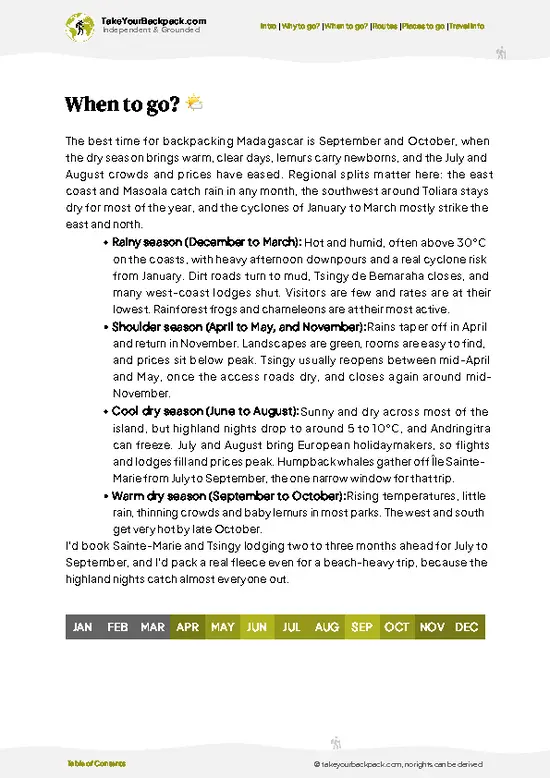
Best months and weather: The best months for beaches in Madagascar are May to October, the dry season, when skies are clear, humidity drops and cyclone risk is absent. Daytime temperatures on the coast sit around 25 to 30°C, with sea temperatures of roughly 23 to 27°C. Evenings can be cool enough for a light layer, especially in the south, and the light is crisp, with sunsets turning the sand copper.

Shoulder seasons: April and November are the best shoulder months. Rain tapers off or has not fully returned, the sea warms toward 27 to 29°C, and lodges drop prices or negotiate more readily. Showers are short, often in the afternoon, and they cool the air with a smell of wet earth and ylang-ylang on the northwest coast.

Wet season and cyclones: From December to March, the north and east get … read more 👉
Best months and weather: The best months for beaches in Madagascar are May to October, the dry season, when skies are clear, humidity drops and cyclone risk is absent. Daytime temperatures on the coast sit around 25 to 30°C, with sea temperatures of roughly 23 to 27°C. Evenings can be cool enough for a light layer, especially in the south, and the light is crisp, with sunsets turning the sand copper.

Shoulder seasons: April and November are the best shoulder months. Rain tapers off or has not fully returned, the sea warms toward 27 to 29°C, and lodges drop prices or negotiate more readily. Showers are short, often in the afternoon, and they cool the air with a smell of wet earth and ylang-ylang on the northwest coast.

Wet season and cyclones: From December to March, the north and east get heavy rain and the cyclone season peaks, usually January to March. The east coast can receive well over 2,000 millimeters of rain across the year, much of it in this period, and dirt roads turn to red mud that stops taxi-brousses for days. The southwest stays far drier, with perhaps 300 to 400 millimeters annually, and is hot, around 30 to 35°C in summer, so it is the sensible choice if you must travel in the wet months.

Crowds and prices: Peak demand runs July to September and around Christmas and New Year, especially on Nosy Be and Sainte Marie. Beachfront bungalow prices can rise 20 to 50 percent, and boats and flights fill early, so book key transfers ahead. Whale season off the east coast overlaps the same months. Some small lodges on remote stretches close from February to March, and boat services can pause when the sea turns rough. Outside those peaks, walk-in rates for simple bungalows are often 40,000 to 100,000 ariary (about US$9 to 22) a night.

beach hoppingPlanning Your Route Efficiently

How long you need: A trip linking several beach areas in Madagascar needs 14 to 21 days, because distances are large and roads are slow. Trying to squeeze three coasts into ten days means spending most of it on seats, not sand.

Which regions group well: Cluster by coast. The southwest pairs Toliara with the lagoon villages to its north and south, reached on a sandy track or by shared taxi. The northwest clusters around Nosy Be and its satellite islands, with Hell-Ville as the hub and boats leaving from Ankify on the mainland. The east runs along the Pangalanes canals and Toamasina, with Sainte Marie reached by short flight or boat from Soanierana-Ivongo. These areas are far apart, so pick two at most for a first trip.

Direction and timing: Flying between regions saves days. Antananarivo … read more 👉
How long you need: A trip linking several beach areas in Madagascar needs 14 to 21 days, because distances are large and roads are slow. Trying to squeeze three coasts into ten days means spending most of it on seats, not sand.

Which regions group well: Cluster by coast. The southwest pairs Toliara with the lagoon villages to its north and south, reached on a sandy track or by shared taxi. The northwest clusters around Nosy Be and its satellite islands, with Hell-Ville as the hub and boats leaving from Ankify on the mainland. The east runs along the Pangalanes canals and Toamasina, with Sainte Marie reached by short flight or boat from Soanierana-Ivongo. These areas are far apart, so pick two at most for a first trip.

Direction and timing: Flying between regions saves days. Antananarivo is the hub for domestic flights, which take about 1 to 1.5 hours to Nosy Be, Toliara or Sainte Marie. Overland, the road from the capital to Toliara takes roughly 18 to 24 hours by taxi-brousse, with a stop at Ranohira or Ranomafana on the way. A sensible direction is to start in the capital, head to the south or east by road or air, then finish in the northwest, which has the easiest comforts for a final stretch. Allow 3 to 5 days per beach stop, enough to settle into the rhythm of tides, boats and meals of fresh fish and coconut rice.

Planning mistakes: The most common error is underestimating transit. A 200-kilometer stretch can take 8 to 12 hours, especially after rain, so keep a one-day buffer before any flight. Another is booking tight international connections after a long road leg, since delays are routine. Travelers also forget that boats depend on tides and wind, so schedules shift. Carry cash ariary for each region, since ATMs are few outside the main towns, and build slack in, not more stops.

The ListThe Best beaches of Madagascar

1 Nosy Iranja

Two-kilometer sandbar, nesting turtles, lighthouse hill, island village

Time the tide to cross the white sandbar barefoot, snorkel for turtles off the beach, and climb to the old lighthouse for the view.

2 Andilana Beach

Nosy Tanikely day trips, west-facing sunsets, shallow bay, beach huts

Wade far out through gentle shallows, take a boat to the Nosy Tanikely reserve for turtles, and finish with grilled prawns as the bay turns gold.

3 Ramena Beach

Emerald Sea trips, Sugar Loaf backdrop, dune bays, sand-side fried fish

Cross the bay by boat to turquoise sandbanks, kite or watch from the dunes, and buy fried fish and samosas straight from the sand.

madagascar-beach-ramena-beach
© Google |

4 Anakao

Nosy Ve boobies, sand-street bungalows, boat-only access, reef snorkeling

Sail a pirogue to the sacred offshore island to see breeding red-footed boobies, then snorkel calm reef spots and watch fishing boats return at sunrise.

madagascar-beach-anakao
© Google |

5 Ifaty

Walk-in snorkeling lagoon, Reniala baobabs, whale season, Vezo shoreline

Snorkel the shallow reef by pirogue, walk spiny forest among ancient baobabs, and look for humpbacks offshore between July and September.

madagascar-beach-ifaty
© Google |

6 Ambatomilo

Charcoal-grilled octopus, Vezo pirogues, tidal reef flats, no nightlife

Join local fishing families on the reef flats at low tide, then snorkel the calm lagoon and sleep under a sky free of electric light.

7 Salary Bay

Flat-water kitesurfing, offshore reef, sail-in fishing boats, fish-and-rice huts

Ride afternoon wind over a shallow lagoon, sail a Vezo outrigger to the reef, and buy fish from families sorting the evening catch.

8 Baie des Sakalava

Kitesurf wind, open surf, pale fine sand, beach-shack grills

Book a kite lesson or watch canopies fill the sky at sunset, and save swimming for the calmer hours when the wind drops.

madagascar-beach-baie-des-sakalava
© Google |

9 Antsanitia Beach

Casuarina shade, calm warm shallows, Mahajanga day-trip, thatched fish lunches

Float in gentle water, eat grilled fish under thatch, and walk a long, quiet strip of sand toward a copper sunset over the channel.

10 Foulpointe

Fort Manda, reef-protected lagoon, dawn nets, lobster huts

Swim only inside the reef line, climb the old Merina fort for sea views, and eat grilled lobster at beachfront huts after dark.

madagascar-beach-foulpointe
© Google |

11 Belo sur Mer

Schooner building, Vezo village, firm flat shore, remote road

Hear adzes shaping wooden hulls on the sand, sail a small pirogue over the shallows, and buy fish the moment boats land.

12 Antsiranana Bay

Sugar Loaf rock, enclosed basin, waterfront grills, gray-tan sand

Hire a pirogue for a close look at the Sugar Loaf, then walk the shore away from town toward quieter sand and a copper sunset.

13 Mahambo

Kilometers of firm sand, roadside charcoal stalls, village market, river pirogues

Walk hard low-tide sand past palms and fishing hamlets, then paddle mangrove channels nearby and eat charcoal-grilled shrimp with chili sauce.

14 Morondava Beach

Silty dark sand, baobab-road base, estuary mudflats, sunset seafront

Walk toward the river mouth for feeding birds and passing canoes, then eat grilled prawns and calamari at beach tables as the sun sets.

15 Anjajavy

Private reserve, Coquerel’s sifakas, mangrove channels, lodge-only stay

Follow guides to leaping sifakas in dry forest, paddle tidal mangrove channels, and end on an empty pale beach at sunset.

16 Vohémar Beach

Iharana tombs, dawn pirogue landing, Baie de Rigny, port-side shore

Hire a guide to find the medieval burial sites, buy crab or lobster from landing fishers, and take a boat around the sheltered bay.

17 Manakara Beach

Dark windswept shore, FCE railway terminus, stilt-house canal, surf-launched pirogues

Stroll the pounding seafront at sunset, ride a boat through the calm canal behind town, and catch the train station at work.

18 Evatraha

Indian Ocean breakers, Fort Dauphin outskirts, rocky tideline, sunrise surf

Watch long swells crash on pale sand and dark rock at sunrise, wade at the edge, and chat with line fishermen on the rocks.

19 Faux Cap

Dark limestone cliffs, Antandroy tombs, spiny forest, surf launches

Walk the headland at sunrise, watch pirogues launch through the breakers, and visit painted tombs and thorny forest with a local guide.

20 Lavanono

Empty crescent, dune backdrop, wind-cut cliffs, night sky

Walk hard low-tide sand beneath dunes, climb the headlands toward Cap Sainte Marie, and watch the Milky Way from a fire on the beach.

21 Ambila-Lemaitso

Canal des Pangalanes, casuarina grove, east-coast sunrise, weekend families

Paddle the still canal in a pirogue at dusk, then walk the casuarina shore at first light while fishermen haul in their catch.

22 Tampolo Beach

Littoral forest reserve, night walks, mouse lemurs, pounding surf

Take a guided forest walk behind the sand by day or headlamp by night to find chameleons, lemurs and frogs, then visit nearby fishing hamlets.

23 Lokaro Bay

Pirogue landings, drying-fish smell, village behind dunes, tide-dependent swims

Watch paddlers bring in the catch to be weighed on the sand, then eat grilled fish with rice as sunrise lights the bay.

24 Cap Diego

Headland views, Emerald Sea departures, soft pale sand, noon fish grills

Beachcomb tide pools at low tide, photograph the Sugar Loaf at golden hour, or take a skiff across turquoise shallows to sandbanks.

25 Maroantsetra Beach

Masoala boat departures, Antongil Bay, river-mouth walk, dusk landings

Catch a boat across the bay toward the rainforest peninsula, then follow the shore to the river mouth and watch crews land nets at dusk.

Think you know Madagascar?

Prove you’re a true local — uncover 15 lesser-known beaches in Madagascar that locals tend to keep to themselves.
Loading the map 🌍

Expert viewInsights from Locals and Experts

How many beaches to visit: Plan on three to four beach stops for a two to three week trip. In Madagascar, each transfer costs a day of jolting along potholed roads or waiting for a boat, so more stops mean more time on seats than on sand. Three to four lets you settle in, learn the tide times and enjoy a full evening of woodsmoke, grilled fish and surf noise before moving on.

Choosing the kind of beach: Match the coast to your style. Travelers who want easy swimming and snorkeling do best on the northwest and southwest, where lagoons are calm and water clear. Those who like quiet and local life should favor fishing villages in the southwest, where pirogues with striped sails slide out at dawn. The east offers lush palms and whale watching in season, but it is more for scenery than swimming. … read more 👉
How many beaches to visit: Plan on three to four beach stops for a two to three week trip. In Madagascar, each transfer costs a day of jolting along potholed roads or waiting for a boat, so more stops mean more time on seats than on sand. Three to four lets you settle in, learn the tide times and enjoy a full evening of woodsmoke, grilled fish and surf noise before moving on.

Choosing the kind of beach: Match the coast to your style. Travelers who want easy swimming and snorkeling do best on the northwest and southwest, where lagoons are calm and water clear. Those who like quiet and local life should favor fishing villages in the southwest, where pirogues with striped sails slide out at dawn. The east offers lush palms and whale watching in season, but it is more for scenery than swimming. Divers can find reefs off the northwest and southwest, while surfers look to the far south. Pick one main kind and add a contrast, not three of the same.

What it costs: Budget US$25 to 45 a day (about 110,000 to 200,000 ariary) for simple bungalows, local meals and shared transport. Bungalows run roughly US$8 to 25 a night, a plate of fish and rice is usually US$2 to 5, and a lobster dinner can reach US$8 to 15. Per visit, expect small extras: a pirogue or boat day trip at US$10 to 40 depending on distance and group size, snorkel gear rental at about US$3 to 6, and marine park or reserve entry fees typically in the US$5 to 15 range. Island transfers by speedboat can run US$15 to 50 each way. Pay in cash, bring small notes, and your money lasts longer.

Safety and swimming: Check locally before entering open water, especially on the east coast, where rip currents and sharks are a real concern and villagers will tell you where swimming is safe. Reef edges bring sea urchins, so wear water shoes. The sun is fierce, and a hat and reef-safe sunscreen pay off. Keep valuables out of sight on the sand, avoid walking empty beaches at night, and use a registered guide or lodge-arranged boat captain for any open-sea trip. Malaria is present on the coasts, so carry prophylaxis and repellent, and mosquito nets are a practical bed companion.

Cultural respect: Coastal communities live and work on these shores, so treat beaches as shared workplaces. Ask before photographing people, nets or boats, and offer a small payment or buy fish if invited into a village. Cover up when walking through settlements, since swimwear belongs on the sand. Some sites carry fady, taboos such as no pointing at certain rocks or no visits on specific days, and your guide will explain them. Following them earns warm welcomes, shared meals and the best seat by the evening fire.

✈️ The backpacker research shortcutMadagascar Travel Guide

An offline-friendly backpacking guide with optimized travel routes, ranked highlights, transport advice, and the best areas to stay.
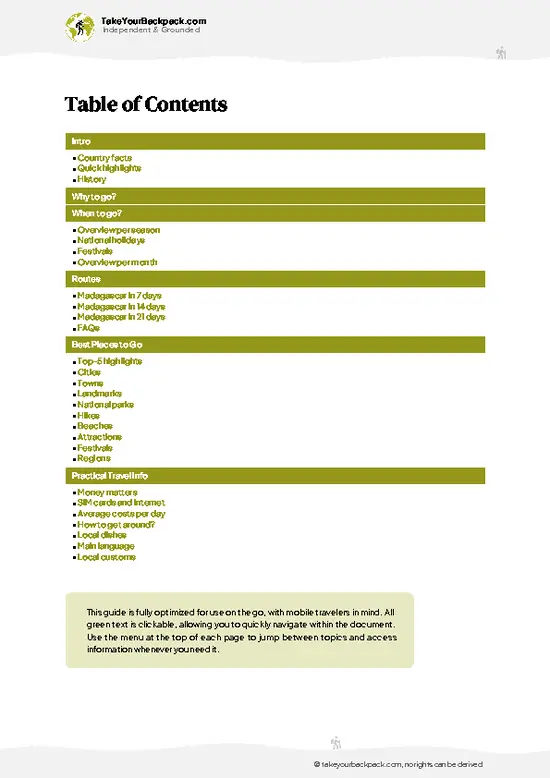
example page 0 from our offline Travel Guide for Madagascar
example page 1 from our offline Travel Guide for Madagascar
example page 2 from our offline Travel Guide for Madagascar
example page 3 from our offline Travel Guide for Madagascar
example page 4 from our offline Travel Guide for Madagascar
example page 5 from our offline Travel Guide for Madagascar
example page 6 from our offline Travel Guide for Madagascar
example page 7 from our offline Travel Guide for Madagascar
The digital guide (301 pages) contains:
✅ 96 highlights, ranked by travel appeal
✅ Optimized 7, 14 & 21-day travel routes
✅ Cities, national parks, landmarks, beaches
✅ How to get around
✅ Offline-friendly for travel without Wi-Fi
👉 Click to see all 30+ guide features

📅 Plan smarter in minutes, not weeks
✅ Month by month travel advice
✅ Festivals & national holidays
✅ Budget expectations

🗺️ Go to the right places, skip the overrated ones
✅ Honest pros & cons of destinations
✅ Top hikes, parks & viewpoints
✅ Lesser-known places most travelers miss
✅ Clear “worth it vs skip it” guidance

🛏️ Travel smoothly without rookie mistakes
✅ Best areas to stay
✅ Transport systems explained simply
✅ Common scams & safety advice
✅ SIM cards, money & practical tips

🌍 Understand the country, not just visit it
✅ Culture & traditions
✅ 52 Essential phrases & customs
✅ Festivals worth planning around
✅ Traveler-friendly historical context
✅ Insights that make places more meaningful

📱 Built for real travel conditions
✅ Fully downloadable PDF
✅ Works completely offline
✅ Optimized for phone use
✅ Useful in remote areas & buses
✅ Everything in one place
Stop searching, start planning
Get instant access to your full guide. 30‑day money-back guarantee.
+ Add another guide for just

By proceeding you agree to our terms.
Sent to your inbox immediately after payment • 100% Secure Checkout
Best Backpacking Travel Advisor 2025 tourism awardBest Backpacking
Travel Advisor
2025
What others say about Take Your Backpack Guides:
⭐⭐⭐⭐⭐
Fantastic, amazing amount of information!
⭐⭐⭐⭐⭐
My goodness this is amazing, it's what I've been looking for hats off too you!
⭐⭐⭐⭐⭐
I think this is absolutely BRILLIANT
⭐⭐⭐⭐
Very complete and informative. It's still missing places, but I gotta to commend you
⭐⭐⭐⭐⭐
This is truly amazing, thank you, can't wait to explore it with my kids!
⭐⭐⭐⭐⭐
Awesome resource, thank you!
⭐⭐⭐⭐⭐
This is amazing! Can't wait to explore the ones I haven't seen
⭐⭐⭐⭐
I love this! Well done, great idea.
⭐⭐⭐⭐⭐
Thanks for taking the time to make this gem!
⭐⭐⭐⭐⭐
This might be the best website I've ever seen.
⭐⭐⭐⭐⭐
Congratulations, and thank you so much for your work; it's incredibly valuable.
⭐⭐⭐⭐
In all seriousness I think you did a great job pointing out the important spots
⭐⭐⭐⭐⭐
10/10 very good
⭐⭐⭐⭐⭐
As someone who's only just starting to visit regularly this is awesome, thank you.
⭐⭐⭐⭐
Thank you very much! I'm going to visit my dad, it's going to be very useful!
⭐⭐⭐⭐⭐
This is really cool! We'll be travelling for the first time and this definitely come in handy.
⭐⭐⭐⭐⭐
You are now our minister of culture, congratulations 👨‍💼
⭐⭐⭐⭐⭐
Just wanted to tell you that this is a pearl! Going to follow your recommendations.
⭐⭐⭐⭐⭐
This is so cool. I'll definitely be using the resource for my travels soon.
⭐⭐⭐⭐⭐
This is very impressive! Good work.
⭐⭐⭐⭐⭐
This is an amazing and informative site. Very well done!

🛏️ Where to stay?Where to Base Yourself

Dorm-style hostels are rare in Madagascar, but budget guesthouses and simple hotels with private rooms from roughly 40,000 to 110,000 ariary (US$9 to 25) a night are easy to find in every town on the main tourist routes. In Antananarivo, Isoraka has the densest cluster of traveler-friendly guesthouses within walking distance of restaurants and bars, the Haute-Ville (upper town) is quieter with city views but involves steep climbs, and Analakely puts you beside the market and taxi-be hubs at the cost of noise and pickpockets, especially after dark. On the coast, Ambatoloaka on Nosy Be is the liveliest and most convenient base for nightlife, while Ivato, next to the airport, is a dull but practical … read more 👉
Dorm-style hostels are rare in Madagascar, but budget guesthouses and simple hotels with private rooms from roughly 40,000 to 110,000 ariary (US$9 to 25) a night are easy to find in every town on the main tourist routes. In Antananarivo, Isoraka has the densest cluster of traveler-friendly guesthouses within walking distance of restaurants and bars, the Haute-Ville (upper town) is quieter with city views but involves steep climbs, and Analakely puts you beside the market and taxi-be hubs at the cost of noise and pickpockets, especially after dark. On the coast, Ambatoloaka on Nosy Be is the liveliest and most convenient base for nightlife, while Ivato, next to the airport, is a dull but practical choice for one night before or after a flight.

If you enjoy meeting fellow travelers, consider choosing hostels with high ratings for atmosphere. On the other hand, if you prefer having your own space, a hotel might be a better option.

MadagascarExpand Your Journey

👋 Meet the founderWho’s Behind Take Your Backpack?

Johan, backpacker and founder of TakeYourBackpackHi, I’m Johan (Netherlands 🇳🇱), the creator of TakeYourBackpack. Over the past 3 decades, I’ve backpacked through 90+ countries across six continents, gaining extensive experience with independent travel, long-term trips, and overland routes.

This site is built on a combination of firsthand travel experience and carefully curated insights from other backpackers. Many guides are based on places I’ve personally visited, while others bring together tips, observations, and practical advice shared by trusted travelers I’ve met along the way.

The goal is to provide realistic, experience-driven guidance — not generic itineraries — so you can explore destinations with better context, clearer expectations, and more confidence.