×

Malaysia🇲🇾 | best beachesBest 6 beaches in Malaysia

Beaches in Malaysia come in two moods, and the map decides which one you get. The west coast faces the Strait of Malacca, so expect brownish water and shipping lanes, with the pleasant exceptions on islands like Langkawi. The east coast and its offshore islands deliver the clear water and white sand you saw on the postcard, at the price of ferry timetables and a monsoon that closes the whole show for months. Borneo adds jungle-backed coves and dive-driven prices. Independent travelers can cover most of it cheaply, if they accept that sunbathing in Malaysia involves modest swimwear and a lot of sunscreen.

By Johan Kruseman 🇳🇱 | Updated October 18, 2026
Explore the best attractions in Malaysia

Why go?Understanding Their Importance

Malaysia is split by the South China Sea, which means two coastlines with two climates, and that is the first thing to understand. Few countries hand you a monsoon-proof Plan B so easily: when the east coast shuts, the west side is usually still open for business. The second thing is that Malaysia is a Muslim-majority country, so beach culture is more relaxed than in Thailand but more modest. Bikinis are normal at resort islands and tourist-heavy shores, while on mainland village beaches many visitors, and nearly all locals, swim in T-shirts and shorts. Alcohol is available on some islands, absent or pricey on others, and a few of the quietest islands have none at all.

The real draw is coral and marine life. Much of the best beach experience here happens a few meters offshore, in marine park … read more 👉
Malaysia is split by the South China Sea, which means two coastlines with two climates, and that is the first thing to understand. Few countries hand you a monsoon-proof Plan B so easily: when the east coast shuts, the west side is usually still open for business. The second thing is that Malaysia is a Muslim-majority country, so beach culture is more relaxed than in Thailand but more modest. Bikinis are normal at resort islands and tourist-heavy shores, while on mainland village beaches many visitors, and nearly all locals, swim in T-shirts and shorts. Alcohol is available on some islands, absent or pricey on others, and a few of the quietest islands have none at all.

The real draw is coral and marine life. Much of the best beach experience here happens a few meters offshore, in marine park waters protected by park fees and strict rules, which keep reefs healthier than at many neighboring destinations. Infrastructure is strong: ferries run on schedule, ATMs appear on the larger islands, and mainland access is simple. What you give up is long, empty, wild coastline. Malaysian beaches tend to be compact, backed by resorts, and busy on school holidays. Choose it for the water, not for solitude.
How the List Was Created
The list of best beaches in Malaysia is created based on beauty, vibe, water quality, activities, and surrounding scenery. If you feel a beach is missing in this list, please let us know.

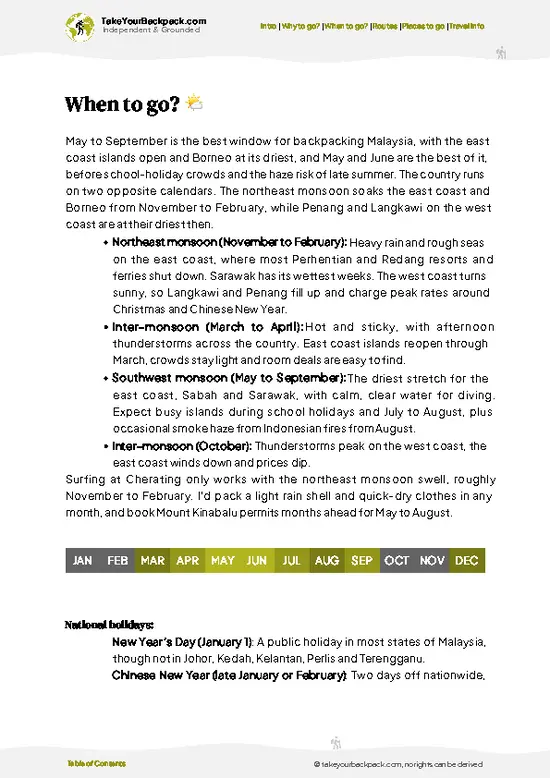
When to go?Seasonal Guide to Visiting

Best months by coast: The best months for beaches in Malaysia are March to October on the east coast and its islands, because the northeast monsoon is gone and the sea is calm and clear. Temperatures hover around 29 to 33°C by day with water near 28 to 30°C, and humidity does the rest of the talking.

The monsoon gap: From roughly November to February, the northeast monsoon batters the east coast and islands. Ferries stop, many resorts close entirely, and rainfall can run to several hundred millimeters a month. Showing up in December with a snorkel is an act of optimism, not planning. The west coast (Langkawi, Penang, the Strait side) is at its driest and sunniest in this same stretch, so it makes the sensible winter swap. Heavier rain hits there around September to November, usually as short … read more 👉
Best months by coast: The best months for beaches in Malaysia are March to October on the east coast and its islands, because the northeast monsoon is gone and the sea is calm and clear. Temperatures hover around 29 to 33°C by day with water near 28 to 30°C, and humidity does the rest of the talking.

The monsoon gap: From roughly November to February, the northeast monsoon batters the east coast and islands. Ferries stop, many resorts close entirely, and rainfall can run to several hundred millimeters a month. Showing up in December with a snorkel is an act of optimism, not planning. The west coast (Langkawi, Penang, the Strait side) is at its driest and sunniest in this same stretch, so it makes the sensible winter swap. Heavier rain hits there around September to November, usually as short afternoon downpours.

Borneo and crowds: Sabah and Sarawak are wettest around November to February but stay open, with the driest stretch from roughly March to September. Peak crowds and prices land on school holidays (late May to June, late November to December), plus Chinese New Year and the Hari Raya period, when island rooms can cost 30 to 50 percent more and ferry seats vanish. Shoulder months like March, April and September give calm seas and spare beds.

beach hoppingHow to Combine beaches Into One Trip

How long to allow: A trip combining several beaches in Malaysia needs 10 to 16 days, and pushing it to three weeks adds comfort rather than extra beaches. Malaysia is wide, and moving between coasts eats entire days.

Grouping and direction: Keep regions together: the northwest (Penang and Langkawi), the east coast islands reached from jetties such as Mersing, Kuala Besut and Kuala Terengganu, and Sabah in Borneo, which needs a flight. Kuala Lumpur works as the hub, since cheap flights and buses fan out from it. In the dry months, travel south to north along the east coast or the reverse, and avoid zigzagging. Allow 3 to 5 nights per island stop, enough to settle into the rhythm without watching your budget thin out. Crossing from the west coast to the east takes about 5 to 7 hours by road … read more 👉
How long to allow: A trip combining several beaches in Malaysia needs 10 to 16 days, and pushing it to three weeks adds comfort rather than extra beaches. Malaysia is wide, and moving between coasts eats entire days.

Grouping and direction: Keep regions together: the northwest (Penang and Langkawi), the east coast islands reached from jetties such as Mersing, Kuala Besut and Kuala Terengganu, and Sabah in Borneo, which needs a flight. Kuala Lumpur works as the hub, since cheap flights and buses fan out from it. In the dry months, travel south to north along the east coast or the reverse, and avoid zigzagging. Allow 3 to 5 nights per island stop, enough to settle into the rhythm without watching your budget thin out. Crossing from the west coast to the east takes about 5 to 7 hours by road from KL, and Peninsular Malaysia to Sabah is roughly 2.5 to 3 hours by air.

Planning mistakes: The classic error is stacking three islands in five days and spending the vacation in queues at ferry piers. Pick fewer places and stay longer. Another is forgetting that jetty boats leave in the morning, often before 10 a.m., so an afternoon bus arrival means a night in the port town. Book the first and last legs ahead, and leave the middle loose.

The ListMust-Visit beaches in Malaysia

1 Pantai Cenang

beachfront bars, sunset views, casual dining, island nightlife

Unwind on soft sand, sample fresh seafood, and watch the sky change color before joining the evening crowd along the main strip.

malaysia-beach-pantai-cenang
© Google |

2 Batu Ferringhi

night market, water sports, resort strip, Penang food

Wander a lively stretch where jet skis buzz offshore, street vendors set up at dusk, and local flavors fill the air after sunset.

3 Pulau Kapas

white sand coves, hammock stays, relaxed pace, shallow reefs

Step off the ferry onto quiet beaches, nap in a hammock, and snorkel just offshore where marine life thrives close to land.

malaysia-beach-pulau-kapas
© Google |

4 Tanjung Aru Beach

local food stalls, sunset watching, city proximity, palm-lined shore

Join locals for grilled snacks, watch planes descend nearby, and linger as the sun dips behind the South China Sea.

5 Cherating

surf breaks, turtle sanctuary, laid-back village, mangrove river

Catch seasonal waves, spot nesting turtles, and drift along quiet waterways in a coastal area where daily life moves at a gentle pace.

6 Timba-Timba Island

sandbar walks, shallow turquoise sea, remote setting, sea turtle sightings

Wade across shifting sands, spot turtles in clear water, and experience a quiet, undeveloped island far from crowds and roads.

malaysia-beach-timba-timba-island
© Google |
Loading the map 🌍

Expert viewInsights from Locals and Experts

How many beaches to visit: I advise three to four beach stops on a typical two-week trip. That number is dictated by transport, not enthusiasm: every island move costs half a day and roughly US$5 to 15 in ferry or bus fares, and the third beach rarely looks different enough to justify a fourth transfer. Beach-hopping in Malaysia is a fine way to see the inside of ferry terminals.

Which kind to choose: If you want snorkeling and clear water, the east coast islands and Borneo's marine parks give the most for your money, though you pay in fees and boat rides. If you want easy and social, west coast and Langkawi shores come with cheaper food, reliable transport and nightlife, while the water is less clear. If you want quiet, pick a small island without a big resort, accept basic rooms, and bring … read more 👉
How many beaches to visit: I advise three to four beach stops on a typical two-week trip. That number is dictated by transport, not enthusiasm: every island move costs half a day and roughly US$5 to 15 in ferry or bus fares, and the third beach rarely looks different enough to justify a fourth transfer. Beach-hopping in Malaysia is a fine way to see the inside of ferry terminals.

Which kind to choose: If you want snorkeling and clear water, the east coast islands and Borneo's marine parks give the most for your money, though you pay in fees and boat rides. If you want easy and social, west coast and Langkawi shores come with cheaper food, reliable transport and nightlife, while the water is less clear. If you want quiet, pick a small island without a big resort, accept basic rooms, and bring cash. Divers should spend their budget on Borneo, where dive days run about US$40 to 80 per two-tank trip, while casual snorkelers do fine on the cheaper peninsula islands. Comfort-minded travelers get the most from mid-range chalets with air-conditioning at US$30 to 50, because fans in a humid, 30°C night cost sleep.

What it costs: Plan on US$25 to 45 a day for a dorm or simple chalet, hawker meals, and local transport. Island prices run a notch higher than the mainland. Marine park fees are usually around RM5 to 30 (about US$1 to 7) per person, and snorkel trips with gear run roughly RM40 to 100 (US$9 to 22). Island hopping boats are priced per boat, so splitting with others saves real money. Carry cash, since smaller islands have few or no ATMs.

Safety and etiquette: Jellyfish are the main nuisance, especially in the wetter months, and stings are treated with vinegar available at most resorts. Check for rip currents on open coasts and swim where lifeguards or flags exist. Never touch or stand on coral, and do not take shells or turtle eggs. Sunburn arrives in 20 minutes near the equator, so reef-safe sunscreen and a rash guard pay for themselves. Culturally, wear modest swimwear on village or mainland beaches, cover up when walking through settlements, and keep shirts on away from the sand. Public drinking and nudity are bad ideas, and drones need permits. Lock valuables away, since opportunistic theft from unattended bags on beaches does occur.

✈️ The backpacker research shortcutMalaysia Travel Guide

An offline-friendly backpacking guide with optimized travel routes, ranked highlights, transport advice, and the best areas to stay.
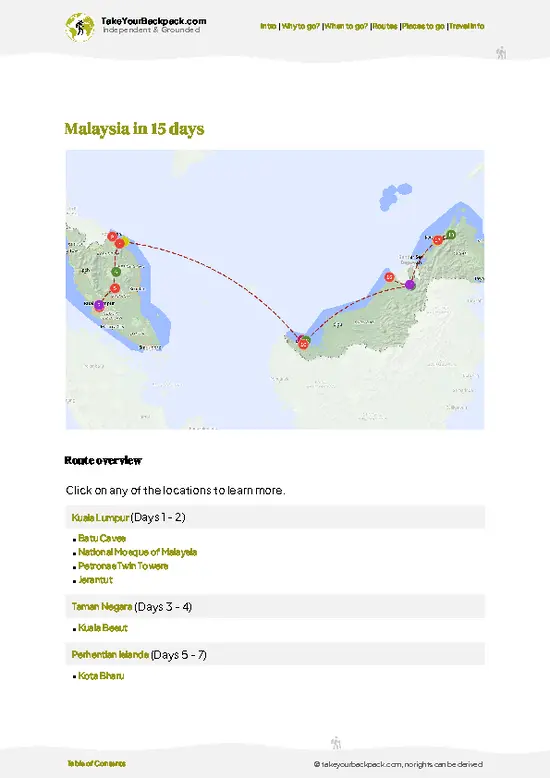
example page 0 from our offline Travel Guide for Malaysia
example page 1 from our offline Travel Guide for Malaysia
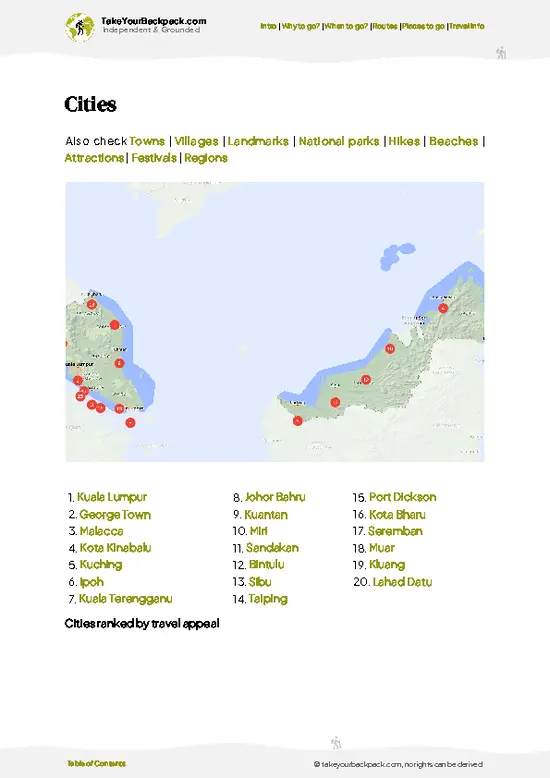
example page 2 from our offline Travel Guide for Malaysia
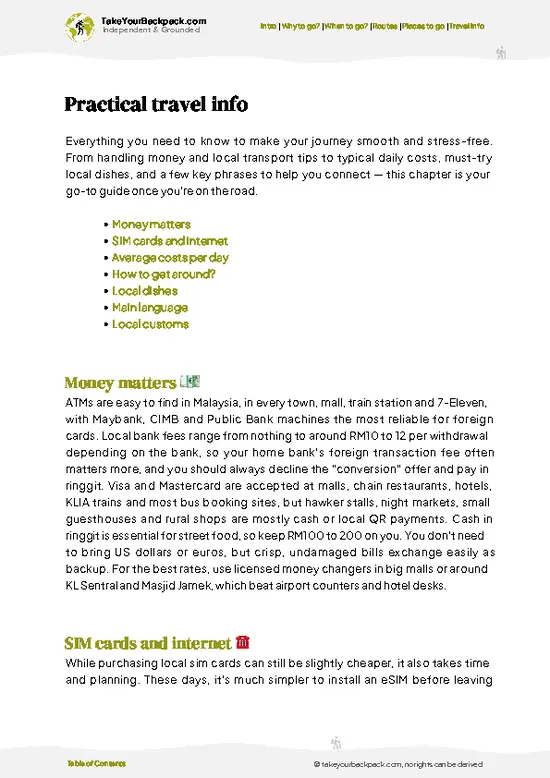
example page 3 from our offline Travel Guide for Malaysia
example page 4 from our offline Travel Guide for Malaysia
example page 5 from our offline Travel Guide for Malaysia
example page 6 from our offline Travel Guide for Malaysia
example page 7 from our offline Travel Guide for Malaysia
The digital guide (400 pages) contains:
✅ 106 highlights, ranked by travel appeal
✅ Optimized 5, 10 & 15-day travel routes
✅ Cities, national parks, landmarks, beaches
✅ How to get around
✅ Offline-friendly for travel without Wi-Fi
👉 Click to see all 30+ guide features

📅 Plan smarter in minutes, not weeks
✅ Month by month travel advice
✅ Festivals & national holidays
✅ Budget expectations

🗺️ Go to the right places, skip the overrated ones
✅ Honest pros & cons of destinations
✅ Top hikes, parks & viewpoints
✅ Lesser-known places most travelers miss
✅ Clear “worth it vs skip it” guidance

🛏️ Travel smoothly without rookie mistakes
✅ Best areas to stay
✅ Transport systems explained simply
✅ Common scams & safety advice
✅ SIM cards, money & practical tips

🌍 Understand the country, not just visit it
✅ Culture & traditions
✅ 52 Essential phrases & customs
✅ Festivals worth planning around
✅ Traveler-friendly historical context
✅ Insights that make places more meaningful

📱 Built for real travel conditions
✅ Fully downloadable PDF
✅ Works completely offline
✅ Optimized for phone use
✅ Useful in remote areas & buses
✅ Everything in one place
Stop searching, start planning
Get instant access to your full guide. 30‑day money-back guarantee.
+ Add another guide for just

By proceeding you agree to our terms.
Sent to your inbox immediately after payment • 100% Secure Checkout
Best Backpacking Travel Advisor 2025 tourism awardBest Backpacking
Travel Advisor
2025
What others say about Take Your Backpack Guides:
⭐⭐⭐⭐⭐
Fantastic, amazing amount of information!
⭐⭐⭐⭐⭐
My goodness this is amazing, it's what I've been looking for hats off too you!
⭐⭐⭐⭐⭐
I think this is absolutely BRILLIANT
⭐⭐⭐⭐
Very complete and informative. It's still missing places, but I gotta to commend you
⭐⭐⭐⭐⭐
This is truly amazing, thank you, can't wait to explore it with my kids!
⭐⭐⭐⭐⭐
Awesome resource, thank you!
⭐⭐⭐⭐⭐
This is amazing! Can't wait to explore the ones I haven't seen
⭐⭐⭐⭐
I love this! Well done, great idea.
⭐⭐⭐⭐⭐
Thanks for taking the time to make this gem!
⭐⭐⭐⭐⭐
This might be the best website I've ever seen.
⭐⭐⭐⭐⭐
Congratulations, and thank you so much for your work; it's incredibly valuable.
⭐⭐⭐⭐
In all seriousness I think you did a great job pointing out the important spots
⭐⭐⭐⭐⭐
10/10 very good
⭐⭐⭐⭐⭐
As someone who's only just starting to visit regularly this is awesome, thank you.
⭐⭐⭐⭐
Thank you very much! I'm going to visit my dad, it's going to be very useful!
⭐⭐⭐⭐⭐
This is really cool! We'll be travelling for the first time and this definitely come in handy.
⭐⭐⭐⭐⭐
You are now our minister of culture, congratulations 👨‍💼
⭐⭐⭐⭐⭐
Just wanted to tell you that this is a pearl! Going to follow your recommendations.
⭐⭐⭐⭐⭐
This is so cool. I'll definitely be using the resource for my travels soon.
⭐⭐⭐⭐⭐
This is very impressive! Good work.
⭐⭐⭐⭐⭐
This is an amazing and informative site. Very well done!

🛏️ Where to stay?Best Places to Stay in Malaysia

Malaysia has plenty of hostels and budget guesthouses, with dorm beds typically running RM30 to 70 (about US$7 to 16) and basic private rooms from around RM80 (US$18). In Kuala Lumpur, Chinatown around Petaling Street is the cheapest central base and sits a short walk from Pasar Seni and Merdeka Square, though some older buildings feel worn, while Bukit Bintang puts you next to Jalan Alor’s night food stalls and the city’s best nightlife at the cost of street noise until late. In George Town on Penang, the hostels cluster around Chulia Street and Love Lane, steps from the heritage core and backpacker bars, and in Melaka the area around Jonker Street keeps you close to the old town but gets crowded … read more 👉
Malaysia has plenty of hostels and budget guesthouses, with dorm beds typically running RM30 to 70 (about US$7 to 16) and basic private rooms from around RM80 (US$18). In Kuala Lumpur, Chinatown around Petaling Street is the cheapest central base and sits a short walk from Pasar Seni and Merdeka Square, though some older buildings feel worn, while Bukit Bintang puts you next to Jalan Alor’s night food stalls and the city’s best nightlife at the cost of street noise until late. In George Town on Penang, the hostels cluster around Chulia Street and Love Lane, steps from the heritage core and backpacker bars, and in Melaka the area around Jonker Street keeps you close to the old town but gets crowded and loud during the weekend night market.

If you enjoy meeting fellow travelers, consider choosing hostels with high ratings for atmosphere. On the other hand, if you prefer having your own space, a hotel might be a better option.

MalaysiaExplore Malaysia

👋 Meet the founderWho’s Behind Take Your Backpack?

Johan, backpacker and founder of TakeYourBackpackHi, I’m Johan (Netherlands 🇳🇱), the creator of TakeYourBackpack. Over the past 3 decades, I’ve backpacked through 90+ countries across six continents, gaining extensive experience with independent travel, long-term trips, and overland routes.

This site is built on a combination of firsthand travel experience and carefully curated insights from other backpackers. Many guides are based on places I’ve personally visited, while others bring together tips, observations, and practical advice shared by trusted travelers I’ve met along the way.

The goal is to provide realistic, experience-driven guidance — not generic itineraries — so you can explore destinations with better context, clearer expectations, and more confidence.