×

Malaysia🇲🇾 | best landmarksBest 3 landmarks in Malaysia

Malaysia’s landmarks come in three flavors, and your trip will feel very different depending on which you chase. Peninsular Malaysia offers colonial-era buildings, temples and towering skyscrapers, mostly reachable by cheap trains, buses and ride-hailing apps. Malaysian Borneo trades concrete for rainforest, caves and mountains, with flights, permits and higher costs attached. The east coast and islands sit somewhere between, quieter and slower. Crowds peak around the capital and Penang, where selfie sticks outnumber pigeons. For backpacking or any independent travel, the trick is matching the kind of landmark to your appetite for logistics, sweat and queueing.

By Johan Kruseman 🇳🇱 | Updated October 18, 2026
Explore the best national parks in Malaysia

Why go?Understanding Their Importance

Few countries stack this many cultures on one map. Malay, Chinese, Indian and Indigenous traditions all built things here, so a single street can hold a mosque, a clan house and a Hindu shrine within a short walk. Add British colonial rule, then a post-independence building spree, and the country ends up with heritage towns and record-chasing modern architecture side by side.

Geography splits the offer too. The peninsula is compact, well connected and easy to string together on public transport. Borneo and the wild interior have natural landmarks, but they sit behind rivers, jungle and flight tickets, so plan more time and money there.

The tropical climate matters more than most guidebooks admit. Heat and humidity sit around 30 to 33°C most of the year, and afternoon downpours arrive with … read more 👉
Few countries stack this many cultures on one map. Malay, Chinese, Indian and Indigenous traditions all built things here, so a single street can hold a mosque, a clan house and a Hindu shrine within a short walk. Add British colonial rule, then a post-independence building spree, and the country ends up with heritage towns and record-chasing modern architecture side by side.

Geography splits the offer too. The peninsula is compact, well connected and easy to string together on public transport. Borneo and the wild interior have natural landmarks, but they sit behind rivers, jungle and flight tickets, so plan more time and money there.

The tropical climate matters more than most guidebooks admit. Heat and humidity sit around 30 to 33°C most of the year, and afternoon downpours arrive with the reliability of a bus that does not. Outdoor sites are best tackled early, and your shirt will be damp by 10 a.m. regardless of effort.

Before choosing Malaysia for landmarks, know that it is a Muslim-majority country with strong etiquette around sacred places. Modest clothing is expected, shoes come off at doors, and prayer times can shift opening hours. Infrastructure is good, English is widely understood, and nothing requires heroic planning, just a bit of respect and a rain jacket.
Our Approach to Ranking
The list of best unique sites in Malaysia is created based on history or culture, wow factor, atmosphere, quirks, and memorability. If you feel a unique site is missing in this list, please let us know.

When to go?Seasonal Guide to Visiting

Best months: The best months are May to September for most of Peninsular Malaysia's west coast and for Borneo, when rainfall is lower and outdoor sites are easier to enjoy, though a drier month is a relative idea here. Temperatures hover around 30 to 33°C by day and 23 to 25°C at night, with humidity that makes it feel hotter.

The east coast and the monsoon: The east coast (Terengganu, Kelantan, Pahang) flips the calendar. Its northeast monsoon runs roughly November to February, bringing heavy rain, rough seas and some seasonal closures of island services. Visit from March to October instead. Borneo's wet season also peaks from about November to February, when trails turn to mud and river trips can be disrupted.

Shoulder seasons and crowds: The west coast gets its heaviest rain around October … read more 👉
Best months: The best months are May to September for most of Peninsular Malaysia's west coast and for Borneo, when rainfall is lower and outdoor sites are easier to enjoy, though a drier month is a relative idea here. Temperatures hover around 30 to 33°C by day and 23 to 25°C at night, with humidity that makes it feel hotter.

The east coast and the monsoon: The east coast (Terengganu, Kelantan, Pahang) flips the calendar. Its northeast monsoon runs roughly November to February, bringing heavy rain, rough seas and some seasonal closures of island services. Visit from March to October instead. Borneo's wet season also peaks from about November to February, when trails turn to mud and river trips can be disrupted.

Shoulder seasons and crowds: The west coast gets its heaviest rain around October and November, usually in short, violent afternoon bursts. Mornings are often clear, so sightseeing early solves most of it. Prices are lowest in these wetter months, with room rates often 10 to 30 percent below peak.

Peak crowds and prices arrive during school holidays (June and December), Chinese New Year (January or February), and around Hari Raya, when locals travel en masse and transport sells out. Book buses and trains several days ahead then. Dry-season mornings before 9 a.m. beat any month for cooler air and fewer tour groups.

unique site hoppingHow to Combine landmarks Into One Trip

How long you need: A trip linking several landmarks needs 10 to 21 days. Ten covers the peninsula comfortably, while adding Borneo realistically pushes it toward three weeks.

Which regions pair well: The west coast corridor is the natural backbone: Kuala Lumpur, Melaka, Ipoh and Penang are linked by frequent buses and trains. Kuala Lumpur to Melaka takes about 2 hours, Kuala Lumpur to Ipoh around 2 to 3, and Ipoh to Penang about 2 to 3. Travel north from Kuala Lumpur and finish in Penang, which has an international airport, or reverse it if you are arriving from Singapore. Allow 1 to 2 days per city stop for heritage and temple sites, and 2 to 3 days for mountain or rainforest areas.

Borneo and the east: Treat Borneo as a separate trip block. Flights from Kuala Lumpur to Kuching or Kota … read more 👉
How long you need: A trip linking several landmarks needs 10 to 21 days. Ten covers the peninsula comfortably, while adding Borneo realistically pushes it toward three weeks.

Which regions pair well: The west coast corridor is the natural backbone: Kuala Lumpur, Melaka, Ipoh and Penang are linked by frequent buses and trains. Kuala Lumpur to Melaka takes about 2 hours, Kuala Lumpur to Ipoh around 2 to 3, and Ipoh to Penang about 2 to 3. Travel north from Kuala Lumpur and finish in Penang, which has an international airport, or reverse it if you are arriving from Singapore. Allow 1 to 2 days per city stop for heritage and temple sites, and 2 to 3 days for mountain or rainforest areas.

Borneo and the east: Treat Borneo as a separate trip block. Flights from Kuala Lumpur to Kuching or Kota Kinabalu take around 2 to 2.5 hours, and permits for some mountain and park sites need booking well ahead. The east coast of the peninsula is slow going, with long bus rides of 5 to 8 hours, so pair it with a dry-season visit only.

Planning mistakes: The classic error is cramming one landmark per day, then spending each day in a bus station. Instead, keep moves to one per three days. Another is underestimating heat, so schedule outdoor visits before 11 a.m. and save afternoons for museums, air-conditioned malls and naps. Last, do not book flights between peninsula and Borneo on the same day as a long bus ride.

The ListMust-Visit landmarks in Malaysia

1 Batu Caves

towering limestone, Hindu shrines, steep stairway

Climb past vivid statues and flocks of macaques to reach temple chambers carved into cliffs, where rituals unfold beneath natural skylights.

malaysia-unique-site-batu-caves
© Google |

2 Mulu Caves

vast chambers, rainforest setting, bat exodus

Witness immense underground spaces hidden within dense jungle, and time your visit to see thousands of bats spiral out at dusk.

malaysia-unique-site-mulu-caves
© Google |

3 Gua Tempurung

underground river, marble chambers, stalactite formations

Venture deep into a multi-level cave system, navigating cool tunnels and echoing caverns shaped by centuries of water and mineral flow.

malaysia-unique-site-gua-tempurung
© Google |
Loading the map 🌍

Expert viewInsights from Locals and Experts

How many to visit: Plan on 8 to 12 landmarks across a two-to-three-week trip. Fewer leaves you with spare days and sunburn, while more turns Malaysia into a checklist and your memory into a blur of ticket stubs. Heat plays a part: three solid outdoor sites a day is a fantasy, and two before lunch is a realistic ceiling. For a backpacker, the time cost of each extra site is far larger than the money cost, so stop collecting once the days start to feel alike.

Which kinds to prioritize: If your budget is tight, favor heritage and religious sites in the peninsula. Many temples, mosques and old town streets are free or cost under US$2 to 4, and they sit within a short ride of cheap hostels. Modern skyscraper viewpoints and observation decks are priced for tourists, often RM60 to 150 (about US$13 … read more 👉
How many to visit: Plan on 8 to 12 landmarks across a two-to-three-week trip. Fewer leaves you with spare days and sunburn, while more turns Malaysia into a checklist and your memory into a blur of ticket stubs. Heat plays a part: three solid outdoor sites a day is a fantasy, and two before lunch is a realistic ceiling. For a backpacker, the time cost of each extra site is far larger than the money cost, so stop collecting once the days start to feel alike.

Which kinds to prioritize: If your budget is tight, favor heritage and religious sites in the peninsula. Many temples, mosques and old town streets are free or cost under US$2 to 4, and they sit within a short ride of cheap hostels. Modern skyscraper viewpoints and observation decks are priced for tourists, often RM60 to 150 (about US$13 to 33), and you get one good view for that money, so choose one rather than several. Natural landmarks in Borneo give the biggest sense of wonder, but flights, guides, park fees and permits can add US$50 to 150 per site. If you have the time and cash, put your splurge there. If not, the peninsula gives you the most for the least.

What it costs: A frugal backpacker can manage US$25 to 40 a day on the peninsula, including a dorm bed (US$6 to 12), street food, local transport and a couple of entry fees. In Borneo, expect US$40 to 70 a day when guides and transfers are included. Foreigner pricing is common at national parks and some attractions, often several times the local rate, so carry small notes and treat it as part of the ticket. Ride-hailing apps such as Grab are cheaper than negotiating with taxi drivers, and most trips across town cost US$2 to 6.

Safety and etiquette: Malaysia is generally safe, and the main risks are petty theft, motorbike snatch thefts in busy cities, and heat. Keep your phone on the side away from the road and drink water before you feel thirsty. At mosques and temples, cover shoulders and knees (most offer robes at the entrance), remove shoes, and avoid visiting during Friday midday prayers at mosques. Ask before photographing worshippers, and never point your feet at altars or step on thresholds. Jungle and mountain sites require registered guides in many cases, and the rule exists because trails flood and tropical weather changes fast, so book them rather than arguing.

✈️ The backpacker research shortcutMalaysia Travel Guide

An offline-friendly backpacking guide with optimized travel routes, ranked highlights, transport advice, and the best areas to stay.
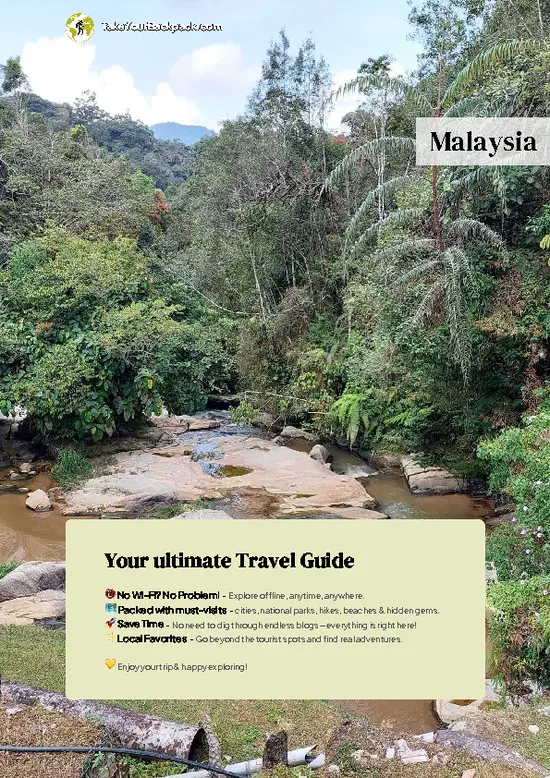
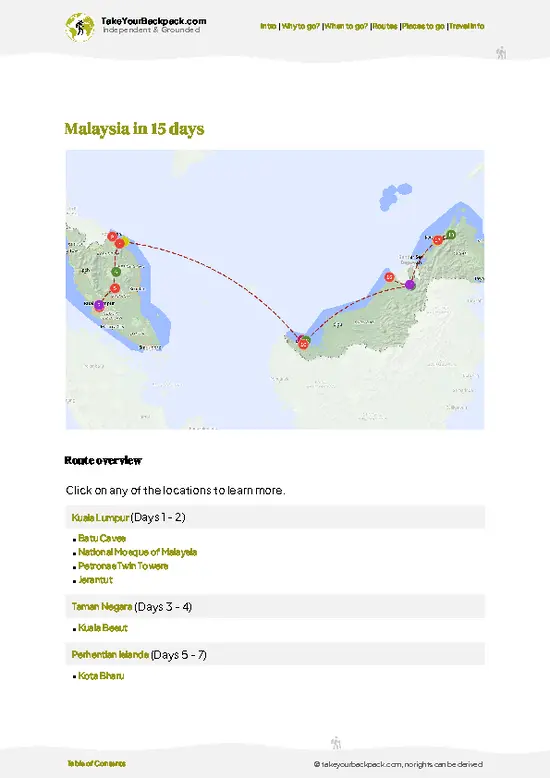
example page 0 from our offline Travel Guide for Malaysia
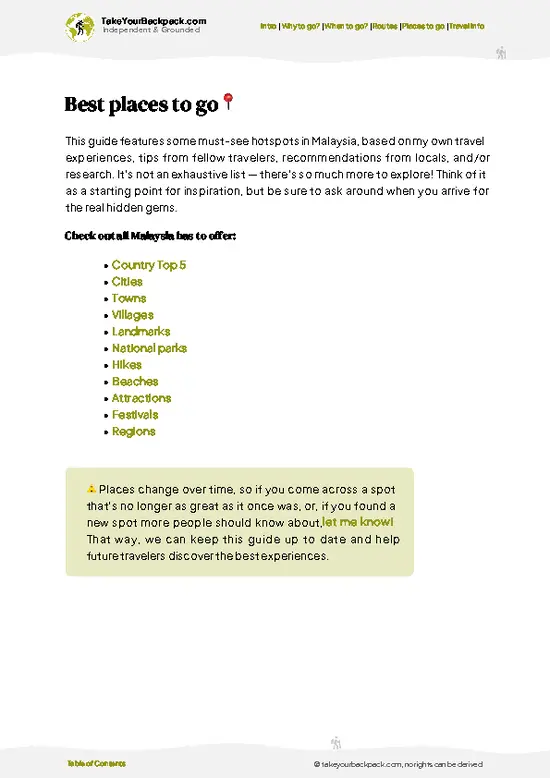
example page 1 from our offline Travel Guide for Malaysia
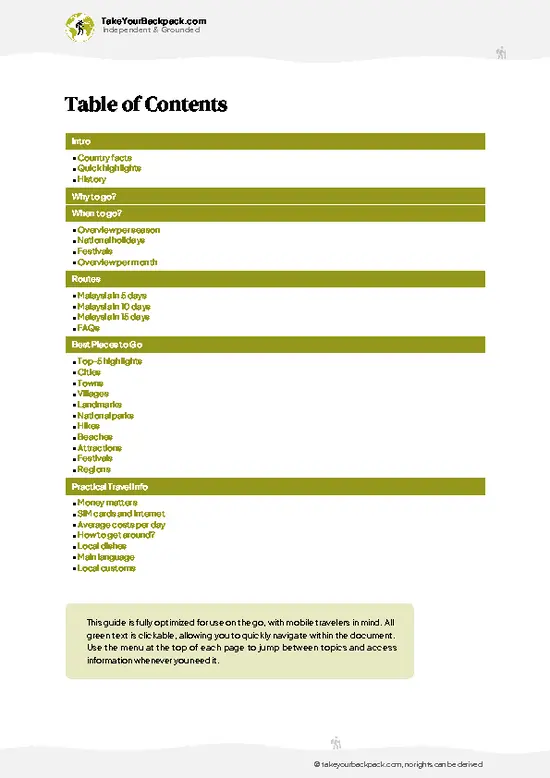
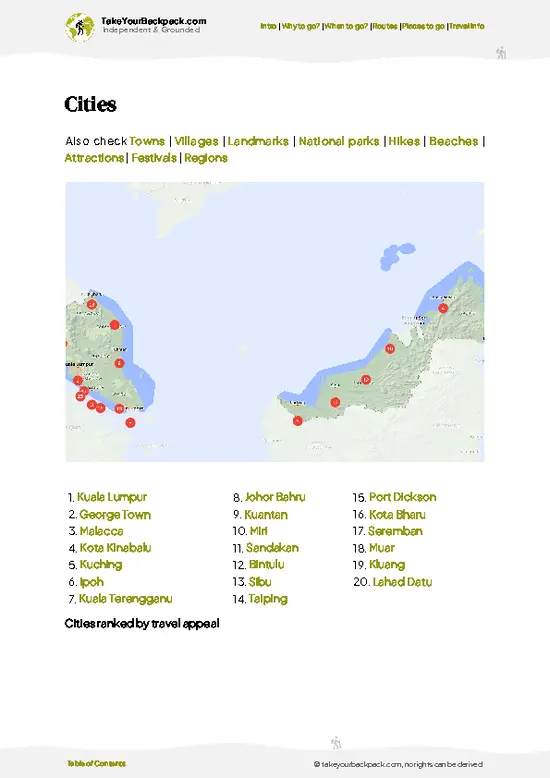
example page 2 from our offline Travel Guide for Malaysia
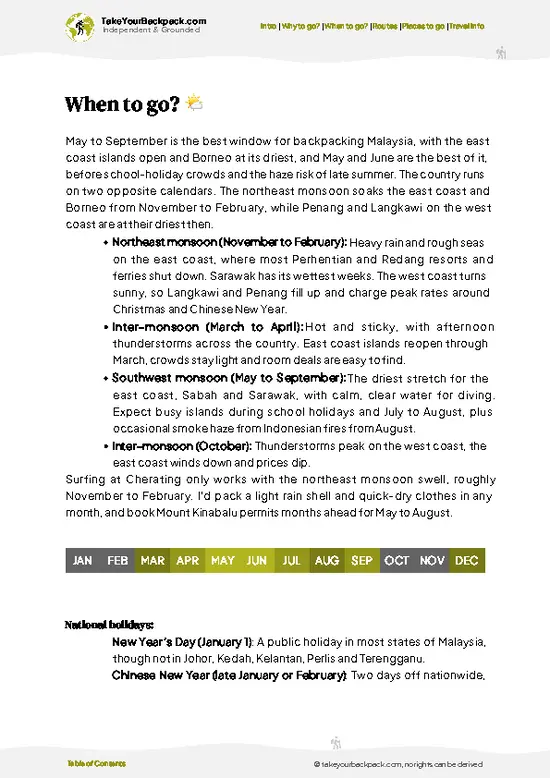
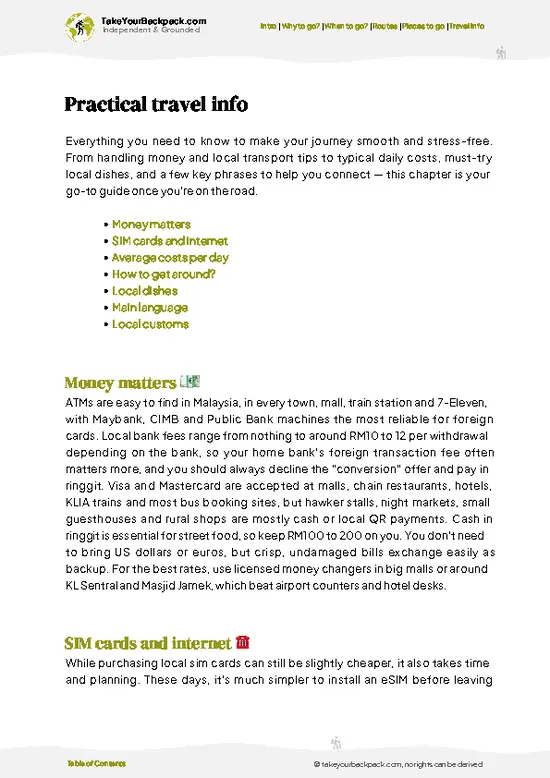
example page 3 from our offline Travel Guide for Malaysia
example page 4 from our offline Travel Guide for Malaysia
example page 5 from our offline Travel Guide for Malaysia
example page 6 from our offline Travel Guide for Malaysia
example page 7 from our offline Travel Guide for Malaysia
The digital guide (400 pages) contains:
✅ 106 highlights, ranked by travel appeal
✅ Optimized 5, 10 & 15-day travel routes
✅ Cities, national parks, landmarks, beaches
✅ How to get around
✅ Offline-friendly for travel without Wi-Fi
👉 Click to see all 30+ guide features

📅 Plan smarter in minutes, not weeks
✅ Month by month travel advice
✅ Festivals & national holidays
✅ Budget expectations

🗺️ Go to the right places, skip the overrated ones
✅ Honest pros & cons of destinations
✅ Top hikes, parks & viewpoints
✅ Lesser-known places most travelers miss
✅ Clear “worth it vs skip it” guidance

🛏️ Travel smoothly without rookie mistakes
✅ Best areas to stay
✅ Transport systems explained simply
✅ Common scams & safety advice
✅ SIM cards, money & practical tips

🌍 Understand the country, not just visit it
✅ Culture & traditions
✅ 52 Essential phrases & customs
✅ Festivals worth planning around
✅ Traveler-friendly historical context
✅ Insights that make places more meaningful

📱 Built for real travel conditions
✅ Fully downloadable PDF
✅ Works completely offline
✅ Optimized for phone use
✅ Useful in remote areas & buses
✅ Everything in one place
Stop searching, start planning
Get instant access to your full guide. 30‑day money-back guarantee.
+ Add another guide for just

By proceeding you agree to our terms.
Sent to your inbox immediately after payment • 100% Secure Checkout
Best Backpacking Travel Advisor 2025 tourism awardBest Backpacking
Travel Advisor
2025
What others say about Take Your Backpack Guides:
⭐⭐⭐⭐⭐
Fantastic, amazing amount of information!
⭐⭐⭐⭐⭐
My goodness this is amazing, it's what I've been looking for hats off too you!
⭐⭐⭐⭐⭐
I think this is absolutely BRILLIANT
⭐⭐⭐⭐
Very complete and informative. It's still missing places, but I gotta to commend you
⭐⭐⭐⭐⭐
This is truly amazing, thank you, can't wait to explore it with my kids!
⭐⭐⭐⭐⭐
Awesome resource, thank you!
⭐⭐⭐⭐⭐
This is amazing! Can't wait to explore the ones I haven't seen
⭐⭐⭐⭐
I love this! Well done, great idea.
⭐⭐⭐⭐⭐
Thanks for taking the time to make this gem!
⭐⭐⭐⭐⭐
This might be the best website I've ever seen.
⭐⭐⭐⭐⭐
Congratulations, and thank you so much for your work; it's incredibly valuable.
⭐⭐⭐⭐
In all seriousness I think you did a great job pointing out the important spots
⭐⭐⭐⭐⭐
10/10 very good
⭐⭐⭐⭐⭐
As someone who's only just starting to visit regularly this is awesome, thank you.
⭐⭐⭐⭐
Thank you very much! I'm going to visit my dad, it's going to be very useful!
⭐⭐⭐⭐⭐
This is really cool! We'll be travelling for the first time and this definitely come in handy.
⭐⭐⭐⭐⭐
You are now our minister of culture, congratulations 👨‍💼
⭐⭐⭐⭐⭐
Just wanted to tell you that this is a pearl! Going to follow your recommendations.
⭐⭐⭐⭐⭐
This is so cool. I'll definitely be using the resource for my travels soon.
⭐⭐⭐⭐⭐
This is very impressive! Good work.
⭐⭐⭐⭐⭐
This is an amazing and informative site. Very well done!

🛏️ Where to stay?Top Places to Consider Staying

Malaysia has plenty of hostels and budget guesthouses, with dorm beds typically running RM30 to 70 (about US$7 to 16) and basic private rooms from around RM80 (US$18). In Kuala Lumpur, Chinatown around Petaling Street is the cheapest central base and sits a short walk from Pasar Seni and Merdeka Square, though some older buildings feel worn, while Bukit Bintang puts you next to Jalan Alor’s night food stalls and the city’s best nightlife at the cost of street noise until late. In George Town on Penang, the hostels cluster around Chulia Street and Love Lane, steps from the heritage core and backpacker bars, and in Melaka the area around Jonker Street keeps you close to the old town but gets crowded … read more 👉
Malaysia has plenty of hostels and budget guesthouses, with dorm beds typically running RM30 to 70 (about US$7 to 16) and basic private rooms from around RM80 (US$18). In Kuala Lumpur, Chinatown around Petaling Street is the cheapest central base and sits a short walk from Pasar Seni and Merdeka Square, though some older buildings feel worn, while Bukit Bintang puts you next to Jalan Alor’s night food stalls and the city’s best nightlife at the cost of street noise until late. In George Town on Penang, the hostels cluster around Chulia Street and Love Lane, steps from the heritage core and backpacker bars, and in Melaka the area around Jonker Street keeps you close to the old town but gets crowded and loud during the weekend night market.

If you enjoy meeting fellow travelers, consider choosing hostels with high ratings for atmosphere. On the other hand, if you prefer having your own space, a hotel might be a better option.

MalaysiaMore Places Across Malaysia

👋 Meet the founderWho’s Behind Take Your Backpack?

Johan, backpacker and founder of TakeYourBackpackHi, I’m Johan (Netherlands 🇳🇱), the creator of TakeYourBackpack. Over the past 3 decades, I’ve backpacked through 90+ countries across six continents, gaining extensive experience with independent travel, long-term trips, and overland routes.

This site is built on a combination of firsthand travel experience and carefully curated insights from other backpackers. Many guides are based on places I’ve personally visited, while others bring together tips, observations, and practical advice shared by trusted travelers I’ve met along the way.

The goal is to provide realistic, experience-driven guidance — not generic itineraries — so you can explore destinations with better context, clearer expectations, and more confidence.