×

Malaysia🇲🇾 | best hikesBest 5 hikes in Malaysia

Hikes in Malaysia come in two moods: sweaty jungle walks that start at a ranger hut, and cooler highland tracks that start at a tea shop. Peninsular Malaysia is easy for independent travel, with buses, cheap guesthouses and trailheads an hour or two from a city. Borneo is a different animal. Sabah and Sarawak have bigger mountains, mandatory permits, licensed guides and prices to match, plus flights you will be booking early. Crowds follow the same split, with peak-season weekends thick on the famous peaks and the lowland forest trails nearly empty. Bring a towel. You will use it on yourself, not the leeches.

By Johan Kruseman 🇳🇱 | Updated October 18, 2026
Explore the best beaches in Malaysia

Why go?Understanding Their Importance

Malaysia hikes through some of the oldest rainforest on Earth, a lowland jungle estimated at well over 100 million years old, and that age shows in the sheer layering of trees, vines, fungi and things that bite. Add an equatorial climate with high humidity year-round, and every walk becomes a sauna with views. Temperatures at sea level sit around 24 to 33°C, while the highlands drop to the teens, so the country offers genuine climate choice in a small area.

The infrastructure is a quiet advantage. Peninsular Malaysia has paved roads, reliable buses, national parks with ranger stations and clear signage. Borneo leans on regulation: park permits, mandatory guides on the major mountains and limited daily quotas that sell out months ahead. That protects the forest, but it also means spontaneity … read more 👉
Malaysia hikes through some of the oldest rainforest on Earth, a lowland jungle estimated at well over 100 million years old, and that age shows in the sheer layering of trees, vines, fungi and things that bite. Add an equatorial climate with high humidity year-round, and every walk becomes a sauna with views. Temperatures at sea level sit around 24 to 33°C, while the highlands drop to the teens, so the country offers genuine climate choice in a small area.

The infrastructure is a quiet advantage. Peninsular Malaysia has paved roads, reliable buses, national parks with ranger stations and clear signage. Borneo leans on regulation: park permits, mandatory guides on the major mountains and limited daily quotas that sell out months ahead. That protects the forest, but it also means spontaneity is a bad plan.

Before choosing Malaysia, know that trails are often steep, root-choked and muddy, and fitness matters more than altitude suggests. Distances look short on paper and then take twice as long. Rain arrives with little ceremony. Malaysia is also a Muslim-majority country with a relaxed outlook, but modest clothing in villages is appreciated. Pack as if everything you own will end up damp, because it will.
Behind the Scenes of Selection
The list of best hikes in Malaysia is created based on scenery, challenge, trail quality, landmarks, and overall enjoyment. If you feel a hike is missing in this list, please let us know.

When to go?Seasonal Guide to Visiting

Best months and the rain you cannot dodge: The best months for hikes in Malaysia are March to September for most of the country, when rainfall is lowest and trails are firmest, though Borneo's peaks are best from roughly February to April and June to September for clearer summits. Malaysia has no true dry season, so afternoon downpours remain a regular guest year-round. Start early, finish by 1 or 2 pm, and treat the storm as a built-in lunch break.
The monsoon split: The east coast of the peninsula, including Terengganu and Pahang, gets hammered by the northeast monsoon from November to February, with rainfall that can exceed 300 mm a month and some parks and islands closing. The west coast has its wetter patches around April to May and October to November. Sabah and Sarawak are wettest from … read more 👉
Best months and the rain you cannot dodge: The best months for hikes in Malaysia are March to September for most of the country, when rainfall is lowest and trails are firmest, though Borneo's peaks are best from roughly February to April and June to September for clearer summits. Malaysia has no true dry season, so afternoon downpours remain a regular guest year-round. Start early, finish by 1 or 2 pm, and treat the storm as a built-in lunch break.
The monsoon split: The east coast of the peninsula, including Terengganu and Pahang, gets hammered by the northeast monsoon from November to February, with rainfall that can exceed 300 mm a month and some parks and islands closing. The west coast has its wetter patches around April to May and October to November. Sabah and Sarawak are wettest from about November to February, with landslides occasionally closing roads and tracks.
Crowds, prices and shoulder seasons: Peak pressure falls on school holidays (late May to June, late November to December), Chinese New Year and Hari Raya, when guesthouses fill and transport costs can rise 20 to 50 percent. Permit slots for the big Borneo peaks can sell out three to six months ahead in July and August. Shoulder months like March and October offer thinner crowds and cheaper beds, with a modest bet on the weather.

hike hoppingHow to Combine hikes Into One Trip

How long a multi-hike trip takes: A trip combining several hikes in Malaysia needs 10 to 21 days, and the lower end only works if you stay on one landmass. Peninsular Malaysia and Borneo are separated by the South China Sea, so treat them as two trips that share a visa stamp.
Grouping regions sensibly: On the peninsula, the highlands and national parks chain together in a north-to-south line from Kuala Lumpur, with buses taking 3 to 5 hours between most hubs. Starting in KL and heading toward Taman Negara and then the east or south keeps backtracking low. In Borneo, base yourself around Kota Kinabalu for Sabah and Kuching or Miri for Sarawak, with flights between them of roughly 1.5 to 2 hours. Flying from KL to Borneo takes about 2.5 to 3 hours, and it is usually the cheapest hop at US$25 … read more 👉
How long a multi-hike trip takes: A trip combining several hikes in Malaysia needs 10 to 21 days, and the lower end only works if you stay on one landmass. Peninsular Malaysia and Borneo are separated by the South China Sea, so treat them as two trips that share a visa stamp.
Grouping regions sensibly: On the peninsula, the highlands and national parks chain together in a north-to-south line from Kuala Lumpur, with buses taking 3 to 5 hours between most hubs. Starting in KL and heading toward Taman Negara and then the east or south keeps backtracking low. In Borneo, base yourself around Kota Kinabalu for Sabah and Kuching or Miri for Sarawak, with flights between them of roughly 1.5 to 2 hours. Flying from KL to Borneo takes about 2.5 to 3 hours, and it is usually the cheapest hop at US$25 to 80 if booked ahead.
Pacing and the usual mistakes: Allow 2 to 4 days per stop, including a rest day, because humidity and leg-burning steps stack up. The classic error is cramming hikes on consecutive days. Another is booking Borneo permits last, which leaves the entire route hostage to availability, so reserve those first and build around them. Also avoid tight same-day connections after trailhead descents, since buses and rain both run on their own schedule. Leave a buffer day before any international flight.

The ListMust-Visit hikes in Malaysia

1 Bohey Dulang Viewpoint

island ridge, volcanic crater, turquoise lagoon

Follow a rugged ridge above a flooded crater, where the path reveals vivid blue waters and the unique topography of an ancient volcano.

malaysia-hike-bohey-dulang-viewpoint
© Google |

2 Penang Hill Heritage Trail

colonial relics, mossy forest, switchback ascent

Climb through dense rainforest and relics of Penang’s past, passing moss-draped trees and panoramic lookouts before reaching the breezy summit.

3 Bukit Panorama

pre-dawn climb, rolling hills, sunrise lookout

Ascend before dawn to catch mist lifting over endless hills, with a cool breeze and shifting light rewarding the early effort.

malaysia-hike-bukit-panorama
© Google |

4 Bukit Batu Putih

limestone outcrop, coastal cliffs, sea views

Scramble up a rocky headland for sweeping ocean vistas, where exposed stone and salty air create a stark contrast to the inland jungle.

malaysia-hike-bukit-batu-putih
© Google |

5 Bukit Saga

jungle trails, waterfall stop, fitness stations

Navigate a network of steep forest paths, pausing at a small waterfall and open-air exercise spots popular with local hikers.

malaysia-hike-bukit-saga
© Google |
Loading the map 🌍

Expert viewInsights from Locals and Experts

How many hikes to plan: Plan three to five hikes on a two to three week trip. Fewer leaves you wondering why you packed boots. More turns the trip into a damp cycle of laundry, aching knees and moldy socks. In the heat, each hike costs a recovery day in energy, and you get more from walking well than walking often.
Which kind to prioritize: For a tight budget, choose peninsular jungle and highland walks. They are cheap, usually possible without a guide on marked routes, and let you improvise around the weather. If you want a headline summit and can accept paperwork, spend on one Borneo mountain. It costs more in money and planning, but it gives the biggest return per ringgit and a real sense of scale. Skip the second Borneo peak unless altitude is your thing. If comfort matters, go for day … read more 👉
How many hikes to plan: Plan three to five hikes on a two to three week trip. Fewer leaves you wondering why you packed boots. More turns the trip into a damp cycle of laundry, aching knees and moldy socks. In the heat, each hike costs a recovery day in energy, and you get more from walking well than walking often.
Which kind to prioritize: For a tight budget, choose peninsular jungle and highland walks. They are cheap, usually possible without a guide on marked routes, and let you improvise around the weather. If you want a headline summit and can accept paperwork, spend on one Borneo mountain. It costs more in money and planning, but it gives the biggest return per ringgit and a real sense of scale. Skip the second Borneo peak unless altitude is your thing. If comfort matters, go for day hikes from a city base, which let you sleep in a dry bed with air conditioning.
What it costs: Budget about US$25 to 45 a day (RM110 to 200) on the peninsula, covering a dorm bed or simple room, local food and buses. Borneo runs closer to US$40 to 70 a day before the big climbs. Park entry is typically US$1 to 10 for foreigners on the peninsula, with guides at US$20 to 60 a day where required. Major Borneo summit packages with permit, guide, hut and meals can run US$150 to 400 or more. Transport to trailheads, often shared taxis or e-hailing, adds US$5 to 30.
Safety and etiquette: The real risks are heat exhaustion, slippery roots and sudden storms, not wildlife. Carry 2 to 3 liters of water, start at dawn, and use a headlamp with spare batteries. Leech socks are worth the few dollars. Tell your guesthouse where you are going, and take the ranger registration seriously, because rescue in dense forest can be slow. Rivers rise quickly after rain, so cross cautiously or wait. Some summits and forests carry spiritual significance for local communities, so follow guide instructions, keep voices low and avoid littering or taking souvenirs. Dress modestly in villages, and ask before photographing people.

✈️ The backpacker research shortcutMalaysia Travel Guide

An offline-friendly backpacking guide with optimized travel routes, ranked highlights, transport advice, and the best areas to stay.
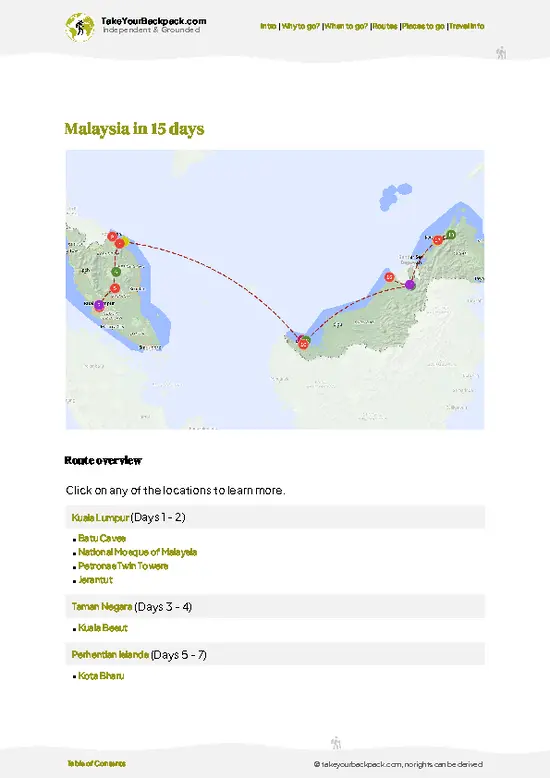
example page 0 from our offline Travel Guide for Malaysia
example page 1 from our offline Travel Guide for Malaysia
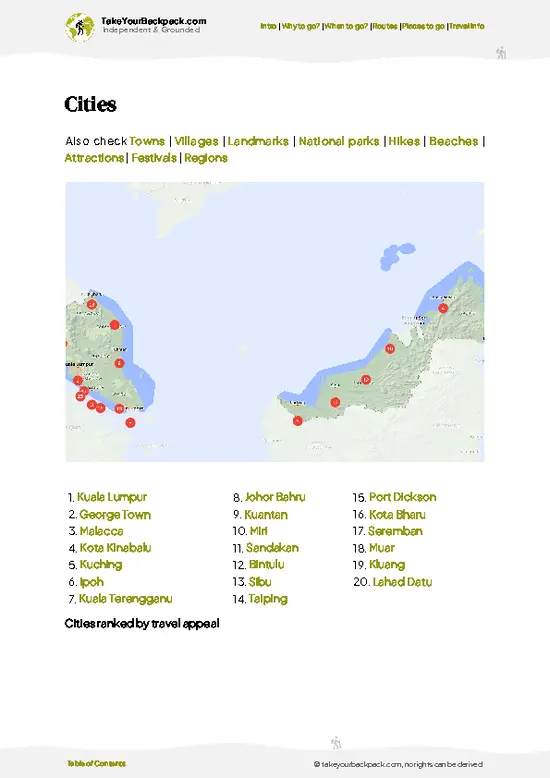
example page 2 from our offline Travel Guide for Malaysia
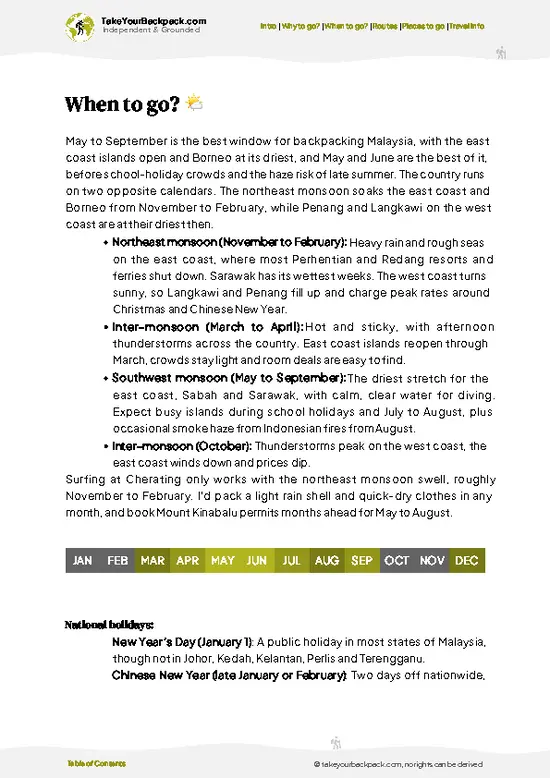
example page 3 from our offline Travel Guide for Malaysia
example page 4 from our offline Travel Guide for Malaysia
example page 5 from our offline Travel Guide for Malaysia
example page 6 from our offline Travel Guide for Malaysia
example page 7 from our offline Travel Guide for Malaysia
The digital guide (400 pages) contains:
✅ 106 highlights, ranked by travel appeal
✅ Optimized 5, 10 & 15-day travel routes
✅ Cities, national parks, landmarks, beaches
✅ How to get around
✅ Offline-friendly for travel without Wi-Fi
👉 Click to see all 30+ guide features

📅 Plan smarter in minutes, not weeks
✅ Month by month travel advice
✅ Festivals & national holidays
✅ Budget expectations

🗺️ Go to the right places, skip the overrated ones
✅ Honest pros & cons of destinations
✅ Top hikes, parks & viewpoints
✅ Lesser-known places most travelers miss
✅ Clear “worth it vs skip it” guidance

🛏️ Travel smoothly without rookie mistakes
✅ Best areas to stay
✅ Transport systems explained simply
✅ Common scams & safety advice
✅ SIM cards, money & practical tips

🌍 Understand the country, not just visit it
✅ Culture & traditions
✅ 52 Essential phrases & customs
✅ Festivals worth planning around
✅ Traveler-friendly historical context
✅ Insights that make places more meaningful

📱 Built for real travel conditions
✅ Fully downloadable PDF
✅ Works completely offline
✅ Optimized for phone use
✅ Useful in remote areas & buses
✅ Everything in one place
Stop searching, start planning
Get instant access to your full guide. 30‑day money-back guarantee.
+ Add another guide for just

By proceeding you agree to our terms.
Sent to your inbox immediately after payment • 100% Secure Checkout
Best Backpacking Travel Advisor 2025 tourism awardBest Backpacking
Travel Advisor
2025
What others say about Take Your Backpack Guides:
⭐⭐⭐⭐⭐
Fantastic, amazing amount of information!
⭐⭐⭐⭐⭐
My goodness this is amazing, it's what I've been looking for hats off too you!
⭐⭐⭐⭐⭐
I think this is absolutely BRILLIANT
⭐⭐⭐⭐
Very complete and informative. It's still missing places, but I gotta to commend you
⭐⭐⭐⭐⭐
This is truly amazing, thank you, can't wait to explore it with my kids!
⭐⭐⭐⭐⭐
Awesome resource, thank you!
⭐⭐⭐⭐⭐
This is amazing! Can't wait to explore the ones I haven't seen
⭐⭐⭐⭐
I love this! Well done, great idea.
⭐⭐⭐⭐⭐
Thanks for taking the time to make this gem!
⭐⭐⭐⭐⭐
This might be the best website I've ever seen.
⭐⭐⭐⭐⭐
Congratulations, and thank you so much for your work; it's incredibly valuable.
⭐⭐⭐⭐
In all seriousness I think you did a great job pointing out the important spots
⭐⭐⭐⭐⭐
10/10 very good
⭐⭐⭐⭐⭐
As someone who's only just starting to visit regularly this is awesome, thank you.
⭐⭐⭐⭐
Thank you very much! I'm going to visit my dad, it's going to be very useful!
⭐⭐⭐⭐⭐
This is really cool! We'll be travelling for the first time and this definitely come in handy.
⭐⭐⭐⭐⭐
You are now our minister of culture, congratulations 👨‍💼
⭐⭐⭐⭐⭐
Just wanted to tell you that this is a pearl! Going to follow your recommendations.
⭐⭐⭐⭐⭐
This is so cool. I'll definitely be using the resource for my travels soon.
⭐⭐⭐⭐⭐
This is very impressive! Good work.
⭐⭐⭐⭐⭐
This is an amazing and informative site. Very well done!

🛏️ Where to stay?Top Areas to Stay

Malaysia has plenty of hostels and budget guesthouses, with dorm beds typically running RM30 to 70 (about US$7 to 16) and basic private rooms from around RM80 (US$18). In Kuala Lumpur, Chinatown around Petaling Street is the cheapest central base and sits a short walk from Pasar Seni and Merdeka Square, though some older buildings feel worn, while Bukit Bintang puts you next to Jalan Alor’s night food stalls and the city’s best nightlife at the cost of street noise until late. In George Town on Penang, the hostels cluster around Chulia Street and Love Lane, steps from the heritage core and backpacker bars, and in Melaka the area around Jonker Street keeps you close to the old town but gets crowded … read more 👉
Malaysia has plenty of hostels and budget guesthouses, with dorm beds typically running RM30 to 70 (about US$7 to 16) and basic private rooms from around RM80 (US$18). In Kuala Lumpur, Chinatown around Petaling Street is the cheapest central base and sits a short walk from Pasar Seni and Merdeka Square, though some older buildings feel worn, while Bukit Bintang puts you next to Jalan Alor’s night food stalls and the city’s best nightlife at the cost of street noise until late. In George Town on Penang, the hostels cluster around Chulia Street and Love Lane, steps from the heritage core and backpacker bars, and in Melaka the area around Jonker Street keeps you close to the old town but gets crowded and loud during the weekend night market.

If you enjoy meeting fellow travelers, consider choosing hostels with high ratings for atmosphere. On the other hand, if you prefer having your own space, a hotel might be a better option.

MalaysiaDiscover the Country

👋 Meet the founderWho’s Behind Take Your Backpack?

Johan, backpacker and founder of TakeYourBackpackHi, I’m Johan (Netherlands 🇳🇱), the creator of TakeYourBackpack. Over the past 3 decades, I’ve backpacked through 90+ countries across six continents, gaining extensive experience with independent travel, long-term trips, and overland routes.

This site is built on a combination of firsthand travel experience and carefully curated insights from other backpackers. Many guides are based on places I’ve personally visited, while others bring together tips, observations, and practical advice shared by trusted travelers I’ve met along the way.

The goal is to provide realistic, experience-driven guidance — not generic itineraries — so you can explore destinations with better context, clearer expectations, and more confidence.