×

Morocco🇲🇦 | best landmarksTop-Rated 8 landmarks in Morocco

Morocco packs its landmarks into three distinct zones, and the one you pick sets your costs and your mood. The imperial cities (Fès, Marrakech, Meknes, Rabat) hold medinas, palaces and madrasas, with entry fees of roughly 70 to 100 MAD (US$7 to 10) and heavy tour-group traffic in Marrakech. The Atlas and desert south offer kasbahs and ksour that cost little to enter but need slow, bumpy transport. The northern and Atlantic coast has fortified ports and Roman ruins that stay quiet. For backpackers traveling independently, the imperial cities are easiest by train. Skip the packaged desert overnights from Marrakech, which burn two days on a bus. Fès and the southern kasbahs repay the effort.

By Johan Kruseman 🇳🇱 | Updated October 23, 2026
Explore the best national parks in Morocco

Why go?Why These unique site Stand Out

Morocco suits landmark-hunting because dynasties kept moving the capital. The Almoravids, Almohads, Merinids and Saadians each built their own cities, mosques and fortifications, so the country holds several distinct architectural periods instead of one. Roman Volubilis and Phoenician-era coastal ports add older layers. Geography did the rest: the Atlas Mountains and the Sahara edge forced caravan trade through fortified settlements, which is why earthen kasbahs and walled villages survive in the south.

Infrastructure is good where it matters. The Al Boraq high-speed train links Tangier, Rabat and Casablanca, and conventional trains reach Marrakech, Fès and Meknes. Beyond that, you rely on CTM and Supratours buses, shared grands taxis and rented cars.

Know three things before choosing Morocco. … read more 👉
Morocco suits landmark-hunting because dynasties kept moving the capital. The Almoravids, Almohads, Merinids and Saadians each built their own cities, mosques and fortifications, so the country holds several distinct architectural periods instead of one. Roman Volubilis and Phoenician-era coastal ports add older layers. Geography did the rest: the Atlas Mountains and the Sahara edge forced caravan trade through fortified settlements, which is why earthen kasbahs and walled villages survive in the south.

Infrastructure is good where it matters. The Al Boraq high-speed train links Tangier, Rabat and Casablanca, and conventional trains reach Marrakech, Fès and Meknes. Beyond that, you rely on CTM and Supratours buses, shared grands taxis and rented cars.

Know three things before choosing Morocco. First, the medinas themselves are the main attraction, and you will not find them on a ticket counter, so expect narrow alleys, hawkers and unofficial guides. Second, many mosques are closed to non-Muslims, so you see exteriors and courtyards only. Third, the climate is harsh at the wrong time, with summer heat above 40°C inland. Do not expect museum-style signage or polished interpretation. Context comes from a good guide or your own reading.
Evaluating the Top Choices
The list of best unique sites in Morocco is created based on history or culture, wow factor, atmosphere, quirks, and memorability. If you feel a unique site is missing in this list, please let us know.

When to go?Timing Your Visit for the Best Experience

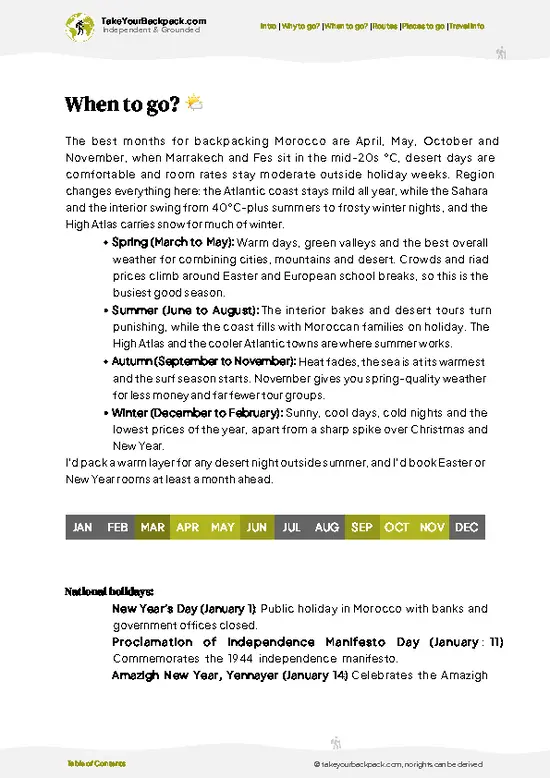
Best months for landmarks: March to May and September to November are the best months, because daytime temperatures sit around 18 to 30°C in the imperial cities and the Atlas, which makes long walks through medinas and ruins comfortable. Spring brings green hills and clear light. Autumn is slightly warmer and drier.
Summer and winter: June to August is not worth it inland. Marrakech, Fès and the Drâa and Dadès valleys regularly pass 38 to 45°C, and the desert south is miserable between noon and 5 pm. The Atlantic coast (Essaouira, Rabat, Asilah) stays around 22 to 28°C and is the exception.

December to February is cool, with 10 to 18°C days in Marrakech and Fès, and nights near freezing in the Atlas and Fès. Rain is concentrated from November to March, and the north and Atlas get the most. … read more 👉
Best months for landmarks: March to May and September to November are the best months, because daytime temperatures sit around 18 to 30°C in the imperial cities and the Atlas, which makes long walks through medinas and ruins comfortable. Spring brings green hills and clear light. Autumn is slightly warmer and drier.
Summer and winter: June to August is not worth it inland. Marrakech, Fès and the Drâa and Dadès valleys regularly pass 38 to 45°C, and the desert south is miserable between noon and 5 pm. The Atlantic coast (Essaouira, Rabat, Asilah) stays around 22 to 28°C and is the exception.

December to February is cool, with 10 to 18°C days in Marrakech and Fès, and nights near freezing in the Atlas and Fès. Rain is concentrated from November to March, and the north and Atlas get the most. Snow can close mountain passes such as the Tizi n’Tichka for hours or days. Desert days stay pleasant, though nights drop to near 0°C.
Crowds and prices: Peak crowds and top prices run from Easter through May, around Christmas and New Year, and in October. Riad rates can rise 30 to 50 percent then. During Ramadan, which moves about 11 days earlier each year, many sites shorten hours and restaurants close by day. Travel is possible, but plan for reduced hours and lower energy.

unique site hoppingTips for Visiting Multiple Destinations

How many days to allow: A trip combining several landmarks in Morocco needs 10 to 14 days. Anything under 8 forces you to rush between regions and spend most of the time in vehicles.
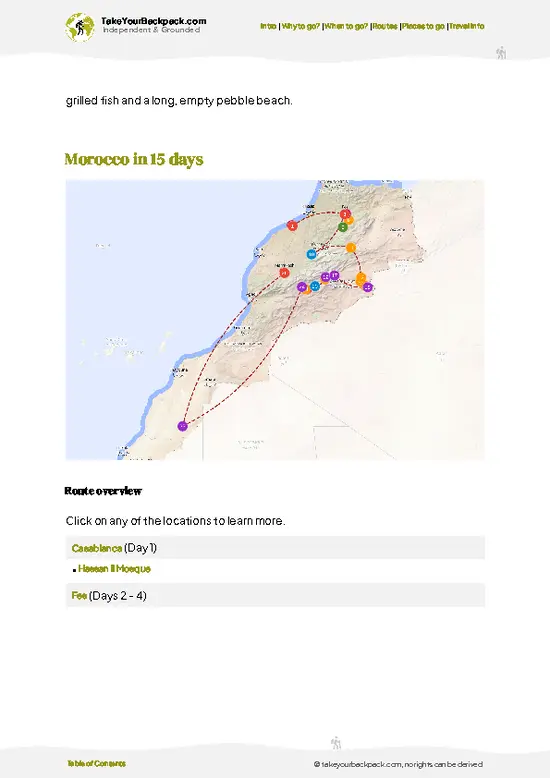
Regional clusters and direction: Group by region. The imperial cities link by train: Tangier or Casablanca to Rabat takes 1 to 1.5 hours, Rabat to Fès about 3 hours, Fès to Marrakech roughly 7 hours by train. Fès to Marrakech cuts through the middle, so most travelers run a loop, starting in Casablanca or Tangier, then Fès, then south through the Middle Atlas to the desert edge, ending in Marrakech. The south is best done last because the desert drive from Fès to Merzouga takes 8 to 10 hours, and the Marrakech to Aït Benhaddou and Ouarzazate leg is 4 to 5 hours over the Tizi n’Tichka pass.
Time per stop: Give Fès … read more 👉
How many days to allow: A trip combining several landmarks in Morocco needs 10 to 14 days. Anything under 8 forces you to rush between regions and spend most of the time in vehicles.
Regional clusters and direction: Group by region. The imperial cities link by train: Tangier or Casablanca to Rabat takes 1 to 1.5 hours, Rabat to Fès about 3 hours, Fès to Marrakech roughly 7 hours by train. Fès to Marrakech cuts through the middle, so most travelers run a loop, starting in Casablanca or Tangier, then Fès, then south through the Middle Atlas to the desert edge, ending in Marrakech. The south is best done last because the desert drive from Fès to Merzouga takes 8 to 10 hours, and the Marrakech to Aït Benhaddou and Ouarzazate leg is 4 to 5 hours over the Tizi n’Tichka pass.
Time per stop: Give Fès 2 to 3 days, Marrakech 2 days, and a single day each for Meknes, Volubilis and Rabat. Kasbah towns need half a day to a night.
Planning mistakes: The classic error is the 3-day Marrakech to Merzouga round trip, which means about 20 hours of driving for one night. Do it in 4 to 5 days with stops in the Dadès and Todra gorges, or skip the desert. Another is cramming Fès, Chefchaouen and Meknes into one day. Spread them out. Last, book trains early for Fridays and Sundays, when they fill.

The ListTop landmarks of Morocco

1 Aït Benhaddou

Rammed-earth ksar, Ounila River crossing, agadir summit, film locations

Cross the river on stepping stones, climb 20 to 30 minutes to the hilltop granary, and look back over palm groves and the Atlas foothills.

2 Guelta Zemmur

Permanent desert pool, dark rock hills, herders at water, haima tea, starry nights

Walk the rocky plain to a small permanent pool where herders water camels and goats, then share tea in a tent under dense stars.

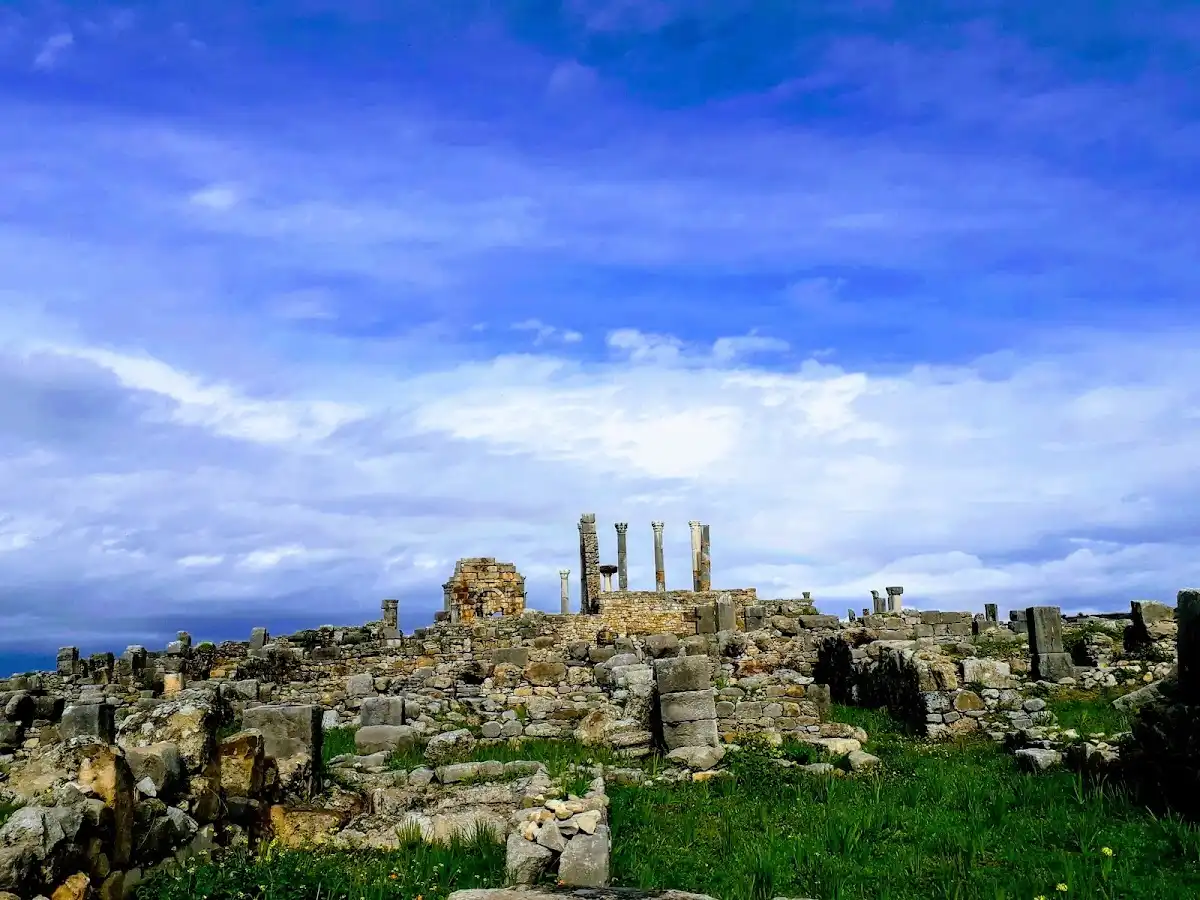
3 Volubilis

Roman mosaics, Caracalla arch, olive presses, Mauretanian site

Walk the Decumanus Maximus to the triumphal arch, read the dolphin and Hercules mosaics in their houses, and look out across the plain.

morocco-unique-site-volubilis
© Google |

4 Todra Gorge

160-meter walls, climbing routes, Tinghir oasis, nomad valley

Pass through the narrows where cold shade fills a road-wide gap, then continue upstream on footpaths toward herders' camps and open canyon.

morocco-unique-site-todra-gorge
© Google |

5 Dadès Gorges

Monkey Fingers rocks, Tamellalt hairpins, river path, kasbah valley

Walk the narrow stretch beneath finger-shaped red columns, then drive the tight hairpins above the valley floor for a clear view of layered cliffs.

morocco-unique-site-dades-gorges
© Google |

6 Erg Chebbi

150-meter dunes, camel trek, desert camp, Merzouga

Ride a camel for one to two hours from Merzouga, sleep in a tent among the sand ridges, and climb a crest before dawn.

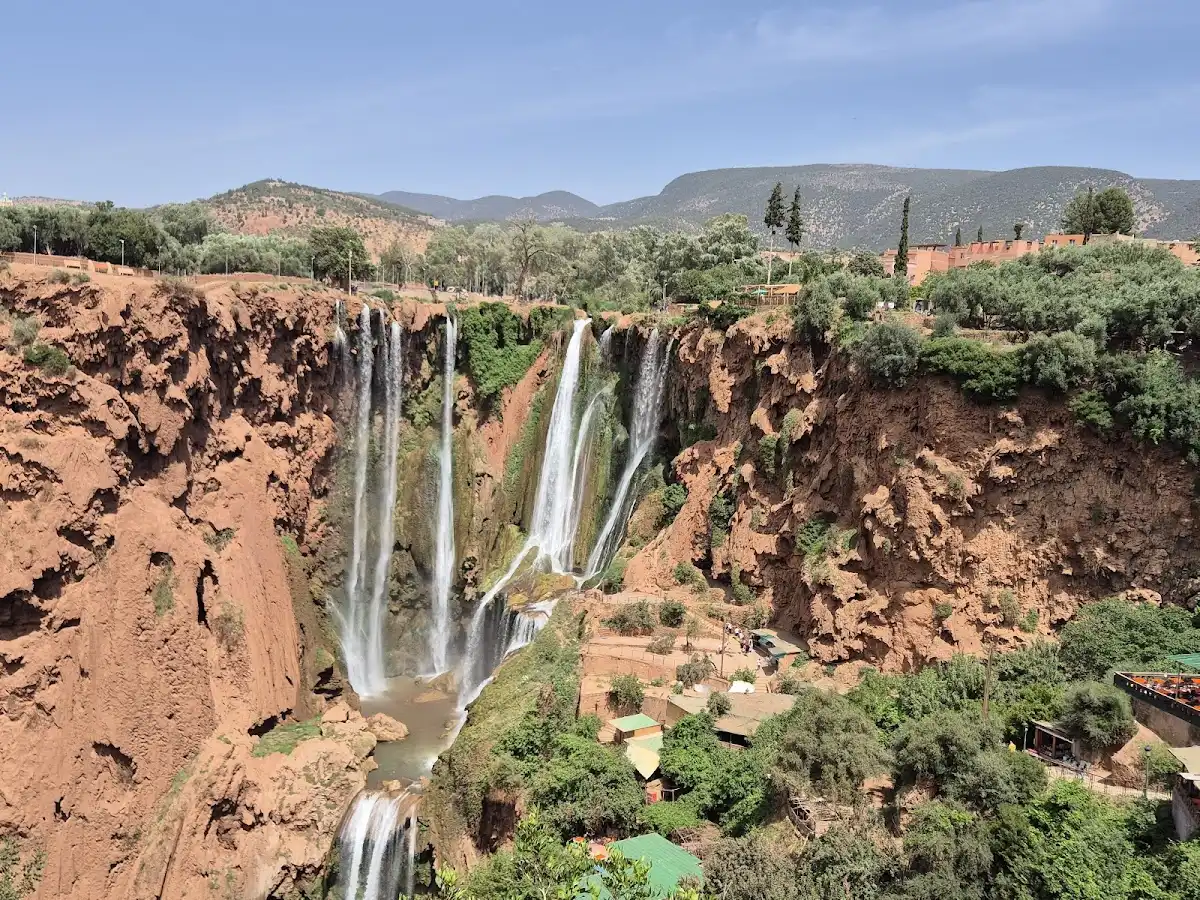
7 Ouzoud Falls

110-meter cascade, macaques, red cliffs, boat to the base

Follow the cliffside paths past olive groves and old mills, then take a rowing boat into the spray at the foot of the falls.

morocco-unique-site-ouzoud-falls
© Google |

8 Imi-n-Ifri Natural Bridge

Limestone arch, stream cave, spring pools, Demnate

Stand beneath the arch spanning the gorge, step into the echoing cave with its stalactites, and wade the shallow pools below the bridge.

morocco-unique-site-imi-n-ifri-natural-bridge
© Google |
Loading the map 🌍

Expert viewPro Tips for Exploring the Best

How many landmarks to visit: Plan on 6 to 8 landmarks in a 10 to 14 day trip. Morocco’s sights need time because getting to them, finding the entrance and dealing with offers of help all take energy, and more than one major stop per day leaves you tired and distracted. Medina sites in particular are best taken one at a time, with an hour or two to wander afterward.
Choosing by travel style: If you travel on a tight budget and want ease, put the imperial cities first: train access, cheap entry and plenty of hostels. If you want fewer people and more atmosphere, favor the southern kasbahs and ksour, where you need a rented car or shared grand taxi and the payoff is empty courtyards and mud-brick villages at dawn. If you like history, add the Roman and coastal sites in the north. Skip anything … read more 👉
How many landmarks to visit: Plan on 6 to 8 landmarks in a 10 to 14 day trip. Morocco’s sights need time because getting to them, finding the entrance and dealing with offers of help all take energy, and more than one major stop per day leaves you tired and distracted. Medina sites in particular are best taken one at a time, with an hour or two to wander afterward.
Choosing by travel style: If you travel on a tight budget and want ease, put the imperial cities first: train access, cheap entry and plenty of hostels. If you want fewer people and more atmosphere, favor the southern kasbahs and ksour, where you need a rented car or shared grand taxi and the payoff is empty courtyards and mud-brick villages at dawn. If you like history, add the Roman and coastal sites in the north. Skip anything that is mostly a photo stop on a day tour. Marrakech’s central square draws massive crowds, and the best moments there come early in the morning or after sunset, not at midday.
What it costs: A realistic budget is US$30 to 50 a day (300 to 500 MAD) including a hostel dorm or simple riad room, meals, local transport and about two paid sites. Entry to palaces, madrasas and tombs usually runs 50 to 100 MAD (US$5 to 10), and many medina mosques charge nothing because you cannot enter. Licensed guides charge around 300 to 600 MAD (US$30 to 60) for a half day, and hiring one for the two or three most complex sites is money well spent. Trains between cities cost about 40 to 200 MAD (US$4 to 20) depending on the route, and CTM buses are slightly cheaper. A car costs around 300 to 500 MAD (US$30 to 50) a day to rent, plus fuel.
Safety and etiquette: Morocco is generally safe, but expect persistent unofficial guides in Fès and Marrakech who steer you toward shops for commissions. A polite “la, shukran” and continued walking works better than engaging. Agree on any price before you start, and use only guides with an official badge. Keep valuables in a front pocket in crowded alleys.

Dress with shoulders and knees covered at religious and historic sites, which is respectful and also draws less attention. Non-Muslims cannot enter most active mosques, so do not try. Ask before photographing people, since many decline and some demand payment. During Ramadan, avoid eating and drinking in public during daylight, and note that opening hours shift. Fridays around midday are prayer time, and some sites close for a few hours.

Finally, carry small bills and coins. Ticket booths and taxi drivers rarely have change for a 200 MAD note.

✈️ The backpacker research shortcutMorocco Travel Guide

An offline-friendly backpacking guide with optimized travel routes, ranked highlights, transport advice, and the best areas to stay.
example page 0 from our offline Travel Guide for Morocco
example page 1 from our offline Travel Guide for Morocco
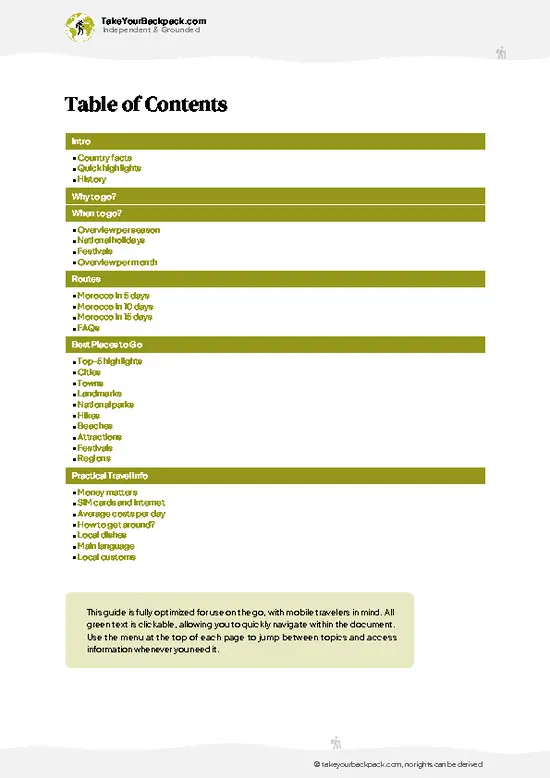
example page 2 from our offline Travel Guide for Morocco
example page 3 from our offline Travel Guide for Morocco
example page 4 from our offline Travel Guide for Morocco
example page 5 from our offline Travel Guide for Morocco
example page 6 from our offline Travel Guide for Morocco
example page 7 from our offline Travel Guide for Morocco
The digital guide (424 pages) contains:
✅ 112 highlights, ranked by travel appeal
✅ Optimized 5, 10 & 15-day travel routes
✅ Cities, national parks, landmarks, beaches
✅ How to get around
✅ Offline-friendly for travel without Wi-Fi
👉 Click to see all 30+ guide features

📅 Plan smarter in minutes, not weeks
✅ Month by month travel advice
✅ Festivals & national holidays
✅ Budget expectations

🗺️ Go to the right places, skip the overrated ones
✅ Honest pros & cons of destinations
✅ Top hikes, parks & viewpoints
✅ Lesser-known places most travelers miss
✅ Clear “worth it vs skip it” guidance

🛏️ Travel smoothly without rookie mistakes
✅ Best areas to stay
✅ Transport systems explained simply
✅ Common scams & safety advice
✅ SIM cards, money & practical tips

🌍 Understand the country, not just visit it
✅ Culture & traditions
✅ 52 Essential phrases & customs
✅ Festivals worth planning around
✅ Traveler-friendly historical context
✅ Insights that make places more meaningful

📱 Built for real travel conditions
✅ Fully downloadable PDF
✅ Works completely offline
✅ Optimized for phone use
✅ Useful in remote areas & buses
✅ Everything in one place
Stop searching, start planning
Get instant access to your full guide. 30‑day money-back guarantee.
+ Add another guide for just

By proceeding you agree to our terms.
Sent to your inbox immediately after payment • 100% Secure Checkout
Best Backpacking Travel Advisor 2025 tourism awardBest Backpacking
Travel Advisor
2025
What others say about Take Your Backpack Guides:
⭐⭐⭐⭐⭐
Fantastic, amazing amount of information!
⭐⭐⭐⭐⭐
My goodness this is amazing, it's what I've been looking for hats off too you!
⭐⭐⭐⭐⭐
I think this is absolutely BRILLIANT
⭐⭐⭐⭐
Very complete and informative. It's still missing places, but I gotta to commend you
⭐⭐⭐⭐⭐
This is truly amazing, thank you, can't wait to explore it with my kids!
⭐⭐⭐⭐⭐
Awesome resource, thank you!
⭐⭐⭐⭐⭐
This is amazing! Can't wait to explore the ones I haven't seen
⭐⭐⭐⭐
I love this! Well done, great idea.
⭐⭐⭐⭐⭐
Thanks for taking the time to make this gem!
⭐⭐⭐⭐⭐
This might be the best website I've ever seen.
⭐⭐⭐⭐⭐
Congratulations, and thank you so much for your work; it's incredibly valuable.
⭐⭐⭐⭐
In all seriousness I think you did a great job pointing out the important spots
⭐⭐⭐⭐⭐
10/10 very good
⭐⭐⭐⭐⭐
As someone who's only just starting to visit regularly this is awesome, thank you.
⭐⭐⭐⭐
Thank you very much! I'm going to visit my dad, it's going to be very useful!
⭐⭐⭐⭐⭐
This is really cool! We'll be travelling for the first time and this definitely come in handy.
⭐⭐⭐⭐⭐
You are now our minister of culture, congratulations 👨‍💼
⭐⭐⭐⭐⭐
Just wanted to tell you that this is a pearl! Going to follow your recommendations.
⭐⭐⭐⭐⭐
This is so cool. I'll definitely be using the resource for my travels soon.
⭐⭐⭐⭐⭐
This is very impressive! Good work.
⭐⭐⭐⭐⭐
This is an amazing and informative site. Very well done!

🛏️ Where to stay?Best Places to Stay in Morocco

Morocco has plenty of hostels and budget guesthouses, most set in converted riads with dorms around a tiled courtyard and a rooftop terrace where breakfast is usually included. In Marrakech, the Medina near Jemaa el-Fnaa keeps you walking distance from the souks and food stalls but comes with motorbike noise, touts and confusing alleys after dark, while Gueliz is calmer and has most of the city’s bars, at the cost of a 20 to 30 minute walk to the old town. In Fes, staying inside Fes el-Bali puts the tanneries and medersas on your doorstep (the lanes go quiet and dim at night, so note your route), whereas the medinas of Chefchaouen and Essaouira are smaller, safer-feeling and easy to find your … read more 👉
Morocco has plenty of hostels and budget guesthouses, most set in converted riads with dorms around a tiled courtyard and a rooftop terrace where breakfast is usually included. In Marrakech, the Medina near Jemaa el-Fnaa keeps you walking distance from the souks and food stalls but comes with motorbike noise, touts and confusing alleys after dark, while Gueliz is calmer and has most of the city’s bars, at the cost of a 20 to 30 minute walk to the old town. In Fes, staying inside Fes el-Bali puts the tanneries and medersas on your doorstep (the lanes go quiet and dim at night, so note your route), whereas the medinas of Chefchaouen and Essaouira are smaller, safer-feeling and easy to find your way around, and Taghazout near Agadir is packed with surf hostels that suit a social crowd more than sightseers.

If you enjoy meeting fellow travelers, consider choosing hostels with high ratings for atmosphere. On the other hand, if you prefer having your own space, a hotel might be a better option.

MoroccoExplore Morocco

👋 Meet the founderWho’s Behind Take Your Backpack?

Johan, backpacker and founder of TakeYourBackpackHi, I’m Johan (Netherlands 🇳🇱), the creator of TakeYourBackpack. Over the past 3 decades, I’ve backpacked through 90+ countries across six continents, gaining extensive experience with independent travel, long-term trips, and overland routes.

This site is built on a combination of firsthand travel experience and carefully curated insights from other backpackers. Many guides are based on places I’ve personally visited, while others bring together tips, observations, and practical advice shared by trusted travelers I’ve met along the way.

The goal is to provide realistic, experience-driven guidance — not generic itineraries — so you can explore destinations with better context, clearer expectations, and more confidence.