How many cities to visit: I advise
three cities, four at most, on a trip of two weeks. Namibia’s towns sit hundreds of kilometers apart, and each transfer swallows half a day of dry, bright, windy road. Three bases give you time to walk, eat and rest without spending the whole trip on tarmac. Beyond that you are chasing a list rather than seeing the country.
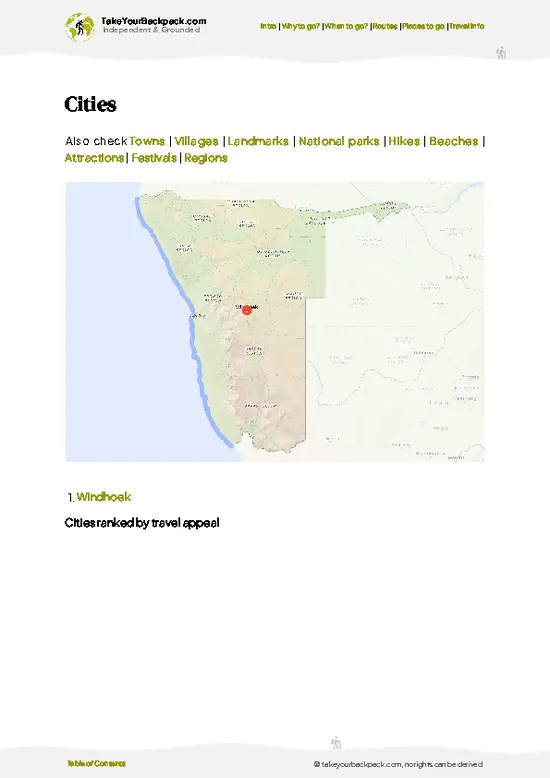
Which kind suits your style: Cities here fall into three types. The
capital and central highland towns suit first-timers: banks, supermarkets, car hire, hostels and decent hospital care. The
coastal towns suit travelers who want adventure activities, cool foggy air and seafood. The
northern towns suit those who want markets, braai smoke and everyday Namibian life, with fewer tourist services. If you have limited time, pick one from the …
read more 👉 How many cities to visit: I advise three cities, four at most, on a trip of two weeks. Namibia’s towns sit hundreds of kilometers apart, and each transfer swallows half a day of dry, bright, windy road. Three bases give you time to walk, eat and rest without spending the whole trip on tarmac. Beyond that you are chasing a list rather than seeing the country.
Which kind suits your style: Cities here fall into three types. The capital and central highland towns suit first-timers: banks, supermarkets, car hire, hostels and decent hospital care. The coastal towns suit travelers who want adventure activities, cool foggy air and seafood. The northern towns suit those who want markets, braai smoke and everyday Namibian life, with fewer tourist services. If you have limited time, pick one from the first group and one from the second, then add a northern stop only if you have a week or more.
What it costs: A solid backpacker budget is US$40 to 70 a day (about N$700 to 1,250). Dorm beds usually cost US$12 to 25, a guesthouse room US$40 to 80, and a simple meal from a takeaway or café US$5 to 12. Museum entries are often only US$1 to 5, and guided township or heritage walks run roughly US$15 to 40. Shuttle or bus transfers between cities typically cost US$25 to 60. Car hire is pricier at US$40 to 80 a day plus fuel, but it removes the long waits that public transport imposes. Splitting a car among three or four people is the smart way to cut costs, since a shared vehicle usually beats individual shuttle tickets.
Safety and culture: Namibia is among the safer countries in southern Africa, but city centers still have petty theft after dark. Leave valuables in the room, avoid walking alone at night, and use a taxi booked through your accommodation. Keep phones out of sight at traffic lights, and never leave bags visible in a parked car. Ask before photographing people, especially in markets and in Herero or Himba communities, as many expect a greeting first and sometimes a small payment. A friendly “Hello, how are you?” before any request is standard courtesy. Dress is relaxed but modest away from the coast, and cash is still useful for markets and small shops, since card machines are not universal.

 Best Backpacking
 Hi, I’m Johan (Netherlands 🇳🇱), the creator of TakeYourBackpack. Over the past 3 decades, I’ve backpacked through 90+ countries across six continents, gaining extensive experience with independent travel, long-term trips, and overland routes.